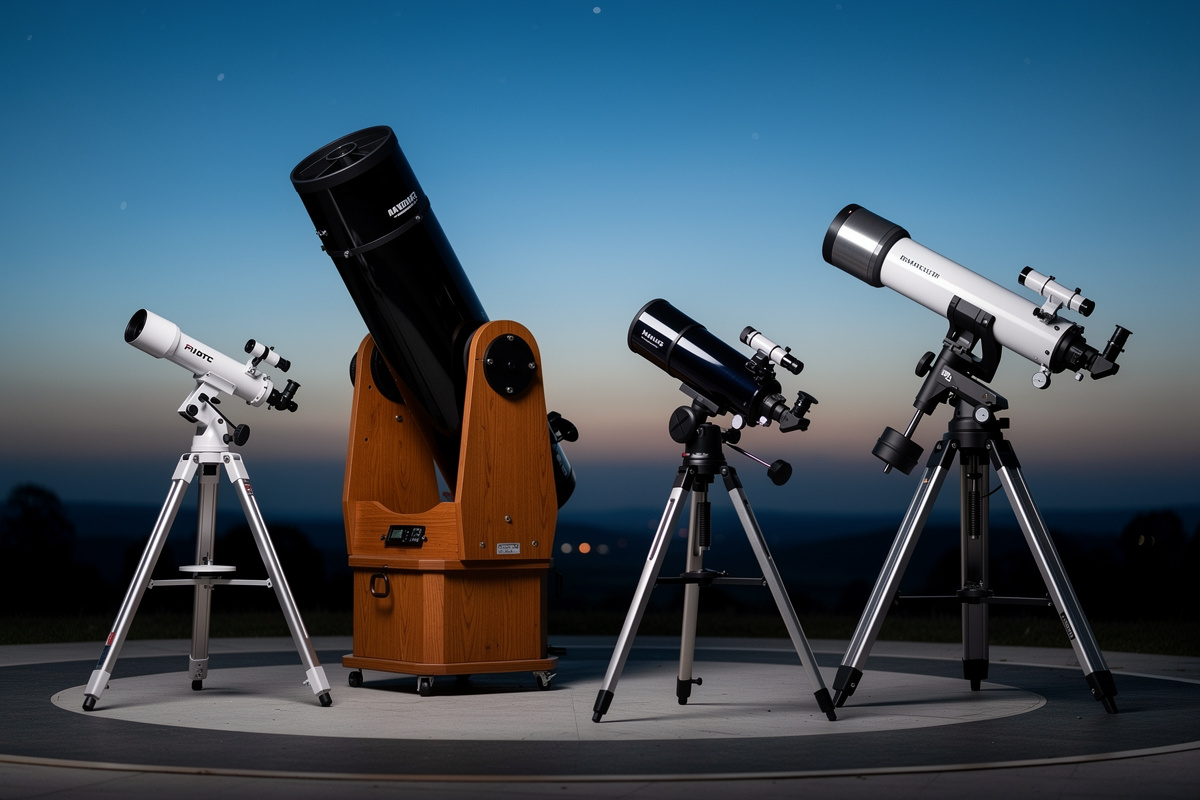

A telescope buying guide in 2026 means choosing between refractors starting at $150, reflectors from $200, and compound telescopes exceeding $3,000. The best telescope for beginners is a 6-inch Dobsonian reflector ($350-500) that reveals Saturn’s rings, Jupiter’s cloud bands, and hundreds of deep-sky objects. Your choice depends on what you want to observe, whether you need portability, and whether astrophotography is a goal.
Telescopes are categorized by their optical design: refractors use lenses, reflectors use mirrors, and compound telescopes (Schmidt-Cassegrain and Maksutov) combine both. Each design excels at different tasks — refractors for wide-field views and astrophotography, reflectors for maximum aperture per dollar, and compound telescopes for versatility and portability. Understanding these designs prevents the most common buying mistake: purchasing the wrong type for your intended use.
How Telescopes Work: Aperture, Focal Length, and Magnification
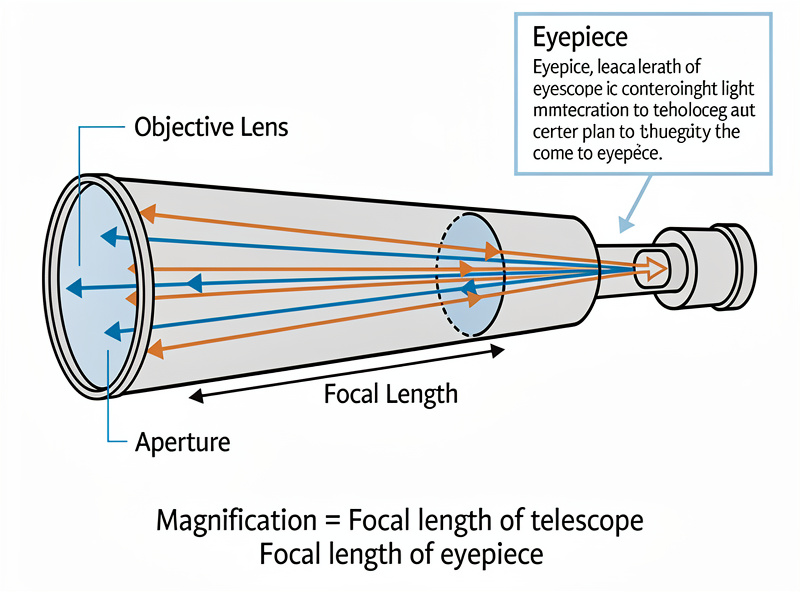
Aperture — the diameter of the telescope’s primary lens or mirror — is the single most important specification. A 6-inch (150mm) aperture telescope collects 2.25 times more light than a 4-inch (100mm) telescope. More light means fainter objects become visible: a 6-inch scope reveals galaxies 50 million light-years away, while a 4-inch scope reaches objects 20 million light-years distant.
Focal length determines magnification when paired with an eyepiece. Magnification equals telescope focal length divided by eyepiece focal length. A 1200mm focal length telescope with a 25mm eyepiece produces 48x magnification (1200 ÷ 25 = 48). The same telescope with a 10mm eyepiece produces 120x. Maximum useful magnification is approximately 50x per inch of aperture — a 6-inch scope maxes out around 300x before atmospheric turbulence degrades the view.
Focal ratio (f-number) describes the telescope’s light-gathering speed. An f/5 telescope is “fast” with a short, bright image ideal for astrophotography. An f/10 telescope is “slow” with a longer, dimmer image ideal for planetary observation. Fast telescopes (f/4-f/6) show wider fields of view; slow telescopes (f/10-f/15) provide higher magnification with the same eyepiece.
The exit pupil — the diameter of light beam entering your eye — determines optimal viewing comfort. Divide the telescope’s aperture by magnification to calculate exit pupil. A 6mm exit pupil matches a dark-adapted young eye’s maximum dilation. Older observers (over 50) have 4-5mm maximum dilation, so eyepieces producing exit pupils larger than 5mm waste light. This calculation determines which eyepieces to buy for your telescope.
Refractor Telescopes: Sharp Images, Zero Maintenance
Refractors use glass lenses to gather and focus light. They produce high-contrast, sharp images with no central obstruction, making them ideal for planetary observation, double star splitting, and wide-field astrophotography. Refractors require zero alignment or maintenance — the lenses are permanently mounted and never need adjustment.
Achromatic refractors ($150-500) use two-element lenses that minimize but do not eliminate chromatic aberration (color fringing around bright objects). An 80mm achromatic refractor costs $200-300 and serves as a capable grab-and-go scope for Moon, planets, and bright deep-sky objects. The color fringing is visible on bright stars and planets but does not significantly degrade the view.
Apochromatic (APO) refractors ($800-5,000+) use three or more elements including extra-low dispersion (ED) glass to virtually eliminate chromatic aberration. A 100mm APO refractor ($2,000-3,500) produces the sharpest, highest-contrast images of any telescope design. These are the premium instruments for serious planetary observers and astrophotographers who demand pinpoint stars across the entire field of view.
Refractor limitations are cost per aperture and weight. A quality 6-inch refractor costs $5,000-10,000 and weighs 25-35 pounds. A 6-inch reflector costs $300-500 and weighs 15 pounds. For visual observation on a budget, reflectors deliver 10x more aperture per dollar. Refractors dominate only when image quality per inch of aperture and zero-maintenance operation justify the premium.
Reflector Telescopes: Maximum Aperture Per Dollar
Reflectors use concave mirrors to gather and focus light. The Newtonian design, invented by Isaac Newton in 1668, uses a single parabolic primary mirror and a small flat secondary mirror to direct light to the side of the tube. This simple, elegant design produces excellent image quality at a fraction of the cost of refractors because mirrors are cheaper to manufacture than lenses.
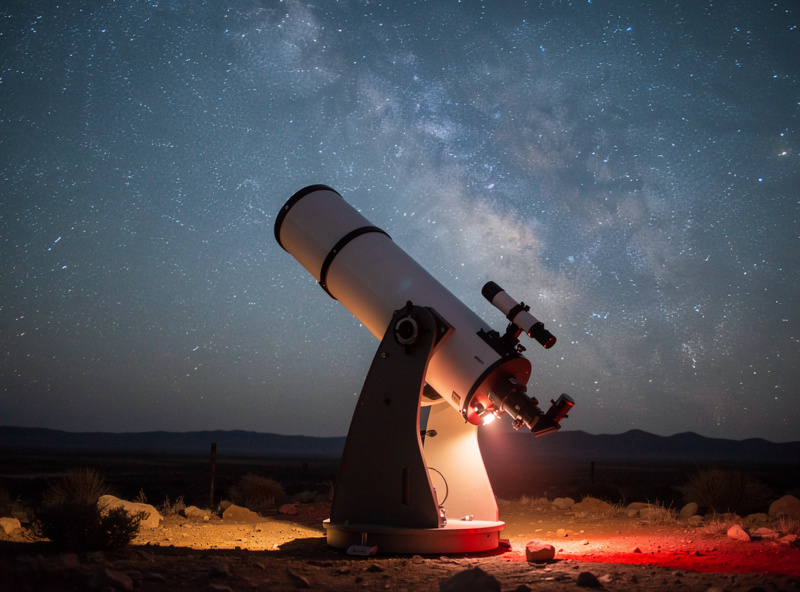
A 6-inch f/8 Dobsonian reflector ($350-500) is the standard recommendation for visual astronomy beginners. It provides enough aperture to resolve Saturn’s Cassini Division (the gap between the A and B rings), Jupiter’s Great Red Spot, and thousands of deep-sky objects including galaxies, nebulae, and star clusters. The Dobsonian mount (a simple alt-azimuth rocker box) costs $50-100 compared to $500-1,000 for an equatorial mount.
8-inch and 10-inch Dobsonians ($500-800) represent the sweet spot for amateur astronomy. An 8-inch scope collects 78% more light than a 6-inch. A 10-inch collects 178% more light than a 6-inch. Each step up reveals objects that are invisible in smaller apertures — the difference between seeing the Whirlpool Galaxy as a faint smudge (6-inch) versus resolving its spiral arms (10-inch).
Reflector maintenance includes periodic collimation (alignment of the mirrors). Collimation takes 5-10 minutes with a $20 laser collimator and is required every few observing sessions. The open tube design collects dust on the primary mirror, requiring cleaning every 6-12 months. Neither task is difficult, but it is maintenance that refractors do not require.
Compound Telescopes: Versatility and Portability
Compound (catadioptric) telescopes combine lenses and mirrors in a folded optical path, producing long focal lengths in short, portable tubes. The Schmidt-Cassegrain (SCT) and Maksutov-Cassegrain (Mak) are the two main designs. An 8-inch SCT has a 2000mm focal length in a tube only 17 inches long — a refractor with the same focal length would be 6 feet long.
Schmidt-Cassegrains ($1,000-3,000) are the most versatile telescope design. They work well for planetary observation, deep-sky viewing, astrophotography, and terrestrial spotting. The Celestron NexStar 8SE ($1,400) is the most popular compound telescope — an 8-inch SCT with computerized GoTo mount that automatically locates and tracks 40,000+ objects. Its compact size fits in a car trunk and sets up in 10 minutes.
Maksutov-Cassegrains ($400-1,500) use a thick corrector lens that produces exceptionally sharp planetary images. The Maksutov design has zero chromatic aberration and minimal coma, making it the best planetary telescope per inch of aperture. The drawbacks are a narrow field of view (due to the long f/12-f/15 focal ratio) and a 10-15 minute cooldown period as the thick corrector lens equalizes with ambient temperature.
Compound telescopes cost 2-3x more per inch of aperture than reflectors. An 8-inch SCT costs $1,400; an 8-inch Dobsonian costs $500. The premium buys portability, versatility, and GoTo computerized tracking. For observers who travel to dark sky sites, the compact SCT tube is worth the cost. For backyard-only observers, the Dobsonian delivers more aperture for less money.
Telescope Comparison Table: Best Options by Budget
| Telescope | Design | Aperture | Price | Weight | Best For |
|---|---|---|---|---|---|
| Celestron StarSense Explorer LT 80AZ | Refractor | 80mm | $180 | 8 lbs | Beginners, Moon/planets |
| Orstar StarBlast 6 | Reflector | 150mm | $400 | 15 lbs | Deep-sky value |
| Apertura AD8 | Dobsonian | 200mm | $550 | 40 lbs | Best beginner Dob |
| Sky-Watcher 10″ Flextube Dob | Dobsonian | 254mm | $750 | 48 lbs | Serious visual |
| Celestron NexStar 6SE | SCT | 150mm | $1,000 | 21 lbs | GoTo versatility |
| Celestron NexStar 8SE | SCT | 203mm | $1,400 | 28 lbs | All-around GoTo |
| Sky-Watcher 100mm APO | Refractor | 100mm | $1,800 | 12 lbs | Astrophotography |
| Meade LX200 10″ ACF | Compound | 254mm | $3,000 | 58 lbs | Advanced visual/imaging |
| Celestron EdgeHD 9.25″ | SCT | 235mm | $2,800 | 30 lbs | Premium astrophotography |
Choosing a Telescope Mount
The mount is as important as the optical tube — a $500 telescope on a wobbly $50 mount produces frustrating views. Alt-azimuth mounts move up-down and left-right, matching how we naturally look around. Equatorial mounts tilt to align with Earth’s rotational axis, allowing motorized tracking of celestial objects as they move across the sky.
Dobsonian mounts (a type of alt-azimuth) are the best value for visual observation. They are stable, simple, and cost $50-150. The telescope sits in a rocker box that pivots on Teflon pads — push it to point at an object, let go, and it stays. An 8-inch Dobsonian mount supports 40 pounds of telescope for $100, while an equatorial mount rated for the same weight costs $500-1,000.
GoTo mounts ($500-2,000) use motors and a computer database to automatically slew to objects. After a 2-star alignment process (5 minutes), the mount locates any of 40,000+ cataloged objects and tracks them as Earth rotates. GoTo is valuable for beginners who cannot star-hop to faint objects and for astrophotographers who need precise tracking. The cost premium is $400-1,000 over manual mounts.
Equatorial mounts are necessary for long-exposure astrophotography. They counteract Earth’s rotation by rotating on a polar axis aligned with the celestial pole. A German equatorial mount (GEM) rated for 30-50 pounds ($800-2,000) provides the tracking accuracy needed for 5-minute exposures. Alt-azimuth mounts produce field rotation during long exposures, making stars trail in arcs rather than points.
Essential Telescope Accessories
Three accessories are essential for every telescope: a quality eyepiece set, a finder scope, and a collimation tool. Everything else — filters, motor drives, dew shields — depends on your specific observing goals. Start with these three, then add accessories based on experience.
Eyepieces determine magnification and field of view. A basic set includes three eyepieces: 32mm (low power, wide field), 15mm (medium power), and 6mm (high power). Plössl eyepieces ($30-50 each) provide good optical quality. Avoid the cheap eyepieces included with budget telescopes — upgrading to a $100 eyepiece set produces dramatically better views than the stock eyepieces.
A 2x Barlow lens ($30-80) doubles the magnification of every eyepiece, effectively giving you six magnifications from three eyepieces. A quality Barlow adds no visible aberration and is the most cost-effective way to expand your eyepiece collection. Pair it with your 15mm eyepiece to get 7.5mm equivalent magnification for planetary detail.
A finder scope or red-dot finder helps locate objects in the sky. The stock finder on most telescopes is adequate but upgradeable. A Telrad ($45) projects three concentric circles onto the sky, matching star charts for easy star-hopping. A 9×50 finder scope ($80-150) shows faint stars invisible to the naked eye, revealing dozens of guide stars near your target object.
What You Can See With Different Telescope Apertures
Aperture determines what is visible through a telescope — not magnification. A 3-inch (76mm) telescope shows the Moon’s craters, Saturn’s rings as a small oval, Jupiter as a disc with 2-3 cloud bands, and the Orion Nebula as a glowing patch. An 8-inch (200mm) telescope resolves Saturn’s Cassini Division, Jupiter’s festoons and barges, hundreds of galaxies with spiral structure, and planetary nebulae with visible central stars.
A 4-inch (100mm) telescope reveals 50-100 Messier objects (the brightest deep-sky catalog) under dark skies. The Andromeda Galaxy appears as an elongated glow. The Pleiades star cluster fills the field of view with hundreds of stars. The Moon shows craters down to 1-2 kilometers across. This aperture is the minimum for satisfying deep-sky observation — anything smaller shows only the brightest objects as featureless smudges.
A 12-inch (300mm) telescope approaches the limit of amateur observation. It resolves dust lanes in edge-on galaxies, shows the spiral structure of galaxies 50 million light-years away, reveals individual stars in globular clusters at 30,000 light-years distance, and captures subtle color in emission nebulae. The difference between 8-inch and 12-inch is dramatic — the 12-inch collects 125% more light, showing objects that are invisible in the smaller scope.
Aperture fever — the desire for ever-larger telescopes — is common but counterproductive. A 16-inch telescope collects 16x more light than a 4-inch, but the practical observing experience improves most between 4-inch and 10-inch. Beyond 12-inch, telescopes become heavy (80+ pounds), expensive ($3,000+), and require dew control, collimation tools, and large vehicles to transport. Buy the largest aperture you will actually use regularly, not the largest you can afford.
Common Telescope Buying Mistakes to Avoid
The most common mistake is buying a telescope from a department store or online marketplace based on magnification claims. “675x Magnification!” printed on a $100 telescope box is marketing fraud — the telescope’s 60mm aperture cannot produce useful views above 120x. These telescopes have wobbly tripods, poor optics, and included eyepieces that are optically terrible. They produce views worse than $50 binoculars and kill interest in astronomy.
The second mistake is choosing a GoTo computerized mount as your first telescope. GoTo mounts add $400-1,000 to the price and require setup, alignment, and power. A manual Dobsonian at the same price point provides 2-3x more aperture — meaning dramatically better views of every object. Learn the sky manually first with a star chart or planetarium app (Stellarium is free). Add GoTo later when you know what objects you want to observe and whether the convenience justifies the cost.
Buying without considering portability is the third mistake. A 12-inch Dobsonian weighs 65 pounds and requires a large vehicle to transport. If you live in a light-polluted city and must drive to dark skies, the telescope must fit in your car. A collapsible or truss-tube Dobsonian reduces transport size by 40-60%. An 8-inch SCT in a backpack is more portable than a 6-inch Dobsonian that must be carried in two pieces.
Ignoring the used market wastes money. Telescopes depreciate 30-50% within 2 years but remain optically identical to new instruments. Cloudy Nights classifieds and Astromart sell quality used telescopes at significant discounts. A used 8-inch Dobsonian ($250-350) provides identical views to a new one ($500). A used Celestron NexStar 8SE ($800) saves $600 over new. Check mirrors for coatings before buying — damaged coatings require re-aluminizing ($150-200).
Frequently Asked Questions
What is the best telescope for a beginner?
A 6-8 inch Dobsonian reflector ($350-550) is the best beginner telescope. It provides enough aperture to see Saturn’s rings, Jupiter’s cloud bands, and hundreds of galaxies and nebulae. The Dobsonian mount is stable, simple to use, and requires no power. Avoid cheap refractors under $200 on tripods — they produce shaky, dim views that discourage beginners.
How much should I spend on my first telescope?
Budget $300-600 for your first telescope. Under $200 buys small refractors with wobbly mounts that produce frustrating views. $350-500 buys a 6-inch Dobsonian that reveals thousands of objects. $500-800 buys an 8-10 inch Dobsonian that shows spiral arms in galaxies. The best value increase happens between $200 and $500 — do not skip this range.
Can I see galaxies with a small telescope?
Yes. A 6-inch telescope resolves the Andromeda Galaxy (M31) as an oval glow spanning 3x the width of a full Moon. An 8-inch telescope shows the Whirlpool Galaxy’s (M51) spiral structure under dark skies. A 4-inch telescope reveals the brightest 50-100 galaxies as fuzzy patches. Larger apertures show more detail and more galaxies overall.
What can I see with a telescope in the city?
Light pollution limits deep-sky objects but does not affect the Moon, planets, and bright double stars. From a city, a 6-inch telescope shows Saturn’s rings, Jupiter’s bands and moons, Mars’s ice caps, Venus’s phases, and thousands of star clusters. Narrowband filters ($80-150) enhance emission nebulae even under moderate light pollution.
Do I need GoTo computerized tracking?
GoTo is helpful for beginners who cannot find objects manually and essential for astrophotography. It is unnecessary for visual observers who enjoy learning the sky through star-hopping. A manual 8-inch Dobsonian ($550) shows the same views as a GoTo 8-inch SCT ($1,400) — the GoTo costs $850 more for the convenience of automatic pointing.
Is astrophotography possible with a beginner telescope?
Basic astrophotography — Moon craters, Jupiter’s bands, Saturn’s rings — is possible with any telescope and a smartphone adapter ($20). Deep-sky astrophotography (galaxies, nebulae) requires a motorized equatorial mount ($800+), a camera, and either a telescope or camera lens. Start with visual astronomy; add astrophotography equipment after learning the sky.
What is the difference between refractor and reflector telescopes?
Refractors use lenses and produce sharp, high-contrast images with no maintenance but cost more per inch of aperture. Reflectors use mirrors and provide 3-5x more aperture per dollar but require periodic collimation (mirror alignment). For visual astronomy on a budget, reflectors offer more aperture. For astrophotography and grab-and-go convenience, refractors excel.
Related Articles
- Reflector vs Refractor Telescope: Which Design Is Right for You?
- Dobsonian Telescopes: Why They Are the Best Value in Astronomy
- Best Telescopes for Beginners in 2026: Top Picks by Budget
- Astronomy for Beginners: Your Complete Guide to Stargazing
- Astrophotography Guide: Equipment, Settings, and Techniques
