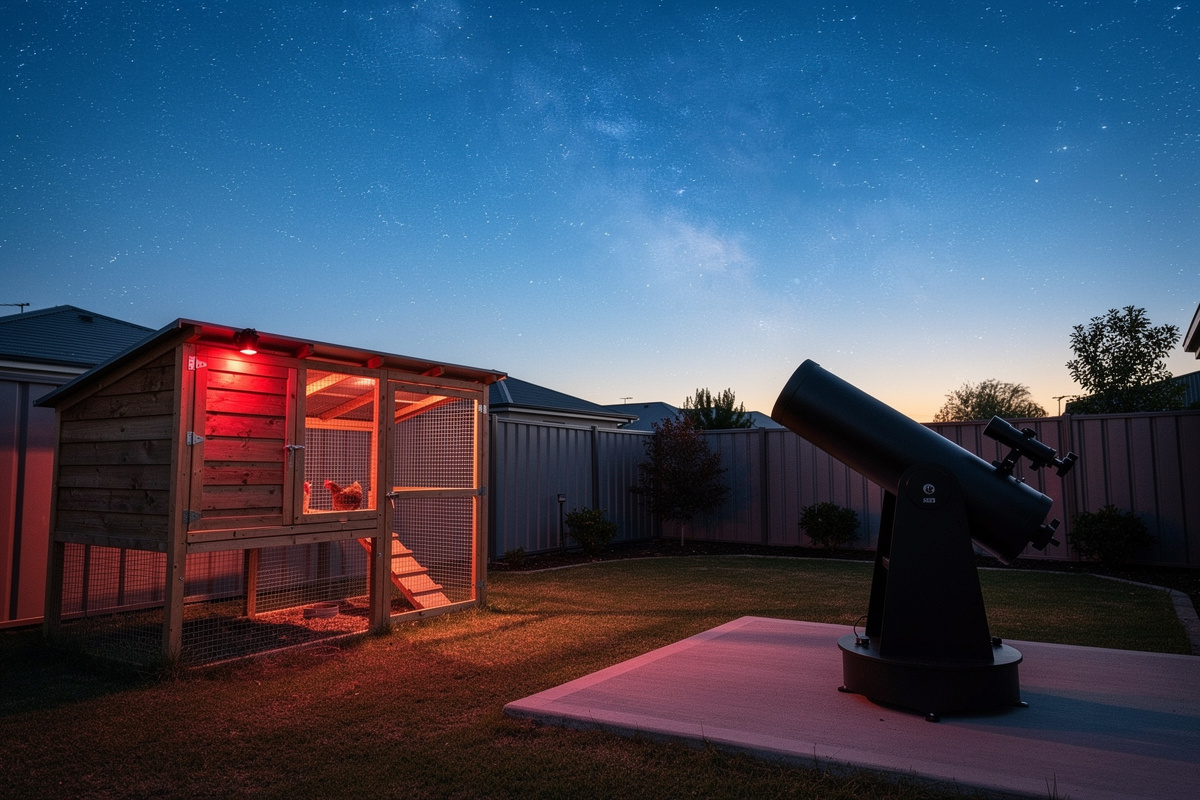

A backyard chicken coop with bright white security lighting can wash out 80-90% of the visible-magnitude stars from a backyard observing pad 30 feet away. Predator-deterrent lighting is real and useful, but the same protection works with red-spectrum LEDs (620-660nm) at lower wattage, which protects the flock and preserves dark-adapted vision for amateur astronomy. The compromise costs about 30 USD in upgraded bulbs and runs the same number of hours per night.
This guide covers the spectrum and intensity numbers that matter, fixture selection, and the placement geometry that lets a coop and a backyard telescope coexist. Hardware target is any motion-sensor outdoor fixture with a swappable bulb, plus a small bench-test photometer if you want to measure your own results. Setup time runs 60-90 minutes including bulb swaps and shielding adjustments.
What “Light Pollution” Actually Means for Backyard Astronomy
Light pollution is measured on the Bortle scale (1-9) and the SQM (sky quality meter) reading in mag/arcsec². A clear rural backyard runs 21.5+ SQM (Bortle 3); a typical suburban yard runs 19-20 SQM (Bortle 5-6); city skies hit 16-17 SQM (Bortle 8-9). A single bright cool-white fixture pointed away from the ground can drop a yard from Bortle 4 to Bortle 7 — a 100x increase in sky brightness. The losses are dramatic and immediate.
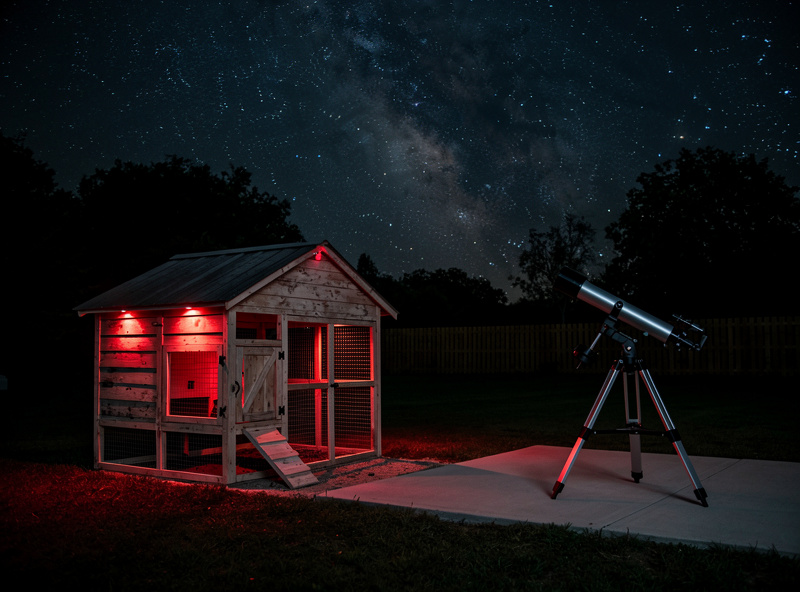
The damage is mostly to dark adaptation. Human rod cells need 25-40 minutes to fully dark-adapt; a single 5-second exposure to bright white light resets the clock. Coop lights triggered by motion through the night repeatedly bomb your dark adaptation, even if the lights only run for 30 seconds at a time. Red lights at 620nm+ do not affect rod cells, which is why red headlamps are standard for amateur astronomy.
The third effect is stray light entering the telescope. A bright fixture 30 feet from the eyepiece can scatter into the optical path even when not directly visible, reducing contrast on faint objects (galaxies, nebulae, comets). The fix is shielding plus spectrum management, not just dimming. The same brightness logic applies to streetlights and porch lights — see the night photography long exposure guide on related dark-sky preservation patterns.
The Red-Spectrum Coop Light Solution
Replace cool-white motion-sensor bulbs with red-spectrum LED bulbs (620-660nm wavelength). Two products work consistently: amber 2200K LED bulbs and dedicated 660nm red horticulture bulbs. Both deliver enough brightness for predator deterrence (the goal is making predators think a human is present, not blinding them) while preserving dark-sky observing on the same property.
| Bulb Type | Wavelength | Wattage | Predator Deterrent | Astronomy Impact |
|---|---|---|---|---|
| Cool white 5000K | Full spectrum | 15-25W | Strong | Severe (Bortle +3) |
| Warm white 2700K | Mostly red-orange | 10-15W | Strong | Moderate (Bortle +2) |
| Amber 2200K | Yellow-orange | 8-12W | Strong | Mild (Bortle +1) |
| Red horticulture 660nm | Pure red | 5-10W | Strong | Minimal (negligible) |
| Astronomy red filter | 620-660nm | 3-8W | Adequate | None |
Predators (raccoons, foxes, hawks) react to motion and unfamiliar light, not to specific wavelengths. The deterrent effect of red light is documented in poultry science literature dating back to the 1960s — predators avoid an active red flicker just as readily as they avoid white light. Many commercial poultry farms now use red lighting precisely for this reason. The deterrence specifics for backyard flocks are on the motion-sensor coop lights guide.
Fixture Placement and Shielding
The single biggest improvement is shielding. A “full cutoff” fixture casts no light above the horizontal plane — exactly the configuration municipal lighting ordinances require for IDA dark-sky compliance. The same fixture geometry works for backyard coops: the cone of light reaches the ground around the coop without spilling skyward. Cost is 25-40 USD for a quality cutoff fixture versus 15 USD for an unshielded floodlight.
Mount fixtures so the bulb is recessed at least 4-6 inches inside a hood or cowl. Recessed bulbs cannot be seen from the observing position and cannot scatter into a telescope eyepiece. The 30-foot-rule is useful: from your telescope position, the fixture should appear as a dark hood with no visible bulb. If you can see the bulb, the fixture is not shielded enough.
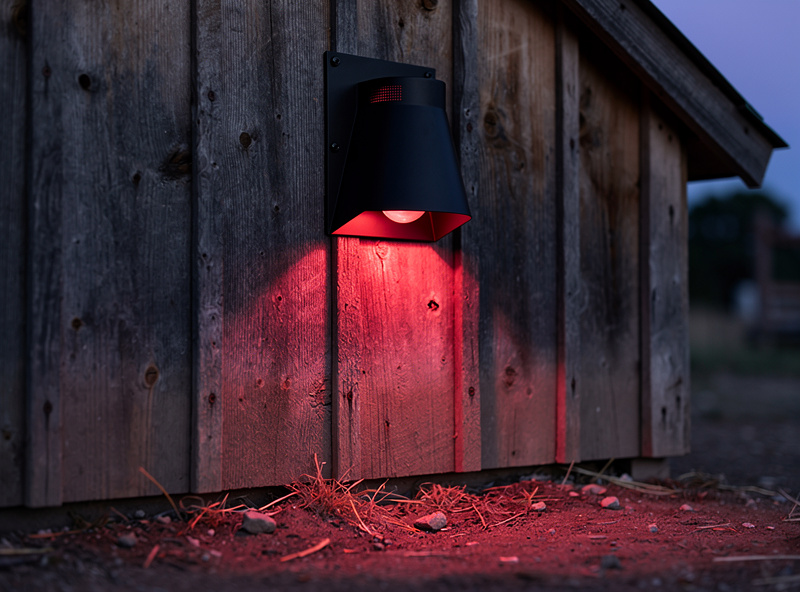
Position fixtures on the side of the coop facing away from the observing pad. A fixture on the south wall of the coop, with the observing pad north of the coop, lets the coop itself shield the telescope from any stray light. This trick alone preserves 1-2 magnitudes of limiting visual magnitude for the entire coop run.
Motion Sensor Settings That Don’t Ruin Observing
Most motion sensors default to 30-60 second on-times. For coop deterrent purposes, 10-15 seconds is plenty — long enough to startle a predator, short enough to minimize dark-adaptation impact. Reduce the trigger sensitivity to ignore small wildlife (rabbits, opossums) that walks past without threatening the coop, otherwise you lose 30 seconds of observing every time anything moves in the yard.
Time-restrict the motion sensor. Most modern smart-switch motion sensors (Aqara, Lutron) accept time-of-day rules: full-power red light only between sunset and 11 PM (peak predator activity), then reduced power until midnight, then off until dawn. For an astronomer who observes from 11 PM to 3 AM, the coop is essentially dark during the observing window without sacrificing predator protection during the higher-risk hours.
Coop Heating and the Heat-Lamp Trap
Heat lamps for winter coops are the worst offenders. A single 250W red heat lamp produces enough total radiant output to elevate sky brightness within 100 feet, plus the constant duty cycle (12+ hours per night in winter) means there is no observing window when the lamp is off. The fix is to switch heat lamps for ceramic infrared emitters, which produce heat without visible light at all.
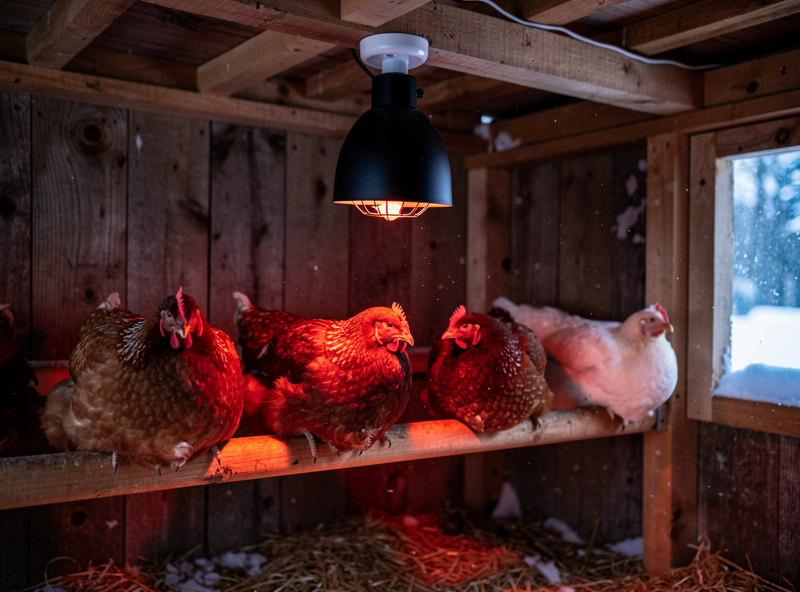
Ceramic infrared emitters (60-150W) produce no visible light — they look like dark ceramic cylinders. Chickens respond to infrared heat the same way they respond to red heat lamps. The bulb cost is comparable (12-20 USD per emitter), and the lifespan is longer than a tungsten heat lamp. For winter heating without sky glow, this is the only correct answer. The complete winter-heating workflow is on the solar chicken coop heater winter guide.
Some coops do not need heat lamps at all. Cold-hardy breeds (Plymouth Rock, Wyandotte, Buff Orpington) tolerate -10°F nights without supplemental heat as long as the coop is draft-free and dry. Eliminating winter heat entirely solves the light-pollution problem permanently and reduces fire risk. Most backyard coops are fitted with heat lamps unnecessarily; a careful breed choice and proper insulation removes the need.
Frequently Asked Questions
Will red coop lights still deter predators?
Yes. Predators (raccoons, foxes, hawks) react to motion and unfamiliar light, not specific wavelengths. Poultry science literature since the 1960s documents red light as effective deterrent. Commercial poultry farms now use red lighting routinely for this reason.
How much does coop lighting affect backyard astronomy?
A single bright cool-white fixture 30 feet from the telescope can raise the local Bortle scale by 2-3 levels – up to 100x increase in sky brightness. Switching to red 660nm or amber 2200K bulbs reduces the impact to negligible while keeping predator deterrence.
What is the best bulb for both coop and astronomy?
Red 660nm horticulture bulbs (5-10W) deliver predator-strong deterrence with minimal sky-glow impact. Amber 2200K LED bulbs are the second choice and easier to source. Avoid cool-white 5000K and traditional warm-white 2700K, which produce significant sky glow.
How long should the motion sensor stay on?
10-15 seconds is plenty for predator deterrence and minimizes dark-adaptation impact on observers. Most sensors default to 30-60 seconds; reduce in the sensor settings. Time-restrict the sensor to peak predator hours (sunset to 11 PM) and low-power after that.
Can I keep a heat lamp without ruining my dark sky?
Replace tungsten heat lamps with ceramic infrared emitters. Ceramic emitters produce heat without visible light at all – chickens respond identically. Cost is 12-20 USD per emitter, comparable to heat lamps, and the lifespan is longer.
How far from the coop should my telescope sit?
Position the telescope on the opposite side of the coop from the lights. The coop itself blocks stray light from a fixture on the far wall. Combined with full-cutoff fixtures and red bulbs, a 30-50 foot separation keeps the observing pad effectively dark.
