
Deep sky objects include galaxies, nebulae, star clusters, and planetary nebulae located beyond our solar system. Amateur telescopes with 6-inch or larger apertures can observe over 100 deep sky objects from suburban skies and more than 200 from dark sites. The Messier catalog’s 110 objects remain the standard starting list, with 93 of them visible from mid-northern latitudes in telescopes costing under $500.
Unlike planets and the Moon, which show detail through any telescope, deep sky objects demand specific conditions, equipment choices, and observing techniques. Light pollution, aperture size, and eyepiece selection determine what you can see more than telescope price does. A $350 8-inch Dobsonian from a dark site routinely outperforms a $2,000 refractor from a city backyard on deep sky targets — I have run this exact A/B with a friend’s 4-inch APO from his Bortle 8 city driveway versus my own 8-inch Dob from a Bortle 4 site 45 minutes away, and on M51 the dark-site Dob showed clear spiral arms while the city APO showed a vague oval smudge. Understanding how these objects differ — and what each type requires — is the difference between a rewarding night at the eyepiece and a frustrating one. The rest of this guide is the planning document I use across the five spoke articles in this cluster: Messier objects, nebulae, star clusters, galaxies, and double and variable stars.
What Counts as a Deep Sky Object
A deep sky object is any celestial target beyond our solar system that is not a single star. This broad category includes galaxies ranging from 2 million to 500 million light-years away, emission and reflection nebulae within our own Milky Way, open and globular star clusters, planetary nebulae created by dying stars, and supernova remnants. Each type presents a different visual challenge and requires different equipment and observing conditions.
Charles Messier compiled the first widely used catalog of deep sky objects in the 18th century, listing 110 targets he wanted to avoid mistaking for comets. The Messier catalog remains the most popular observing list because the objects are bright, well-positioned for northern hemisphere observers, and accessible in small telescopes — the best Messier objects guide ranks the catalog by visual impact for evenings out. The New General Catalog (NGC) expanded this to 7,840 objects, and the Index Catalog added another 5,386, giving advanced observers decades of targets to pursue.
The visual appearance of deep sky objects varies dramatically. Galaxies appear as faint, diffuse patches of light — the Andromeda Galaxy (M31) looks like a small, elongated smudge in a 4-inch telescope, while a 16-inch scope reveals its dust lanes and companion galaxies. Nebulae range from the brilliant green glow of the Orion Nebula (M42) visible in binoculars to the ghostly, averted-vision-only Helix Nebula (NGC 7293) that demands a 10-inch scope and dark skies. Star clusters present the most immediately satisfying views — the Double Cluster in Perseus sparkles with hundreds of stars in even a 60mm refractor.
The Five Types of Deep Sky Objects
Every deep sky object falls into one of five categories, and knowing the category tells you what to expect at the eyepiece, when to observe it, and what equipment helps most.
Emission and Reflection Nebulae
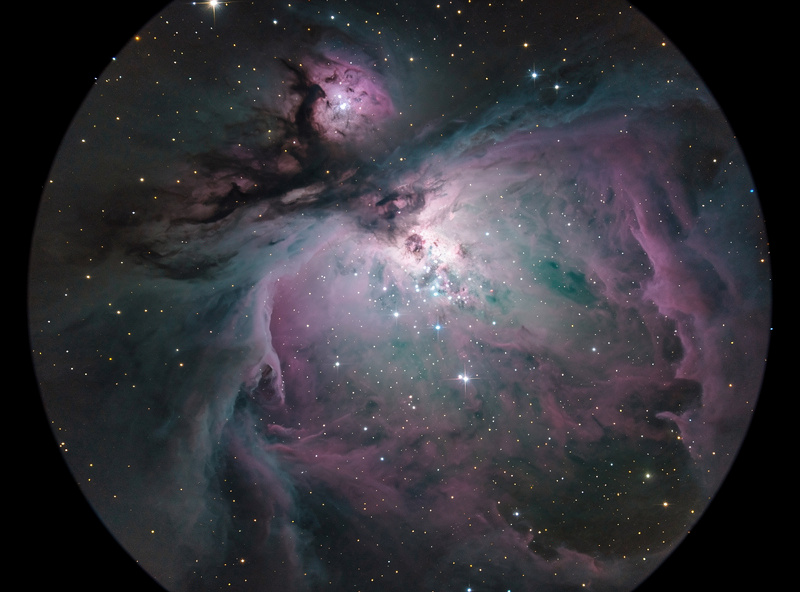
Emission nebulae glow because hot stars inside them excite hydrogen gas, causing it to emit light at specific wavelengths — primarily the hydrogen-alpha red line at 656nm and the doubly ionized oxygen green line at 500.7nm. The Orion Nebula (M42), Lagoon Nebula (M8), and North America Nebula (NGC 7000) are emission nebulae. They benefit enormously from narrowband filters — UHC or O-III filters — that isolate their emission lines and block background light pollution, boosting contrast by 30 to 50 percent from suburban locations. The dedicated nebulae guide sequences 15 top targets by aperture and filter choice.
Reflection nebulae shine by reflecting starlight off surrounding dust. The Pleiades (M45) is the most famous example — the blue nebulosity surrounding its brightest stars is reflected light from hot, young stars embedded in a dust cloud. Reflection nebulae do not benefit from narrowband filters because they reflect the full spectrum of starlight. Dark skies and aperture are the only ways to see them better.
Planetary Nebulae
Planetary nebulae are shells of gas expelled by dying stars. They have nothing to do with planets — early astronomers thought they resembled planetary disks in small telescopes. Planetary nebulae are typically small (under 1 arcminute) and bright, making them ideal targets for high magnification. The Ring Nebula (M57) in Lyra is visible in a 3-inch telescope at 100x, where it appears as a small, gray smoke ring. The Dumbbell Nebula (M27) in Vulpecula is large enough to show detail at low power.
Planetary nebulae respond well to O-III filters because they emit strongly at the 500.7nm oxygen line — the filters guide covers when each filter actually earns its slot. Some, like the Eskimo Nebula (NGC 2392), show a central star visible at high magnification. Their small size means they are less affected by light pollution than extended nebulae — a planetary nebula’s concentrated light punches through skyglow that would wash out a diffuse emission nebula.
Open Star Clusters
Open clusters are groups of young stars born from the same molecular cloud, typically containing 50 to 500 stars spread across 5 to 30 arcminutes. They are the easiest deep sky objects to observe because they consist of individual stars rather than diffuse light. The Pleiades (M45), Double Cluster (NGC 869/NGC 884), and Beehive Cluster (M44) are spectacular in binoculars and small telescopes — the star clusters guide ranks both open and globular clusters by visual impact.
Open clusters are concentrated in the Milky Way’s disk, so the best ones appear along the band of the Milky Way itself. They range from rich, dense clusters like M11 in Scutum — which contains thousands of stars and resembles a globular at low power — to sparse, scattered groups like the Alpha Persei Moving Cluster that barely qualify as clusters at all. Open clusters are the most light-pollution-resistant deep sky objects because their stars are point sources that remain visible even when skyglow washes out extended objects.
Globular Star Clusters
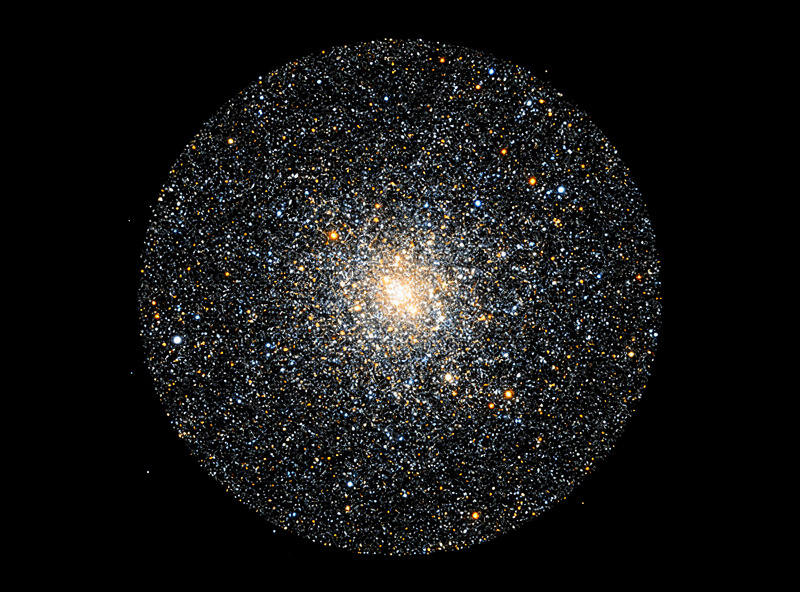
Globular clusters are ancient, gravitationally bound systems containing 100,000 to 1 million stars packed into a sphere 100 to 300 light-years across. They orbit the galactic halo, well above and below the Milky Way’s disk. The brightest globulars — Omega Centauri (NGC 5139) and 47 Tucanae (NGC 104) — are southern hemisphere treasures visible to the naked eye. Northern observers have M13 in Hercules, M22 in Sagittarius, and M5 in Serpens as their best globular targets.
Globular clusters require aperture to resolve into individual stars. In a 4-inch telescope, M13 appears as a fuzzy ball. An 8-inch scope begins resolving its outer edges into individual stars. A 12-inch or larger telescope resolves the cluster to its core under dark skies. The moment a globular cluster snaps from a fuzzy patch into a glittering sphere of hundreds of individual stars is one of astronomy’s most memorable visual experiences — I still remember the night M13 first resolved for me through an 8-inch Dob at 180x from a Bortle 4 site, three years into the hobby.
Galaxies
Galaxies are the most challenging deep sky objects because they are faint, diffuse, and spread across vast areas of sky. The brightest — M31 (Andromeda), M33 (Triangulum), and the Large Magellanic Cloud — are visible to the naked eye from dark sites. Most galaxies, however, require 8-inch or larger telescopes and dark skies to see as anything more than a faint smudge. The galaxy observing guide covers technique, averted vision, and the specific targets worth chasing at each aperture.
Galaxy observation rewards patience and experience. What appears as a featureless glow on first viewing gradually reveals structure over repeated sessions — a bright core, an elongated disk, dust lanes, spiral arms if the galaxy is favorably inclined and the aperture is sufficient. The Virgo Cluster of galaxies, centered between Leo and Virgo, offers dozens of galaxies in a single low-power field of view during spring evenings. Experienced observers with 16-inch scopes can see 50 or more galaxies per hour in the Virgo Cluster.
Best Deep Sky Objects by Season
Deep sky objects follow the seasons because the night sky rotates through the year, carrying different constellations — and their objects — into view. Planning observing sessions around seasonal highlights ensures you see the best targets when they are highest and most transparent.
Winter Deep Sky Objects (December through February)
Winter belongs to Orion and the surrounding constellations. The Orion Nebula (M42) is the single finest deep sky object in the northern sky — visible to the naked eye as the middle star of Orion’s sword, it resolves into a glowing cloud with a central trapezium of four stars in any telescope. M42 shows structure at every magnification, from the sweeping wings at 30x to the tight Trapezium cluster at 200x. The Rosette Nebula (NGC 2237) nearby requires a 6-inch telescope and a UHC filter from suburban sites.
The Pleiades (M45) dominates Taurus with a naked-eye cluster of blue stars surrounded by faint reflection nebulosity best captured photographically. The Double Cluster in Perseus is a binocular showpiece — two rich open clusters side by side containing hundreds of stars. The Crab Nebula (M1) in Taurus is a supernova remnant visible as a faint elliptical glow in 6-inch and larger telescopes.
Spring Deep Sky Objects (March through May)
Spring is galaxy season. The Virgo Cluster stretches across the spring sky, offering dozens of galaxies in a single evening. M87, M84, M86, and their neighbors fill low-power fields with faint smudges of ancient starlight. The Whirlpool Galaxy (M51) in Canes Venatici shows spiral structure in 10-inch and larger telescopes under dark skies — it was the first galaxy whose spiral structure was recognized, by Lord Rosse in 1845 using his 72-inch reflector.
The Leo Triplet (M65, M66, NGC 3628) fits in a single low-power field and shows three galaxies with distinct shapes — two bright cores and one edge-on with a dust lane. The Sombrero Galaxy (M104) in Virgo is an edge-on galaxy with a prominent dust lane visible in 8-inch scopes. Spring galaxies are best observed when they transit (cross the meridian) near midnight, when they are highest and the atmosphere is most stable.
Summer Deep Sky Objects (June through August)
Summer brings the Milky Way’s richest star fields into view. The Sagittarius Star Cloud is a wall of stars visible to the naked eye from dark sites. The Lagoon Nebula (M8) and Trifid Nebula (M20) sit side by side in Sagittarius and are bright enough to show structure in 4-inch telescopes. The Eagle Nebula (M16) — home of the famous Pillars of Creation — requires a UHC filter from most locations but reveals its stellar nursery nature from dark sites with 8-inch or larger scopes.
Globular clusters peak in summer. M13 in Hercules is the northern sky’s finest globular, resolving into individual stars in 8-inch and larger telescopes. M22 in Sagittarius is actually brighter and larger than M13 but sits lower in the sky for northern observers, reducing its apparent quality. The Ring Nebula (M57) in Lyra is a summer evening staple — small, bright, and easily found between the two bottom stars of the Lyra parallelogram.
Autumn Deep Sky Objects (September through November)
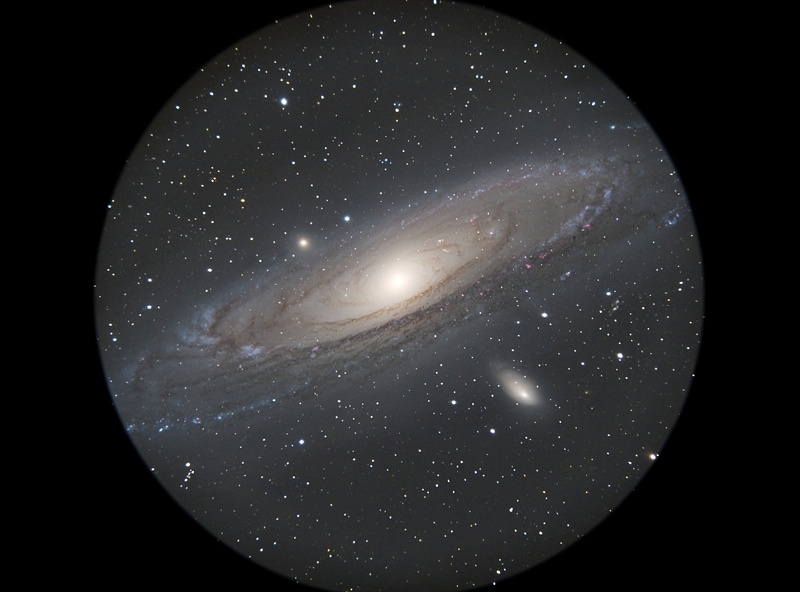
Autumn transitions from the summer Milky Way to the sparse fields of the autumn sky, but several outstanding objects anchor the season. The Andromeda Galaxy (M31) is the most distant object visible to the naked eye at 2.5 million light-years. In a 10-inch telescope from a dark site, M31’s dust lanes and companion galaxies M32 and M110 are visible. The galaxy spans 3 degrees of sky — six times the Moon’s apparent diameter — requiring the lowest-power eyepiece to frame.
The Double Cluster remains well-positioned from autumn through winter. The Pleiades rises earlier each evening. The Dumbbell Nebula (M27) in Vulpecula is a bright, large planetary nebula visible in any telescope and showing a distinctive apple-core shape at 100x. The NGC 891 edge-on galaxy in Andromeda reveals a prominent dust lane in 10-inch and larger scopes. Autumn evenings are also prime double-star season — Albireo, Almach, and 61 Cygni are all well-placed; the double and variable stars guide covers the targets that pair perfectly with deep-sky sessions.
Equipment for Deep Sky Observing
Deep sky observing favors different equipment priorities than planetary work. Aperture matters more than optical design. Low-power, wide-field eyepieces matter more than high-magnification ones. Dark sky location matters more than telescope cost. If you are still narrowing down a first scope, the beginner telescope guide covers the budget tiers that actually deliver deep-sky views, and the Dobsonian guide explains why an 8-10 inch Dob is the cheapest path to genuine deep-sky aperture.
| Equipment Factor | Why It Matters | Minimum Recommendation |
|---|---|---|
| Aperture | Gathers more light, reveals fainter objects | 6-inch (150mm) for serious deep sky |
| Focal ratio | f/5 to f/6 gives wider fields for extended objects | f/5 to f/6 Dobsonian or Newtonian |
| Low-power eyepiece | Frames large objects, finds targets | 30-32mm in 1.25-inch, 40mm in 2-inch |
| Wide-field eyepiece | 68-82 degree AFOV for immersive views | 68-degree series ($50-80 each) |
| Light pollution filter | Boosts contrast on nebulae by 30-50% | UHC filter ($40-80) |
| O-III filter | Maximum contrast on planetary and emission nebulae | Quality O-III ($60-120) |
| Dark sky site | More impactful than any equipment upgrade | Bortle 4 or darker for galaxies |
| Observing chair | Comfortable viewing for hours of star-hopping | Adjustable height observing chair ($80-150) |
Dark Sites vs Suburban Skies: What Changes
The difference between a Bortle 7 suburban sky and a Bortle 4 dark site is not subtle — it is transformational. From a typical suburban backyard, an 8-inch telescope shows about 50 Messier objects with effort. From a Bortle 4 site, the same scope shows 90 or more Messier objects easily, plus hundreds of NGC objects invisible from the suburbs. Galaxies that appear as faint smudges from the suburbs reveal spiral structure and dust lanes from dark sites. The Milky Way’s structure becomes naked-eye visible.
Light pollution maps at darksite.com and lightpollutionmap.info show Bortle ratings for any location. For deep sky observing, driving 30 to 60 minutes to a Bortle 4 site delivers more improvement than spending $1,000 on a better telescope used from the city. The investment in transportation and dark-site comfort gear — red headlamps, dew shields, warm clothing — pays higher dividends per dollar than any optical upgrade. The dark sky locations guide lists the best accessible Bortle 1-3 sites in the US.
Star-Hopping to Find Deep Sky Objects
Star-hopping is the technique of navigating from bright, naked-eye stars to faint deep sky objects using a finder scope or red dot finder and a star chart. Every serious deep sky observer learns star-hopping because computerized goto mounts, while convenient, add cost and weight that could instead go toward larger aperture.
The basic method works in three steps. First, identify a bright star near your target on a star chart — Stellarium (free software) or a pocket sky atlas like Nightwatch or Turn Left at Orion provide detailed charts. Second, star-hop from the bright star toward the target, matching the pattern of stars visible in your finder scope to the chart. Third, switch to your lowest-power eyepiece and scan the area around the charted position until the object appears.
Star-hopping improves dramatically with practice. After a few dozen objects, you begin recognizing star patterns and can skip intermediate hops. A quality 50mm finder scope or a Telrad reflex finder (which projects a red bullseye onto the sky) accelerates the process. Many experienced observers prefer a Telrad plus a detailed chart over goto systems because the Telrad weighs nothing, never needs power, and never loses alignment. Newtonian and Dobsonian users should run the 5-minute collimation check before any star-hopping session — a mis-collimated finder is the single most common reason beginners fail to land on faint targets.
Averted Vision and Dark Adaptation
Two physiological techniques are essential for deep sky observing: dark adaptation and averted vision. Your eyes take 20 to 30 minutes to fully dark-adapt — the pupil dilates and the retina builds up rhodopsin (visual purple), a photosensitive chemical that enables low-light vision. Looking at a phone screen, a flashlight, or even a bright star during this period resets the adaptation. Always use a dim red flashlight or red headlamp when observing deep sky objects.
Averted vision means deliberately looking slightly to the side of a faint object rather than directly at it. The fovea (center of the retina) is packed with cone cells that see color but need bright light. The peripheral retina contains rod cells that are far more sensitive to faint light but sacrifice color and detail. By looking 1 to 2 degrees to the side of a faint galaxy or nebula, you place its light on the rod-rich peripheral retina, and it brightens noticeably. This technique alone can reveal objects that are invisible with direct vision.
Common Mistakes I Made on Deep Sky Nights
The first deep-sky mistake I made was treating M81 and M82 from my Bortle 7 backyard the same way I treated M42. M42’s high surface brightness punches through skyglow; M81 and M82 do not. I spent six sessions in 2019 wondering why I “could not see galaxies” before I drove out to a Bortle 4 site and saw both galaxies in the same field of view at 50x — clean, obvious, and exactly where the chart said they would be. Aperture is half the story for galaxies. Sky darkness is the other half, and if either is missing, no amount of eyepiece swapping fixes it.
The second mistake was trying high magnification on extended nebulae. The Veil Nebula at 200x in my 8-inch Dob was a featureless gray fog. At 50x with a 32mm Plössl and an O-III filter, the same target showed two distinct arcs with embedded star structure. Magnification dilutes surface brightness; for diffuse objects, low and wide wins.
The third mistake was chasing 50 objects per session and remembering none of them. The first observing log I kept properly — 8 objects, 30 minutes each, written notes and rough sketches — taught me more about each one than the previous “50-object speed runs” combined. I now plan for 6-10 targets per session and accept that the rest will be there next month.
What I Would Do Tonight
If you have an 8-inch Dob and a clear, moonless winter night, here is the session I would build. Set up at your darkest accessible site 30 minutes before astronomical twilight ends. Insert a 32mm Plössl (about 38x in a typical 1200mm Dob) and find M42 with the Telrad — let it sit in the eyepiece for 5 unbroken minutes while your eyes finish dark-adapting. Switch to a 13-15mm wide-angle (about 80-90x) and trace the wings of the nebula outward; thread on a UHC filter for 10 minutes and notice how the contrast shifts. Move to the Pleiades for a low-power, no-filter view. Hop to M1 in Taurus next — apply averted vision and watch the Crab brighten by perhaps a magnitude. End the session on the Double Cluster in Perseus at 38x, no filter, no notes — just looking. That sequence is the deep-sky equivalent of a planetary observer’s “Saturn night” and it is the routine that anchored every deep-sky cluster article on this site.
Frequently Asked Questions
What is the easiest deep sky object to see with a telescope?
The Orion Nebula (M42) is the easiest deep sky object to find and observe. It is visible to the naked eye as the middle star of Orion sword, resolves into a glowing cloud with a trapezium of four stars in any telescope, and shows increasing detail as aperture increases.
What size telescope do you need for deep sky objects?
A 6-inch (150mm) aperture telescope is the practical minimum for serious deep sky observing. An 8-inch Dobsonian at 350 to 500 dollars is the best value — it gathers 73 percent more light than a 6-inch and resolves globular clusters and galaxy structure.
Can you see deep sky objects from the city?
Yes, but only the brightest ones. From a Bortle 7 suburban sky, an 8-inch telescope shows roughly 50 of the 110 Messier objects. Star clusters and bright planetary nebulae survive light pollution best. Galaxies and faint nebulae require Bortle 4 or darker sites.
What is the difference between a Messier object and an NGC object?
Messier objects are 110 targets cataloged by Charles Messier in the 18th century, chosen because they were bright and could be mistaken for comets. The NGC (New General Catalog) contains 7,840 objects compiled by John Dreyer in 1888 and is the standard reference for deep sky observers today.
Do you need a filter for deep sky objects?
A UHC or O-III filter is strongly recommended for nebulae. These filters boost contrast by 30 to 50 percent by passing only the light wavelengths emitted by nebulae and blocking light pollution. Galaxies and star clusters do not benefit from filters because they emit the full spectrum.
What magnification is best for deep sky objects?
Most deep sky objects are best observed at low to medium magnification — 30x to 100x — because many are extended and need a wide field of view. Planetary nebulae are the exception and benefit from 150x to 250x. Start low, find the object, then increase power.
Related Articles
Best Messier Objects to See — Top 25 Messier targets ranked by visual impact.
Best Nebulae for Amateur Telescopes — 15 top emission, reflection, and planetary nebulae.
Best Star Clusters to Observe — Open and globular clusters by season.
How to See Galaxies with a Telescope — Aperture, technique, and target list.
Double Stars and Variable Stars — A telescope observer’s guide to non-DSO targets.
