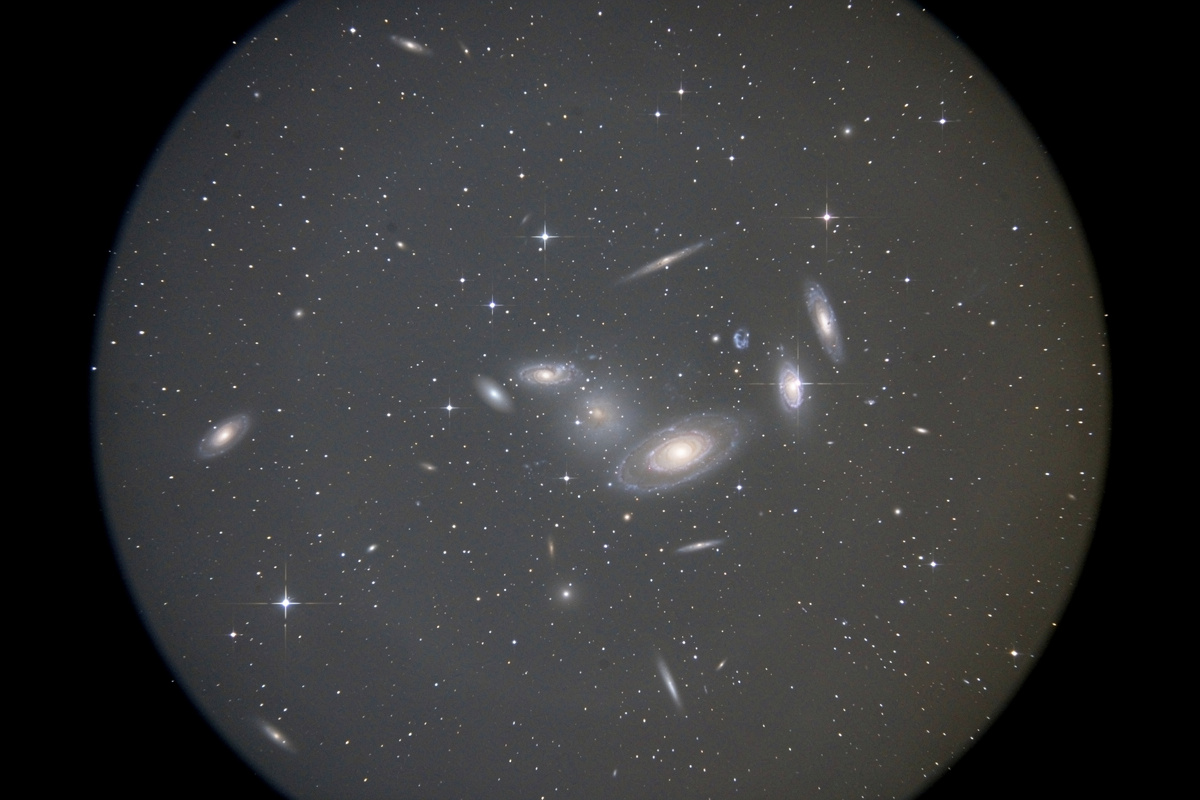

Charles Messier built his catalog as a list of fuzzy patches he wanted to ignore — objects he kept mistaking for comets between 1771 and 1781. Two and a half centuries later, those 110 fuzzy patches are the most-observed deep-sky targets in amateur astronomy: M42’s glowing trapezium core, M13’s pinprick globular shells, M31’s edge-on dust lanes, and M45 (Pleiades) sparkling in any backyard 60mm scope. All of them are visible in telescopes costing under $500, and 93 of the 110 are accessible from mid-northern latitudes in 6-inch or larger amateur instruments.
The Messier catalog remains the most popular observing list in amateur astronomy because every object is bright enough to find in modest equipment, well-documented with finder charts, and spread across all seasons. Completing the Messier list — observing all 110 objects — is a rite of passage that typically takes one to two years of dedicated observing and teaches star-hopping, chart reading, and patience with the sky’s schedule. I worked through my own Messier list over 14 months from spring 2019 to summer 2020 in an 8-inch Dob, with one frustrating gap of three months where the weather refused to cooperate on the late-spring Virgo galaxies. This guide covers the 25 best Messier objects ranked by visual impact, accessibility, and what they reveal as your telescope aperture grows. The cluster deep sky objects guide covers the broader category context, and the nebulae and star clusters spokes go deeper on the specific Messier targets in each category.
What Makes a Messier Object Worth Observing
Not all 110 Messier objects are equal at the eyepiece. Some — M42, M13, M45 — deliver jaw-dropping views in any telescope. Others — M53, M72, M91 — are faint fuzzies that reward experienced observers but frustrate beginners. Three factors determine which Messier objects deserve your first nights: brightness (magnitude and surface brightness), size (whether the object fills the eyepiece or appears as a tiny smudge), and structural detail (whether you can see more than a featureless glow).
Apparent magnitude alone is misleading for extended objects like nebulae and galaxies. M33 (Triangulum Galaxy) has a total magnitude of 5.7 — theoretically naked-eye visible — but its light spreads across 70 arcminutes of sky, giving it a surface brightness so low that many observers with 8-inch telescopes struggle to see it. Conversely, M57 (Ring Nebula) has a magnitude of only 8.8 but concentrates its light into a 1-arcminute disk, making it visible in 3-inch telescopes. Surface brightness, not total magnitude, determines what you actually see. The galaxy observing guide covers the surface-brightness math in detail.
Top 25 Messier Objects by Visual Impact
Tier 1: Showpiece Objects (See These First)
These ten Messier objects deliver the most impressive views regardless of telescope size. If you have one clear night, start here.
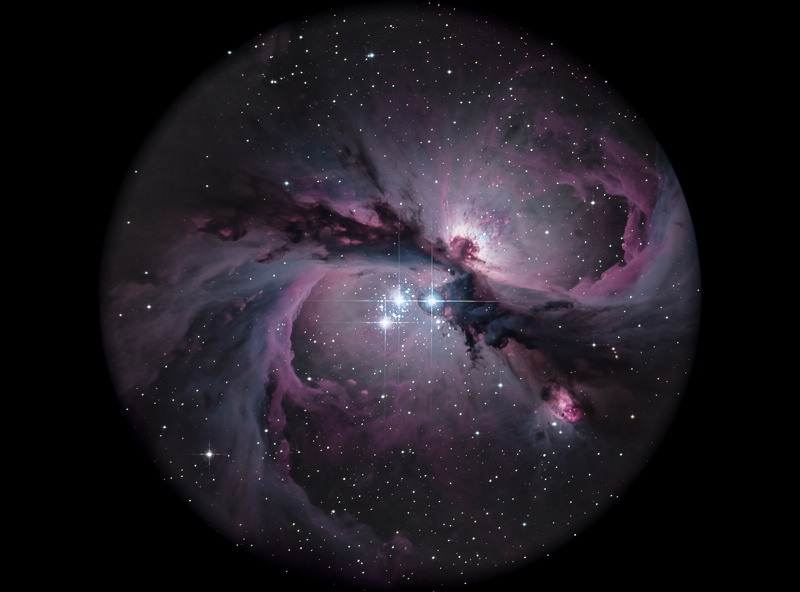
M42 — Orion Nebula (Magnitude 4.0, Size 85×60 arcmin). The finest deep sky object in the northern sky. Visible to the naked eye as the middle star of Orion’s sword, M42 resolves into a glowing cloud with a central trapezium of four stars in any telescope. At 30x, the nebula fills the field with sweeping wings of glowing gas. At 150x, the Trapezium cluster resolves and faint companion nebula M43 becomes distinct. Under dark skies with a 10-inch scope, mottling and dark lanes appear throughout the nebula. M42 shows structure at every magnification and rewards repeat visits.
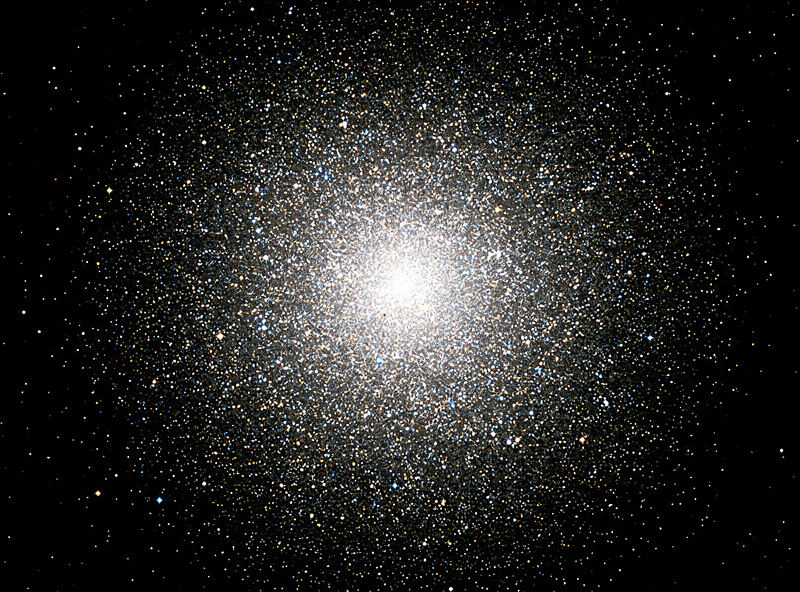
M13 — Hercules Globular Cluster (Magnitude 5.8, Size 20 arcmin). The northern sky’s finest globular cluster. In a 4-inch telescope, M13 appears as a bright, round fuzzy ball. An 8-inch scope begins resolving its outer edges into chains of individual stars. A 12-inch resolves the cluster nearly to its core — hundreds of pinpoint stars packed into a glittering sphere. M13 contains approximately 300,000 stars and sits 22,000 light-years away. Look for a dark notch on one side — the propeller feature — visible in 10-inch and larger scopes.
M31 — Andromeda Galaxy (Magnitude 3.4, Size 190×60 arcmin). The most distant object visible to the naked eye at 2.5 million light-years. M31 is enormous — 3 degrees across, six times the apparent diameter of the full Moon — and demands the lowest-power, widest-field eyepiece you own. In a 6-inch scope from a dark site, the bright core and elongated disk are obvious. A 10-inch scope reveals dust lanes along the southern edge and the companion galaxies M32 and M110. M31 is a spiral galaxy larger than our own Milky Way.
M45 — Pleiades (Magnitude 1.6, Size 110 arcmin). The Seven Sisters — a naked-eye open cluster of hot, blue stars in Taurus. Binoculars show 20 or more stars. A telescope at low power frames the cluster beautifully, though the wide field means a rich-field scope or short-tube refractor performs best. Faint reflection nebulosity surrounds the brightest stars, visible in long-exposure photographs but extremely challenging visually. The Pleiades is best observed with the naked eye or binoculars rather than at high magnification.
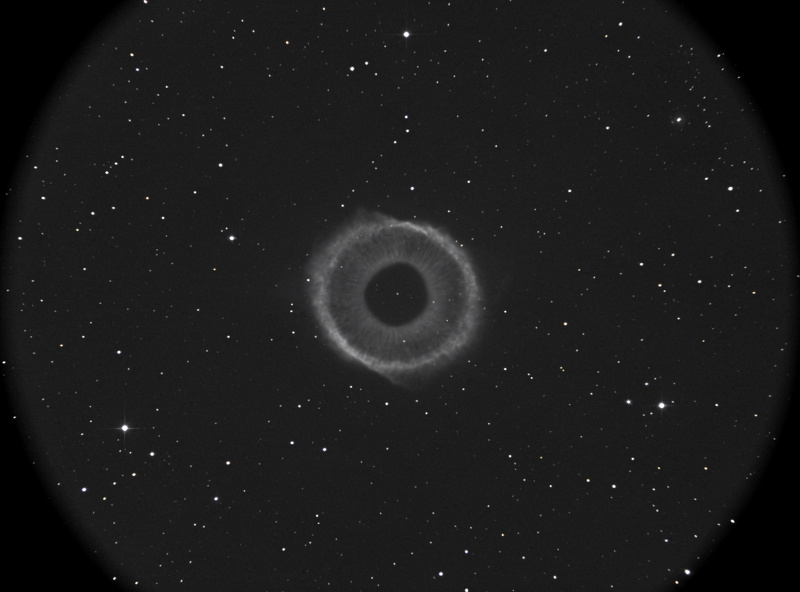
M57 — Ring Nebula (Magnitude 8.8, Size 1.4 arcmin). The textbook planetary nebula — a small, gray smoke ring in Lyra. At 100x in a 4-inch scope, the ring shape is clear. At 200x in an 8-inch, subtle texture appears within the ring and a faint central star becomes visible. M57 sits almost exactly between the two bottom stars of the Lyra parallelogram, making it one of the easiest deep sky objects to locate. A 6mm eyepiece for 200x or higher shows the most detail.
M51 — Whirlpool Galaxy (Magnitude 8.4, Size 11×7 arcmin). The first galaxy whose spiral structure was recognized, by Lord Rosse in 1845. M51’s spiral arms are visible in 10-inch and larger telescopes under dark skies — they appear as curved extensions from a bright nucleus. The companion galaxy NGC 5195 sits at the end of one arm and is visible in 8-inch scopes. M51 is in Canes Venatici and best observed in spring when it transits near midnight.
M8 — Lagoon Nebula (Magnitude 6.0, Size 90×40 arcmin). A massive emission nebula in Sagittarius visible in binoculars as a bright haze with a dark lane bisecting it. A 6-inch telescope shows the dark lane clearly and reveals the open cluster NGC 6530 embedded within the nebula. A UHC filter boosts contrast dramatically, making the lagoon structure pop against the background sky. M8 is one of only two Messier nebulae (with M42) that are genuinely bright enough to show color in large telescopes.
M44 — Beehive Cluster (Magnitude 3.7, Size 95 arcmin). An open cluster in Cancer visible to the naked eye as a fuzzy patch on dark nights. Binoculars resolve 50 or more stars scattered across nearly 2 degrees. A telescope at 30x frames the cluster beautifully. M44 is one of the nearest open clusters at 577 light-years and one of the oldest at 600-700 million years. It is well-positioned for winter and spring observing.
M27 — Dumbbell Nebula (Magnitude 7.5, Size 8.0×5.7 arcmin). The second-brightest planetary nebula in the sky and one of the largest. Its apple-core shape is distinctive at 60-100x in any telescope. M27 is in Vulpecula, easy to find between Albireo in Cygnus and the head of Delphinus. Unlike most planetaries, M27 is large enough to benefit from low magnification and wide-field eyepieces. An O-III filter reveals additional outer shell structure in 8-inch and larger scopes.
Double Cluster — NGC 869/NGC 884 (Magnitudes 5.3/6.1, Size 30 arcmin each). Two rich open clusters side by side in Perseus — technically not Messier objects but so famous they belong on every best-of list. Binoculars show dozens of stars. A telescope at 40-60x frames both clusters in a single field and reveals color contrasts between blue-white and gold stars. The Double Cluster is visible from autumn through winter and requires no finder chart — it is a naked-eye object in reasonably dark skies.
Tier 2: Excellent Objects Worth Seeking Out
These fifteen objects require slightly more effort to find or more aperture to appreciate, but reward the search with memorable views.
M22 — Sagittarius Globular (Magnitude 5.1, Size 24 arcmin). Brighter and larger than M13 but sits lower in the sky for northern observers, reducing its apparent quality. M22 resolves into individual stars more easily than M13 because it is slightly less concentrated. Best observed when highest in summer, near the spout of the Teapot in Sagittarius.
M11 — Wild Duck Cluster (Magnitude 6.3, Size 14 arcmin). The richest open cluster in the Messier catalog — at low power it resembles a faint globular. M11 contains thousands of stars in Scutum and resolves beautifully in 6-inch and larger telescopes. It sits in a rich Milky Way star field that fills the background with fainter stars.
M5 — Serpens Globular (Magnitude 5.7, Size 20 arcmin). A bright, well-resolved globular often overlooked because it sits between the more famous M13 and M22. M5 resolves to its core in 10-inch scopes under dark skies and shows a distinctive fan-shaped extension of stars from one edge.
M97 — Owl Nebula (Magnitude 9.9, Size 3.4 arcmin). A large, faint planetary nebula in Ursa Major that requires a UHC filter and 8-inch or larger telescope to see its characteristic two-eye structure. M97 sits near M108, and both fit in the same low-power field — a satisfying double observation.
M104 — Sombrero Galaxy (Magnitude 8.0, Size 9×4 arcmin). An edge-on galaxy in Virgo with a prominent dust lane visible in 8-inch and larger scopes. The Sombrero’s bright nucleus and distinctive hat-brim shape make it one of the most recognizable galaxies in the catalog. It sits just south of the Virgo Cluster and is best in spring.
M17 — Swan Nebula (Magnitude 6.0, Size 11 arcmin). An emission nebula in Sagittarius whose shape resembles a swan at low magnification. M17 benefits from a UHC filter and shows detailed structure in 8-inch scopes — the swan’s neck curves through a dark lane and its body glows brightly with embedded star clusters.
M20 — Trifid Nebula (Magnitude 9.0, Size 28 arcmin). Sits just north of M8 and is best observed in the same session. The Trifid combines an emission nebula, a reflection nebula, and a dark nebula in one field. The three-lobed dark lanes that give it its name require 8-inch or larger scopes and a UHC filter to see visually.
M16 — Eagle Nebula (Magnitude 6.4, Size 7 arcmin). Home of the famous Pillars of Creation imaged by Hubble. Visually, M16 shows as an open cluster surrounded by faint nebulosity. The pillars themselves are a photographic target — visual observers see the cluster easily but the surrounding nebula requires dark skies and a UHC filter.
M1 — Crab Nebula (Magnitude 8.4, Size 7×5 arcmin). The remnant of a supernova observed by Chinese astronomers in 1054 AD. In a 6-inch scope, M1 appears as a faint, elongated glow in Taurus. An 10-inch under dark skies reveals subtle texture. The Crab is small and concentrated, making it resistant to light pollution compared to extended nebulae.
M101 — Pinwheel Galaxy (Magnitude 7.9, Size 29 arcmin). A face-on spiral galaxy in Ursa Major that is large but has low surface brightness. M101 requires dark skies and 10-inch or larger aperture to see its spiral structure. The galaxy spans nearly the width of the full Moon, so use your widest-field eyepiece. Several supernovae have been observed in M101 in recent decades.
M92 — Hercules Globular (Magnitude 6.4, Size 14 arcmin). Often overshadowed by nearby M13, M92 is actually a superb globular that resolves more easily than M13 because it is more compact. M92 sits about 9 degrees from M13 and can be observed in the same session. Its concentrated core snaps into individual stars in 10-inch scopes.
M35 — Gemini Open Cluster (Magnitude 5.3, Size 28 arcmin). A rich open cluster near the foot of Castor in Gemini, well-positioned for winter observing. M35 contains about 200 stars spread across nearly a full Moon-width of sky, making it best at 30-50x magnification. The fainter cluster NGC 2158 sits nearby and provides a visual contrast of young and old star clusters.
M109 — Galaxy in Ursa Major (Magnitude 9.8, Size 8×5 arcmin). A barred spiral galaxy near the star Phecda (the bottom-right star of the Big Dipper’s bowl). M109 is the most distant Messier object at 83 million light-years and requires 8-inch or larger telescopes and dark skies. It is a satisfying catch for experienced observers completing the Messier marathon.
M73 — Asterism in Aquarius (Magnitude 9.0, Size 3 arcmin). Technically not a true deep sky object — M73 is an asterism of four unrelated stars — but it earns its place on this list because it teaches observers to look carefully and question what they see. M73 is easy to find and quick to observe.
M76 — Little Dumbbell Nebula (Magnitude 10.1, Size 2.7×1.8 arcmin). A faint planetary nebula in Perseus that resembles a miniature version of M27. M76 requires a 6-inch telescope and an O-III filter to see well. At 150x, the double-lobed structure becomes apparent. M76 is one of the faintest Messier objects and a genuine challenge under suburban skies.
Equipment for Messier Hunting
The Messier list was designed for 18th-century telescopes, so modern equipment handles it easily. A 6-inch Dobsonian is the minimum for completing all 110 objects — a few (M74, M33, M76) challenge smaller scopes. An 8-inch Dob at $350-500 is the sweet spot: it gathers 73% more light than a 6-inch and resolves the fainter Messier objects comfortably.
The most important accessory for Messier hunting is a good low-power eyepiece. A 32mm Plössl (giving about 40x in a 1200mm focal length scope) provides the widest true field and makes finding and framing extended objects easier — the eyepiece guide compares specific options at each focal length. A Telrad or Rigel QuikFinder reflex finder accelerates star-hopping by projecting a red bullseye onto the sky, replacing slow finder-scope navigation with instant aiming. My own Messier kit through 2019-2020 was a 32mm Astro-Tech Paradigm widefield, a 13mm middle eyepiece, and a 6mm planetary for M57 and M27 — three eyepieces handled every object in the catalog.
A UHC filter helps on the nebulae in the list — M42, M8, M17, M20, M16, and others show dramatically improved contrast through a filter. The filters guide walks through which Wratten and broadband filters earn their slot. A detailed atlas like Turn Left at Orion or the Pocket Sky Atlas provides finder charts for every Messier object and makes star-hopping systematic rather than random.
Messier Marathon: All 110 in One Night
A Messier Marathon is the attempt to observe all 110 objects in a single night — typically a moonless night in March, when the sky’s rotation carries every Messier object above the horizon between dusk and dawn. The marathon requires clear skies for 10-12 hours, a well-organized observing plan, and the stamina to stay at the eyepiece all night.
The marathon sequence starts at dusk with M74 and M33 — the two hardest objects because they are setting in the west as darkness falls. The plan then sweeps eastward through the spring galaxies (M81, M82, M51, Virgo Cluster), the summer Milky Way (M8, M17, M22), and finishes at dawn with M30 in Capricornus, which rises just before sunrise. Completing all 110 requires a 10-inch or larger telescope from a dark site and a clear horizon in all directions.
Most marathoners complete 90-105 objects on their first attempt, with the twilight objects and low-altitude summer targets being the usual misses. The marathon is a social event — astronomy clubs organize group marathons where dozens of observers share a dark site and compare lists through the night.
Common Mistakes I Made on My Messier List
The first mistake was starting on M74 before I was ready. I had read that M74 was hard but I was three months into the hobby and confident — I burned three full sessions in autumn 2019 from my Bortle 7 backyard convinced I was missing it through bad technique. I was missing it because the surface brightness made it nearly invisible from where I was. M74 came easily on the first attempt at a Bortle 4 site six months later. Some Messier objects need dark skies and there is no skill substitute.
The second mistake was logging objects without sketching them. Every “tick mark” Messier observation I did from the first 30 objects has blurred together — I cannot tell you what M22 looked like compared to M13 because I only spent 90 seconds on each before moving on. Once I started sketching simple field circles with the brightest stars and the object’s apparent shape, I started actually remembering the views. The Messier list is not a checklist sport.
The third mistake was treating high-magnification eyepieces as more “advanced.” The 6mm Astro-Tech Paradigm I bought specifically for M57 ended up almost unused because most Messier objects show their best detail at 50-100x. Only the planetaries M57, M27, M76, and M97 reward 150-250x. Buying high-power eyepieces before low-power widefields is the most common budget mistake new Messier hunters make.
What I Would Do Tonight
If you are starting your Messier list tonight and the season is winter, here is the session I would build. Set up at your darkest accessible site 30 minutes before twilight ends. Find M42 first with a 32mm Plössl — let it sit for 5 minutes while your eyes finish adapting. Hop to M45 (Pleiades) for a low-power, no-filter naked-eye-plus-eyepiece view. Move to M1 (Crab) east of Zeta Tauri — apply averted vision and watch it brighten. End the session on the Double Cluster at low power — not technically a Messier object, but the right last image to leave you smiling. Sketch each one in a 4-inch field circle on an index card before you move to the next. After ten nights of this routine you will have a personal Messier portfolio that beats any photo memory.
Frequently Asked Questions
What is the easiest Messier object to find?
The Pleiades (M45) is the easiest Messier object — it is visible to the naked eye as a tight cluster of stars in Taurus during winter. The Orion Nebula (M42) is the second easiest, visible as the middle star of Orion sword without any equipment.
How many Messier objects can you see with a 6-inch telescope?
A 6-inch telescope can show all 110 Messier objects from a dark site, though M74, M33, M76, and M101 require Bortle 4 or darker skies and careful observing technique. From a suburban Bortle 7 sky, a 6-inch scope shows roughly 70 to 80 Messier objects.
What is the hardest Messier object to see?
M74 in Pisces is generally considered the hardest Messier object due to its very low surface brightness — magnitude 9.4 spread across 10 arcminutes. M33 (Triangulum Galaxy) is the second hardest for the same reason. Both require dark skies, low magnification, and averted vision.
How long does it take to complete the Messier list?
Most dedicated observers complete the Messier catalog in one to two years. If you observe two to three nights per month through all four seasons, you can finish in about 12 months. The objects are spread across every season, so you must observe year-round to catch them all.
Do you need a goto telescope for Messier objects?
No. Every Messier object is accessible through star-hopping with a finder scope and star chart. A Telrad reflex finder plus a pocket sky atlas makes star-hopping faster and more enjoyable than goto for many observers. Goto saves time but adds cost, weight, and setup complexity.
What is the best season to see Messier objects?
Spring offers the most Messier objects in one session — the Virgo Cluster alone contains 16 Messier galaxies. Summer brings the Sagittarius and Scorpius nebulae and globular clusters. Winter has M42, M45, and several open clusters. You need all four seasons to complete the full 110-object list.
Related Articles
Deep Sky Objects: The Complete Amateur Astronomer Guide — overview of all deep sky object types and how to observe them.
Best Nebulae for Amateur Telescopes — 15 top nebulae with filter and aperture notes.
Best Star Clusters to Observe — Open and globular clusters by season.
How to See Galaxies with a Telescope — Surface brightness, technique, and target list.
Double Stars and Variable Stars — Sibling deep-sky targets beyond the Messier list.
