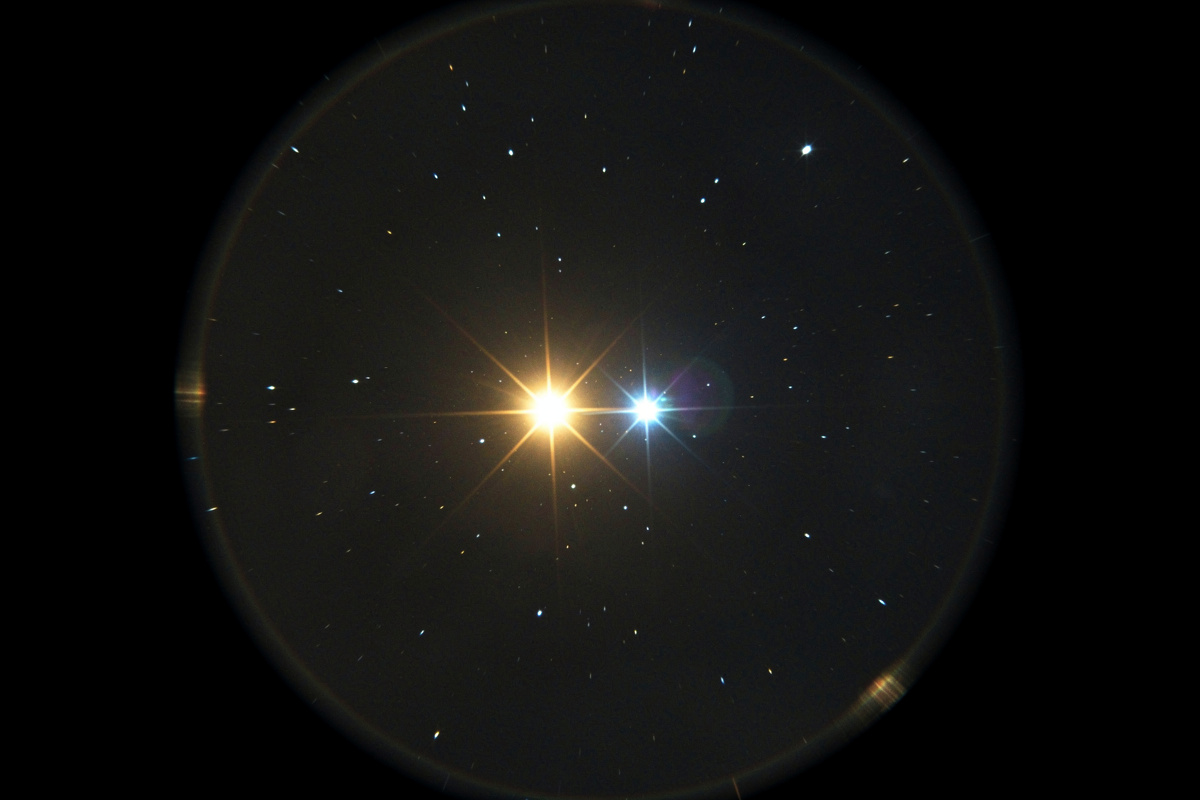

Double stars and variable stars are ideal telescope targets that show real-time changes visible in a single observing session. Albireo in Cygnus displays gold and blue stars separated by 34 arcseconds in any telescope, while variable stars like Mira cycle from magnitude 2 to magnitude 10 over 11 months, changing visibly between weekly observations.
While most deep sky observing focuses on galaxies, nebulae, and clusters, double and variable stars offer something those objects cannot — the experience of watching something change. Double stars reveal color contrasts between stellar companions that may orbit each other in days or millennia. Variable stars pulse, eclipse, or erupt, changing brightness on timescales from hours to years. Both types are accessible in any telescope, from a 60mm refractor to a 16-inch Dobsonian, and both provide an observing program that rewards regular, repeated sessions over months and years. The cluster deep sky objects guide covers the broader category context, and the Messier, nebulae, cluster, and galaxy spokes go deeper on the diffuse-object families that double and variable stars complement on a single observing night.
Double Stars: What Makes Them Interesting
A double star is a pair of stars that appear close together in the sky. True doubles are gravitationally bound binary systems orbiting each other. Optical doubles are unrelated stars that happen to lie along nearly the same line of sight. Most visually interesting doubles are true binaries, though distinguishing true from optical doubles requires tracking their motion over years or decades.
Double stars appeal to observers for three reasons: color contrast, separation challenge, and orbital motion. Color contrast occurs when two stars of different spectral types appear side by side — a blue-white A-type star paired with an orange K-type star creates a striking color pair. Separation challenge ranges from wide, easy pairs visible in binoculars to tight, difficult splits requiring high magnification and excellent seeing. Orbital motion means some doubles visibly change position angle and separation over years of observation.
Best Double Stars for Every Telescope
Albireo (Beta Cygni) — The Most Beautiful Double
The gold and blue pair at the head of Cygnus is the most famous double star in amateur astronomy. Albireo’s primary is a magnitude 3.1 K-type giant shining warm gold, while its secondary is a magnitude 5.1 B-type star burning blue-white. The two stars are separated by 34 arcseconds — wide enough to split in any telescope at 30-40x. Whether Albireo is a true binary or optical double remains debated, but the color contrast is real and spectacular. Albireo was the first double star I showed friends through my 8-inch SCT, and it is the only deep-sky-adjacent target where the immediate “oh wow” reaction is essentially guaranteed; the gold-blue split needs no explanation.
Double-Double (Epsilon Lyrae)
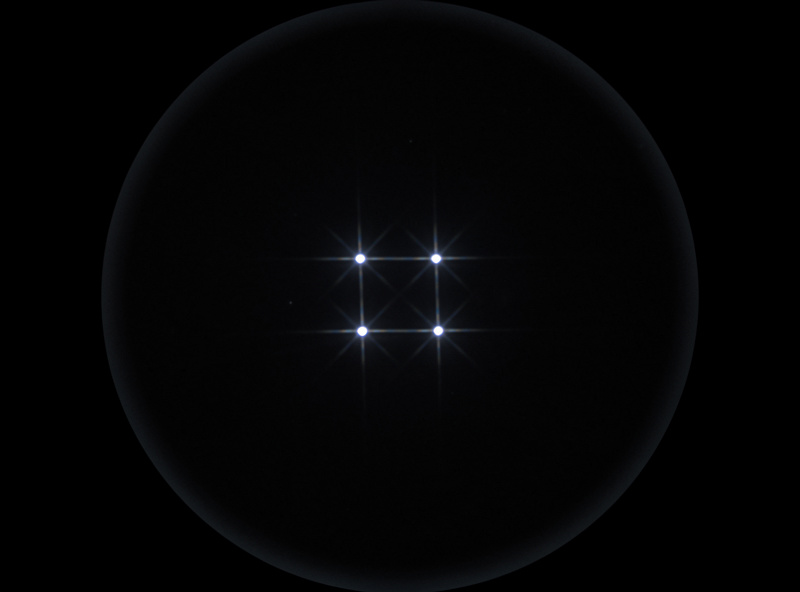
Four stars in a 2×2 pattern in Lyra. At low magnification, Epsilon Lyrae appears as a single star. At 100x, it splits into two stars separated by 208 arcseconds. Each of those stars is itself a double — the northern pair (Epsilon-1) splits at 200x, and the southern pair (Epsilon-2) splits at 250x. Splitting all four stars in a 4-inch or larger telescope is a satisfying challenge that tests your optics and the atmosphere.
Mizar and Alcor
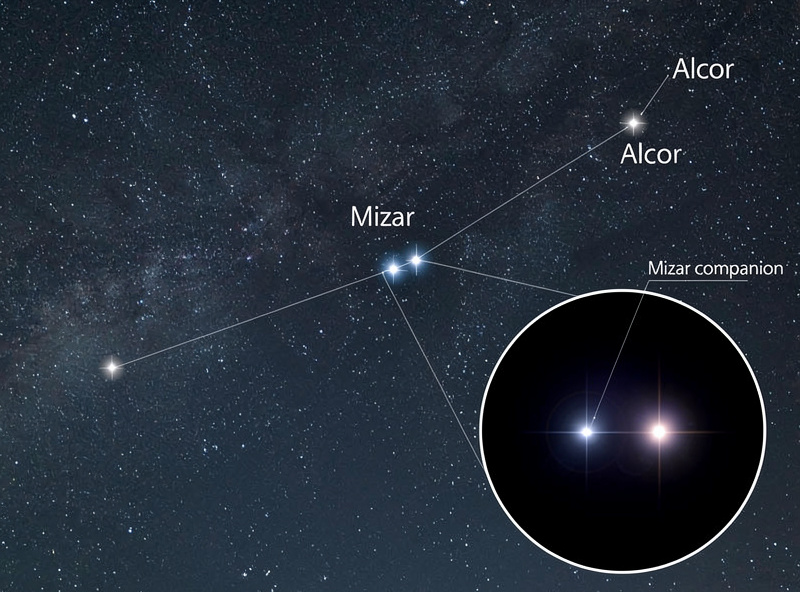
The famous naked-eye double in the handle of the Big Dipper. Mizar itself is a telescopic double — its companion Mizar B, separated by 14.4 arcseconds, is visible at 80x in any telescope. Both Mizar A and Mizar B are themselves spectroscopic binaries, making the system a complex multiple star. Alcor, 12 arcminutes from Mizar, is visible to the naked eye and easily resolved in binoculars.
Castor (Alpha Geminorum)
A beautiful double star in Gemini with components separated by 6 arcseconds. Castor A and B are both white stars of magnitudes 1.9 and 3.0, split at 100-150x in 4-inch and larger telescopes. A third, fainter star (Castor C) sits 72 arcseconds away and is easy in any telescope. Like Mizar, both Castor A and B are spectroscopic binaries, making the system six stars in total.
Antares (Alpha Scorpii)
The red supergiant Antares has a blue-white companion at 2.6 arcseconds separation — a challenging split requiring 200-300x and excellent seeing in 6-inch and larger telescopes. The color contrast between the brilliant orange-red primary and the faint blue companion is one of the finest in the sky. Antares is best observed when Scorpius is highest in summer.
Polaris (Alpha Ursae Minoris)
The North Star is a double star with a magnitude 8.2 companion separated by 18 arcseconds. Polaris B is easy in 3-inch and larger telescopes at 100x. The companion is a white star that contrasts subtly with Polaris A’s yellow-white light. Polaris is available for observation every clear night from the northern hemisphere, making it an easy target for testing telescope optics.
Gamma Virginis (Porrima)
A pair of nearly identical yellow-white stars separated by 1.5 to 6 arcseconds depending on their orbital phase. Porrima’s stars orbit each other every 169 years, and the separation varies dramatically — the pair was extremely tight (under 1 arcsecond) around 2005 and is now widening. Porrima requires 200x or higher and 4-inch or larger aperture to split.
Variable Stars: Types and How to Observe Them
Variable stars change brightness over time for three reasons: pulsation (the star physically expands and contracts), eclipses (a companion star passes in front), or eruptive events (outbursts from the stellar surface). Each type produces different light curves and observation challenges.
Pulsating Variables: Mira and the Cepheids
Mira (Omicron Ceti) is the most famous variable star — a red giant that pulses every 332 days, cycling from magnitude 2 (easily visible to the naked eye) to magnitude 10 (invisible in binoculars). Mira’s 8-magnitude brightness swing means it literally appears and disappears from visual observation over the course of months. Observing Mira monthly and estimating its brightness relative to nearby comparison stars creates a light curve that tracks the star’s pulsation over an entire year.
Cepheid variable stars pulse with periods of 1 to 100 days and are important in astronomy because their period-luminosity relationship allows astronomers to measure distances to galaxies. Delta Cephei in Cepheus is the prototype — it varies from magnitude 3.5 to 4.4 every 5.37 days, visible as a change in brightness between nightly observations.
Eclipsing Variables: Algol
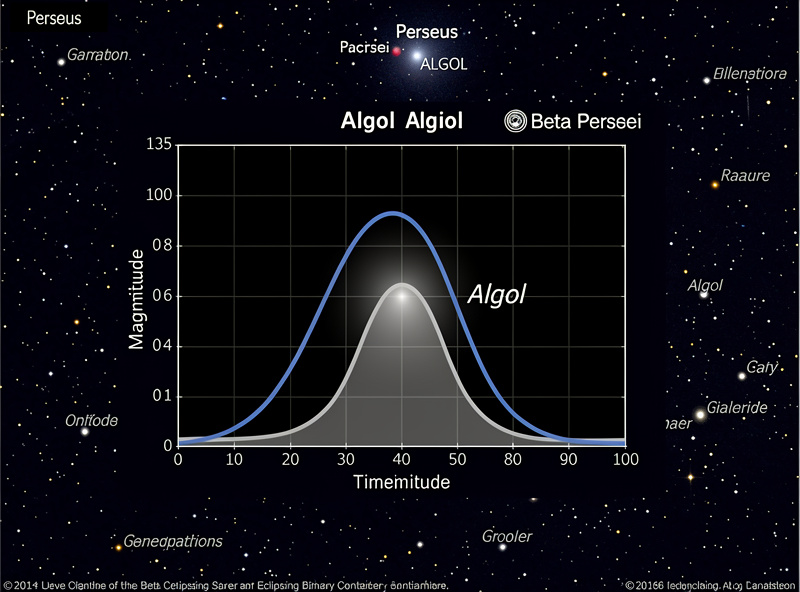
Algol (Beta Persei) is the most famous eclipsing binary — a pair of stars that orbit each other every 2.87 days, and every 2.87 days the fainter star passes in front of the brighter one, causing a dip from magnitude 2.1 to magnitude 3.4. The eclipse lasts about 10 hours and is dramatic enough to see with the naked eye. Predicting Algol’s eclipses using the American Association of Variable Star Observers (AAVSO) calculator and watching the star fade and recover in real time is one of the most engaging observations in amateur astronomy. The first time I tracked an Algol minimum I set up at 9 PM, watched the star drop a full magnitude over four hours, and was back inside by 1 AM with one of the most genuinely satisfying observations of that year — the star physically dimmed in front of me.
Irruptive Variables: Novae and Recurrent Novae
Nova eruptions occur when material accumulated on a white dwarf from a companion star ignites in a thermonuclear explosion, causing the star to brighten by 7-16 magnitudes in days. Novae are unpredictable but several per year reach naked-eye visibility. T Pyxidis and RS Ophiuchi are recurrent novae that erupt every few decades and are favorite targets for amateur monitoring programs.
How to Observe Variable Stars
Variable star observing uses the technique of visual magnitude estimation — comparing the variable star’s brightness to nearby comparison stars of known magnitude. The AAVSO publishes comparison charts for thousands of variable stars, showing the variable’s position and the magnitudes of surrounding stars.
To estimate a variable’s brightness, find two comparison stars — one brighter than the variable and one fainter. Interpolate the variable’s brightness between them. For example, if comparison star A is magnitude 5.0 (clearly brighter) and comparison star B is magnitude 6.0 (clearly fainter), and the variable appears halfway between them, you estimate magnitude 5.5. With practice, visual estimates are accurate to 0.1-0.3 magnitudes.
Record every estimate with the date, time (in Universal Time), star name, estimated magnitude, and comparison stars used. Submit observations to the AAVSO, which aggregates amateur data into light curves used by professional astronomers. Amateur variable star observations have contributed to discoveries of new outbursts, period changes, and previously unknown behavior in hundreds of stars.
Equipment for Double and Variable Star Observing
Double and variable stars require less equipment than any other deep sky observing category. A 3-inch refractor splits all the bright doubles listed above and observes variables down to magnitude 10. A 6-inch scope splits doubles down to 1 arcsecond separation and reaches magnitude 12 variables. The critical accessory is a high-quality eyepiece for splitting tight doubles — orthoscopic or planetary eyepieces with excellent on-axis sharpness perform better than wide-field designs for this purpose. The eyepiece guide compares specific options for double-star work.
Dark skies are helpful but not essential for double and variable star observing. Because stars are point sources, they remain visible through substantial light pollution. Variable star observing from urban locations is entirely practical — many AAVSO members observe from city backyards and contribute valuable data.
A red flashlight, a comfortable observing chair, and a set of AAVSO comparison charts are the essential accessories. A logbook for recording observations helps track variables over months and years. Software like the AAVSO’s VStar analyzes your observations and generates light curves automatically. Newtonian and Dobsonian users should run the collimation check before any double-star session — sub-arcsecond splits demand perfect optical alignment.
Common Mistakes I Made on Star Pair Nights
The first mistake was trying to split tight doubles on poor seeing nights. Antares B at 2.6 arcseconds is genuinely difficult, and on 4-arcsecond seeing nights it is invisible regardless of aperture. I burned dozens of summer sessions chasing Antares B before I learned to read the seeing on Polaris first — if Polaris B (18 arcsecond split) is rock solid, the night might support Antares; if Polaris B itself is mushy, no double tighter than 5 arcseconds will split.
The second mistake was using my widest-field eyepiece for tight doubles. The 24mm panoptic-style eyepiece I love for clusters has slight off-axis aberrations that smear sub-arcsecond pairs. My 5mm orthoscopic — narrow apparent field, no eye relief, no glamour — splits Porrima cleanly when the wider eyepiece blurs it. Optical design matters more than apparent field for double-star work.
The third mistake was missing Algol minima because I never bothered to download the AAVSO eclipse predictor. Algol is the easiest variable star to observe live, but you have to know when minimum occurs in your local time. The AAVSO calculator gives you the next 30 minima for any location; once I started checking it weekly, I caught 3-4 Algol eclipses per year instead of zero.
What I Would Do Tonight
If you have a 4-8 inch scope and a clear summer night, here is the star-pair session I would build. Find Albireo first at 50x — let your friends or family see the gold-blue split. Hop to the Double-Double in Lyra and work up from 100x to 200x; resolve all four stars by the end. Find Mizar in the Big Dipper and split it from Alcor; if seeing cooperates, push to Antares for the orange-blue contrast. Check Algol’s brightness against the AAVSO chart — even on a non-eclipse night, that 30-second check trains your eye for the next minimum. Five star pairs and one variable estimate in 90 minutes is the kind of low-equipment, high-payoff observing that anchors deep-sky-cluster nights when conditions do not support galaxies.
Frequently Asked Questions
What is the easiest double star to see?
Albireo (Beta Cygni) is the easiest and most beautiful double star. Its gold and blue components are separated by 34 arcseconds, visible in any telescope at 30-40x magnification. Albireo requires no finder chart — it sits at the head of Cygnus and is visible from June through October.
Can you see double stars from the city?
Yes. Double stars are point sources that are not significantly affected by light pollution. Albireo, the Double-Double in Lyra, Mizar, and Castor are all easily split from urban locations. Variable star observing is also practical from cities because stars remain visible through substantial skyglow.
What telescope do you need to see double stars?
Any telescope splits bright double stars. A 60mm refractor at 40x splits Albireo. A 4-inch telescope splits doubles down to 2 arcseconds at 150x. A 6-inch scope resolves pairs down to 1 arcsecond. Splitting sub-arcsecond doubles requires 8-inch or larger aperture and excellent seeing conditions.
How do you observe variable stars?
Compare the variable star brightness to nearby stars of known magnitude. Use AAVSO comparison charts to find comparison stars. Estimate where the variable falls between a brighter and fainter comparison. Record the date, time, and magnitude estimate. Submit observations to the AAVSO for aggregation into professional-quality light curves.
What is the best variable star for beginners?
Algol (Beta Persei) is the best beginner variable because its eclipses are dramatic (magnitude 2.1 to 3.4), predictable (every 2.87 days), and visible to the naked eye. Mira (Omicron Ceti) is the second-best because its 8-magnitude brightness swing over 11 months is dramatic and easy to track.
Do you need a special eyepiece for double stars?
Orthoscopic or planetary eyepieces with excellent on-axis sharpness perform best for splitting tight doubles. These designs have narrower apparent fields than wide-field eyepieces but deliver sharper star images at high magnification. A good 5-6mm orthoscopic or dedicated planetary eyepiece is ideal for double star splitting.
Related Articles
Deep Sky Objects Guide — complete overview of all deep sky types including stars.
Best Messier Objects to See — top 25 Messier objects to pair with star nights.
Best Nebulae for Amateur Telescopes — sibling spoke covering nebulae across all apertures.
Best Star Clusters to Observe — open and globular cluster targets.
How to See Galaxies with a Telescope — surface brightness and aperture techniques.
