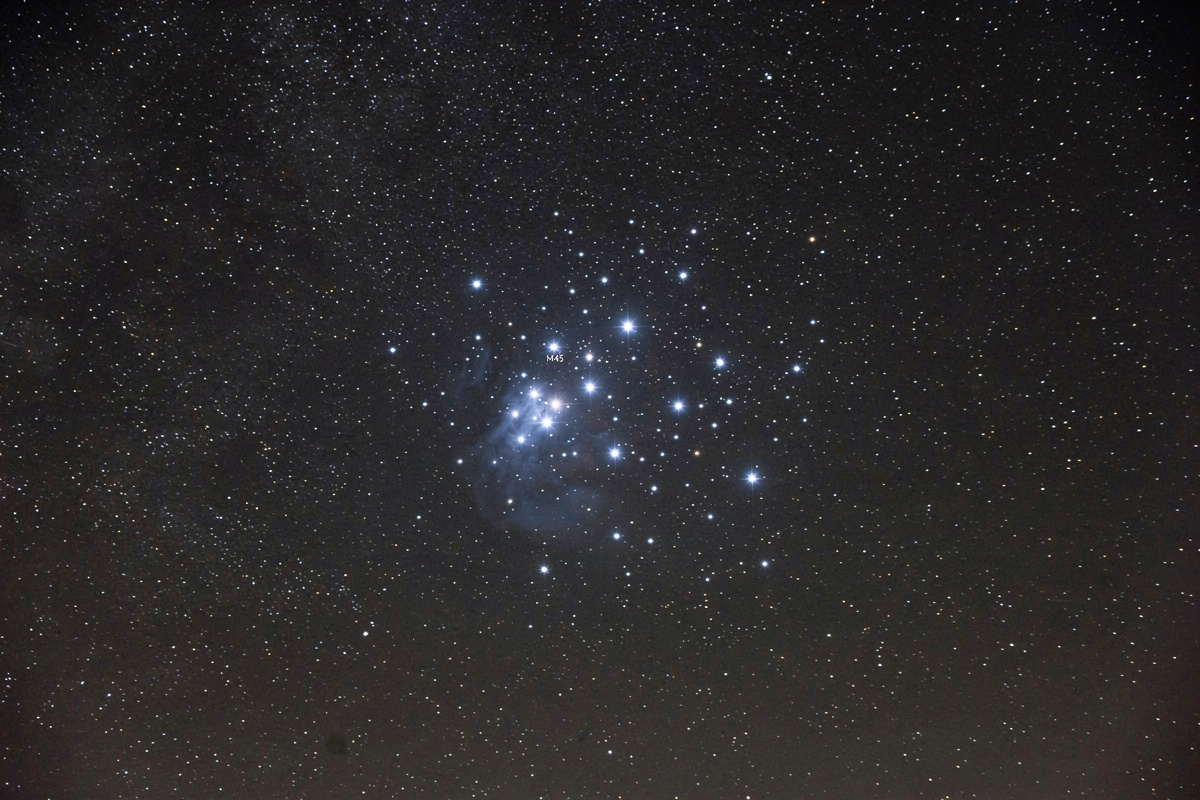

Star clusters split into two fundamentally different families: open clusters of young, loosely-bound stars in the Milky Way’s disk, and globular clusters of ancient, densely-packed stars in the galactic halo. The Pleiades (M45), Double Cluster (NGC 869/884), and Hercules Globular (M13) anchor any starter list — all spectacular in binoculars and telescopes under $500. Amateur astronomers can observe over 50 showpiece star clusters from mid-northern latitudes, ranging from naked-eye open clusters to globular clusters that require 8-inch telescopes to resolve into individual stars.
Star clusters are the most visually rewarding deep sky objects for beginners because they consist of individual stars rather than faint, diffuse light. Open clusters glow with dozens to hundreds of young stars born from the same molecular cloud. Globular clusters pack hundreds of thousands of ancient stars into dense, spherical systems orbiting the galactic halo. Both types survive light pollution better than nebulae and galaxies because their stars are point sources that remain visible even when skyglow washes out extended objects. The cluster deep sky objects guide covers the broader category context, and the nebulae and galaxies spokes go deeper on the diffuse-object cousins of clusters.
Open Clusters vs Globular Clusters
Open clusters and globular clusters differ in age, size, star count, and location within the galaxy. Understanding these differences helps you choose targets, plan sessions, and know what to expect at the eyepiece.
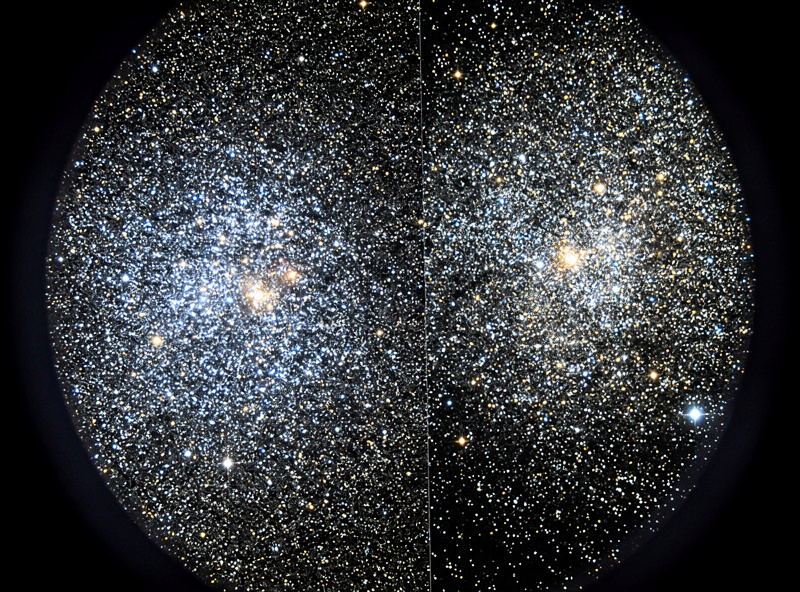
Open clusters are young — typically 10 million to 1 billion years old — and contain 50 to a few thousand stars spread across 5 to 30 arcminutes of sky. They reside in the Milky Way’s disk and are concentrated along the galactic plane. Open clusters are irregular in shape, ranging from tight, compact groupings like M11 in Scutum to scattered, sparse associations like the Alpha Persei Moving Cluster. Because their stars are relatively bright and spread over moderate areas, open clusters are easy targets for binoculars and small telescopes.
Globular clusters are ancient — 10 to 13 billion years old — and contain 100,000 to over 1 million stars packed into a sphere 100 to 300 light-years across. They orbit in the galactic halo, well above and below the Milky Way’s disk. Globular clusters are round, dense, and require telescope aperture to resolve into individual stars. In small telescopes, they appear as fuzzy balls. In 8-inch and larger scopes, the outer edges resolve into chains and streams of stars, and under dark skies with 12-inch or larger instruments, the cluster resolves to its glittering core.
Best Open Clusters to Observe
The Pleiades (M45)
The Seven Sisters dominate the winter sky as a tight group of hot, blue stars in Taurus. Naked-eye observers see six or seven stars. Binoculars reveal 20 or more. The Pleiades is best observed without a telescope — its 110-arcminute extent fills even wide-field eyepieces. The cluster sits 444 light-years away and is one of the nearest open clusters to Earth. Surrounding reflection nebulosity is visible in long-exposure photographs but extremely challenging visually. The Pleiades rises in October and is best positioned from November through February.
The Double Cluster (NGC 869/NGC 884)
Two rich open clusters side by side in Perseus, each about 30 arcminutes across and separated by 25 arcminutes — close enough to fit in a single low-power field. The Double Cluster contains hundreds of stars, with a mix of blue-white supergiants and gold foreground stars creating color contrast visible in any telescope. Binoculars show both clusters as fuzzy patches. A telescope at 40-60x resolves both into glittering groups. The Double Cluster is a naked-eye object from reasonably dark skies and one of the most immediately impressive sights in amateur astronomy. The first time I framed both clusters in a single 32mm Plössl field at 38x in my 8-inch Dob from a Bortle 4 site, I sat at the eyepiece for 25 minutes without moving — the gold stars against blue-white supergiants are color contrasts you do not expect from a hobby that mostly delivers shades of gray.
The Beehive Cluster (M44)
M44 in Cancer is visible to the naked eye as a fuzzy patch on dark winter and spring nights. Binoculars resolve 50 or more stars scattered across nearly 2 degrees of sky. A telescope at 30-40x frames the cluster beautifully — it is too large for high magnification. M44 is one of the nearest open clusters at 577 light-years and one of the oldest at 600-700 million years. Its age means many of its original blue stars have evolved off the main sequence, giving the cluster a warmer color palette than younger clusters like the Pleiades.
The Wild Duck Cluster (M11)
M11 in Scutum is the richest open cluster in the Messier catalog. At low power, it resembles a faint globular — a concentrated ball of stars that resolves into hundreds of individual points in 6-inch and larger telescopes. M11 sits in a rich Milky Way star field and rewards high magnification (150-200x) where its dense core separates into a glittering mass of stars. The cluster is about 220 million years old and 6,200 light-years away. M11 is best observed in summer when Scutus transits near midnight.
The Jewel Box (NGC 4755)
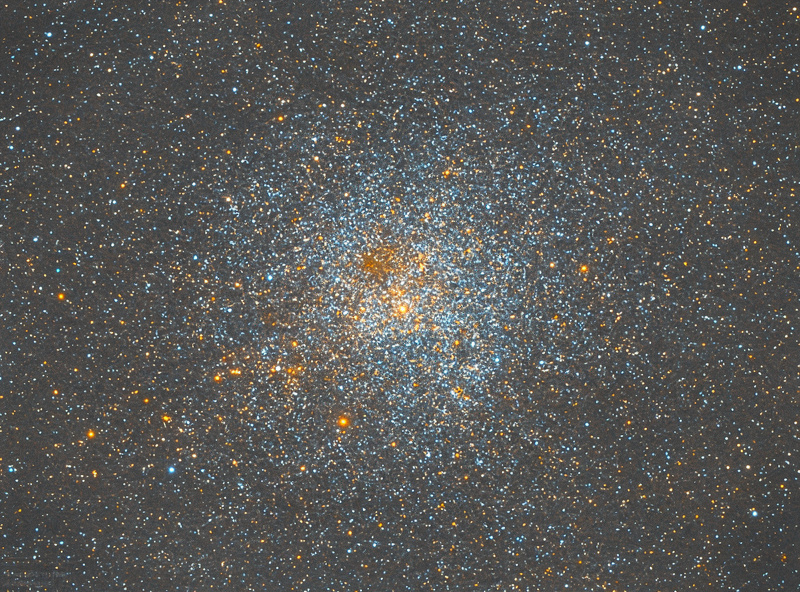
A southern hemisphere treasure near the Southern Cross, the Jewel Box contains about 100 stars arranged in a trapezoidal pattern with a bright red supergiant at its center. The color contrast between the blue, white, and red stars is among the finest in the sky. The Jewel Box is visible from latitudes south of 30 degrees north and is a showpiece object for observers in the southern United States, Hawaii, and the southern hemisphere.
The Coathanger (Collinder 399)
An asterism — not a true star cluster — that perfectly resembles a coathanger in binoculars and finderscopes. The Coathanger sits in Vulpecula between Albireo and the head of Delphinus and is one of the easiest objects in the sky to find. Binoculars show the coathanger shape instantly. The Coathanger is an optical asterism — its stars are not physically related — but it provides one of the most satisfying binocular views in astronomy.
M35 in Gemini
M35 is a rich open cluster near the foot of Castor in Gemini, well-positioned for winter observing. It contains about 200 stars spread across 28 arcminutes — nearly the width of the full Moon. At 30-50x, M35 fills the field with scattered stars of varying brightness. The fainter, more compact cluster NGC 2158 sits nearby and provides a visual contrast between a young, nearby open cluster and a distant, older cluster compressed by its greater age.
Best Globular Clusters to Observe
M13 — The Great Hercules Cluster
The finest globular cluster visible from the northern hemisphere. M13 contains approximately 300,000 stars packed into a sphere 145 light-years across at a distance of 22,000 light-years. In a 4-inch telescope, M13 appears as a bright, round fuzzy ball with a concentrated core. An 8-inch scope resolves the outer edges into individual stars and chains. A 12-inch resolves the cluster deeply into its core, revealing hundreds of pinpoint stars. Look for the propeller — a dark, Y-shaped feature on one side — visible in 10-inch and larger scopes under dark skies. M13 was the third object I ever found through my own scope, and I will never forget the moment at 180x when the outer edges first snapped from “fuzzy ball” to “individual stars” — that one transition is the gateway drug for every globular cluster I have observed since.
M22 in Sagittarius
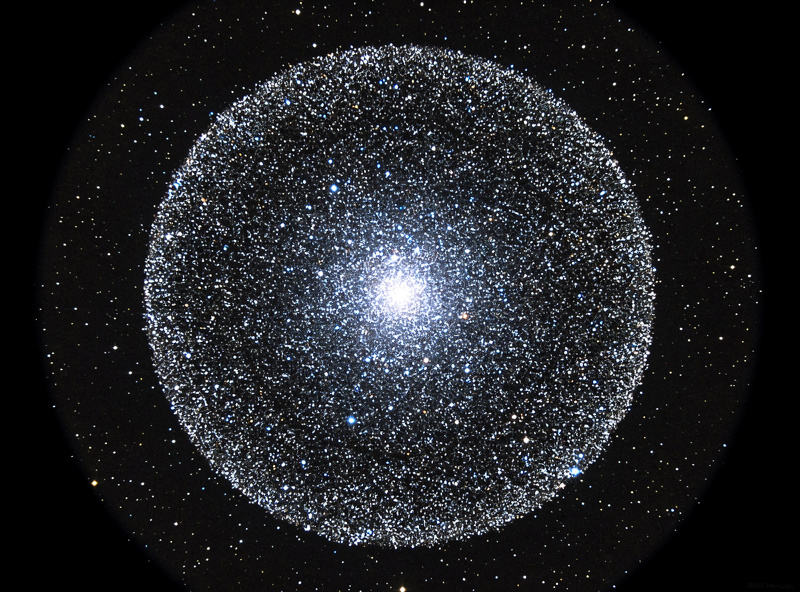
Brighter and larger than M13, M22 is the finest globular in the Sagittarius Milky Way. It sits lower in the sky for northern observers, which reduces its apparent quality through atmospheric extinction, but from southern latitudes or when M22 transits at its highest, it surpasses M13 in visual impact. M22 resolves more easily than M13 because it is slightly less concentrated. It contains about 70,000 stars and sits 10,400 light-years away — making it one of the nearest globulars.
M5 in Serpens
M5 is an excellent globular often overlooked because it sits between the more famous M13 and M22. It resolves to its core in 10-inch scopes under dark skies and shows a distinctive fan-shaped extension of stars from one edge. M5 contains approximately 100,000 stars and is 24,500 light-years away. It is well-positioned for spring and early summer observing in the constellation Serpens Caput.
M92 in Hercules
M92 sits about 9 degrees from M13 and can be observed in the same session. It is actually more compact than M13, which means it resolves more easily — the outer stars snap into focus in 8-inch scopes while M13’s equivalent resolution requires 10-inch aperture. M92 is 26,700 light-years away and contains about 330,000 stars. It is an excellent target that deserves more attention than it receives.
Omega Centauri (NGC 5139)
The largest and brightest globular cluster visible from Earth, Omega Centauri contains approximately 10 million stars and spans 36 arcminutes — larger than the full Moon. It is visible to the naked eye as a fuzzy star near the Southern Cross. Binoculars resolve it into a bright, mottled ball. A telescope at 100x begins resolving its edges, and a 12-inch resolves thousands of individual stars. Omega Centauri is accessible from latitudes south of 25 degrees north and is one of the most spectacular objects in the night sky.
47 Tucanae (NGC 104)
The second-brightest globular after Omega Centauri, 47 Tucanae is a southern hemisphere showpiece near the Small Magellanic Cloud. It is more concentrated than Omega Centauri, with a blazing core and dense outer halo. Binoculars show it as a bright fuzzy star. A 6-inch telescope begins resolving its outer edges. 47 Tucanae is accessible from latitudes south of 20 degrees north and rivals Omega Centauri for the title of finest globular in the sky.
When to Observe Star Clusters
Star clusters are visible year-round, but each season features different showpieces. Winter brings the Pleiades, Double Cluster, and M35. Spring offers M44 and several Virgo Cluster galaxies containing embedded clusters. Summer is globular cluster season — M13, M22, M5, and M92 are all well-positioned. Autumn transitions from summer globulars to the winter open clusters. Planning sessions around seasonal highlights ensures you see the best clusters at their highest altitude and clearest atmospheric perspective. The best Messier objects guide indexes the major clusters alongside the rest of the catalog by season.
Open clusters are best observed on nights with average or better seeing — they are bright enough that transparency (atmospheric clarity) matters more than perfect conditions. Globular clusters benefit from excellent seeing and transparency because resolving their stars requires sharp images. The best globular cluster nights are dry, stable, moonless nights when stars barely twinkle. The eyepiece guide compares low-power widefields (best for open clusters) and medium-power planetary eyepieces (best for resolving globulars).
Common Mistakes I Made on Cluster Nights
The first mistake was using my 6mm planetary eyepiece on the Pleiades. The cluster spans 110 arcminutes; my 6mm gave me a 0.4° field of view in the 8-inch SCT, which framed maybe 8 of the brightest stars. The Pleiades is a low-power, wide-field object — anything above 60x ruins it. I now use a 32mm Plössl or a 24mm widefield for any open cluster bigger than the full Moon, and the framing alone is what makes those targets memorable.
The second mistake was treating M13 like an open cluster. The first three sessions I observed it I sat at 50x marveling at the “fuzzy ball” without realizing the magic happens at 150-200x. Once I pushed magnification, the outer edges snapped into individual stars and the cluster transformed. Globulars need power; open clusters need width. The two cluster types are nearly opposite in optimal magnification.
The third mistake was skipping color observations. The Double Cluster shows blue-white supergiants alongside golden foreground stars, but you only see it if you spend 5+ minutes at the eyepiece letting the rod and cone cells argue. My early “tick mark” observations of the Double Cluster never registered the color because I gave each visit 90 seconds. Once I started spending 10 minutes per cluster minimum, the views started looking like the photographs.
What I Would Do Tonight
If you have a 6-8 inch scope and a clear winter night, here is the cluster session I would build. Start with M45 (Pleiades) at the lowest power you own — a 32mm Plössl or 30mm widefield — and just frame the cluster in your peripheral vision for 5 minutes. Hop to M35 in Gemini next at the same low power. Switch to a 25mm and find the Double Cluster in Perseus; spend 10 minutes at 40-50x letting the colors register. Increase to a 13-15mm wide-angle for M37, M36, and M38 in Auriga (the trio of clusters along the Auriga Milky Way). End the session on M13 in Hercules if it is up — push to 150-200x and watch the outer stars resolve. Five clusters in two hours will teach you more about cluster framing than reading every guide ever written.
Frequently Asked Questions
What is the easiest star cluster to see?
The Pleiades (M45) is the easiest star cluster — it is visible to the naked eye as a tight group of stars in Taurus during winter. Binoculars show 20 or more stars. The Double Cluster in Perseus is the second easiest, also visible to the naked eye from reasonably dark skies.
What is the difference between open and globular clusters?
Open clusters contain 50 to a few thousand young stars (10 million to 1 billion years old) spread across moderate areas in the Milky Way disk. Globular clusters contain 100,000 to millions of ancient stars (10-13 billion years old) packed into dense spheres orbiting the galactic halo. Open clusters are irregular; globulars are round.
What telescope do you need to resolve globular clusters?
An 8-inch telescope is the minimum for beginning to resolve globular clusters into individual stars. The outer edges of M13 resolve in 8-inch scopes under dark skies. A 12-inch resolves most globulars deeply, and a 16-inch resolves even the most compact globulars to their cores.
Can you see star clusters from the city?
Yes. Star clusters are the most light-pollution-resistant deep sky objects because their stars are point sources that remain visible even when skyglow washes out extended objects like nebulae and galaxies. The Pleiades, Double Cluster, M44, and M13 are all visible from suburban skies in binoculars and small telescopes.
What magnification is best for star clusters?
Open clusters are best at low magnification (20-60x) because they are extended and need a wide field to show all their stars. Globular clusters benefit from medium to high magnification (100-250x) to resolve individual stars. Start with low power to find the cluster, then increase magnification to resolve it.
What is the largest star cluster visible from Earth?
Omega Centauri (NGC 5139) is the largest globular cluster visible from Earth, spanning 36 arcminutes — larger than the full Moon. It contains approximately 10 million stars and is visible to the naked eye from the southern hemisphere. It is accessible from latitudes south of 25 degrees north.
Related Articles
Deep Sky Objects Guide — complete overview of galaxies, nebulae, and clusters.
Best Messier Objects to See — top 25 Messier objects including the finest clusters.
Best Nebulae for Amateur Telescopes — emission, reflection, and planetary nebulae.
How to See Galaxies with a Telescope — sibling deep-sky targets needing different technique.
Double Stars and Variable Stars — non-DSO targets that pair with cluster sessions.
