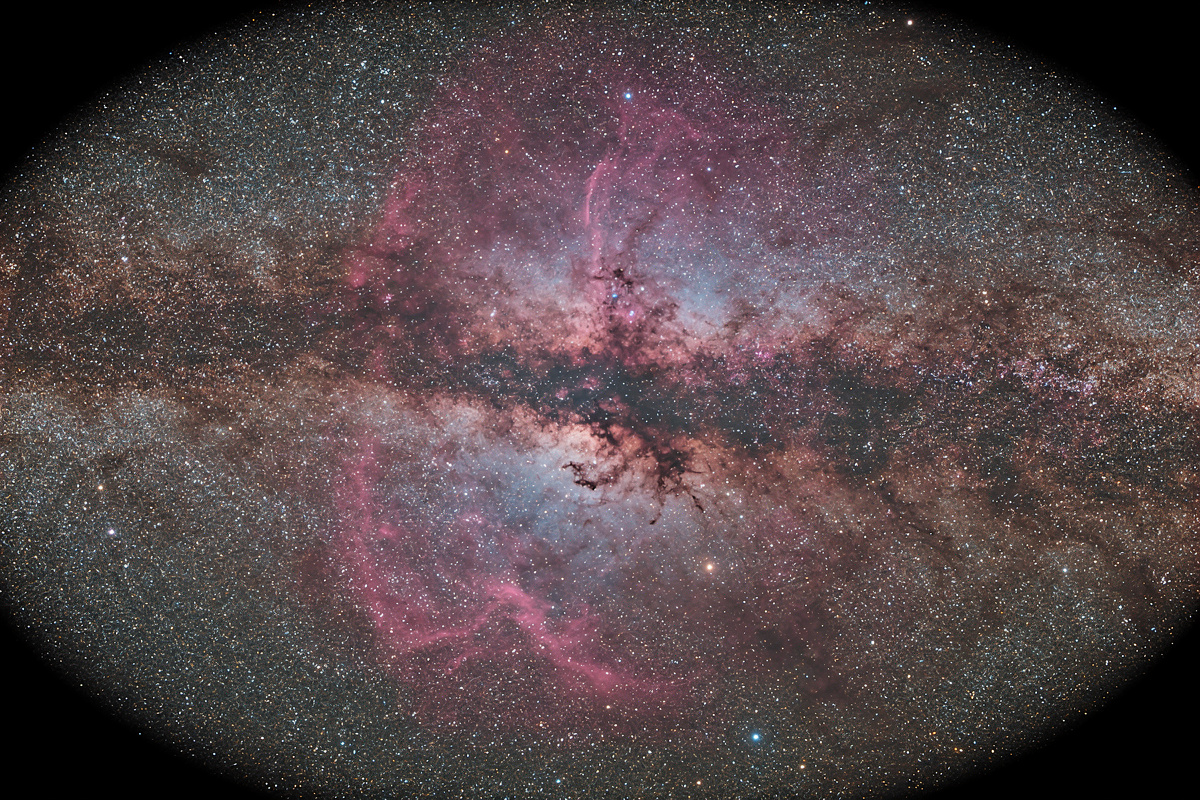

Nebulae split into three observable types — emission, reflection, and planetary — and each rewards a different combination of aperture, magnification, and filter. The Orion Nebula (M42) is bright enough that any 60mm scope shows it; the Veil supernova remnant is invisible in a 16-inch scope without an O-III filter and obvious through one. Amateur telescopes from 6 to 12 inches can observe over 30 emission, reflection, and planetary nebulae from dark sites with the right filtration.
Nebulae are clouds of interstellar gas and dust that either glow from embedded starlight or reflect the light of nearby stars. Unlike galaxies and star clusters, which consist of discrete points of light, nebulae are diffuse extended objects that spread their light across large areas of sky. This makes them uniquely sensitive to light pollution — a nebula invisible from a city backyard can become a showpiece object from a dark site 30 minutes away. Filters are the single most important accessory for nebula observation, capable of boosting contrast by 30 to 50 percent by isolating the specific wavelengths at which nebulae emit light. The cluster deep sky objects guide covers the broader category context, and the best Messier objects guide lists the bright Messier nebulae alongside the catalog’s clusters and galaxies.
Types of Nebulae You Can Observe
Nebulae divide into three observable categories: emission nebulae that glow from ionized gas, reflection nebulae that shine by scattered starlight, and planetary nebulae that are shells of gas expelled by dying stars. Each type presents different visual characteristics and responds differently to equipment and filters.
Emission nebulae glow because hot, young stars inside or nearby excite hydrogen gas, causing it to emit light at specific wavelengths — primarily hydrogen-alpha at 656nm (deep red) and doubly ionized oxygen at 500.7nm (green). The human eye is most sensitive to the oxygen line, which is why many emission nebulae appear greenish in large telescopes. UHC and O-III filters isolate these emission lines, blocking broadband light pollution and dramatically increasing contrast.
Reflection nebulae do not emit their own light — they scatter starlight off surrounding dust particles, much like fog scatters a flashlight beam. The Pleiades’ surrounding nebulosity and the area around the star Rho Ophiuchi are reflection nebulae. Because they reflect the full spectrum of starlight, narrowband filters do not help. Dark skies and aperture are the only ways to see them better.
Planetary nebulae are shells of gas expelled by dying stars in their final evolutionary stages. They are typically small (under 3 arcminutes), bright, and well-suited to high magnification. O-III filters work extremely well on planetaries because their gas emits strongly at the 500.7nm oxygen line. Planetary nebulae resist light pollution better than extended emission nebulae because their concentrated light punches through skyglow more effectively.
Best Nebulae for Small Telescopes (3 to 5 Inches)
Small telescopes reveal the brightest nebulae with surprising detail when skies are dark and magnification is appropriate. These objects do not need large aperture — they need low power, dark adaptation, and patience.
Orion Nebula (M42)
The undisputed champion of amateur astronomy. M42 in Orion is visible to the naked eye as the middle star of the sword hanging from Orion’s Belt. Binoculars resolve it into a fuzzy patch. Any telescope reveals the glowing cloud, and at 40-80x the central Trapezium cluster of four stars becomes distinct. M42 spans 85 by 60 arcminutes — larger than the full Moon — so low magnification with a wide-field eyepiece frames it best. From dark skies, faint extensions of the nebula reach across several degrees of sky. The companion nebula M43, separated from M42 by a dark lane, is visible in any telescope. M42 is also the only nebula I have ever observed that genuinely shows a tinge of green color in my 8-inch SCT — every other emission nebula stays gray for human eyes regardless of aperture.
Dumbbell Nebula (M27)
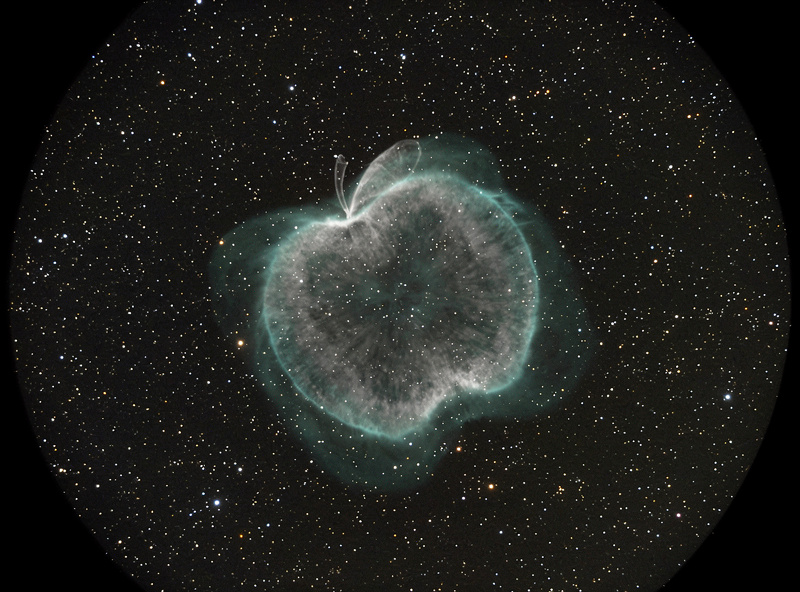
The second-brightest planetary nebula in the sky, M27 in Vulpecula is large enough to show its distinctive apple-core shape at 40-80x in a 3-inch refractor. M27 sits between Albireo in Cygnus and the head of Delphinus — a straight star-hop from Epsilon Vulpeculae. At 100x in a 5-inch scope, the dumbbell structure is obvious and subtle texture appears within the nebulosity. M27 is one of the few nebulae where a UHC filter helps even in small scopes.
Ring Nebula (M57)
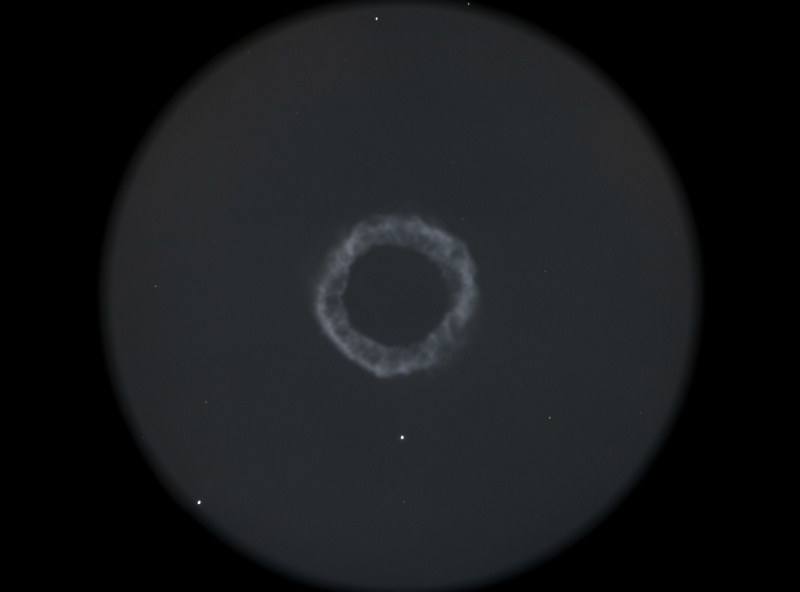
A small, bright planetary in Lyra that appears as a gray smoke ring at 100-150x. M57 sits between the two bottom stars of the Lyra parallelogram — virtually impossible to miss. A 4-inch telescope at 150x shows the ring clearly, and a 5-inch at 200x reveals subtle variations in brightness around the ring’s edge. The central star requires 8-inch or larger aperture and excellent seeing conditions.
Best Nebulae for Medium Telescopes (6 to 10 Inches)
Medium telescopes open the door to dozens of nebulae that small scopes cannot show. The additional aperture gathers enough light to reveal structure in extended objects and enables meaningful filtration with UHC and O-III filters.
Lagoon Nebula (M8)
M8 in Sagittarius is the largest and brightest emission nebula accessible from northern latitudes. Visible in binoculars as a bright haze with a dark lane bisecting it, M8 resolves into a glowing cloud with embedded star cluster NGC 6530 in a 6-inch telescope. The famous hourglass structure near the cluster’s brightest star requires 8-inch aperture and a UHC filter. M8 is one of only two Messier nebulae (with M42) that show actual color — a reddish-pink tint — in 12-inch and larger telescopes from very dark sites. The star clusters guide covers NGC 6530 and the other open clusters embedded in the summer Milky Way.
Eagle Nebula (M16)
The Eagle Nebula in Serpens contains the star cluster NGC 6611 surrounded by emission nebulosity. The famous Pillars of Creation — imaged by the Hubble Space Telescope — are a photographic target; visually, the cluster is easy to see and the surrounding nebula responds well to a UHC filter in 8-inch scopes. The pillars themselves are extremely difficult visually and require 12-inch or larger aperture, excellent transparency, and an O-III filter from a dark site.
North America Nebula (NGC 7000)
Named for its shape resembling the North American continent, NGC 7000 in Cygnus is an emission nebula spanning 120 by 100 arcminutes — larger than four full Moons. The nebula’s size means a telescope can actually show only a portion at a time. NGC 7000 is best observed with a UHC filter and wide-field eyepiece from a dark site. In 8-inch scopes, the Gulf of Mexico region (a dark lane separating the nebula’s two brightest sections) is visible. NGC 7000 is a naked-eye object from truly dark sites — look for a bright, diffuse patch about 3 degrees east of Deneb.
Trifid Nebula (M20)
M20 sits just 1.5 degrees north of M8 and can be observed in the same session. The Trifid combines emission (red), reflection (blue), and dark nebula components in one field. The three-lobed dark lanes that give the nebula its name require 8-inch aperture and a UHC filter to see visually. M20 is smaller and fainter than M8 but more structurally complex.
Swan Nebula (M17)
M17 in Sagittarius earns its name from the swan shape visible at low magnification in 6-inch and larger telescopes. The swan’s neck curves through a dark lane and its body glows brightly with embedded star clusters. A UHC filter enhances the nebulosity significantly. M17 is bright enough to show detail from moderately light-polluted sites where other nebulae wash out.
Best Nebulae for Large Telescopes (12+ Inches)
Large aperture reveals nebulae that smaller scopes simply cannot detect. Objects that appear as faint smudges in 8-inch scopes become structured, textured displays in 12-inch and larger instruments. This is where the deepest and most challenging objects reward patient observers.
Helix Nebula (NGC 7293)
The Helix in Aquarius is the closest planetary nebula to Earth at 655 light-years and one of the largest in apparent size — 16 arcminutes, over half the Moon’s diameter. Paradoxically, its enormous size means very low surface brightness. The Helix requires a 12-inch telescope, an O-III filter, and dark skies to see well. From a Bortle 4 site, 12-inch scopes show the ring structure and the dark central hole. The Helix is a challenging but deeply satisfying catch.
Crescent Nebula (NGC 6888)
NGC 6888 in Cygnus is a shell of gas blown by the massive Wolf-Rayet star WR 136. The crescent shape requires 10-inch or larger aperture and an O-III filter. From dark skies with a 14-inch scope, the crescent’s walls become distinct and subtle surface texture appears. The Crescent is a favorite among experienced deep sky observers because it is genuinely difficult — many observers with 8-inch scopes fail to see it without a filter.
Veil Nebula Complex (NGC 6960/6992)
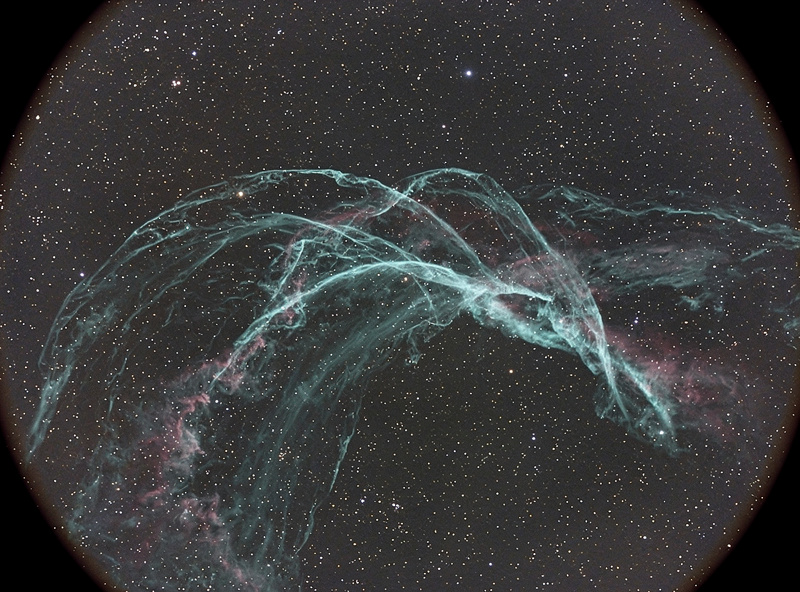
The Veil is a supernova remnant in Cygnus — the expanding shell of a star that exploded approximately 8,000 years ago. The Western Veil (NGC 6960, the Witch’s Broom) and Eastern Veil (NGC 6992) are the brightest sections, each spanning about 1 degree. An O-III filter transforms the Veil from invisible to spectacular — without a filter, even 16-inch scopes struggle. With an O-III filter, 8-inch scopes show both sections as glowing arcs of filamentary structure. The Veil is the single most filter-dependent object in amateur astronomy. The first time I screwed an Orion Ultrablock O-III into my 8-inch SCT and pointed it at NGC 6992, the eastern arc snapped into view like a switch had flipped — there is no other object where adding a $90 piece of glass produces that magnitude of difference.
Rosette Nebula (NGC 2237)
The Rosette in Monoceros is a massive emission nebula surrounding the open cluster NGC 2244. The nebula spans 80 arcminutes and requires a UHC filter, 8-inch or larger telescope, and dark skies. The rose-petal structure of the nebulosity is visible in 12-inch scopes from Bortle 4 sites. The central cluster provides a striking contrast of bright stars against glowing gas.
Filters for Nebula Observation
Filters are the most cost-effective upgrade for nebula observing. A $60 filter can reveal objects invisible without it, making the impact per dollar far higher than any eyepiece or telescope upgrade. The full filters guide compares broadband, UHC, O-III, and H-alpha filters with specific use cases.
| Filter Type | What It Passes | Best For | Does Not Help |
|---|---|---|---|
| Broadband (Light Pollution) | Most visible wavelengths, blocks mercury/sodium lines | Galaxies, general contrast improvement | Faint nebulae, heavy light pollution |
| UHC (Ultra High Contrast) | H-beta (486nm) + O-III (500.7nm) only | Emission nebulae, planetary nebulae | Galaxies, star clusters, reflection nebulae |
| O-III (Oxygen-III) | O-III (500.7nm) only — very narrow band | Planetary nebulae, supernova remnants, strongest emission nebulae | Galaxies, star clusters, reflection nebulae, most emission nebulae |
| H-alpha | H-alpha (656nm) only | Photography only — eye insensitive at this wavelength | All visual observation |
The UHC filter is the first filter every nebula observer should buy. It passes the two strongest emission lines of nebulae — hydrogen-beta and oxygen-III — while blocking mercury and sodium streetlight wavelengths. From a Bortle 7 suburban sky, a UHC filter on the Lagoon Nebula (M8) transforms a faint haze into a structured cloud with visible dark lanes. The O-III filter is more aggressive, passing only the oxygen-III line, and works best on planetary nebulae and supernova remnants like the Veil Nebula. My own filter set is a Lumicon UHC and an Orion Ultrablock O-III, and the two cover essentially every nebula worth chasing in 8-10 inch scopes.
Observing Techniques for Faint Nebulae
Seeing faint nebulae requires combining dark adaptation, averted vision, and appropriate magnification. Dark adaptation takes 20 to 30 minutes — your eyes build up rhodopsin, a photosensitive chemical that enables low-light vision. Looking at a phone screen or white flashlight resets this adaptation. Use only red light for star charts and equipment adjustments.
Averted vision — looking slightly to the side of a faint nebula rather than directly at it — places the image on the rod-rich peripheral retina, which is far more sensitive to faint light than the cone-packed fovea. This technique alone can reveal nebulae that are invisible with direct vision. For the faintest targets, look 1 to 2 degrees to the side and let the object drift through your peripheral vision. The galaxy observing guide covers averted vision in more depth alongside the surface-brightness math.
Magnification matters for nebulae more than most observers realize. While the instinct is to use low power for extended objects, moderate magnification (80-150x) often shows more detail because it darkens the background sky relative to the nebula — the nebula’s surface brightness stays constant, but skyglow is spread over more eyepiece area, increasing contrast. Experiment with different magnifications on every nebula you observe.
Common Mistakes I Made on Nebula Nights
The first mistake was buying an O-III filter before a UHC. The O-III is more dramatic on the Veil and on planetary nebulae, but it shows nothing on M42, M8, or about half the emission nebulae most beginners want to chase. The UHC is the broader, more useful first filter; the O-III earns its slot only after the UHC has been used for a few months. I rotated this in the wrong order and lost six months of nebula sessions assuming the filter was “not working” when the wavelength simply was not what I needed for the targets I was on.
The second mistake was treating reflection nebulae like emission nebulae. The Pleiades’ surrounding nebulosity and the bright stars near M78 do not respond to UHC or O-III at all — they reflect a broadband spectrum and a narrowband filter just dims everything. I screwed the UHC into the eyepiece on the Pleiades for about 3 minutes before the lesson sank in: filter type has to match nebula type.
The third mistake was running the Veil at 50x without first trying 100-120x. Faint extended nebulae often look better at moderate magnification because the dark sky between filaments fills more of the field, raising perceived contrast. I now sweep through three eyepiece focal lengths on every faint nebula before deciding which view is the keeper.
What I Would Do Tonight
If you have a 6-8 inch scope, a UHC filter, and a moonless winter night, here is the session I would build. Start at M42 with a 25-32 mm eyepiece and no filter — the Trapezium and central wings need no help. Switch to M1 in Taurus next, screw in the UHC, and watch the Crab brighten by perhaps a magnitude. Move to NGC 2244 (the cluster at the heart of the Rosette) and try the UHC at 60x — the Rosette structure is faint but visible from Bortle 4 sites. Hop to the Eagle Nebula M16 if it is up. End on M27 in Vulpecula or M57 in Lyra at 150-200x with the UHC for the planetary nebulae. Sketch each one in a 4-inch field circle. Six nebulae in two hours is a richer Messier-list session than any 30-object speed run.
Frequently Asked Questions
What is the best nebula to see with a small telescope?
The Orion Nebula (M42) is the best nebula for any telescope size. It is visible to the naked eye, resolves into a glowing cloud with a central star cluster in a 3-inch telescope at 40x, and shows increasing detail with aperture. M42 requires no filter to see well.
Do you need a filter to see nebulae?
Not for the brightest nebulae like M42, M8, and M27 — these are visible without filters from suburban skies. However, a UHC or O-III filter increases contrast by 30 to 50 percent and reveals nebulae that are completely invisible without a filter. A UHC filter is the single most impactful upgrade for nebula observers.
What magnification is best for nebulae?
Most nebulae are best at 40-150x magnification. Extended nebulae like M42 and M8 benefit from low power (40-80x) to show their full extent. Planetary nebulae like M57 and M27 benefit from higher power (150-250x) to reveal structure. Moderate magnification often shows more detail than low power because it darkens the background sky.
Can you photograph nebulae with a regular camera?
Yes. The Orion Nebula, North America Nebula, and Lagoon Nebula are bright enough to photograph with a DSLR camera on a tripod using 10-30 second exposures at ISO 1600-3200. A star tracker mount enabling 60-120 second exposures dramatically improves results. Narrowband filters for cameras isolate nebula emission and reduce light pollution.
What is the difference between a UHC and O-III filter?
A UHC filter passes two emission lines — hydrogen-beta and oxygen-III — and works on most emission and planetary nebulae. An O-III filter passes only the oxygen-III line and is more aggressive, producing higher contrast on planetary nebulae and supernova remnants but showing nothing on some emission nebulae. Buy a UHC first, then add O-III later.
Why can I not see nebulae from the city?
Nebulae are diffuse, extended objects whose faint light is overwhelmed by skyglow from city lights. Unlike stars and planets that concentrate their light into points, nebulae spread their light across large areas, making them extremely vulnerable to light pollution. Driving 30-60 minutes to a Bortle 4 dark site has more impact than any equipment upgrade.
Related Articles
Deep Sky Objects: The Complete Amateur Astronomer Guide — overview of all deep sky object types and equipment.
Best Messier Objects to See — the top 25 Messier objects ranked by visual impact.
Best Star Clusters to Observe — open and globular clusters by season.
How to See Galaxies with a Telescope — surface brightness and aperture techniques.
Double Stars and Variable Stars — sibling deep-sky targets beyond nebulae.
