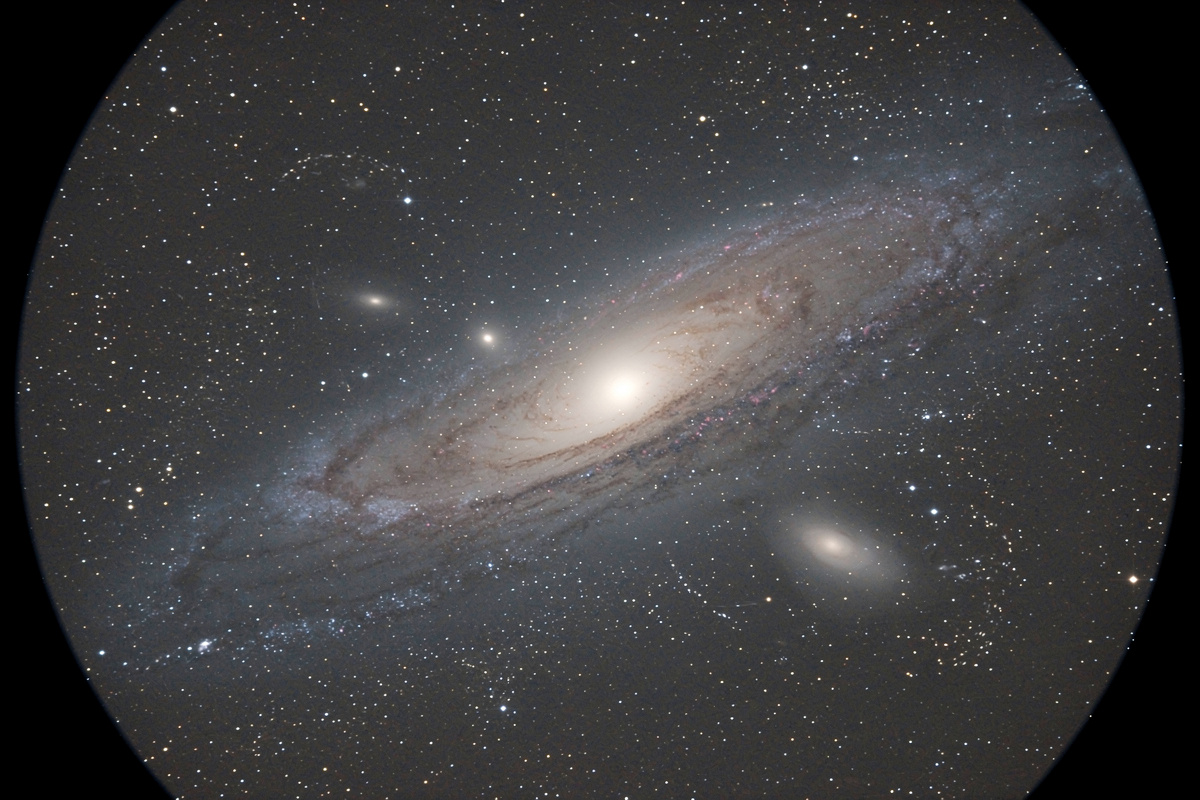

You can see galaxies with a telescope as small as 4 inches, but an 8-inch or larger aperture from a dark site reveals spiral arms, dust lanes, and companion galaxies. The Andromeda Galaxy (M31) is visible to the naked eye, while the 50+ galaxies in the Virgo Cluster require 10-inch telescopes and Bortle 4 skies to observe efficiently.
Galaxies are the most challenging deep sky objects because their light is faint, diffuse, and spread across vast areas of sky. Unlike nebulae and star clusters, which are relatively close and bright, galaxies are entire star systems millions to hundreds of millions of light-years away. The key to seeing galaxies is not expensive equipment — it is dark sky location, proper technique, and patience. A $350 8-inch Dobsonian from a Bortle 4 dark site will show more galaxy detail than a $2,000 refractor from a city backyard. I have run this exact A/B with a friend’s 4-inch APO from his Bortle 8 driveway versus my own 8-inch Dob from a Bortle 4 site 45 minutes away, and on M51 the dark-site Dob showed clear spiral arms while the city APO showed a vague oval smudge. The cluster deep sky objects guide covers the broader category context, and the nebulae and star clusters spokes go deeper on the cousin object types.
What Determines What You Can See in a Galaxy
Three factors control galaxy visibility: apparent magnitude (total brightness), surface brightness (brightness per unit area), and angular size (how large the galaxy appears). Apparent magnitude alone is misleading — M33 in Triangulum has a magnitude of 5.7, theoretically naked-eye visible, but its light spreads across 70 arcminutes, giving it such low surface brightness that many observers with 8-inch scopes struggle to see it. Conversely, M87 in Virgo has a magnitude of 8.6 but concentrates its light into a 7-arcminute disk with a bright core, making it easy in 6-inch scopes.
Surface brightness is the critical factor for galaxies. A galaxy’s surface brightness depends on its total magnitude divided by its area. Galaxies with bright nuclei, small angular size, or high concentration show first. Large, face-on galaxies with uniform surface brightness are the hardest — their light is spread so thin that only dark skies and large aperture can detect them. Understanding surface brightness explains why the Sombrero Galaxy (M104) is easier to see than the Triangulum Galaxy (M33) despite M33 being 3 magnitudes brighter.
Best Galaxies for Beginners
Andromeda Galaxy (M31)
The most distant object visible to the naked eye at 2.5 million light-years, M31 is the starting point for every galaxy observer. It is visible as a fuzzy patch from any location with reasonably dark skies. Binoculars show an elongated glow. A 4-inch telescope at low power reveals the bright core and elongated disk. A 10-inch scope from a dark site shows dust lanes along the southern edge and two companion galaxies — M32 and M110. M31 spans 3 degrees of sky, six times the full Moon’s diameter, so use the widest-field eyepiece you own.
Triangulum Galaxy (M33)
M33 is the third-largest galaxy in the Local Group after M31 and the Milky Way. Its low surface brightness makes it a challenge despite its magnitude of 5.7. From a Bortle 4 site with a 10-inch telescope, M33 shows a diffuse glow with a brighter core. Dark lanes and spiral arm structure require 14-inch or larger aperture and exceptional transparency. M33 is best observed near the meridian when it is highest and the atmosphere is thinnest.
Whirlpool Galaxy (M51)
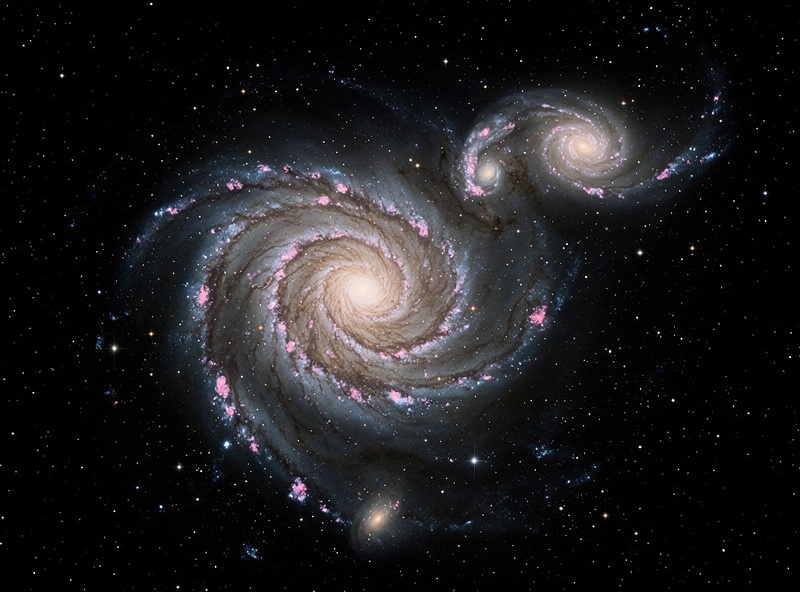
The first galaxy whose spiral structure was recognized. M51 in Canes Venatici shows spiral arms in 10-inch and larger telescopes under dark skies — the arms appear as curved extensions from a bright nucleus. The companion galaxy NGC 5195 sits at the end of one arm and is visible in 8-inch scopes. M51 is a spring object, best observed in April and May when it transits near midnight.
Best Galaxies for Intermediate Observers (8 to 12 Inches)
Leo Triplet (M65, M66, NGC 3628)
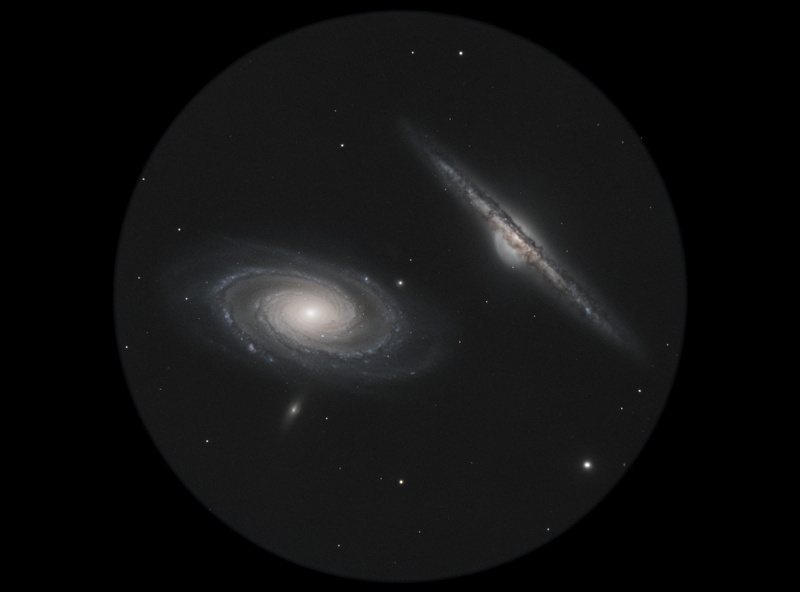
Three galaxies in a single low-power field in Leo. M65 and M66 show bright nuclei and elongated disks in 8-inch scopes. NGC 3628 is the edge-on member — a faint, elongated streak with a prominent dust lane visible in 10-inch and larger telescopes. The Leo Triplet is a spring target, best in March and April.
Sombrero Galaxy (M104)
An edge-on galaxy in Virgo with a prominent dust lane visible in 8-inch scopes and a bright nucleus that punches through moderate light pollution. The Sombrero’s hat-brim shape is distinctive at 100-150x. It sits just south of the Virgo Cluster and is best observed in spring.
M81 and M82 — Bode’s Galaxy and the Cigar
Two galaxies in Ursa Major visible in the same low-power field. M81 is a grand-design spiral showing a bright core and oval disk in 8-inch scopes. M82 is an irregular starburst galaxy with a distinctive cigar shape and dark lanes visible in 10-inch scopes. The pair is one of the most satisfying galaxy observations because both objects are bright enough to show detail and their contrasting shapes make a dramatic pair.
Centaurus A (NGC 5128)
A peculiar galaxy with a dramatic dark dust lane bisecting its bright elliptical core. Centaurus A is visible from latitudes south of 30 degrees north and shows its dust lane in 8-inch scopes from dark sites. It is one of the nearest radio galaxies at 12 million light-years and a favorite among southern hemisphere observers.
Galaxy Hunting in the Virgo Cluster
The Virgo Cluster is the nearest large galaxy cluster to Earth, centered between the constellations Leo and Virgo. It contains over 2,000 galaxies, of which about 30 are bright enough to observe in amateur telescopes. During spring evenings, the Virgo Cluster transits near midnight and offers the highest galaxy density in the northern sky — experienced observers with 16-inch scopes can see 50 or more galaxies per hour.
The Virgo Cluster’s core sits in a triangle formed by the stars Denebola (Beta Leonis), Vindemiatrix (Epsilon Virginis), and the star 6 Comae Berenices. A low-power eyepiece in this region reveals multiple galaxies per field. Start with the bright pair M84 and M86 — two elliptical galaxies visible in 4-inch scopes — and star-hop outward to progressively fainter members. Markarian’s Chain, a curved line of 7-8 galaxies, is a showpiece target for 8-inch and larger telescopes. The best Messier objects guide indexes the brightest galaxies of the catalog by season.
Observing Techniques for Galaxies
Galaxies demand dark adaptation more than any other deep sky object type. Your eyes require 20 to 30 minutes of darkness to fully build up rhodopsin. During this time, avoid all white light — use only a dim red flashlight or red headlamp. Looking at a phone screen for even a few seconds resets the adaptation timer.
Averted vision is essential for faint galaxies. Look 1 to 2 degrees to the side of a galaxy and let it drift through your peripheral vision. The rod cells in your peripheral retina are far more sensitive to faint light than the cone cells in the fovea. Many galaxies that are invisible with direct vision become detectable with averted vision.
Magnification affects galaxy observation in counterintuitive ways. Low power (30-60x) frames large galaxies and helps find objects. But moderate magnification (100-150x) often shows more detail because it darkens the background sky relative to the galaxy — the galaxy’s surface brightness stays constant, but skyglow spreads over more eyepiece area, increasing contrast. For small galaxies with bright nuclei, high magnification (200-300x) reveals core structure and companion galaxies. The double and variable stars guide covers the high-magnification stellar targets that pair perfectly with galaxy sessions when atmospheric seeing cooperates.
Equipment for Galaxy Observing
Galaxy observing prioritizes aperture, dark skies, and dark adaptation over any other factor. The best telescope for galaxies is the largest aperture you can transport to a dark site — an 8-inch Dobsonian is the practical minimum, and 12-inch to 16-inch instruments transform galaxy observing from challenging to rewarding.
Eyepieces for galaxies should include a quality low-power option (30-40mm focal length, 68-82 degree apparent field) for finding and framing, plus a medium-power eyepiece (12-18mm) for detailed observation. Filters do not help on galaxies because galaxies emit the full spectrum of starlight — narrowband filters that boost nebula contrast actually reduce galaxy visibility by blocking most of their light. The eyepiece guide compares specific options at each focal length for galaxy work.
Dark sky location is the single most important factor for galaxy observing. From a Bortle 7 suburban sky, an 8-inch telescope shows about 30-40 galaxies as faint smudges. From a Bortle 4 dark site, the same scope shows 100+ galaxies with visible structure. The difference between suburban and dark-site galaxy observing is not subtle — it is transformative. The dark sky locations guide lists the best accessible Bortle 1-3 sites in the US.
Common Mistakes I Made on Galaxy Nights
The first mistake was observing galaxies before my eyes were properly dark-adapted. I would set up the scope, find M31 within 5 minutes, and wonder why the dust lanes I had read about were not visible. They never appeared in those rushed sessions — and they appeared every time once I disciplined myself to spend 25 minutes in true darkness before swinging to the first galaxy. Dark adaptation is not optional for galaxies; it is half the equipment.
The second mistake was using a UHC filter on M81 hoping it would “boost contrast.” Filters that work on emission nebulae actively dim galaxies because galaxies emit broadband starlight, not narrow emission lines. M81 through a UHC was a dimmer M81. I unscrewed the filter and never tried that experiment again.
The third mistake was treating M33 like M31. M31 has a bright core and high surface brightness in its inner regions; M33 is huge and uniformly diffuse. The first time I tried to find M33 from a Bortle 6 site I scanned for 30 minutes through a 13mm eyepiece and saw nothing. Dropping to a 32mm Plössl at 38x and applying averted vision finally produced a faint, diffuse glow exactly where the chart said it should be. M33 needs the lowest power you own; high magnification spreads its already-thin light too thin to detect.
What I Would Do Tonight
If you have an 8-inch scope, a Bortle 4 site, and a clear spring night, here is the galaxy session I would build. Dark-adapt for a full 25 minutes — phone in pocket, red headlamp only. Start at M81 and M82 in Ursa Major at 80x; both fit in one field. Hop to the Leo Triplet at the same magnification — M65, M66, and edge-on NGC 3628 in one low-power view. Cross to the Virgo Cluster and find M84/M86 as your anchors; trace Markarian’s Chain at 100x. End on M104 in Virgo at 150x for the dust-lane payoff. Five galaxy fields, ten distinct galaxies, two hours of dark-adapted vision. That is the spring routine that justified upgrading from a 6-inch to an 8-inch in the first place.
Frequently Asked Questions
What size telescope do you need to see galaxies?
A 4-inch telescope shows the brightest galaxies — M31, M81, M82 — as faint smudges from dark sites. An 8-inch telescope is the practical minimum for serious galaxy observing, showing 30-100 galaxies depending on sky darkness. A 12-inch telescope reveals spiral structure in the brighter galaxies.
Can you see galaxies from the city?
Only the very brightest. From a Bortle 7 suburban sky, an 8-inch telescope shows M31, M81, M82, and M104 as faint smudges. Most galaxies require Bortle 4 or darker skies to show any detail. Driving 30-60 minutes to a dark site has more impact than any equipment upgrade for galaxy observing.
What is the best galaxy to see with a telescope?
The Andromeda Galaxy (M31) is the easiest galaxy to find and observe — it is visible to the naked eye, shows a bright core and elongated disk in any telescope, and reveals dust lanes and companion galaxies in 8-inch and larger scopes. M81 and M82 in Ursa Major are the second-best pair.
Do you need a filter for galaxies?
No. Filters do not help on galaxies because they emit the full spectrum of starlight. Narrowband UHC and O-III filters that boost nebula contrast actually reduce galaxy visibility by blocking most of their light. The best galaxy filter is a dark sky — no optical filter can replace a Bortle 4 site.
What magnification is best for galaxies?
Most galaxies are best observed at 80-150x magnification. Low power (30-60x) frames large galaxies like M31 and helps find objects. Moderate power (100-150x) shows more detail by darkening the background sky. High power (200-300x) reveals core structure in compact galaxies like M87 and M64.
How many galaxies can you see in one night?
From a Bortle 4 dark site during spring, an experienced observer with a 12-inch telescope can see 50-100 galaxies in one session. The Virgo Cluster alone contains over 30 galaxies visible in 8-inch scopes. A 16-inch scope from a Bortle 3 site can log 200+ galaxies in a single spring night.
Related Articles
Deep Sky Objects Guide — complete overview of all deep sky object types.
Best Messier Objects to See — top 25 Messier objects including the brightest galaxies.
Best Nebulae for Amateur Telescopes — sibling spoke covering nebulae across all apertures.
Best Star Clusters to Observe — open and globular cluster targets.
Double Stars and Variable Stars — non-DSO targets that pair with galaxy nights.
