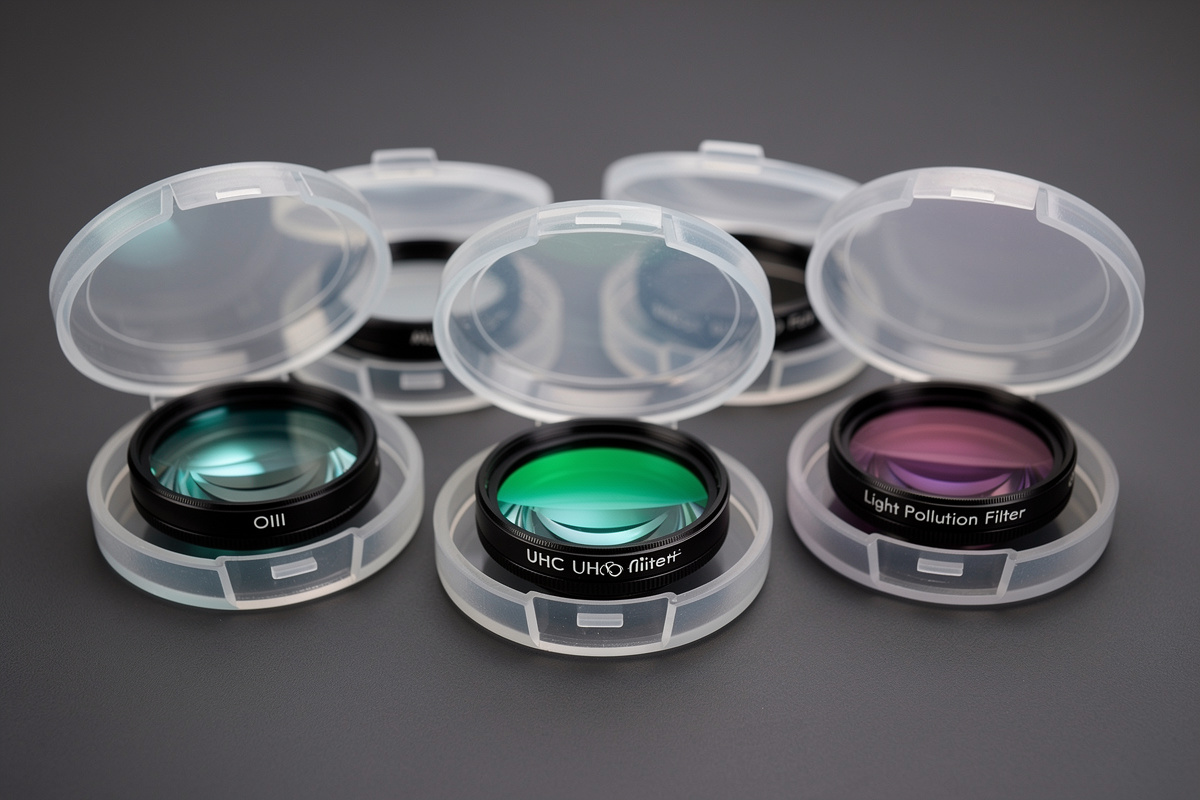

Telescope filters improve contrast on specific celestial objects by selectively transmitting or blocking wavelengths of light. A UHC filter increases nebula visibility by 30 to 50 percent under suburban skies, while broadband light pollution filters recover color on galaxies and star clusters. Every serious observer needs at least one filter.
Filters screw directly onto the barrel of standard 1.25-inch or 2-inch eyepieces and work with every telescope design — refractors, reflectors, and compound scopes all benefit equally. The key is matching the filter type to your targets and sky conditions. A filter that transforms the Veil Nebula from invisible to spectacular will do nothing for a globular cluster.
Light Pollution Filters: Broadband vs Narrowband
Light pollution filters split into two categories based on bandpass width. Broadband filters block 30 to 40 percent of artificial light while passing 85 percent of nebula emission lines. Narrowband filters block over 90 percent of artificial light but pass only the specific hydrogen and oxygen wavelengths emitted by nebulae. Choose broadband for versatility and narrowband for maximum nebula contrast.
Broadband filters (also called sky-glow, CLS, or LPS filters) work by blocking the primary mercury and sodium emission lines used in streetlights — specifically the 546nm mercury line and 589nm sodium doublet. They pass most other wavelengths, which means galaxies, star clusters, and stars appear nearly as bright as without a filter, but the background sky darkens noticeably. The improvement is subtle but consistent across all object types.
Popular broadband options include the Orion SkyGlow ($40 to $55), Astronomik CLS ($65 to $85), and Optolong L-Pro ($70 to $100). The Astronomik CLS is the most recommended broadband filter because it provides a good balance between sky darkening and light transmission. The Optolong L-Pro uses a newer multi-bandpass design that passes more light while still blocking common light pollution wavelengths, making it a better choice for observers who also do astrophotography.
Narrowband UHC and OIII filters provide the most dramatic improvement on emission nebulae but darken everything else — including stars, galaxies, and reflection nebulae. They are specialized tools for specific targets, not general-purpose filters. Buy a broadband filter first if you observe a mix of objects; buy a UHC first if nebulae are your primary target.
UHC Filters: The Best Single Filter for Nebulae
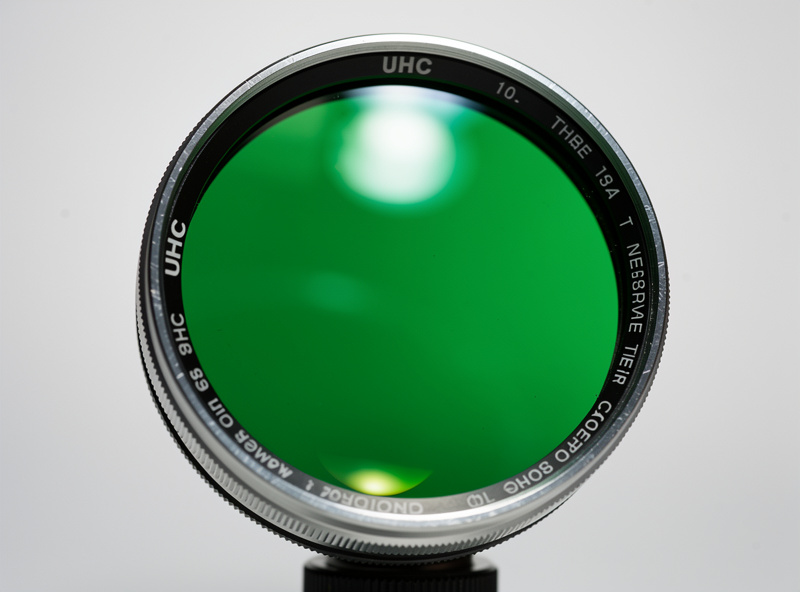
A UHC (Ultra High Contrast) filter passes hydrogen-alpha at 656nm and both oxygen-III lines at 496nm and 501nm with a bandpass of 25 to 30 nanometers. This lets through the light emitted by ionized hydrogen and oxygen in emission nebulae while blocking nearly everything else. Under suburban Bortle 6 to 7 skies, a UHC filter reveals nebulae that are completely invisible without filtration.
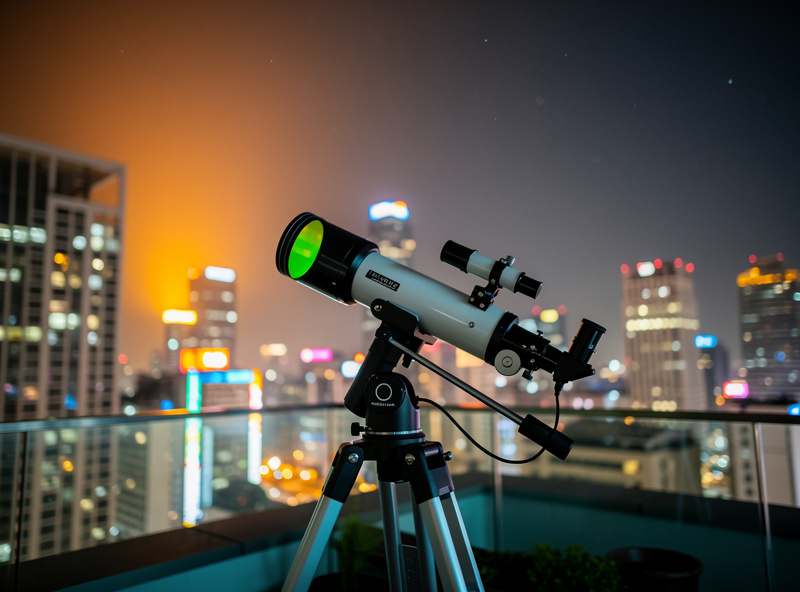
The UHC is the first filter every nebula observer should buy. It improves the following common targets: the Orion Nebula (M42) shows extended wings and filamentary structure; the Lagoon Nebula (M8) becomes visible from suburban locations where it was previously undetectable; the Swan Nebula (M17) reveals its distinctive shape; and dozens of smaller emission nebulae in the Milky Way become detectable where without a filter only a faint smudge or nothing appears.
Recommended UHC filters include the Astronomik UHC ($75 to $95), Baader UHC-S ($60 to $80), and Optolong UHC ($50 to $70). The Astronomik UHC has the tightest bandpass and highest transmission at the hydrogen-alpha and oxygen-III lines, making it the most effective filter for observers in heavily light-polluted areas. The Baader UHC-S provides nearly identical performance at a lower price and is the most popular UHC filter in amateur astronomy.
A UHC filter does not help with galaxies because galaxies emit broadband light across the entire visible spectrum — the filter blocks galaxy light along with the light pollution. For galaxies, use a broadband filter or no filter at all.
OIII Filters: Maximum Contrast on Specific Nebulae
An OIII filter passes only the two oxygen-III emission lines at 496nm and 501nm with an extremely narrow bandpass of 10 to 12 nanometers. This produces a higher contrast view than UHC on objects that emit strongly in OIII, but it dims stars significantly and makes star-hopping more difficult.
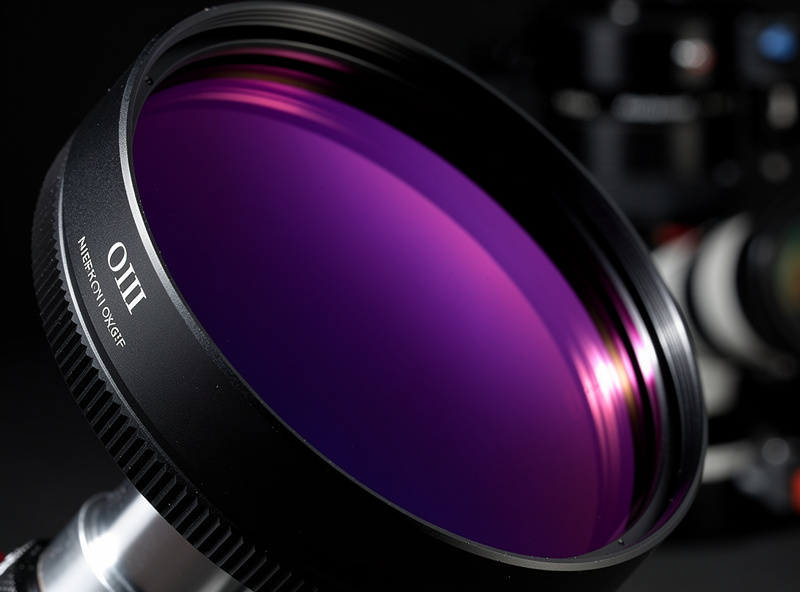
The OIII filter excels on the Veil Nebula (NGC 6960 and NGC 6992), where it transforms a faint wisp into a dramatic filament spanning half a degree of sky. Other standout targets include the Helix Nebula, the Dumbbell Nebula (M27), and the Ring Nebula (M57) — all of which show significantly more structure and contrast through an OIII than through a UHC.
The Astronomik OIII ($80 to $100) and Baader OIII ($70 to $90) are the top choices. Both provide sharp bandpass edges that eliminate any light leakage from nearby wavelengths. Budget OIII filters from Optolong ($50 to $65) perform well for visual use but may show slightly more internal reflections on bright stars.
The practical recommendation is to buy a UHC first, use it for six months to explore the emission nebulae visible from your location, then add an OIII for targets that respond specifically to oxygen-III emission. The two filters are complementary — they do not replace each other.
Planetary Filters: Color Enhancement for Solar System Targets
Planetary filters are colored glass filters that increase contrast on specific planetary features by emphasizing or suppressing certain colors. They cost $10 to $25 each and produce immediately visible improvements on Jupiter, Saturn, and Mars when seeing conditions are average or better.
The most useful planetary filters by target are: #80A light blue for Jupiter’s belts and Saturn’s ring detail (passes blue and green, suppresses red); #58 green for Jupiter’s Great Red Spot and Saturn’s atmospheric bands (emphasizes red-orange features against green background); #21 orange for Mars surface features during opposition (enhances surface contrast against atmospheric haze); #25 red for Venus cloud detail and lunar mineralogy (high contrast but dark image); and #47 violet for Venus atmospheric features.
A planetary filter set containing #80A, #58, #21, #25, and #47 costs $40 to $75 from brands like Celestron, Baader, or Orion. Individual filters from Baader ($15 to $22 each) offer the highest optical quality with anti-reflection coatings that reduce ghosting on bright planets. Budget sets from Celestron ($10 to $15 each) work adequately but may show more internal reflections.
Use planetary filters at medium to high magnification (150x to 300x). At low magnification, planets are too small for color filters to provide meaningful contrast enhancement. The filter darkens the image, so you need sufficient aperture to maintain a bright enough view — a 6-inch or larger telescope benefits most from planetary filters.
Moon Filters: Reducing Glare for Comfortable Lunar Observing
The Moon is bright enough at quarter phase and beyond to cause eye discomfort and destroy dark adaptation without a neutral density filter. A moon filter reduces transmission by 13 to 25 percent (ND 0.9 to ND 1.8) and makes extended lunar observing comfortable without affecting color balance.
A standard 13 percent transmission moon filter (ND 0.9) is sufficient for most telescopes up to 10 inches of aperture. It reduces the Moon’s brightness to a comfortable level while preserving the subtle color differences in lunar mare and highland regions. Polarizing moon filters ($15 to $25) allow variable transmission from 1 to 40 percent by rotating the filter, which is useful for matching brightness to your telescope’s aperture and current phase.
Moon filters cost $8 to $15 for fixed-density versions and $15 to $25 for variable polarizing versions. Every telescope owner should have at least one — there is no reason to suffer through a blindingly bright lunar view when an $8 filter solves the problem completely.
Filter Comparison Table
| Filter Type | Bandpass | Best Targets | Price Range | Priority |
|---|---|---|---|---|
| Broadband (LPS/CLS) | Multi-bandpass | All objects, suburban sky | $40-$100 | First filter for mixed observing |
| UHC | 25-30nm | Emission nebulae | $50-$95 | First filter for nebula observers |
| OIII | 10-12nm | Veil, Helix, Ring nebulae | $50-$100 | Second filter, after UHC |
| H-Beta | 8-12nm | Horsehead, California nebulae | $60-$110 | Third filter, specialized |
| Planetary (#80A) | Colored glass | Jupiter, Saturn | $10-$22 | Essential for planetary observers |
| Moon (ND 0.9) | Neutral density | Moon | $8-$15 | Essential for all observers |
| Solar (full aperture) | Narrowband H-alpha | Sun | $80-$300+ | Specialized, safety critical |
Related Articles
Telescope Accessories Guide: Eyepieces, Filters, Mounts, and Must-Haves — The complete accessory overview for all telescope equipment.
Best Planets to Observe with a Telescope in 2026 — Which planetary filters help on which targets.
Dark Sky Locations: Best Places to Stargaze in the US — Filters help less under truly dark skies.
Astrophotography Guide: Equipment, Settings, and Techniques — Narrowband imaging filters for astrophotography.
Astronomy for Beginners: Your Complete Guide to Stargazing — What objects to observe with each filter type.
What is the best telescope filter for light pollution?
A UHC filter provides the best improvement on nebulae from light-polluted skies, increasing contrast by 30 to 50 percent by passing only hydrogen and oxygen emission lines. For all-around use including galaxies and star clusters, a broadband CLS filter is the better first choice.
Do telescope filters work on galaxies?
Broadband light pollution filters provide a subtle improvement on galaxies by darkening the sky background. Narrowband UHC and OIII filters do not help galaxies because galaxies emit broadband light that these filters block along with the light pollution.
What is the difference between UHC and OIII filters?
A UHC filter passes hydrogen-alpha and oxygen-III lines with a 25 to 30 nanometer bandpass. An OIII filter passes only oxygen-III lines with a 10 to 12 nanometer bandpass. OIII produces higher contrast on oxygen-rich nebulae like the Veil but dims stars much more than UHC.
Do I need a filter if I have dark skies?
Even under Bortle 3 to 4 dark skies, UHC and OIII filters improve emission nebula contrast because they enhance the nebula signal relative to natural skyglow and airglow. The improvement is smaller than under suburban skies but still visible on fainter targets.
What size filter do I need: 1.25-inch or 2-inch?
Match the filter size to your eyepiece barrel size. If all your eyepieces are 1.25-inch, buy 1.25-inch filters. If you own 2-inch wide-field eyepieces, buy 2-inch filters and use a step-down adapter for 1.25-inch eyepieces. Filters work identically regardless of barrel size.
Can I stack multiple filters together?
Yes, you can thread a planetary color filter onto a UHC or broadband filter to combine sky darkening with color enhancement. Stacking adds 2 to 4 percent light loss per additional filter surface but the combined effect on Jupiter’s belts through a UHC plus #80A blue filter is noticeable.
