
Jupiter: The King of Planets
Jupiter is the most rewarding planet for telescope observation, showing visible detail at magnifications as low as 40x. The gas giant displays alternating light zones and dark bands caused by ammonia ice clouds at different altitudes in its atmosphere, along with the Great Red Spot — a storm larger than Earth that has persisted for at least 350 years.
The best time to observe Jupiter is during opposition, when Earth passes between Jupiter and the Sun, placing Jupiter at its closest approach and highest altitude in the sky. In 2026, Jupiter reaches opposition on February 10 at magnitude -2.5, making it unmistakably bright in the evening sky. At opposition, Jupiter’s apparent diameter reaches 46 arcseconds — large enough that an 8-inch telescope at 200x magnification shows at least five distinct band structures, the Great Red Spot rotating into view every 9.9 hours, and the four Galilean moons (Io, Europa, Ganymede, and Callisto) as tiny points of light flanking the planet.
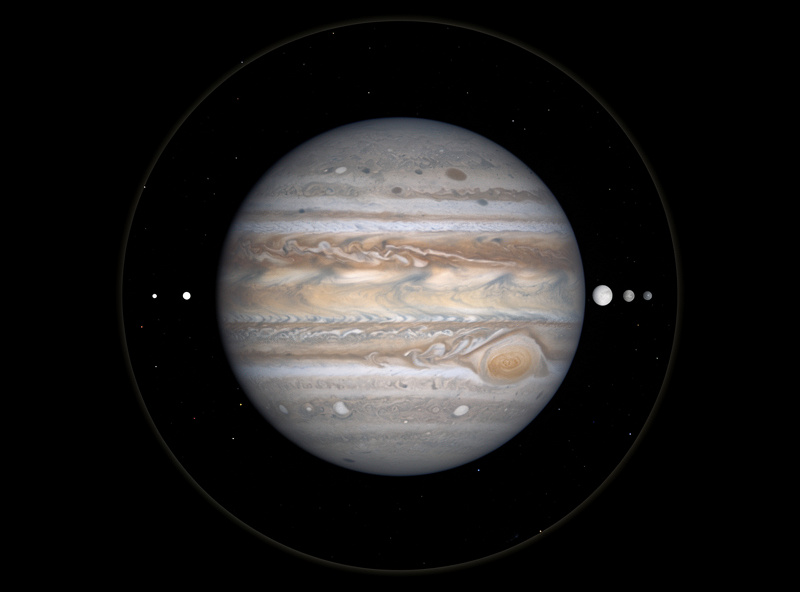
Watch for Galilean moon transits and shadows. When Io or Europa crosses in front of Jupiter, its shadow appears as a sharp black dot on the cloud tops — one of the most striking sights in planetary observation. Europa’s shadow is noticeably smaller than Ganymede’s due to its smaller size. Optimal magnification for Jupiter: 150x-250x with an 8-inch telescope.
Saturn and Its Iconic Rings
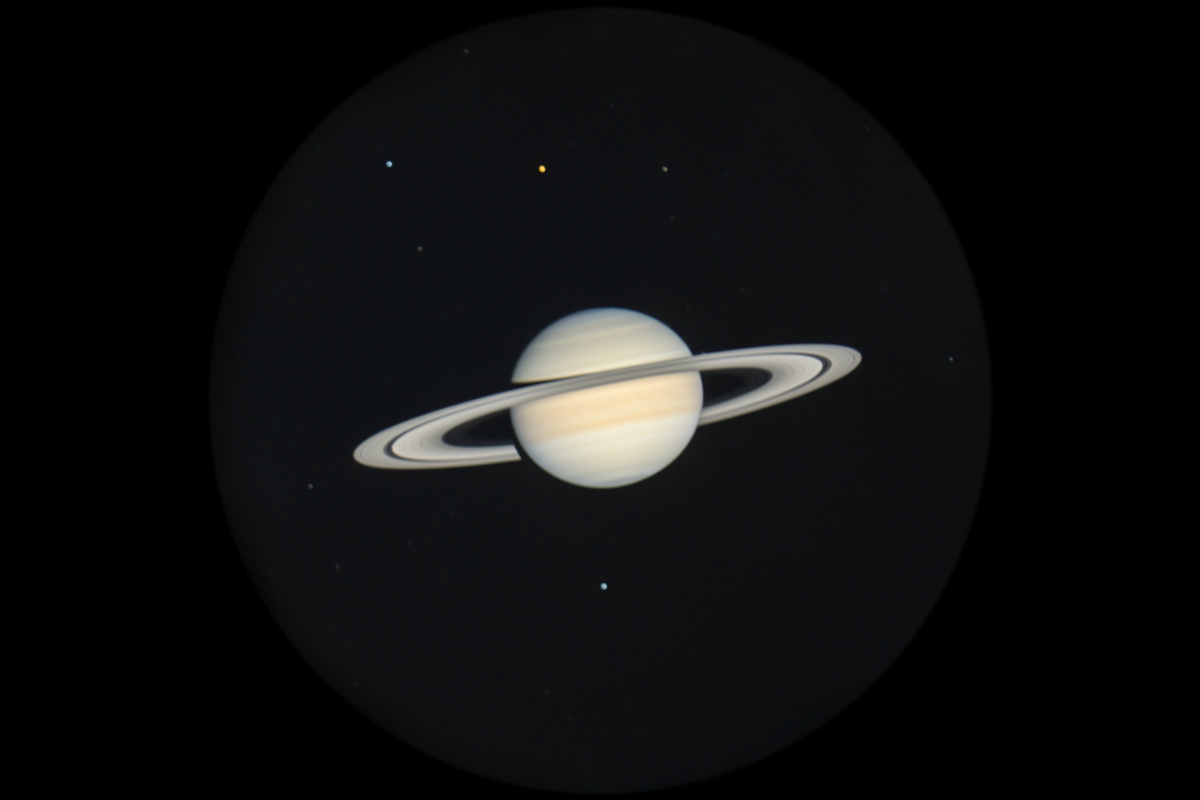
Saturn delivers the most spectacular visual experience in planetary astronomy. The ring system, tilted at varying angles to our line of sight as Saturn orbits the Sun every 29.5 years, reveals the Cassini Division — a 3,000-mile-wide gap between the A and B rings — in any telescope of 6-inch aperture or larger at 150x magnification or higher.
In 2026, Saturn reaches opposition on September 21 at magnitude +0.4. The ring tilt is opening after edge-on in 2025, reaching approximately 7 degrees — still narrow but increasingly visible. The rings will continue widening until 2032. Saturn’s largest moon, Titan (magnitude +8.5), is visible in any telescope as an orange-tinged point of light orbiting the planet every 16 days.
Saturn’s atmosphere shows subtle banding similar to Jupiter’s but in muted browns and golds. The Encke Division in the A ring is visible only in 12-inch or larger telescopes under excellent seeing conditions. Optimal magnification for Saturn: 150x-300x. Saturn looks good at higher magnifications than Jupiter because its lower surface brightness produces less atmospheric turbulence artifacts.
Mars: The Red Planet at Opposition
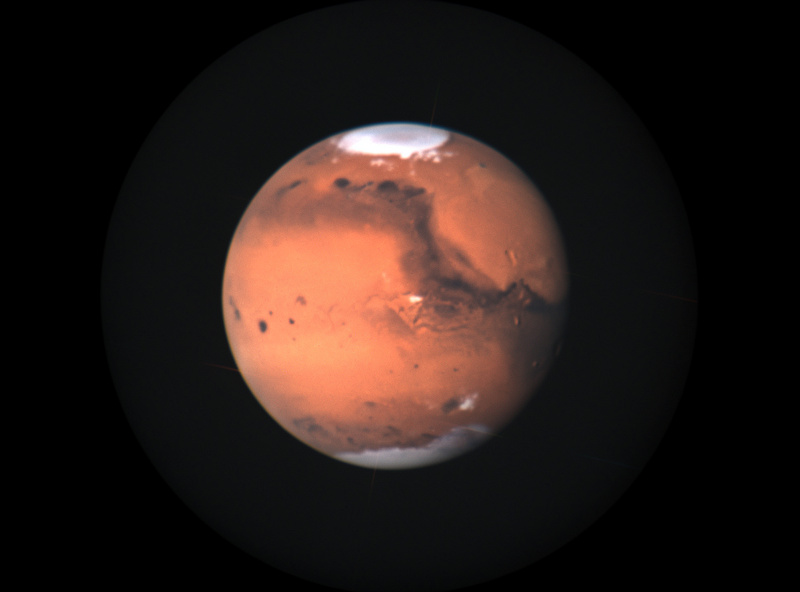
Mars is the most challenging of the bright planets to observe well because its apparent size varies enormously depending on where it is in its orbit. At conjunction (far side of the Sun from Earth), Mars shrinks to 3.5 arcseconds — a featureless orange dot. At opposition when closest to Earth, it swells to 24+ arcseconds and reveals surface detail in modest telescopes.
Mars reaches opposition on December 10, 2026, at magnitude -1.8 and an apparent diameter of 17.1 arcseconds. This is a favorable opposition — not as close as the historic 2020 approach (22.6 arcseconds) but significantly better than average. The south polar ice cap will be prominent, and dark surface features like Syrtis Major and the Hellas Basin (a bright impact crater) rotate into view every 24.6 hours.
Mars requires patient observation. Wait for moments of steady seeing (the atmosphere stabilizes briefly), then sketch or memorize the surface features visible. A red or orange filter enhances contrast on surface markings by blocking blue scattered light. Optimal magnification for Mars: 200x-400x. Mars tolerates high magnification better than any other planet because its small disk benefits from the apparent enlargement.
Venus and Mercury: The Inner Planets
Venus is the brightest planet in the sky and shows a complete range of phases — from thin crescent to nearly full — as it orbits between Earth and the Sun. Galileo first observed Venus’s phases in 1610, providing crucial evidence for the heliocentric model. Through a telescope, Venus displays a brilliant white disk with no surface features visible (permanent cloud cover), but the phase changes are dramatic and obvious even at 40x magnification.
Venus is best observed at greatest elongation (maximum angular distance from the Sun), when it is highest in the twilight sky. In 2026, Venus reaches greatest eastern elongation on January 10 (evening sky) and greatest western elongation on September 19 (morning sky). At these times, Venus shows a 50% illuminated half-moon phase at 25 arcseconds diameter. Optimal magnification: 50x-150x.
Mercury is the most difficult naked-eye planet to observe, never straying more than 28 degrees from the Sun. Through a telescope, it shows phases similar to Venus but on a much smaller disk (4.5-13 arcseconds). Mercury transits across the Sun’s disk occur occasionally — the next visible from North America is November 13, 2032. Never point a telescope at or near the Sun without a proper full-aperture solar filter. Optimal magnification for Mercury: 100x-200x.
Uranus and Neptune: The Ice Giants
Uranus and Neptune represent the practical limit of amateur planetary observation. Both require telescopes of 6-inch aperture or larger, detailed star charts, and patience to locate — they are invisible to the naked eye and appear as faint, tiny disks rather than showing obvious planetary detail.
Uranus (magnitude +5.7, 3.7 arcseconds) appears as a pale blue-green dot in binoculars and resolves into a tiny disk at 150x or higher in an 8-inch telescope. It shows no surface features through amateur instruments — the color is the only clue that you are not looking at a star. Uranus reaches opposition on November 16, 2026, in the constellation Aries. Use a detailed finder chart from Stellarium or SkySafari to star-hop to its exact position.
Neptune (magnitude +7.8, 2.3 arcseconds) is significantly harder. It requires a 10-inch or larger telescope to resolve as a disk rather than a point, and even then appears as a featureless blue-gray circle. Neptune reaches opposition on September 20, 2026, in Pisces. Its moon Triton (magnitude +13.5) is visible in 12-inch and larger telescopes as a faint point of light orbiting every 5.9 days. Finding Uranus and Neptune is the astronomical equivalent of a rite of passage — an achievement that marks the transition from beginner to intermediate observer. See our astronomy for beginners guide for star-hopping techniques.
Planet Observation Comparison Table
| Planet | 2026 Opposition Date | Max Apparent Size | Magnitude | Min Telescope Aperture | Optimal Magnification | Key Features |
|---|---|---|---|---|---|---|
| Jupiter | Feb 10 | 46″ | -2.5 | 4″ | 150x-250x | Cloud bands, Great Red Spot, Galilean moons |
| Saturn | Sep 21 | 19″ | +0.4 | 6″ | 150x-300x | Rings, Cassini Division, Titan |
| Mars | Dec 10 | 17.1″ | -1.8 | 6″ | 200x-400x | Polar ice caps, Syrtis Major, Hellas Basin |
| Venus | N/A (inferior) | 64″ | -4.6 | Any | 50x-150x | Phases, atmospheric haze |
| Mercury | N/A (inferior) | 13″ | -1.9 | 4″ | 100x-200x | Phases |
| Uranus | Nov 16 | 3.7″ | +5.7 | 6″ | 150x+ | Blue-green disk |
| Neptune | Sep 20 | 2.3″ | +7.8 | 10″ | 200x+ | Blue-gray disk, Triton (12″+) |
Frequently Asked Questions
What is the best planet to observe with a small telescope?
Jupiter is the best planet for small telescopes. A 4-inch refractor at 120x shows two dark equatorial bands and the four Galilean moons. Jupiter shows more detail at lower magnifications than any other planet, making it the most rewarding target for beginners.
When is the best time to observe planets in 2026?
Jupiter is best around opposition on February 10. Saturn peaks around September 21. Mars is best in November-December 2026 around its December 10 opposition. Venus is visible as an evening star in January and a morning star from April through December 2026.
Can you see Saturn’s rings with a 6-inch telescope?
Yes. A 6-inch telescope at 150x clearly separates Saturn’s rings from the planet body and shows the Cassini Division as a thin dark line in the ring system. The rings are the most spectacular sight in amateur astronomy and require no specialized equipment.
What magnification do I need to see details on Mars?
Mars requires 200x-400x magnification to see surface features clearly. At opposition in December 2026, an 8-inch telescope at 250x shows the south polar ice cap, dark surface markings like Syrtis Major, and the bright Hellas Basin impact crater.
Can I observe Uranus and Neptune with a beginner telescope?
Uranus is visible as a tiny blue-green disk in a 6-inch telescope at 150x. Neptune requires at least 8-10 inches to resolve as a disk rather than a point. Both require detailed finder charts to locate — they are invisible to the naked eye and not obvious in telescopes.
Why does Jupiter’s Great Red Spot change position?
The Great Red Spot is a persistent anticyclonic storm in Jupiter’s southern hemisphere that rotates with the planet every 9.9 hours. Jupiter’s rotation period is 9 hours 55 minutes, so the Great Red Spot drifts across the disk and disappears around the limb roughly every 10 hours before reappearing on the other side.
