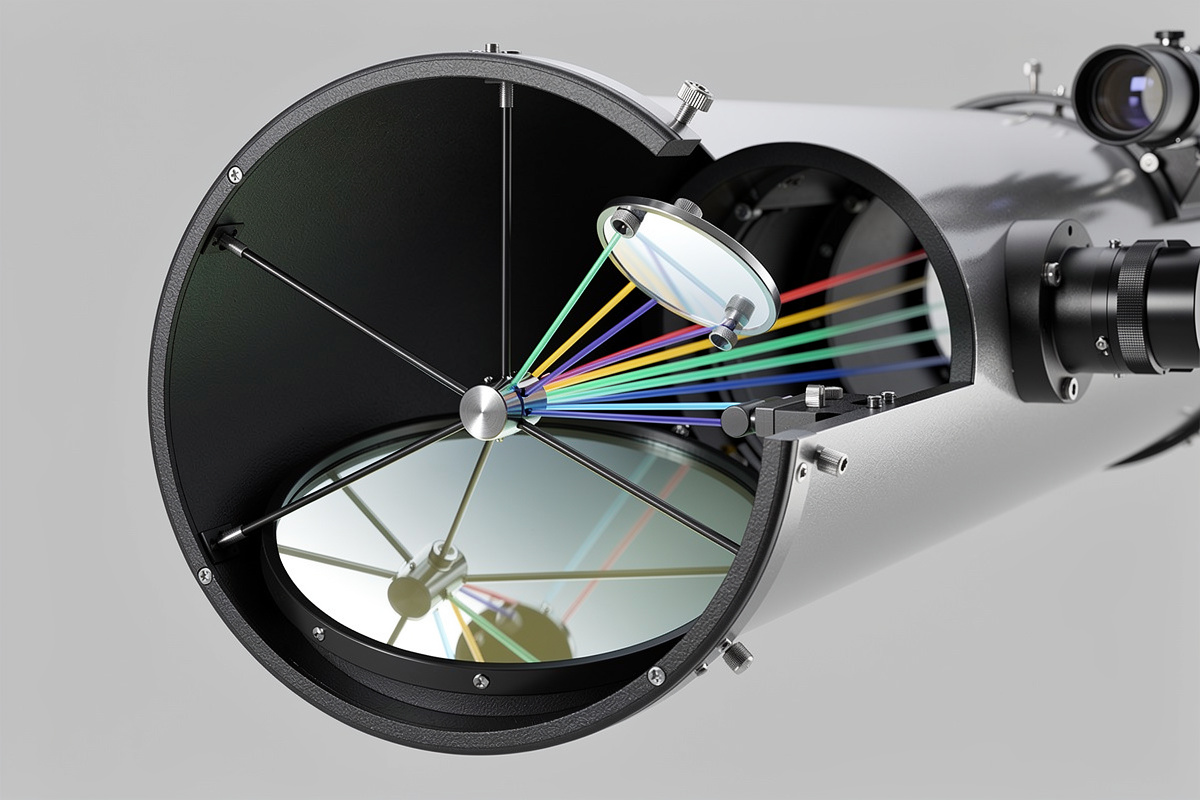

Telescope collimation is the process of aligning the primary and secondary mirrors in a reflector telescope so that all light converges to a single focal point. Uncollimated reflectors produce elongated stars, soft planetary images, and reduced contrast. A properly collimated 8-inch Dobsonian resolves stars down to 0.57 arcseconds — the telescope’s theoretical limit.
Collimation is the single most important maintenance task for Newtonian and Dobsonian telescope owners. It takes 2 to 3 minutes with a Cheshire eyepiece and should be checked before every serious observing session. Refractors and most compound telescopes (SCTs, Maksutovs) rarely need collimation because their optical elements are permanently fixed in alignment.
What Is Collimation and Why Does It Matter?
Collimation aligns two mirrors in a Newtonian reflector: the primary mirror (the large parabolic mirror at the bottom of the tube) and the secondary mirror (the small flat mirror near the top that directs light to the focuser). Both mirrors must be precisely centered and tilted so that the light cone converges to a sharp focus at the eyepiece.
Even small misalignments degrade image quality noticeably. A 1mm offset of the secondary mirror from the focuser axis introduces coma — stars at the field edge become comet-shaped. A 2mm offset of the primary mirror’s tilt defocuses the star image by 10 to 15 percent, making high-magnification planetary views noticeably softer. At 200x magnification, the difference between a collimated and slightly miscollimated telescope is obvious on Jupiter’s cloud bands.
Reflector mirrors shift alignment during transport, during temperature changes (metal tubes expand and contract), and from vibration during use. A Dobsonian transported in a car will almost certainly be miscollimated when you set it up at the observing site. This is normal and expected — it takes 2 minutes to fix and is not a sign of a defective telescope.
Cheshire Eyepiece: The Standard Collimation Tool
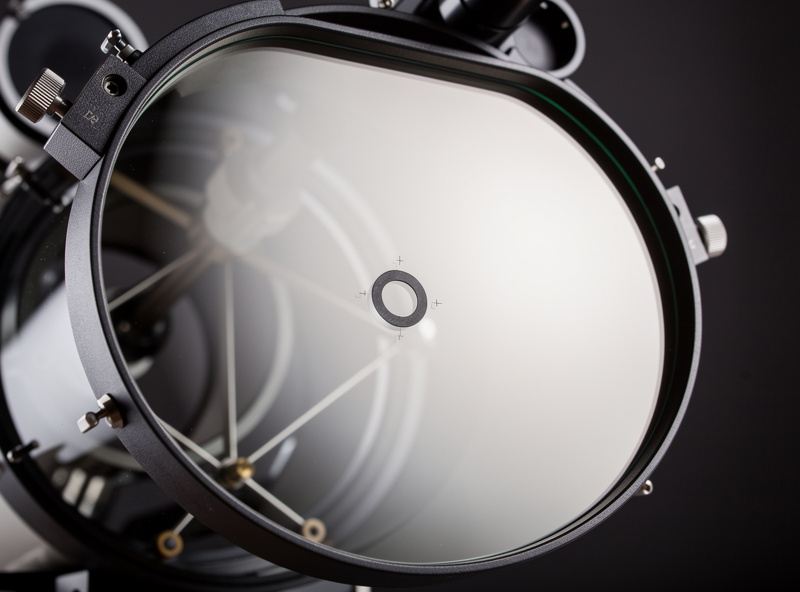
A Cheshire eyepiece is a tubular tool that inserts into the focuser like an eyepiece and contains a crosshair reticle and a reflective surface illuminated by ambient light. You look through the Cheshire and align the secondary mirror’s reflection, the primary mirror’s center spot, and the crosshair to achieve collimation. Cheshire eyepieces cost $20 to $35 and require no power.
The Cheshire is the most reliable collimation tool because it works on the actual optical axis defined by the focuser drawtube. Unlike laser collimators, which can themselves be misaligned, the Cheshire’s accuracy depends only on the physical precision of its crosshair — which is machined to tight tolerances in quality units.
Using a Cheshire: Insert the Cheshire into the focuser and look through it while pointing the telescope at a bright surface (daylight sky or a white wall). Adjust the secondary mirror tilt screws until the secondary mirror appears centered under the Cheshire’s crosshair. Then adjust the primary mirror tilt knobs (accessible from the back of the tube) until the primary mirror’s center spot aligns with the crosshair center. The entire process takes 2 to 3 minutes.
Recommended Cheshire eyepieces: the Astro-Tech Cheshire ($20 to $28), the Celestron Cheshire ($25 to $30), and the Hotech Cheshire ($35 to $45). The Hotech version includes an illuminated reticle for use in the field at night, which is helpful when you cannot use daylight to illuminate the mirrors.
Laser Collimators: Fast and Convenient
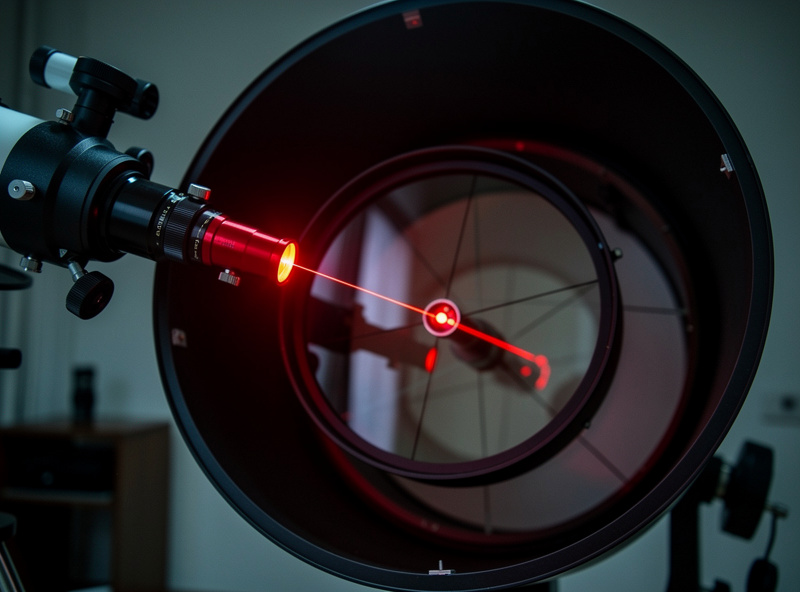
Laser collimators project a collimated laser beam down the focuser axis onto a target grid on the secondary mirror or primary mirror center spot. They provide visual feedback that makes alignment faster than Cheshire eyepieces — experienced users achieve collimation in under 60 seconds. The speed advantage is real but comes with a caveat: the laser itself must be collimated.
Budget laser collimators under $30 are often misaligned out of the box. The laser beam points slightly off-axis, which means your telescope’s mirrors will be aligned to the laser’s error rather than to the true optical axis. This produces a telescope that appears collimated but actually introduces the same aberrations as an uncollimated scope. Before using any laser collimator, check it by inserting it into the focuser, rotating it 180 degrees, and noting whether the laser dot moves. If it moves, the laser needs adjustment before it can collimate your telescope.
Quality laser collimators with self-centering mechanisms ($50 to $80) solve the alignment problem. The HoTech SCA Laser Collimator ($55 to $70) uses a self-centering adapter that seats concentrically in the focuser, eliminating the barrel wobble that causes misalignment in cheap lasers. The Glatter Laser Collimator ($70 to $90) uses a precision-machined barrel and adjustable beam position to ensure the beam is perfectly on-axis.
The practical recommendation: Use a Cheshire as your primary collimation tool and a laser collimator as a quick check. The Cheshire provides absolute accuracy; the laser provides speed. If they disagree, trust the Cheshire.
Star Testing Collimation Accuracy
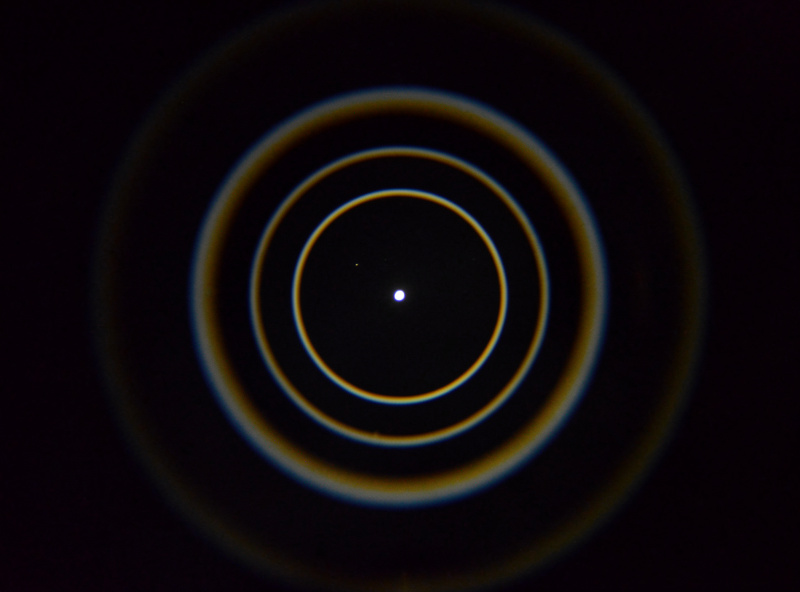
Star testing is the final verification of collimation accuracy. Even after Cheshire or laser alignment, checking a bright star at high magnification confirms whether the mirrors are truly aligned at the focal point. Star testing reveals misalignments too small for Cheshire or laser tools to detect.
Procedure: Center a bright magnitude 2 to 3 star (like Polaris, which conveniently does not move) at high magnification (200x or above). Defocus slightly in both directions (inside and outside focus). A perfectly collimated telescope shows concentric circular rings centered on the star in both directions. If the rings are offset to one side, the primary mirror tilt needs adjustment — turn the appropriate collimation knob a tiny amount and recheck.
The star test takes 1 to 2 minutes and catches the last 5 percent of misalignment that tools alone may miss. It is particularly important after replacing or cleaning mirrors, which can introduce small tilt errors that Cheshire alignment alone does not fully correct.
Collimating SCTs and Maksutovs
SCTs and Maksutovs collimate differently from Newtonians because they adjust the secondary mirror tilt (located in the center of the corrector plate) rather than the primary mirror. The process uses a star test only — there is no Cheshire or laser tool for SCT collimation because the closed tube design prevents direct optical access to the mirrors.
SCT collimation procedure: Center a bright star at high magnification (200x or above). Defocus slightly. If the diffraction rings are not concentric, adjust the three push-pull screws on the secondary mirror housing (accessible from the front of the corrector plate). Make tiny adjustments — 1/8 turn at a time — and recheck after each. The goal is perfectly concentric rings in both intra-focal and extra-focal directions.
SCTs and Maks hold collimation much better than Newtonians because the tube is closed and the mirrors are mounted rigidly. Most SCT owners check collimation once per observing season rather than every session. If your SCT produces sharp star images, do not adjust the secondary — leave it alone.
Collimation Tools Comparison
| Tool | Speed | Accuracy | Price Range | Works At Night | Best For |
|---|---|---|---|---|---|
| Cheshire Eyepiece | 2-3 minutes | Excellent | $20-$45 | Yes (illuminated) or daylight | Primary tool, all reflectors |
| Laser Collimator | 30-60 seconds | Good (if aligned) | $25-$90 | Yes | Quick check, experienced users |
| Combination Cheshire + Laser | 1-2 minutes | Excellent | $40-$70 | Yes | Best of both worlds |
| Star Test | 1-2 minutes | Highest | Free | Yes (stars required) | Final verification |
| Artificial Star | 2-3 minutes | Highest | $15-$30 | Yes (setup required) | Daylight collimation verification |
Related Articles
Telescope Accessories Guide: Eyepieces, Filters, Mounts, and Must-Haves — The complete accessory overview for all telescope equipment.
Dobsonian Telescopes: Why They Are the Best Value in Astronomy — Why Dobs need regular collimation.
Refractor vs Refractor Telescope: Which Design Is Right for You? — Refractors never need collimation.
Best Telescopes for Beginners in 2026: Top Picks by Budget — Beginner reflectors that need collimation.
Telescope Buying Guide 2026: How to Choose Your First Telescope — How telescope design affects maintenance needs.
How often should I collimate my reflector telescope?
Collimate before every serious observing session and after any transport. Reflector mirrors shift from vibration, temperature changes, and movement. The process takes 2 to 3 minutes with a Cheshire eyepiece. SCTs and Maksutovs only need collimation once per season or after physical impact.
What is the best collimation tool for a beginner?
A Cheshire eyepiece ($20 to $35) is the best first collimation tool because it is always accurate — it cannot be misaligned like a laser collimator. It works in daylight by pointing the telescope at the sky, or at night with an illuminated reticle version. Learn the Cheshire method before trying laser collimation.
Can I collimate without any tools?
You can rough-align using a defocused star test: center a bright star at high magnification, defocus, and adjust the primary mirror knobs until the diffraction rings are concentric. This method works but is slower and less precise than using a Cheshire eyepiece. Every reflector owner should own a dedicated collimation tool.
How do I know if my telescope needs collimation?
Look at a bright star at 200x or higher magnification. A well-collimated telescope shows a tight Airy disk with concentric diffraction rings. If the star appears asymmetrical, flared on one side, or the defocused rings are not concentric, your telescope needs collimation. On planets, miscollimation shows as soft, low-contrast images with reduced detail.
Do refractor telescopes need collimation?
No. Refractors have permanently cemented lens elements in a fixed cell that rarely shifts. If a refractor produces poor images, the issue is almost never collimation — check for dew on the lens, a dirty lens surface, or atmospheric seeing conditions before assuming an optical problem.
What happens if I use a misaligned laser collimator?
A misaligned laser collimator aligns your mirrors to the laser’s error rather than the true optical axis. Your telescope will appear collimated but produce the same soft star images as an uncollimated scope. Always check a laser collimator by rotating it 180 degrees in the focuser and confirming the dot does not move.
