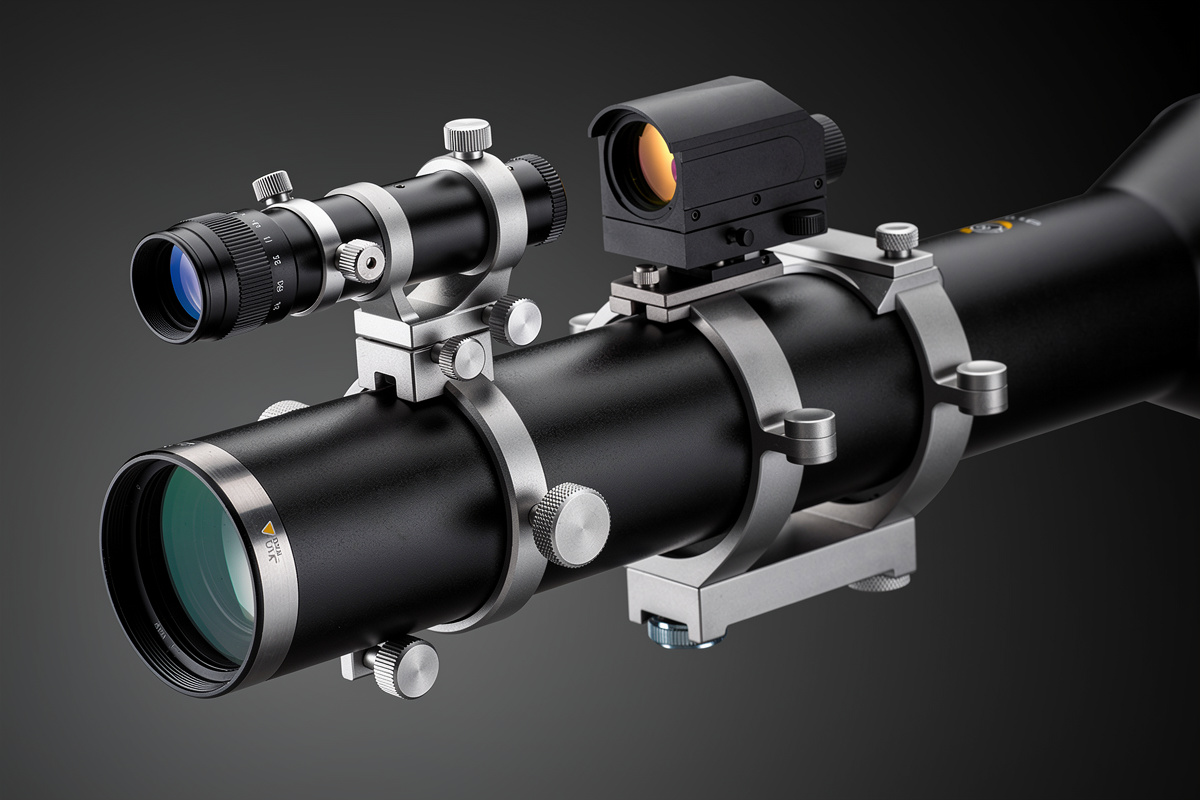

The best telescope finder for most observers is a red dot reflex sight like the Telrad ($45) or Rigel QuikFinder ($38). These zero-magnification finders project a reticle onto a transparent window, allowing you to aim the telescope with both eyes open. They are faster to align, easier to use, and more intuitive than magnifying finderscopes.
Every telescope needs a pointing system because even low-power eyepieces show a field of view too narrow to locate objects by scanning the sky. The finder — whether a red dot, reflex, or magnifying finderscope — provides the wide-field reference that bridges naked-eye star identification and the telescope’s narrow eyepiece view.
Red Dot Finders: The Standard Choice for Refractors and Reflectors
Red dot finders project a small illuminated dot onto a transparent glass or plastic window. You look through the window with both eyes open and move the telescope until the dot covers the target. The design provides zero magnification and a very wide field of view, which makes star-hopping from naked-eye reference stars to telescopic targets fast and intuitive.
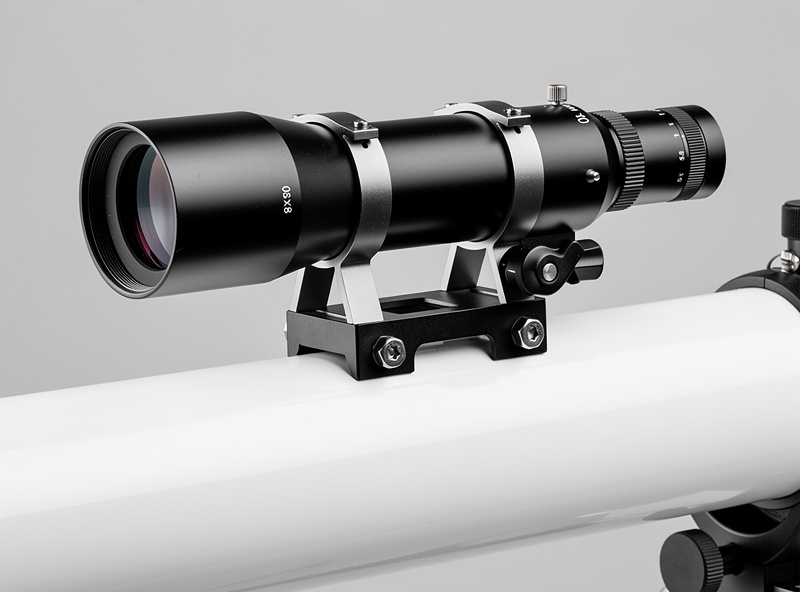
The Telrad ($40 to $48) is the most popular finder in amateur astronomy. It projects three concentric rings (0.5, 2, and 4 degrees) along with a center dot, which allows estimating angular distances for star-hopping. The base mounts to the telescope tube with adhesive pads, and the Telrad itself slides on and off the base for transport. The large 1.8-inch window and bright adjustable reticle make it usable even by observers with glasses.
The Rigel QuikFinder ($35 to $40) is a compact alternative to the Telrad that uses two concentric rings (0.5 and 2 degrees) instead of three. Its smaller size and lighter weight make it ideal for smaller refractors and short-tube telescopes where a Telrad would look oversized. The Rigel mounts with a single screw rather than adhesive pads, making it easier to transfer between telescopes.
Generic red dot finders ($15 to $25) from brands like Celestron and Orion provide the basic red-dot-on-window function without concentric rings. They work adequately for casual use but often suffer from dot wobble (the dot shifts position as you move your head), dim reticles at low battery, and fragile adjustment screws. For serious observing, spend the extra $15 to $20 for a Telrad or Rigel.
Magnifying Finderscopes: 6×30, 8×50, and 9×50
Magnifying finderscopes are small refracting telescopes mounted parallel to the main scope. They provide 6x to 10x magnification with 30mm to 50mm aperture, showing fainter stars and small deep-sky objects that a red dot finder cannot reveal. Magnifying finders are most useful for observers who star-hop to very faint targets (magnitude 9 to 11) where naked-eye reference stars are scarce.
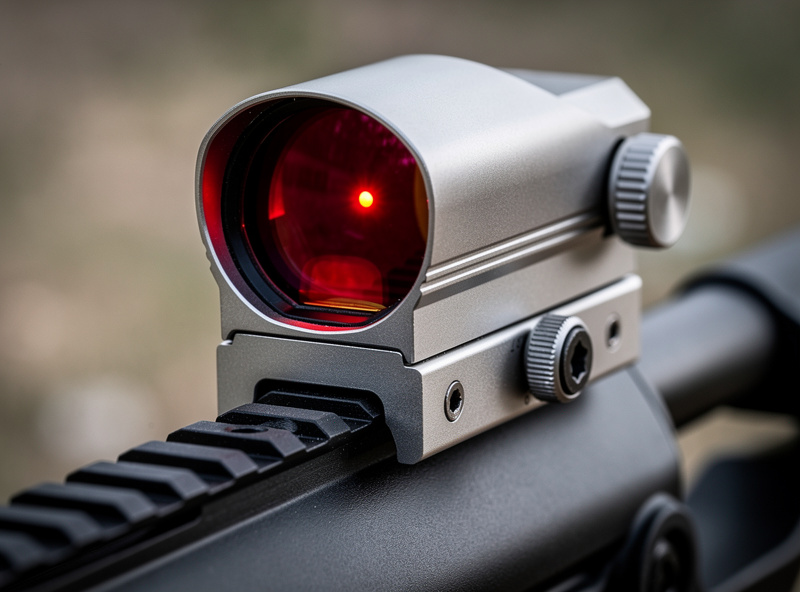
An 8×50 finderscope gathers enough light to show magnitude 9.5 to 10 stars, which matches many objects in the Messier catalog and some NGC objects. With crosshairs centered on a target, the main telescope’s eyepiece field will contain the object — provided the finder is accurately aligned. This eliminates the guesswork involved in estimating angular offsets from a red dot finder.
The tradeoffs are significant. Magnifying finders show an inverted image (upside-down and reversed left-right), which makes matching star patterns to charts confusing for beginners. They have a narrower true field (5 to 7 degrees vs 10+ degrees for a red dot) and take longer to align because the magnification amplifies any alignment error.
Popular options include the Orion 9×50 ($60 to $80), Celestron 9×50 ($55 to $70), and the Sky-Watcher 8×50 RACI ($80 to $120). The RACI (Right-Angle Correct Image) designation means the finder uses a prism to correct the image orientation, showing the sky right-side-up and correctly oriented. This makes star-hopping dramatically easier and is worth the extra cost if you rely on finderscopes.
Reflex Sights: Telrad vs Rigel QuikFinder
The Telrad and Rigel QuikFinder are the two dominant reflex finders in amateur astronomy. Both project illuminated reticles onto transparent windows, but they differ in ring design, size, and mounting method. The choice between them comes down to telescope size and personal preference.
The Telrad’s three concentric rings at 0.5, 2, and 4 degrees make it uniquely suited for star-hopping using the Telrad Finder Charts (a popular series of deep-sky charts designed around the Telrad’s ring system). The charts print Telrad rings directly onto star maps, so you place the rings over the correct stars and the telescope points at the target. This system has a dedicated following because it eliminates the need for a magnifying finder entirely.
The Rigel QuikFinder’s two rings (0.5 and 2 degrees) cover 90 percent of the same function in a package that is 40 percent smaller and 60 percent lighter. For telescopes under 6 inches of aperture or for observers who carry their telescope to dark sky sites, the Rigel’s compact size is a genuine advantage.
Both cost under $50, both run on common CR2032 batteries lasting 100+ hours, and both mount in seconds. The right choice depends on whether you value the Telrad’s third ring for chart-based star-hopping or the Rigel’s smaller footprint for portability.
How to Align a Finder with Your Telescope
Finder alignment is the process of adjusting the finder’s aim so that its crosshair or reticle center matches what the main telescope shows in the eyepiece. An unaligned finder is worse than no finder at all because it points you to the wrong part of the sky.
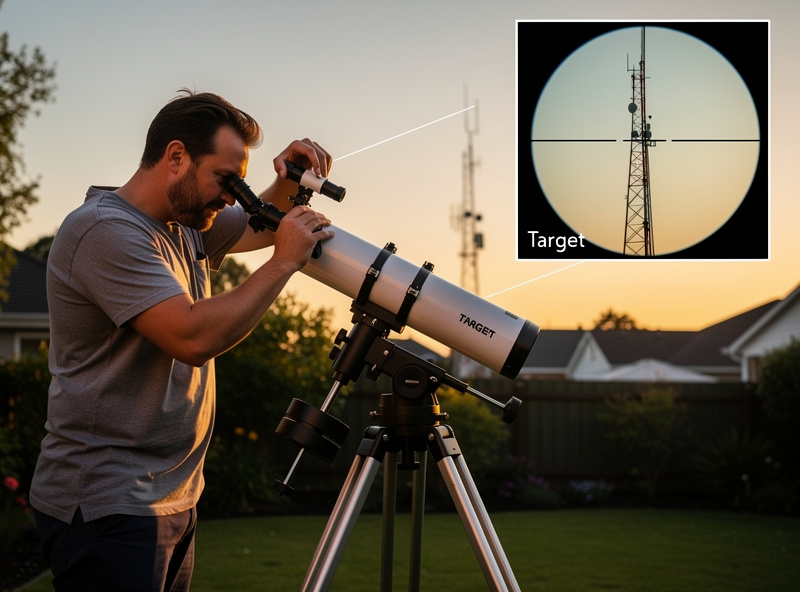
Alignment procedure: First, insert a low-power eyepiece (25mm or 32mm) in the main telescope and point at a bright, stationary object — a terrestrial target like a radio tower during the day or a bright star at night. Center the object in the eyepiece field. Then, without moving the telescope, look through the finder and adjust its alignment screws (typically three screws in a push-pull configuration) until the reticle or crosshair centers on the same object. Check the main telescope eyepiece to confirm the object is still centered. Repeat until both the eyepiece and finder show the same target.
Realign after every transport, after bumping the telescope, and after temperature changes of more than 20 degrees Fahrenheit (which can shift tube alignment). A well-aligned finder saves more observing time than any other accessory — it is the difference between finding an object in 30 seconds and spending 10 minutes searching.
Finder Accessories and Mounting Options
Finder bases, mounting brackets, and dual-finder setups expand your pointing options. Most telescopes include one finder shoe (the V-shaped or Synta-style bracket that the finder slides into). Adding a second shoe ($5 to $15) lets you mount both a red dot finder and a magnifying finderscope on the same telescope.
A common dual-finder setup uses a Telrad or Rigel for initial pointing (wide field, fast targeting) and an 8×50 or 9×50 finderscope for precise centering of faint objects. The red dot gets you in the neighborhood; the finderscope gets you on the doorstep; the eyepiece takes you inside. This two-stage approach works exceptionally well for observers targeting the Herschel 400 or other faint-object lists.
Dew shields for finders ($5 to $10 for flexible neoprene versions) prevent condensation on the finder window or objective lens during humid nights. A dewed-up Telrad window renders the finder useless. A $5 neoprene wrap solves the problem permanently.
Finder Comparison Table
| Finder Type | Magnification | True Field | Faintest Stars | Price Range | Best For |
|---|---|---|---|---|---|
| Telrad | 0x (reflex) | 4° rings | Naked eye limit | $40-$48 | Dobsonians, star-hopping with charts |
| Rigel QuikFinder | 0x (reflex) | 2° rings | Naked eye limit | $35-$40 | Small scopes, portability |
| Generic Red Dot | 0x (dot only) | Unlimited | Naked eye limit | $15-$25 | Budget, casual use |
| 6×30 Finderscope | 6x | 6-7° | Magnitude 8.5 | $35-$55 | Lightweight refractors |
| 8×50 RACI | 8x | 5-6° | Magnitude 10 | $80-$120 | Faint objects, corrected image |
| 9×50 Finderscope | 9x | 5° | Magnitude 10 | $55-$80 | Faint objects, budget |
Related Articles
Telescope Accessories Guide: Eyepieces, Filters, Mounts, and Must-Haves — The complete accessory overview for all telescope equipment.
Astronomy for Beginners: Your Complete Guide to Stargazing — Learn star-hopping techniques that make finders effective.
Best Telescopes for Beginners in 2026: Top Picks by Budget — Starter telescopes with included finder options.
Dobsonian Telescopes: Why They Are the Best Value in Astronomy — Telrad is the standard finder for Dobs.
Dark Sky Locations: Best Places to Stargaze in the US — Dark sites where faint finderscopes shine.
What is the best finder for a Dobsonian telescope?
The Telrad reflex finder is the standard choice for Dobsonians because its three concentric rings (0.5, 2, and 4 degrees) integrate with Telrad Finder Charts for fast star-hopping. It costs $40 to $48, mounts with adhesive pads, and needs no magnification to use.
Do I need a magnifying finderscope?
A magnifying finderscope helps only if you regularly star-hop to objects fainter than magnitude 8, where naked-eye reference stars are scarce. For the Messier catalog and brighter NGC objects, a red dot finder is faster and easier to use than a magnifying finderscope.
How do I align a red dot finder with my telescope?
Center a bright object in the main telescope eyepiece at low magnification. Then adjust the finder’s alignment screws until the red dot or reticle center covers the same object. Check the main eyepiece again to confirm alignment. Realign after every transport or significant temperature change.
Can I use both a red dot finder and a finderscope?
Yes. Most telescopes accept a second finder shoe ($5 to $15) that lets you mount both a red dot finder for initial pointing and a magnifying finderscope for precise centering of faint targets. This dual-finder setup is popular among observers working through the Herschel 400 list.
What is a RACI finderscope?
RACI stands for Right-Angle Correct Image. A RACI finderscope uses a prism to show the sky right-side-up and correctly oriented, unlike standard finderscopes that show an inverted image. RACI finders cost $20 to $40 more than standard versions but make star-hopping dramatically easier.
Why does my red dot finder show a dim or flickering dot?
A dim or flickering dot almost always indicates a dying CR2032 battery. Replace it with a fresh battery ($2 to $5 for a pack). If the dot still flickers, check the battery contacts for corrosion. Cold temperatures below 20 degrees Fahrenheit also reduce battery output temporarily.
