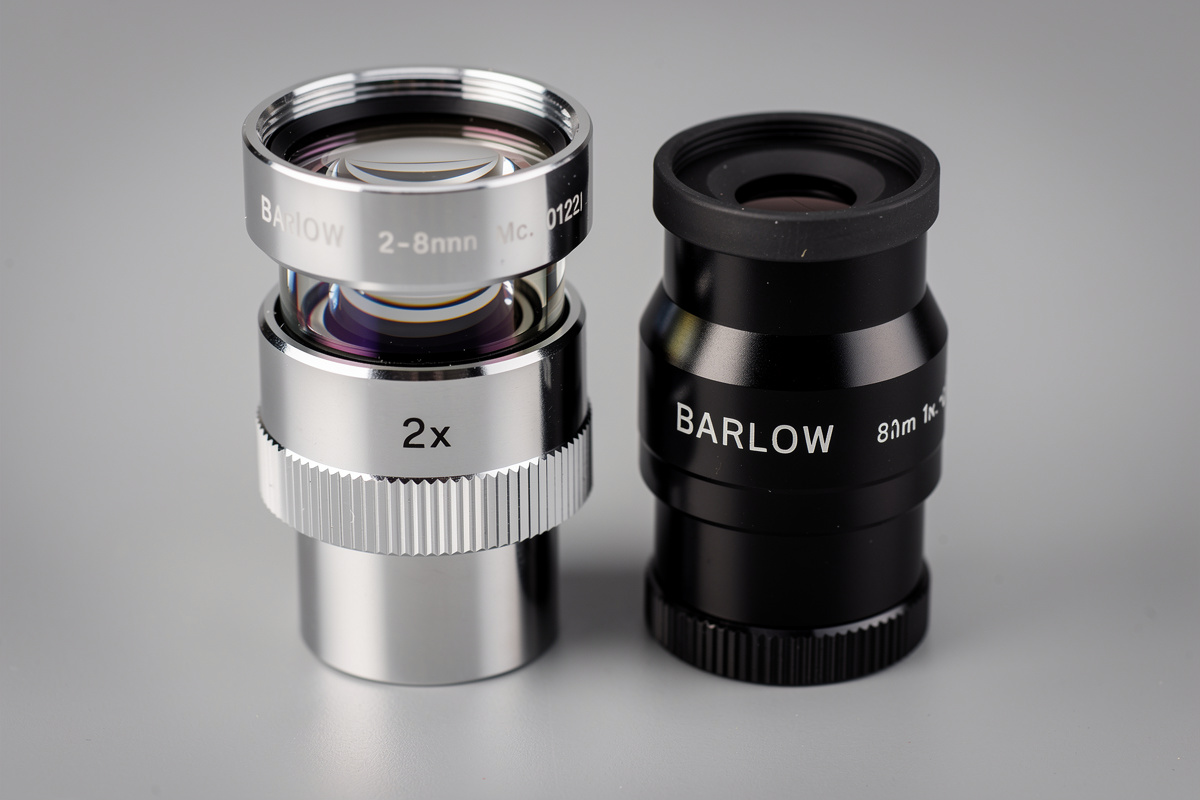

The best Barlow lenses in 2026 are the GSO 2x APO ($45), Apertura 2x ($40), and Celestron X-Cel LX 2x ($60). Each delivers sharp images across the full field in telescopes at f/6 or slower. For 3x magnification, the Celestron X-Cel LX 3x ($65) and GSO 3x ($40) provide the best value with minimal chromatic aberration.
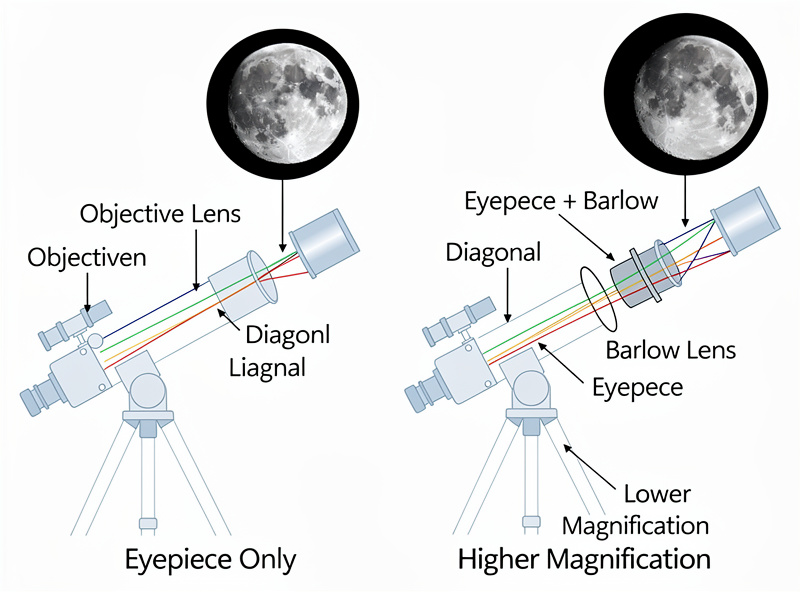
A Barlow lens sits between the focuser and eyepiece, multiplying the telescope’s effective focal length. A 2x Barlow doubles magnification; a 3x Barlow triples it. This means a single Barlow effectively doubles your eyepiece collection — every eyepiece you own produces two different magnifications, with and without the Barlow.
Best 2x Barlow Lenses Under $50
The $30 to $50 price range is where Barlow lenses deliver the best value. Multi-element achromatic designs from GSO and Apertura provide sharp, color-free images in telescopes with f/6 or slower focal ratios. These Barlows introduce less than 1 percent lateral chromatic aberration at f/8 and remain well-corrected even at f/5.
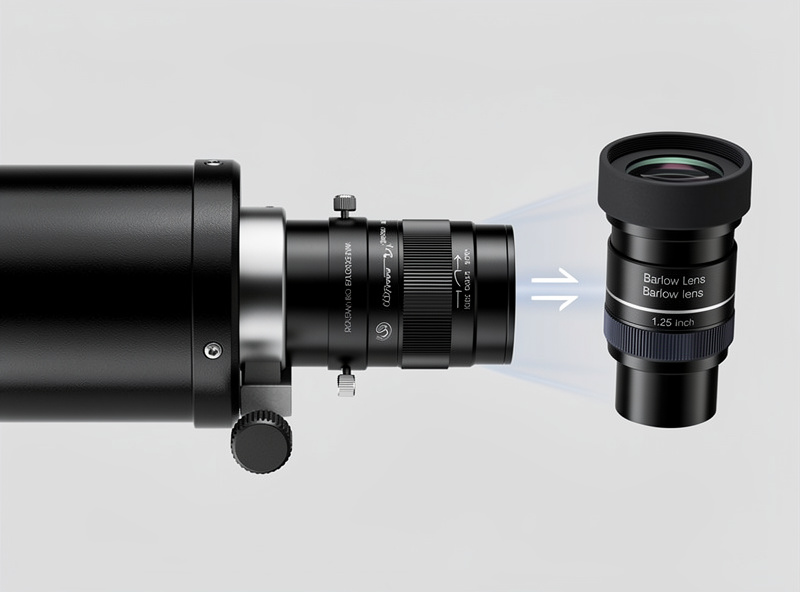
The GSO 2x APO Barlow ($40 to $50) uses a two-element achromatic design with multi-coated optics. It delivers sharp stars to the field edge in f/6 and slower telescopes and acceptable performance in f/5 Newtonians. The 1.25-inch barrel fits all standard focusers, and the chrome-plated brass barrel seats securely without wobble. This is the most recommended budget Barlow across astronomy forums.
The Apertura 2x Barlow ($35 to $45) is manufactured by the same factory as the GSO and provides identical optical performance in a slightly different housing. It includes a compression ring instead of a thumbscrew, which holds eyepieces more securely without marring the barrel. Both the GSO and Apertura are excellent choices — pick whichever is in stock or cheaper.
The Orion Shorty 2x ($30 to $40) is another popular budget option that uses a compact two-element design. It works well at f/7 and slower but shows more chromatic aberration at f/5 than the GSO or Apertura. The shorter barrel length (2 inches vs 3 inches) makes it easier to achieve focus in some refractors with limited focuser travel.
Best 2x Barlow Lenses Over $50
Premium 2x Barlows from Celestron, Baader, and Tele Vue use more sophisticated multi-element designs with better coatings, tighter tolerances, and edge correction in fast telescopes. They cost $60 to $180 but provide visibly better performance in f/4 to f/6 instruments where budget Barlows start to show field curvature and chromatic aberration.
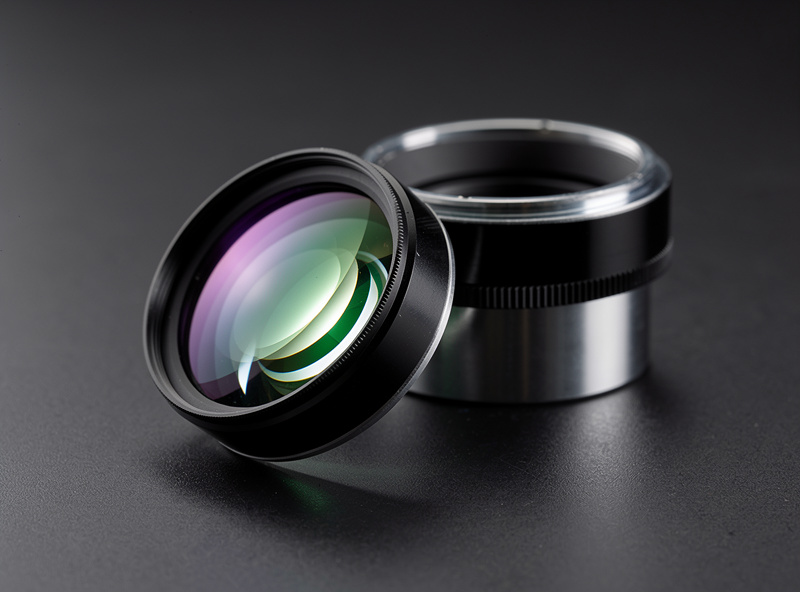
The Celestron X-Cel LX 2x ($55 to $65) uses a three-element design with fully multi-coated optics. It provides tack-sharp images across the full field in f/5 Newtonians, which is where most budget two-element Barlows begin to soften. The 1.25-inch barrel includes a safety undercut and compression ring. For observers with fast reflectors, the X-Cel LX is the minimum recommended Barlow.
The Baader Classic Q 2.25x ($90 to $110) multiplies by 2.25x instead of the standard 2x, providing slightly more magnification per eyepiece. The four-element design with Phantom Coating Group III multi-coatings delivers virtually zero scatter or ghosting on bright planets. The unique magnification factor means your 25mm eyepiece becomes an 11mm equivalent rather than 12.5mm — a subtle but useful shift that fills a magnification gap.
The Tele Vue Powermate 2x ($150 to $180) is a telecentric Barlow that maintains the exit pupil position regardless of magnification, which prevents focus shift when switching between Barlowed and non-Barlowed views. It is overkill for visual use at f/8 or slower but provides unmatched performance for fast Newtonians, SCTs, and astrophotography applications where focus consistency matters.
Best 3x Barlow Lenses
3x Barlows provide higher magnification per eyepiece and are particularly useful for planetary observers who need 250x to 350x magnification from eyepieces in the 10mm to 15mm range. A 12mm eyepiece with a 3x Barlow delivers 4mm equivalent magnification — ideal for splitting close double stars and observing planetary detail.
The Celestron X-Cel LX 3x ($60 to $70) is the top recommended 3x Barlow. The three-element design delivers sharp images across the field in f/6 and slower telescopes, matching the 2x version’s optical quality. At 3x magnification, atmospheric seeing limits useful magnification more than the Barlow’s optics do — on most nights, the atmosphere blurs detail before the Barlow introduces any visible aberration.
The GSO 3x ($35 to $45) provides 90 percent of the X-Cel LX’s performance at half the price. It shows slight chromatic aberration at f/5 but is essentially perfect at f/8. For SCT owners (typically f/10), the GSO 3x is an excellent value that performs identically to options costing twice as much.
The Tele Vue Powermate 4x ($170 to $200) multiplies by 4x rather than 3x and is the specialist choice for high-magnification planetary and double-star work. A 12mm eyepiece becomes a 3mm equivalent — pushing 400x in a 1200mm focal length scope. This magnification is only useful on nights of excellent seeing (sub-arcsecond) but provides extraordinary detail on Jupiter and Saturn when the atmosphere cooperates. For the full framework on how to pick the right power for each planet and each seeing condition, the best magnification for planets guide covers the exit-pupil math and the live stepping method.
When to Use a Barlow vs Buying More Eyepieces
A Barlow makes financial sense when you need magnification flexibility without buying multiple eyepieces in the $40 to $100 range. Three eyepieces plus a 2x Barlow produce six useful magnifications. Five eyepieces without a Barlow produce five magnifications at roughly double the cost.
The tradeoff is optical quality. A Barlow adds two to four glass elements between the telescope and your eye, which introduces slight light loss (2 to 4 percent with multi-coated optics) and potential chromatic aberration in fast telescopes. At f/10 (SCT), this difference is invisible. At f/5 (fast Newtonian), a cheap Barlow may degrade the view enough to notice compared to a dedicated short-focal-length eyepiece.
For beginners, a $40 Barlow plus two quality eyepieces ($80 to $120) is the most cost-effective starting setup. For experienced observers building a premium eyepiece collection, buying dedicated eyepieces at each focal length eliminates the Barlow’s compromises and provides the best possible image. Both approaches work — the choice depends on budget and how much optical perfection matters to you.
Barlow Lens Compatibility and Focus Issues
Barlow lenses add optical path length that can push the focal point beyond the focuser’s inward travel, especially in Newtonian reflectors and short-focus refractors. Before buying a Barlow, check whether your telescope can achieve focus with the added 70 to 100mm of optical path.
Newtonian reflectors on Dobsonian mounts typically have generous focuser travel (40 to 60mm) and achieve focus with any Barlow without issues. Short-tube refractors (under 600mm focal length) may run out of inward focuser travel when a Barlow is inserted. The solution is a shorty Barlow (2-inch barrel length instead of 3-inch), which reduces the optical path length and helps achieve focus in tight-focus systems.
SCTs and Maksutovs have long focal ratios (f/10 to f/15) and plenty of back-focus travel, so Barlow compatibility is never an issue. In fact, SCTs benefit most from Barlows because their long focal length means a 2x Barlow produces high magnification from comfortable long-eye-relief eyepieces — a 25mm eyepiece Barlowed to 12.5mm equivalent at f/10 gives 200x with 20mm eye relief, compared to a dedicated 12.5mm Plössl with only 10mm eye relief.
Barlow Lens Comparison Table
| Model | Magnification | Elements | Price | Best For |
|---|---|---|---|---|
| GSO 2x APO | 2x | 2 | $40-$50 | Best budget 2x, f/6+ |
| Apertura 2x | 2x | 2 | $35-$45 | Budget 2x with compression ring |
| Orion Shorty 2x | 2x | 2 | $30-$40 | Short barrel, tight focusers |
| Celestron X-Cel LX 2x | 2x | 3 | $55-$65 | Fast Newtonians, best mid-range |
| Baader Classic Q 2.25x | 2.25x | 4 | $90-$110 | Planetary, zero scatter |
| Celestron X-Cel LX 3x | 3x | 3 | $60-$70 | Best 3x value |
| GSO 3x | 3x | 2 | $35-$45 | Budget 3x, SCTs |
| Tele Vue Powermate 2x | 2x | 4 | $150-$180 | Astrophotography, fast scopes |
Related Articles
Telescope Accessories Guide: Eyepieces, Filters, Mounts, and Must-Haves — The complete accessory overview for all telescope equipment.
Best Telescope Eyepieces 2026: Wide Angle, Planetary, Budget — Eyepiece designs and focal lengths that pair with Barlows.
Best Planets to Observe with a Telescope in 2026 — How Barlows reach planetary magnification targets.
Astrophotography Guide: Equipment, Settings, and Techniques — Telecentric Barlows and projection imaging.
Telescope Buying Guide 2026: How to Choose Your First Telescope — Focal ratio determines Barlow compatibility.
What does a Barlow lens do for a telescope?
A Barlow lens multiplies the telescope’s effective focal length. A 2x Barlow doubles magnification for every eyepiece you insert into it, effectively doubling your eyepiece collection. A 25mm eyepiece becomes a 12.5mm equivalent, and a 10mm becomes a 5mm equivalent.
Is a 2x or 3x Barlow better?
A 2x Barlow is more versatile because it provides moderate magnification increase across all eyepiece focal lengths. A 3x Barlow is specialized for planetary and double-star observing where very high magnification is needed. Buy a 2x first — it covers 90 percent of situations.
Can I use a Barlow with any telescope?
Most telescopes work with Barlows, but short-focus refractors under 600mm focal length may run out of inward focuser travel. A shorty Barlow with a 2-inch barrel length solves this by reducing the optical path. SCTs and Newtonians have no compatibility issues with standard Barlows.
Does a Barlow lens reduce image quality?
A quality multi-coated Barlow at f/6 or slower introduces less than 1 percent chromatic aberration — invisible to the eye. Cheap single-element Barlows at f/5 or faster show visible color fringing. Spending $40 to $60 eliminates the issue entirely for visual use.
Should I buy a Barlow or more eyepieces?
For beginners, a $40 Barlow plus two eyepieces ($80 to $120 total) gives six magnifications. Five dedicated eyepieces at $50 to $100 each cost $250 to $500 for five magnifications. The Barlow path is more cost-effective; the dedicated eyepiece path delivers marginally better optical quality.
What is the difference between a Barlow and a Powermate?
A standard Barlow increases magnification and shifts the focal point farther out, which can change the exit pupil position. A Tele Vue Powermate is telecentric — it maintains the exit pupil position regardless of magnification, so focus does not shift when switching between Barlowed and non-Barlowed views.
