
How Dobsonian Telescopes Work
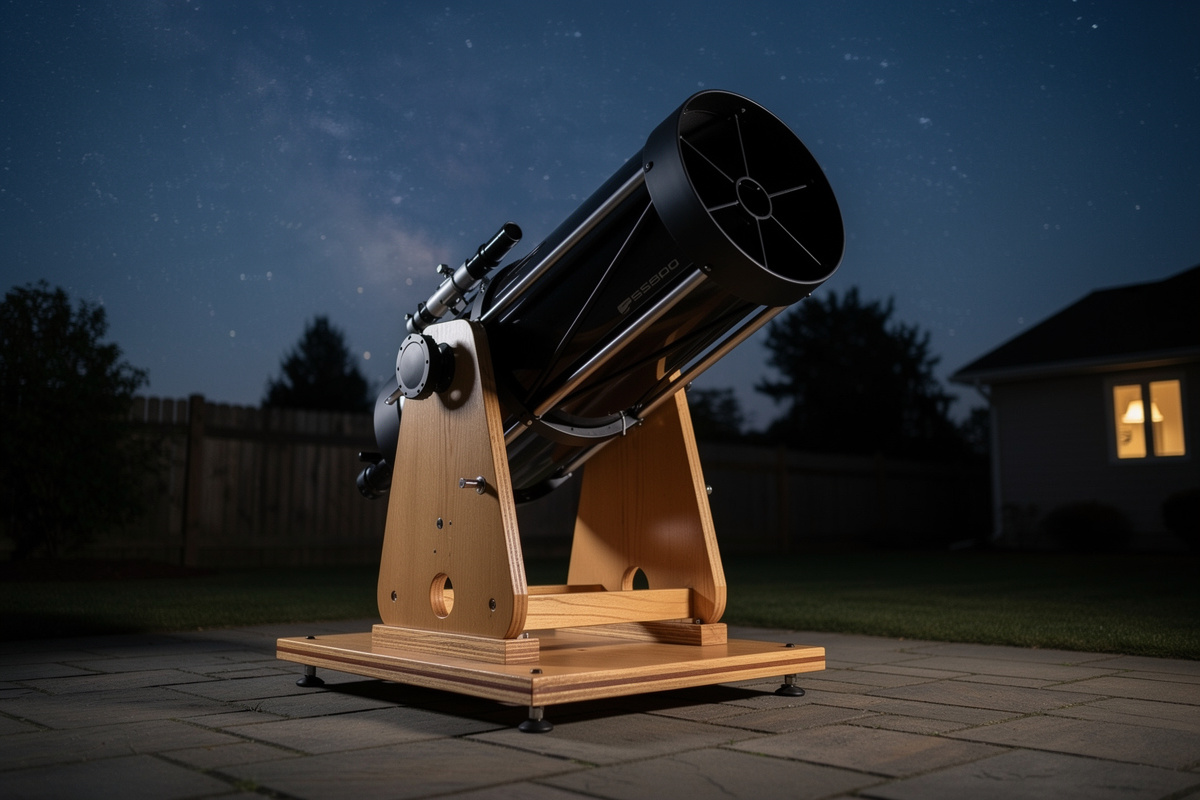
A Dobsonian telescope is a Newtonian reflector mounted on a simple alt-azimuth rocker box, invented by John Dobson in the 1960s. By stripping away expensive equatorial mount hardware, Dobsonians deliver the largest aperture per dollar of any telescope design — a 10-inch Dobsonian costs roughly $600 while a comparable 10-inch Schmidt-Cassegrain runs $1,800 or more.
The optical path is straightforward: light enters the open tube, bounces off a large parabolic primary mirror at the base, travels back up to a small flat secondary mirror near the front, and is directed into the eyepiece at the side. This simple two-mirror system produces sharp, high-contrast images with no chromatic aberration because mirrors do not refract light. The rocker box uses Teflon pads and a lazy-Susan bearing for smooth manual movement in altitude and azimuth, making it intuitive for beginners to point at any object in the night sky.
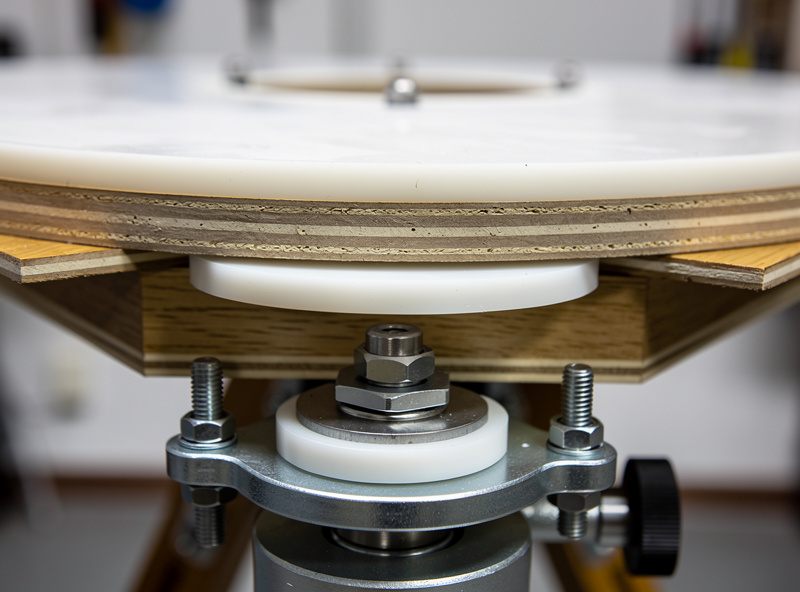
Unlike equatorially mounted telescopes, Dobsonians require no polar alignment. You simply set them on the ground and start observing. This simplicity is why most astronomy clubs recommend Dobsonians as first telescopes for visual observers.
Dobsonian Sizes: 6-Inch to 12-Inch Apertures
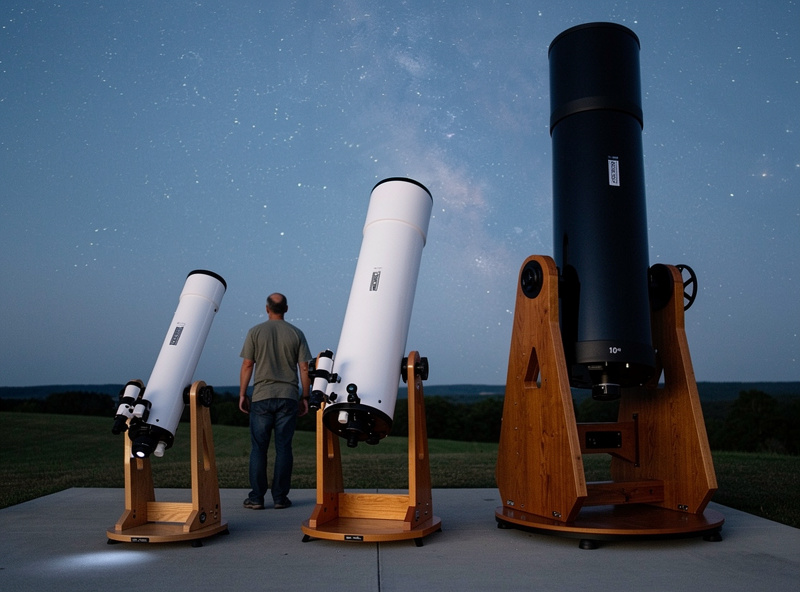
Dobsonian telescopes come in apertures from 4 inches up to 18 inches or larger for the dedicated amateur. The most popular sizes — 6, 8, 10, and 12 inch — each represent a meaningful step in light-gathering power. A 6-inch Dobsonian collects 444 times the light of the naked eye, while a 12-inch gathers 1,778 times — revealing faint galaxies and nebulae that smaller apertures simply miss.
A 6-inch Dobsonian like the Sky-Watcher Heritage 150P is ultra-portable at 20 pounds total weight and fits in a compact car trunk. The 8-inch (such as the Apertura AD8) hits the sweet spot of performance, portability, and price — it resolves the Cassini Division in Saturn’s rings on nights of good seeing and shows spiral structure in M51, the Whirlpool Galaxy. The 10-inch pushes deeper still, but at 55 pounds assembled it is a two-person load. The 12-inch aperture (like the Orion SkyQuest XX12i) reveals galaxies by the dozens in the Virgo Cluster but weighs 75 pounds and needs a dedicated vehicle to transport.
Best Dobsonian Telescopes Compared
Choosing the right Dobsonian depends on your budget, observing goals, and how far you need to carry the scope. The following table compares the most popular models currently available.
| Model | Aperture | Focal Length | Weight | Best For | Price Range |
|---|---|---|---|---|---|
| Sky-Watcher Heritage 150P | 6″ | 750mm | 20 lbs | Budget beginners, tabletop use | $200-$250 |
| Apertura AD8 | 8″ | 1200mm | 45 lbs | Best overall value, serious beginners | $500-$600 |
| Sky-Watcher Classic 200P | 8″ | 1200mm | 42 lbs | Portability with 8-inch aperture | $500-$550 |
| Zhumell Z10 | 10″ | 1250mm | 55 lbs | Intermediate observers, deep-sky | $700-$800 |
| Apertura AD12 | 12″ | 1500mm | 75 lbs | Dedicated deep-sky, star parties | $1,000-$1,200 |
| Orion SkyQuest XX12i | 12″ | 1500mm | 75 lbs | Push-to electronics, advanced use | $1,400-$1,600 |
For most first-time buyers, the 8-inch Dobsonian delivers the best balance. It resolves planetary detail comparable to much more expensive refractors and shows hundreds of deep-sky objects from dark sites. Upgrade to 10 or 12 inches only if you have a vehicle for transport and access to dark skies where the extra aperture can shine.
How to Collimate a Dobsonian
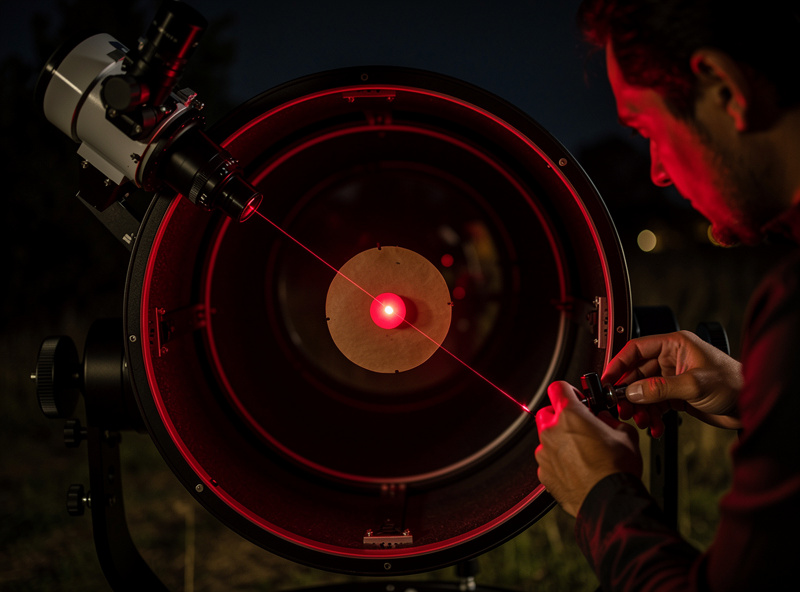
Collimation — aligning the primary and secondary mirrors — is the single most important maintenance task for any reflector telescope. A Dobsonian out of collimation delivers blurry images regardless of aperture size. The good news: collimation takes under 5 minutes with a $15 Cheshire eyepiece or a $30 laser collimator.
Start by loosening the secondary mirror adjustment screws at the front of the tube. Look through the Cheshire eyepiece and center the secondary mirror reflection on the primary mirror. Then tighten the secondary screws. Next, turn the three spring-loaded adjustment knobs on the back of the primary mirror cell until the center dot on the primary mirror appears centered in the Cheshire crosshairs. That is the entire process.
Collimate every time you set up the telescope. Transportation and temperature changes shift the mirrors slightly. A laser collimator makes the process faster, but always verify with a star test at high magnification — laser collimators themselves can be misaligned from the factory.
Transporting a Dobsonian Telescope
Dobsonians are bulkier than tripod-mounted refractors, but their two-part design separates the tube from the rocker box for easier transport. A 6-inch Dob fits across the back seat of most sedans. An 8-inch fits diagonally in a midsize SUV trunk. For 10-inch and larger models, fold the rear seats down or use a roof rack with a padded tube cradle.
Wrap the open tube end with a stretch cap or heavy-duty rubber band holding a microfiber cloth to keep dust off the primary mirror during transport. Store the tube upright when possible to prevent the secondary mirror from shifting. Never lay the tube on its side in a hot car for extended periods — thermal expansion can stress the mirror cell.
Carrying handles mounted to the rocker box (available as aftermarket accessories for $20-$40) make a significant difference for 10-inch and 12-inch models. Some observers install wheels on one end of the rocker box for roll-out transport from garage to driveway.
When to Choose a Dobsonian Over Other Designs
Dobsonians are the right choice for visual observers who prioritize aperture and simplicity. If your goal is to see as much detail as possible on planets and deep-sky objects with your eyes — not a camera — a Dobsonian gives you 2-3x more aperture per dollar than any other design.
Choose a different telescope if you need equatorial tracking for astrophotography, if you require GoTo computerized object finding (though push-to Dobsonians like the Orion Intelliscope series offer this), or if portability above all else is your priority — a 5-inch refractor on a compact tripod fits in an airplane overhead bin while even a 6-inch Dob requires a checked bag.
For backyard and driveway observing from light-polluted suburbs, a Dobsonian on your lawn sees more than a $3,000 apochromatic refractor because sheer aperture overcomes light pollution better than optical perfection in a small aperture. This is why best telescopes for beginners lists consistently place Dobsonians at the top for visual use.
Frequently Asked Questions
Are Dobsonian telescopes good for beginners?
Yes. Dobsonians require no polar alignment, have no complex mount to learn, and offer the largest aperture per dollar. An 8-inch Dobsonian shows clear Jupiter bands, Saturn’s rings, and hundreds of deep-sky objects on the first night of use.
Can you do astrophotography with a Dobsonian?
Short-exposure lunar and planetary astrophotography works well with Dobsonians. Deep-sky astrophotography requiring long exposures needs equatorial tracking, which standard Dobsonians lack. An equatorial platform can add 30-60 minutes of tracking for basic deep-sky imaging.
How much does a Dobsonian telescope weigh?
A 6-inch Dobsonian weighs about 20 pounds fully assembled. An 8-inch weighs 40-45 pounds, a 10-inch weighs 55-60 pounds, and a 12-inch weighs 70-80 pounds. The tube and rocker box separate for carrying in two trips.
What can you see with an 8-inch Dobsonian?
An 8-inch Dobsonian resolves Jupiter’s cloud bands and the Great Red Spot, Saturn’s Cassini Division, hundreds of star clusters, dozens of nebulae, and galaxies like M31 and M51 under dark skies. It collects 1,300 times the light of the human eye.
Do Dobsonian telescopes need collimation?
Yes. Collimate the mirrors before every observing session, especially after transport. A laser collimator or Cheshire eyepiece completes the process in under 5 minutes. Properly collimated mirrors are the most important factor in image sharpness.
What is the best size Dobsonian to buy?
An 8-inch Dobsonian is the best first choice for most people. It offers a meaningful upgrade over 6-inch models in light gathering while remaining portable at 45 pounds. The 10-inch is ideal for experienced observers with dark sky access.
