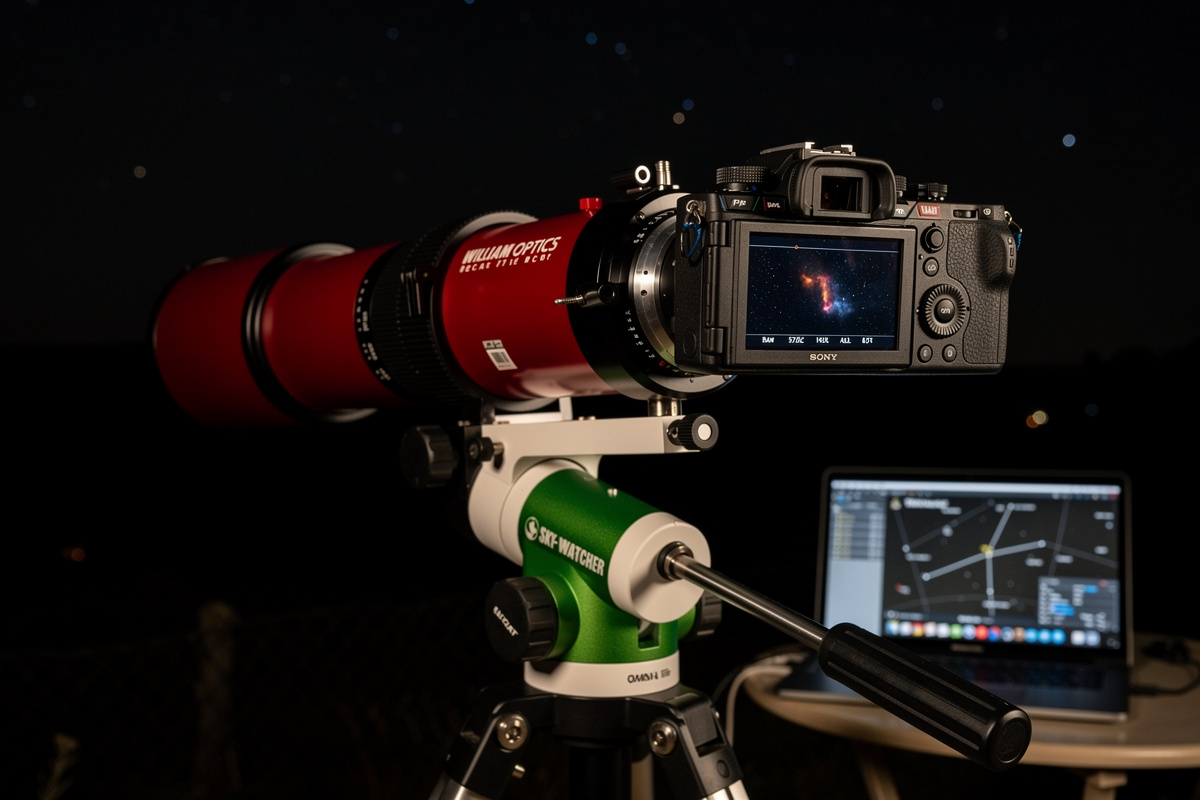

Astrophotography exposes camera sensors more harshly than any other genre. Long exposures concentrate read noise; high ISOs reveal fixed-pattern noise; cold air shifts thermal characteristics; H-alpha-rich nebulae demand red-channel sensitivity that most consumer cameras filter out. The right camera body for deep-sky work is not the same camera that wins for landscapes or wildlife. This guide walks the sensor-side decisions: full-frame vs APS-C vs dedicated astro cameras, the cooled-vs-uncooled trade-off, the modification market for stock DSLRs, and which models actually perform on real targets.
The lens-vs-telescope decision is covered in the companion article on focal length and field of view; the broader sensor-size context is covered in the full frame vs APS-C comparison. This article focuses on the camera body decisions specific to astrophotography.
The Sensor Properties That Actually Matter
Four sensor properties determine astrophotography image quality, and they are not the same properties that win daytime reviews.
1. Read noise. The noise added by the sensor and ADC during readout. Lower is better; matters most on faint deep-sky targets where signal is small. Modern back-illuminated CMOS sensors have read noise of 1.5–3 electrons; older CCDs can be 5–10 electrons.
2. Quantum efficiency at H-alpha (656nm). The fraction of red photons converted to electrons. Most stock cameras filter H-alpha aggressively (the IR-cut filter blocks it), reducing nebula recording to 20–25% of incoming photons. Astro-modified cameras hit 60–80%.
3. Dynamic range at base ISO. The ratio between maximum signal and read noise floor. Determines how many stops of detail can be recovered from shadows in stretched processing. 14+ stops is excellent; 12 is acceptable; below 11 gets noisy in deep stretches.
4. Pixel size (and well capacity). Larger pixels collect more photons per pixel but resolve less detail. The math: pixel-scale matching to optical resolution determines whether the sensor under-samples (loses detail) or over-samples (wastes resolution).
Daytime camera reviews focus on autofocus speed, frame rate, and ergonomics. None of these matter for astrophotography. The cameras that win the daylight benchmarks (Sony A1, Canon R5, Nikon Z9) are NOT necessarily the cameras that win for deep-sky imaging.
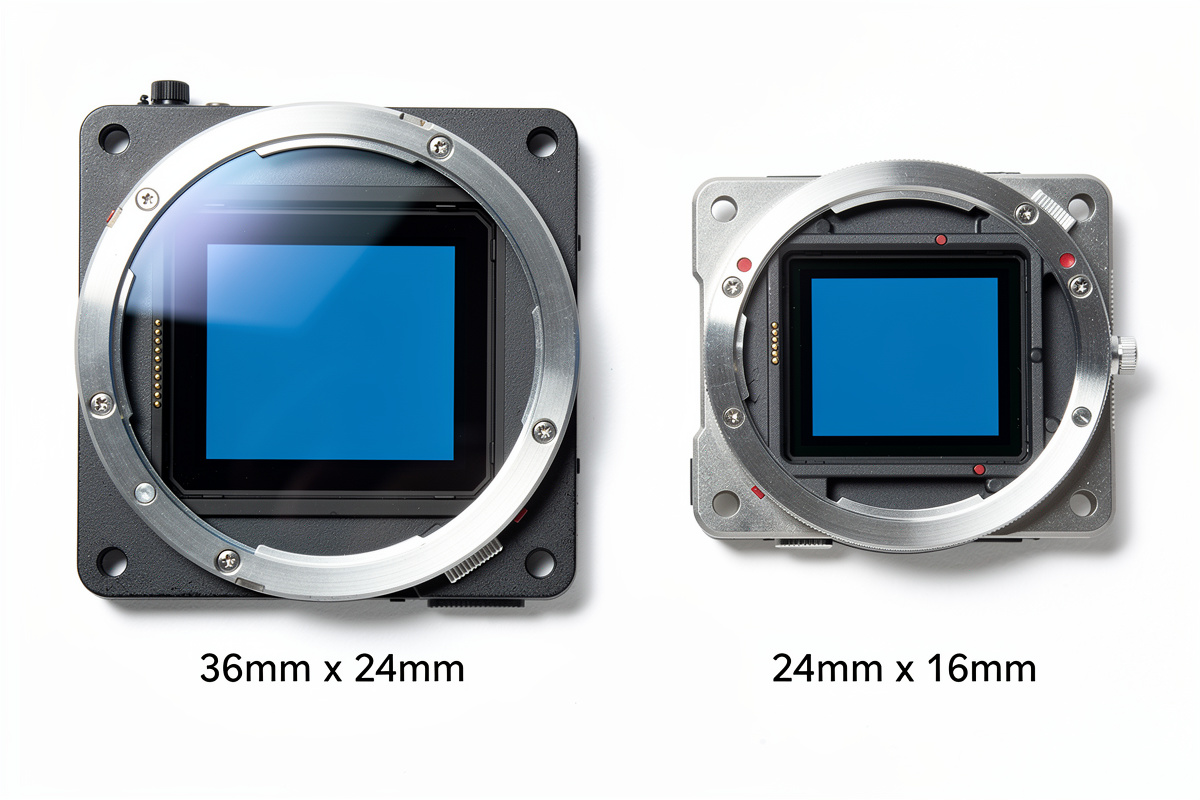
Full Frame vs APS-C: The Sensor Size Decision
Both work; they suit different targets.
Full-frame advantages for astrophotography:
- Larger pixels at equivalent megapixel count = lower noise per pixel
- Wider field of view at the same focal length (better for Milky Way, large nebulae)
- Better low-light performance at high ISO
- More dynamic range at base ISO (typically 1-2 stops more)
APS-C advantages for astrophotography:
- 1.5x crop factor effectively extends focal length (better for distant galaxies)
- Smaller sensor area = less light pollution gradient across the frame
- Cheaper bodies often have better low-noise sensors than budget full-frames
- Smaller files = faster post-processing for large image stacks
The full frame vs APS-C guide covers the broader trade-offs. For astrophotography specifically, the rule: full-frame for wide-field Milky Way and large nebulae work; APS-C when you want to tighten the framing on distant galaxies without buying a longer lens.
The crop-factor math matters: a 200mm lens on APS-C frames like a 300mm lens on full-frame. For a $1,500 telephoto budget, an APS-C body + 200mm lens might frame galaxies tighter than a full-frame body + 200mm lens, at significantly less weight. The trade-off is per-pixel noise; APS-C is usually 1 stop noisier at equivalent ISO.
Stock DSLR vs Astro-Modified DSLR vs Dedicated Astro Camera
The modification spectrum for cameras used in deep-sky imaging:
Stock DSLR or mirrorless. Records what the manufacturer ships. The IR-cut filter blocks 75-80% of H-alpha emission, reducing nebula color and detail. Acceptable for Milky Way wide-field, lunar, planetary imaging where H-alpha is not relevant. Inadequate for emission nebula imaging without significant processing compensation.
Full-spectrum modified. The IR-cut filter is removed entirely. Camera now sees H-alpha at full sensitivity, but daytime use becomes problematic without an external IR-cut filter on each lens. Costs $250-500 to convert. Reversible. Recommended for cameras dedicated to astrophotography.
Astro-modified (H-alpha replacement filter). The stock IR-cut is replaced with a custom filter that passes H-alpha (656nm) but blocks IR above 700nm. Nebula color is excellent; daytime use works without external filter (though color balance shifts to red). The middle path. $300-450 to convert. Performed by Hutech, Spencers Camera, or Kolari.
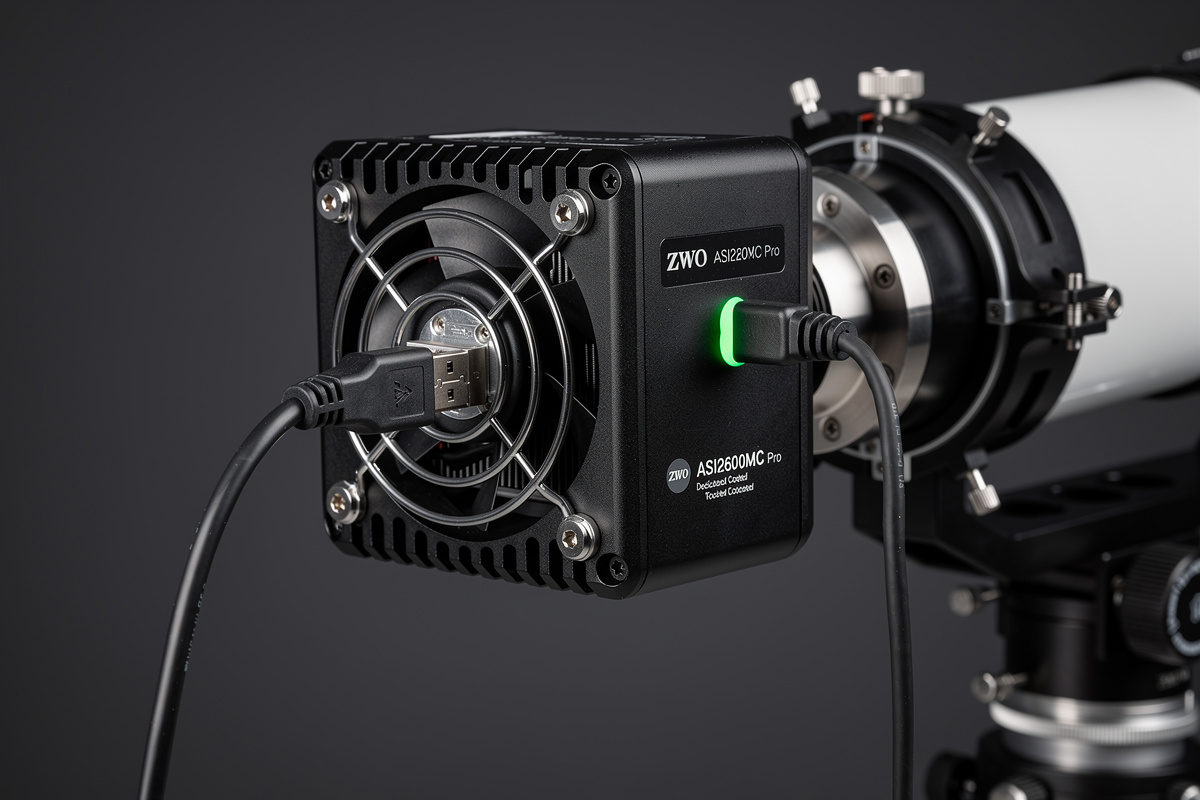
Dedicated cooled astro camera. Purpose-built for astrophotography. Active thermoelectric cooling drops sensor temperature 30-40°C below ambient, dramatically reducing thermal noise on long exposures. Higher quantum efficiency. No live view, no autofocus, no general photography. Brands: ZWO, QHY, Atik, Player One. Prices $300 (mono planetary) to $5,000 (full-frame cooled OSC).
For most photographers transitioning into deep-sky work, the progression is: shoot with stock body to learn the workflow, modify the body once committed, eventually add a dedicated astro camera as the deep-sky tool while the modified DSLR continues for travel and wide-field. The mirrorless vs DSLR comparison covers the body-side considerations that affect this progression.
Best Stock Cameras for Astrophotography
The cameras that perform best for astrophotography out-of-box, by sensor size:
Full-frame stock options:
- Sony A7 III ($1,400 used): Excellent low-noise sensor, good battery life, stable LCD that handles long exposures. The home-astrophotographer favorite.
- Sony A7S III / A7S II ($2,000-3,000): 12MP sensor with huge pixels. Best dynamic range and low-light of any consumer body. Excellent for wide-field Milky Way.
- Canon R6 ($1,400 used): Good for nightscape and wide-field. Stock H-alpha response is mediocre but acceptable.
- Nikon Z6 II ($1,300): Excellent dynamic range, good color. Strong all-around.
APS-C stock options:
- Sony A6700 ($1,400): Modern BSI sensor. Crop factor extends focal length usefully.
- Fujifilm X-T5 ($1,700): Strong base ISO dynamic range. Color science suits nebula post-processing.
- Used Nikon D7500 or D500 ($600-900): The DSLR option for entry-level astro photographers wanting to modify the camera later.
The camera buying guide covers the broader camera selection decisions for photographers who don’t yet have a body and need to balance astro use against general photography.
Dedicated Astro Cameras: When They Make Sense
Dedicated astro cameras (ZWO, QHY, Player One) are not “better DSLRs.” They are different tools for the deep-sky-only workflow.
Where dedicated astro cameras win:
- Cooled sensors hold thermal noise stable across hours of imaging. A 10-minute DSLR exposure shows visibly more noise than a 10-minute cooled-camera exposure on the same sensor.
- Full quantum efficiency. Most astro cameras are designed without IR-cut filters and with peak sensitivity at H-alpha and OIII wavelengths.
- Lower read noise. Modern back-illuminated cooled cameras hit 1.0-1.6 electrons read noise; even excellent DSLRs are 2-3 electrons.
- Long-exposure dynamic range. The cooled noise floor enables longer single-frame exposures (15-30 minutes) without thermal saturation.
Where DSLRs/mirrorless still win:
- Portability and battery life
- Wide-field Milky Way (camera lenses + tracker setup)
- Daytime use of the same body
- Lower upfront cost for getting started
Recommended dedicated astro cameras by application:
| Application | Camera | Sensor | Price |
|---|---|---|---|
| Wide-field cooled OSC | ZWO ASI2600MC Pro | APS-C, 26MP | $2,000 |
| Deep-sky cooled OSC | ZWO ASI533MC Pro | 1″, 9MP | $1,200 |
| Mono narrowband | ZWO ASI2600MM Pro | APS-C, 26MP mono | $2,400 |
| Planetary | ZWO ASI678MC | 1/1.7″ small pixel, fast frame rate | $300 |
| Full-frame cooled | QHY 600M Pro / ZWO ASI6200 | Full-frame, 61MP | $4,000-5,000 |
For most home deep-sky photographers, the ASI533MC Pro is the best entry-level dedicated astro camera at $1,200. Smaller field than APS-C but excellent quantum efficiency and zero thermal artifacts.
Pixel Scale: Matching Camera to Telescope
The math that determines whether the camera and telescope work well together:
Pixel scale (arcseconds/pixel) = (pixel size in microns × 206) ÷ focal length in mm
For sharp deep-sky images, target a pixel scale of 1-3 arcseconds per pixel. Below 1 arcsec/pixel: over-sampled, no extra detail, just bigger files. Above 3 arcsec/pixel: under-sampled, stars look blocky.
Worked examples:
- Canon R6 (full-frame, 5.95μm pixels) on William Optics Z61 (360mm focal length): 5.95 × 206 ÷ 360 = 3.4 arcsec/pixel. Under-sampled — stars will look pixelated.
- Sony A7 III (full-frame, 5.91μm) on Astro-Tech 102mm refractor at 700mm: 5.91 × 206 ÷ 700 = 1.74 arcsec/pixel. Well-matched.
- ZWO ASI533 (3.76μm pixels) on William Optics Z61 (360mm): 3.76 × 206 ÷ 360 = 2.15 arcsec/pixel. Well-matched.
The pattern: small-pixel astro cameras pair with short telescopes; large-pixel full-frame cameras pair with longer telescopes. Bin pixels (combine 2×2 in software) when you need to use a small-pixel camera on a short scope.
Image Stacking: Why Total Integration Matters More Than Camera
For deep-sky imaging, total integration time matters more than which camera you use within reasonable bounds.
“Total integration” is the cumulative exposure time across all frames in a stack. A typical deep-sky image pulls 50-200 frames at 2-10 minute exposures = 3-15 hours of integration per target, often spread across 2-4 nights.
The signal-to-noise math: noise reduces by the square root of integration time. Doubling integration time halves shot noise. Going from 1 hour to 4 hours of total integration produces a visibly cleaner image; from 4 hours to 16 hours produces another clear improvement; from 16 hours to 64 hours diminishes returns.
Most beginner astrophotographers obsess about camera selection while underspending on total integration. A modified DSLR with 4 hours of integration outperforms a cooled astro camera with 30 minutes, every time.
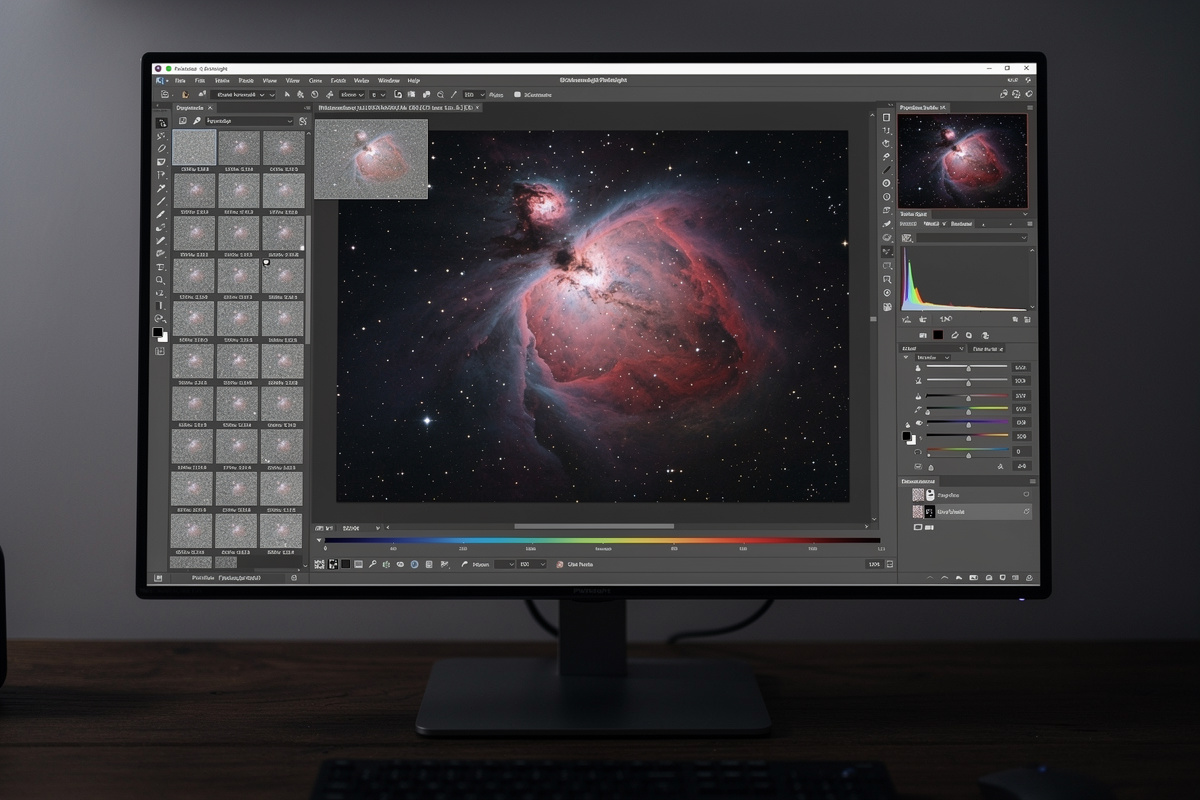
Practical implication: get the cheapest acceptable camera, then spend the savings on time. The camera lens guide covers the lens selection that pairs with the camera; the prime vs zoom lens guide covers the aperture trade-off that matters more than camera body specs.
Do I need a special camera for astrophotography?
No, any modern DSLR or mirrorless camera works for wide-field Milky Way and lunar imaging. For deep-sky nebula work, an astro-modified camera (with H-alpha-friendly filter) or a dedicated cooled astro camera produces noticeably better results. Most photographers start with a stock body and modify it once committed.
Is full-frame or APS-C better for astrophotography?
Full-frame for wide-field Milky Way and large nebulae work because of better low-light performance and wider field of view. APS-C for distant galaxies because the 1.5x crop factor effectively extends focal length without buying a longer lens. Both work; the choice depends on which targets you prioritize.
What is the best beginner camera for deep-sky astrophotography?
Used Sony A7 III (around $1,400) for wide-field. ZWO ASI533MC Pro cooled camera ($1,200) for dedicated deep-sky imaging. The Sony does dual duty for general photography; the ZWO is purpose-built. Most beginners start with the Sony and add the ZWO later.
Should I modify my DSLR for astrophotography?
Yes if it is a dedicated astro camera, no if it is your primary general-purpose camera. The H-alpha modification (around $300) dramatically improves emission nebula imaging. It is reversible but introduces some daytime color balance issues. Modify older bodies you no longer use for daytime.
How much does a complete astrophotography setup cost?
Wide-field starter: $2,500-3,500 (camera + fast lens + tracker). Mid-range deep-sky: $3,500-5,000 (small refractor + EQ mount + dedicated camera). Serious deep-sky: $6,000-12,000 (larger refractor + premium mount + cooled mono camera + filter wheel). Cost scales with target size and total integration goals.
Why is a cooled camera better for astrophotography?
Long exposures generate thermal noise that scales with sensor temperature. Cooling the sensor 30-40C below ambient reduces thermal noise by 8-16x. This enables single-frame exposures of 15-30 minutes versus 2-5 minutes on uncooled DSLRs, plus reduces the calibration frames required.
Related Articles
- Astrophotography Guide: Equipment, Settings, and Techniques — telescope-side equipment
- Telescope Buying Guide 2026 — telescope selection
- Reflector vs Refractor Telescope — optical design choice
- Astronomy for Beginners — sky knowledge that helps composition
- Dark Sky Locations — where to use the camera
