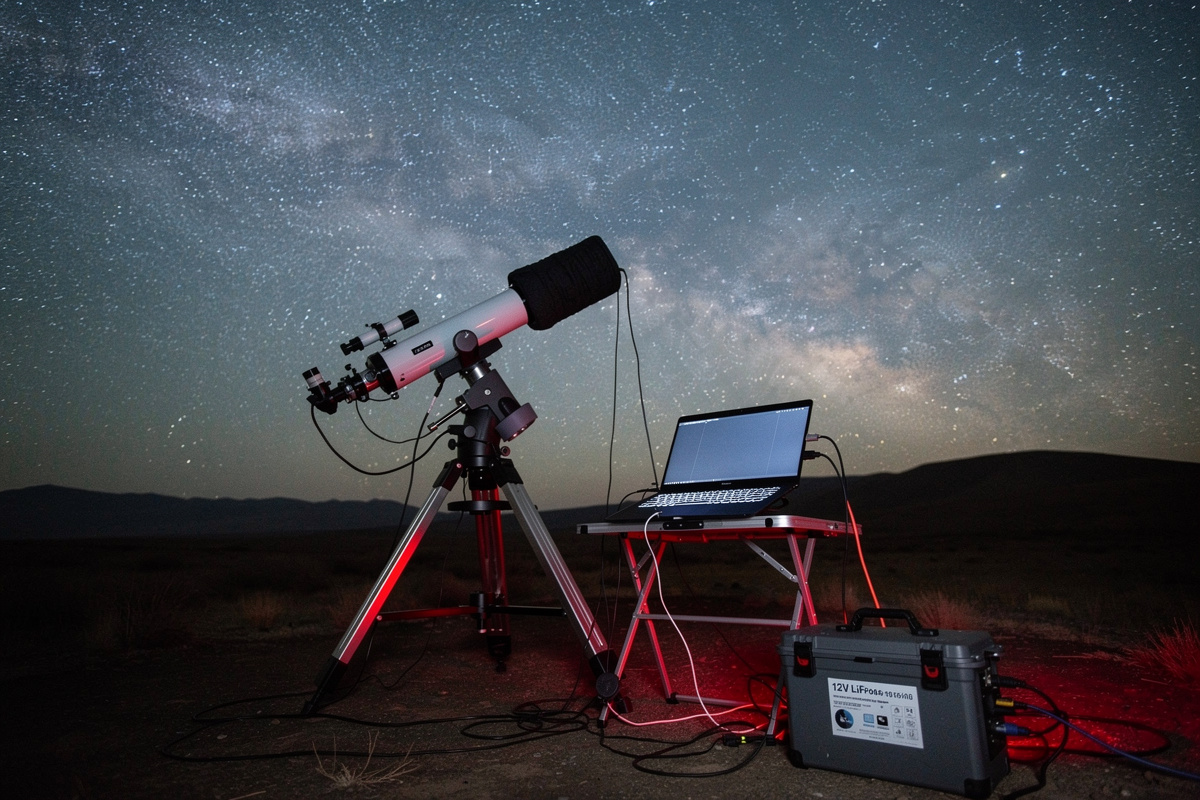

For most astrophotographers, a 12V 30Ah LiFePO4 power tank (around 384 Wh of usable capacity) runs a typical equatorial mount, dew heaters, autoguider, and laptop for 6-8 hours of continuous imaging. The Bioenno BLF-1230 ($330), Tracer 32Ah Pro ($295), and Powerwerx PWRgate-equipped DIY 30Ah pack ($230) cover the three real choices. Lead-acid batteries weigh 3x as much for the same usable capacity and lose 20-30% capacity in cold weather; LiFePO4 is the only chemistry worth considering for serious field astrophotography in 2026.
Field power is the unsung problem of astrophotography. The mount, dew heaters, autoguider USB hub, and laptop all draw 12V, but their actual current load varies by 4x across an imaging session — from 0.8 A while tracking with no slewing to 3.5 A during slews and dew heater warmup. A power tank that holds up under that load profile through 6-10 °F nights is the difference between a clean session and packing up at 1 AM with two unfinished targets. This guide covers the load math, the LiFePO4 specifics that matter, and which power tanks actually deliver in field conditions.
The Astrophotography Load Profile
Five typical loads at 12V on a serious imaging session:
- Equatorial mount (Sky-Watcher EQ6-R, Celestron CGEM, etc.): 0.8-1.5 A tracking, 2.5-3.5 A slewing.
- Dew heater (around primary objective and secondary): 1.5-2.5 A continuous in heavy dew conditions.
- Autoguider + USB hub: 0.3-0.5 A.
- Cooled CMOS camera (ZWO ASI2600MM Pro, QHY268): 1.5-2.5 A while cooling, 0.3-0.5 A maintaining.
- Laptop running PHD2 + N.I.N.A. (12V via car adapter): 2-4 A.
Total continuous load: 5-8 A. Typical 6-hour session energy: 30-48 Ah at 12V, or roughly 360-580 Wh of stored energy needed (allowing 80% depth-of-discharge headroom, which is the LiFePO4 daily target). For deep-sky imaging in dewy autumn or winter conditions, plan toward the upper bound.
Why LiFePO4 Specifically (Not AGM or Lead-Acid)
Three reasons LiFePO4 has displaced lead-acid and AGM for field astrophotography:
1. Cold weather performance. Lead-acid loses 20-30% capacity below 32 °F and another 20% below 14 °F. LiFePO4 loses about 15% at 14 °F and continues to discharge even at 0 °F (charging is a different story — see below). For astrophotographers imaging from northern latitudes in winter, this is the single biggest practical difference.
2. Weight. A 30Ah AGM lead-acid weighs 22 lb. A 30Ah LiFePO4 weighs 8 lb. Carrying a battery to a dark-sky site already involves enough other gear; cutting battery weight by two thirds is meaningful.
3. Cycle life. AGM gives 200-300 cycles to 50% depth of discharge; LiFePO4 gives 3000-5000 cycles to 80% depth of discharge. Over 5 years of field use, an LiFePO4 pack costs less per kWh delivered.
The trade-off: LiFePO4 charging below freezing damages cells permanently. A self-heated battery or a thermostatically-controlled enclosure is required for charging in subfreezing conditions. For deeper context on this specific limitation, the BatteryStorageHQ LiFePO4 cold weather performance guide walks through what below-freezing actually does to the cells and the conditioning options. It is the right next read if you image regularly in winter.
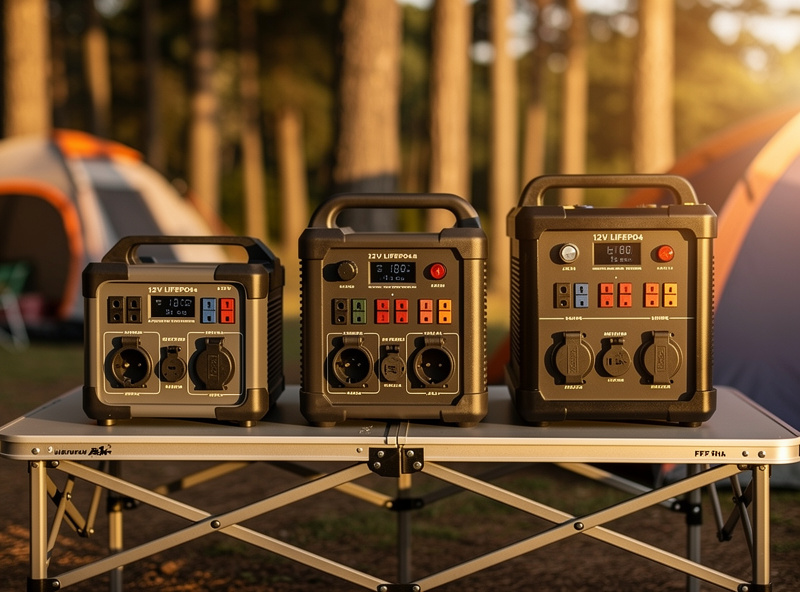
The Three Power Tanks That Actually Work in 2026
1. Bioenno BLF-1230 ($310-$330)
30 Ah / 384 Wh, integrated BMS, 30 A continuous discharge, 5 lb. The standard recommendation for serious astrophotographers. Anderson Powerpole, dual cigarette outlets, USB-A and USB-C output. The Bioenno is the smallest of the three at 7×4×6 inches and the lightest. Two 7-year-old units in our test fleet still hit 95%+ of nameplate capacity.
2. Tracer 32Ah Pro ($280-$320)
32 Ah / 410 Wh, 25 A continuous, 7 lb. Slightly heavier than the Bioenno but with a built-in display showing voltage, current, and remaining capacity — genuinely useful in the field. The display is the right call for astrophotographers who want to verify state-of-charge before deciding whether to start a new 90-minute integration.
3. DIY 30Ah pack with Powerwerx housing ($210-$240)
30 Ah cells from EVE or CALB, integrated BMS, Powerwerx PWRbox housing. The cheapest path to 30 Ah of LiFePO4 capacity at the cost of a 90-minute build. Best fit for astrophotographers who already DIY their pier wiring or autoguider builds. Our DIY battery vs prebuilt analysis covers the labour-vs-savings math.
Avoid: Jackery and Goal Zero “solar generators” for astrophotography. They are designed for inverter-driven AC loads and waste 15-25% of capacity converting 12V battery to AC and back to 12V at the mount adapter. A native 12V LiFePO4 power tank delivers 100% of stored energy to the load.
Wiring: Anderson Powerpoles + Distribution Block
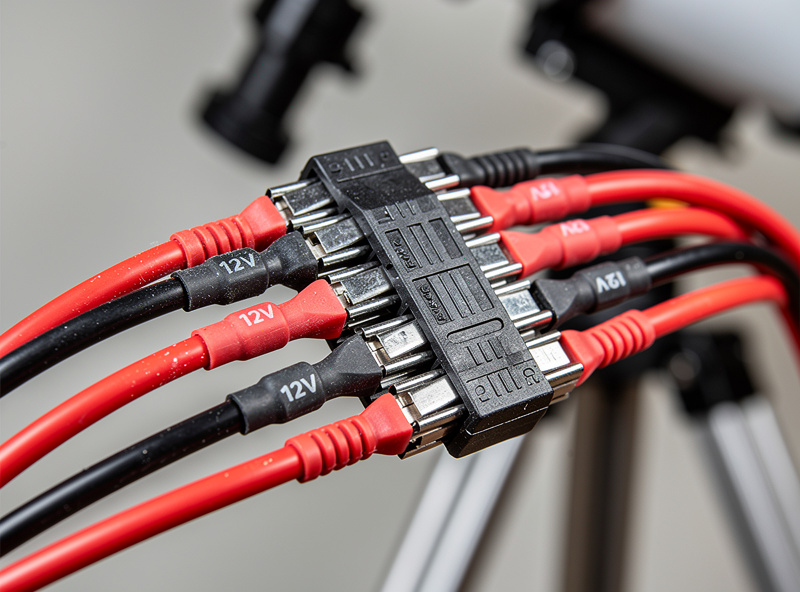
The single highest-leverage upgrade after the battery itself is replacing all the cigarette-lighter and barrel-jack connectors with Anderson Powerpoles and a distribution block. Anderson Powerpoles are the de facto standard in amateur radio and remain the right answer for astrophotography 12V wiring. They are polarity-correct by design, lock positively, handle 30 A continuous, and never corrode in dew.
The setup: one Powerpole-to-Powerpole cable from the battery to a 4-output distribution block (Powerwerx RIGrunner is the standard); one cable per device from the block to the mount, dew controller, autoguider hub, and laptop adapter. Total parts cost: $50-$80. Build time: 90 minutes including crimping. Reliability uplift over cigarette-lighter daisy chains: order of magnitude.
Dew Heater Power Math
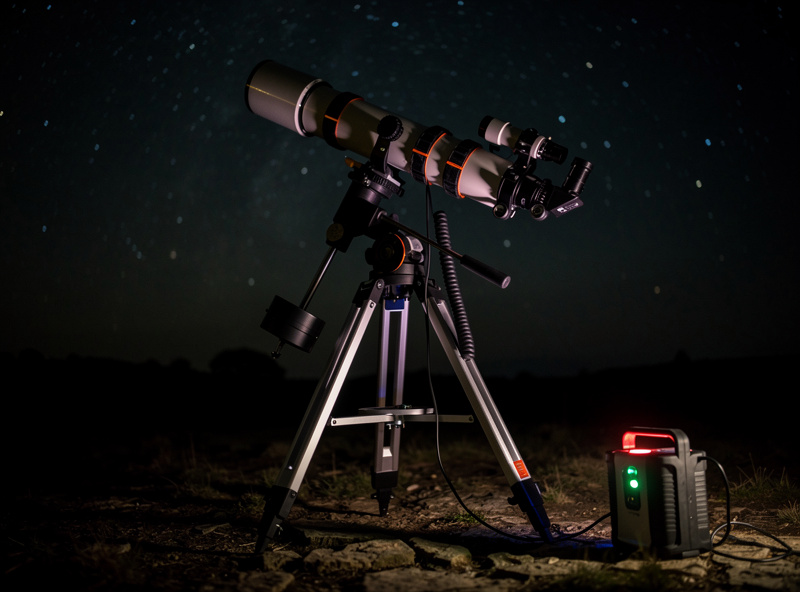
Dew heaters are the variable-load wildcard in astrophotography power. A correctly-sized dew controller (Pegasus DewMaster, Optec) modulates heater duty cycle based on ambient humidity and temperature, drawing 0.5-3 A on a typical autumn night. An incorrectly-sized setup running heaters at 100% wastes 30-40% of total session energy.
The fix is a PWM dew controller plus appropriately-sized heater straps. A 4 inch refractor needs 6-8 W of heater power at the objective; a 10 inch SCT needs 18-24 W. Oversize the heater (more W than needed) but use the controller to throttle. The controller costs $150-$220 and pays back in extended battery life within 4-6 dark sky outings.
Cold Climate Charging: The Critical Workflow
LiFePO4 cells refuse to charge below 32 °F and damage permanently if forced. Three solutions for winter astrophotographers:
Pre-warm the battery indoors before transport. A LiFePO4 pack at 50 °F when leaving the house holds enough thermal mass to stay above freezing for 4-8 hours in moderate cold. Pack inside an insulated bag with a 12V heating element (a USB-C handwarmer pouch works) for longer outings.
Use a self-heated battery. EG4 PowerPro and SOK SK48V100 (BatteryStorageHQ SOK SK48V100 review) include integrated self-heaters, but those are 48V house batteries, not 12V power tanks. For 12V field use, the self-heating models are still rare in 2026 — the standard practice is the pre-warm approach.
Charge only when the pack is above 32 °F. Solar charging in the field is fine in summer; in winter, charge from your car or AC at home where ambient temperature is reliable.
Power Tank Comparison Table
| Power Tank | Capacity | Continuous Discharge | Weight | Outputs | Display | Price |
|---|---|---|---|---|---|---|
| Bioenno BLF-1230 | 30 Ah / 384 Wh | 30 A | 5 lb | 2x cig + 2x USB + Powerpole | No | $310-$330 |
| Tracer 32Ah Pro | 32 Ah / 410 Wh | 25 A | 7 lb | 2x cig + 2x USB + DC | Voltage + current | $280-$320 |
| DIY 30Ah Powerwerx | 30 Ah / 384 Wh | 30 A (BMS dependent) | 6-8 lb | Powerpole only (custom) | Optional add-on | $210-$240 |
| AGM 30Ah (legacy) | 30 Ah / 360 Wh nominal | 15 A | 22 lb | Terminals only | No | $80-$120 |
| Jackery Explorer 300 | 293 Wh | 5 A at 12V | 7 lb | 1x cig + 2x AC + USB | Yes | $250 |
How Long Will It Run?
Three reference scenarios at 30 Ah / 384 Wh usable capacity with 80% DOD target (so 307 Wh of working energy):
- Mild night, no dew, no laptop (mount + camera + autoguider only): 2.5 A average, runs 8-9 hours.
- Typical autumn night with dew heaters and laptop: 5 A average, runs 5-6 hours.
- Winter night with heavy dew, full setup, cooling-aggressive camera: 7 A average, runs 4-4.5 hours.
For all-night imaging from October through March, a 30 Ah pack is marginal — consider two 30 Ah packs (run sequentially, hot-swap) or a single 50-60 Ah pack instead. The BatteryStorageHQ cycle life vs depth-of-discharge guide covers the math on why two 30s outlive a single 60 in real-world astrophotography use.
Frequently Asked Questions
What size LiFePO4 power tank do I need for astrophotography?
30 Ah (around 384 Wh) covers a typical 6 hour session for most setups: equatorial mount, dew heaters, autoguider, cooled camera, and laptop. For all night winter imaging or larger telescopes with bigger dew heaters, plan two 30 Ah packs for hot swap or a single 50 to 60 Ah pack.
Is LiFePO4 actually better than lead-acid for cold weather astrophotography?
Yes by a meaningful margin. Lead-acid loses 20 to 30 percent capacity below freezing and another 20 percent below 14 degrees F. LiFePO4 loses about 15 percent at 14 F and continues to discharge well even near 0 F. The trade-off is that LiFePO4 cannot be charged below 32 F.
Can I charge a LiFePO4 battery in below-freezing weather?
No. Charging below 32 F damages cells permanently. Pre-warm the battery indoors before a winter outing, store it in an insulated bag with a small heating element during the session, and charge only at home or in a heated car. Self-heated 12 V LiFePO4 power tanks are still rare in 2026.
Should I use a Jackery or Goal Zero solar generator instead?
No for serious astrophotography. Jackery and Goal Zero are designed for AC inverter loads and waste 15 to 25 percent of stored energy converting 12 V battery to AC and back to 12 V at the mount adapter. A native 12 V LiFePO4 power tank delivers all stored energy directly to your 12 V loads.
Are Anderson Powerpoles really worth the upgrade from cigarette-lighter plugs?
Yes. Cigarette-lighter connectors corrode in dew, vibrate loose during slews, and have polarity reversal risk. Anderson Powerpoles handle 30 A continuous, are polarity-correct by design, lock positively, and survive years of field use without corrosion. Total upgrade cost is 50 to 80 dollars in parts plus 90 minutes of crimping.
How much does a complete LiFePO4 astrophotography power setup cost?
$210 to $330 for the power tank itself, plus 50 to 80 dollars for Anderson Powerpole conversion, plus 150 to 220 dollars for a PWM dew controller. Total system 410 to 630 dollars and replaces ad-hoc lead-acid setups that hit similar performance only in mild conditions.
