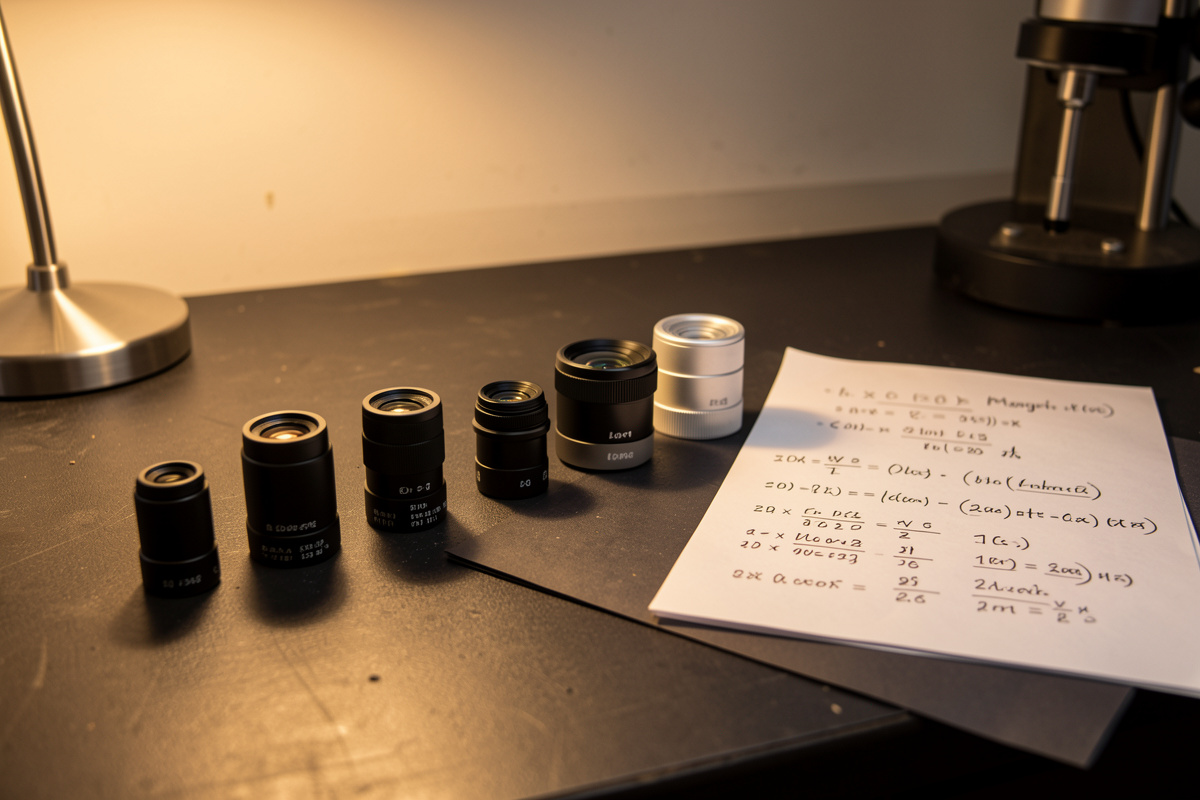

Magnification equals your telescope’s focal length divided by the eyepiece’s focal length. A 1500mm scope with a 10mm eyepiece gives 150x; the same scope with a 30mm gives 50x. That one ratio decides every view you get, and learning it is the difference between buying eyepieces on purpose and buying them by guesswork.
I run the same eyepieces across a fast 12-inch Dobsonian, a 100mm apo, an 8-inch SCT, and a 127mm Maksutov, and the most useful habit I ever built was reading an eyepiece’s focal length and instantly knowing the magnification, exit pupil, and field it would give in whichever scope it was going into. This is that habit, written down.
The magnification formula, and what the millimetre number means
The number stamped on an eyepiece — 32mm, 17mm, 10mm, 5mm — is its focal length in millimetres. Divide your telescope’s focal length by it and you have the magnification. So the magnification you get is never a property of the eyepiece alone; it is the eyepiece and the scope together. My 100mm apo has a 550mm focal length, so a 10mm eyepiece gives 55x in it. My SCT has a 2032mm focal length, so the identical 10mm gives 203x. Same glass, nearly four times the magnification, purely because the telescopes differ.
This is why “what magnification is this eyepiece” is the wrong question and “what magnification does this eyepiece give in my scope” is the right one. Find your scope’s focal length (printed on the tube or in the manual), and every eyepiece purchase becomes arithmetic instead of a gamble.
Exit pupil: the brightness number nobody mentions
Exit pupil is the diameter of the pencil of light leaving the eyepiece and entering your eye, and it sets how bright the image looks. It equals the eyepiece focal length divided by the scope’s focal ratio — a 25mm eyepiece in an f/5 scope gives a 5mm exit pupil. It also equals the aperture divided by the magnification, which is the same thing seen from the other end.
Why it matters: a young dark-adapted eye opens to about 7mm, an older one closer to 5mm. An exit pupil larger than your eye can accept just throws light away around the edge of your pupil, and a very small exit pupil below about 0.5mm makes the image dim and starts showing floaters in your own eye. The sweet spot for low-power deep-sky work is a 4 to 6mm exit pupil — that is the bright, immersive view that hooks people. For planets you deliberately go small, down to around 1mm, trading brightness for magnification on a target that has light to spare.
The useful magnification window
There is a ceiling and a floor. The ceiling is roughly 50x per inch of aperture — about 250x for a 5-inch scope, around 600x for my 12-inch on paper. But that paper limit assumes perfect atmosphere, and from my Nordic latitude planets ride low through unsteady air, so seeing caps most of my real planetary views at 200x to 300x no matter what eyepiece I drop in. Push past what the night allows and you get a big, dim, mushy blur, not more detail. This is the empty-magnification trap that ruins a beginner’s first look at Saturn.
The floor is set by exit pupil. Once the exit pupil climbs past about 7mm, you are wasting aperture, so on a fast scope there is a longest eyepiece worth owning. On my f/4.9 Dob a 35mm eyepiece already gives a 7.1mm exit pupil, so going longer buys nothing. On a slow f/12 Maksutov you could use a much longer eyepiece before hitting that wall, which is one reason slow scopes and short eyepiece kits go together. If you observe planets specifically, it is worth reading how seeing and aperture set the practical limit in the best magnification for planets guide before you buy the shortest eyepiece you can find.
True field: why low power finds things
True field of view is the actual patch of sky you see, and it equals the eyepiece’s apparent field divided by the magnification. Lower magnification means a wider true field, which is why you hunt for faint targets at low power and only then zoom in. Trying to find a small galaxy at 200x is like searching a dark room through a drinking straw; find it at 50x where the field is wide, centre it, then swap to a shorter eyepiece. Apparent field is an eyepiece property and it changes the math a lot — I cover it alongside eye relief in the AFOV and eye relief guide, and the broader low-versus-high-power split in the wide-field versus planetary comparison.
Picking focal lengths for your scope
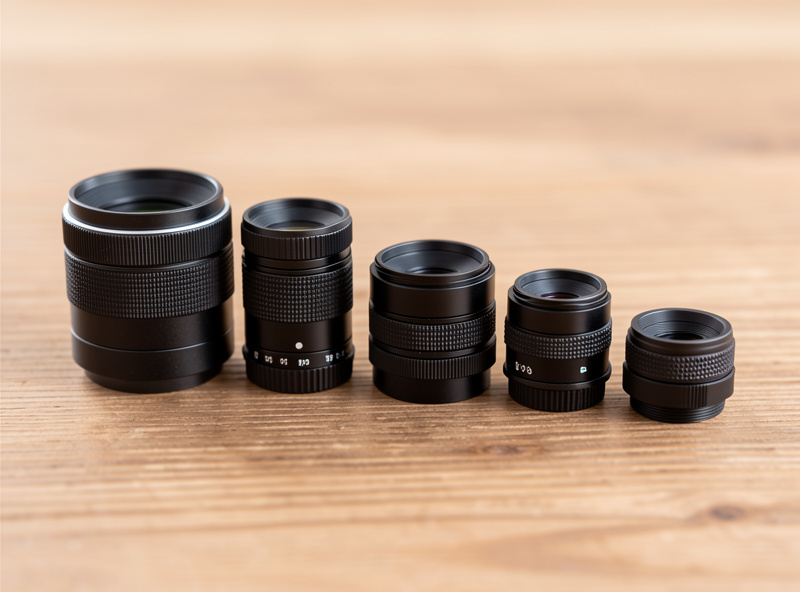
Work backwards from the magnifications you want, not the focal lengths that look tidy. A practical visual kit hits roughly 50x for sweeping and framing, around 100x for the bulk of deep-sky work, and 180x to 250x for planets and the Moon. Convert each target magnification into an eyepiece focal length by dividing your scope’s focal length by it. For my 1500mm Dob that is about a 30mm, a 15mm, and a 7mm. For a 650mm beginner refractor the same magnifications call for roughly a 13mm, a 6.5mm, and a 3mm — and that 3mm is so short it would be miserable to use, which tells you a small fast scope is better served by a Barlow than by ultra-short eyepieces. The table shows how one 20mm eyepiece behaves across my four scopes.
| Scope (focal length / ratio) | Magnification with a 20mm | Exit pupil | Character of the view |
|---|---|---|---|
| 12-inch Dob (1500mm, f/4.9) | 75x | 4.1mm | Bright medium-power, great for galaxies |
| 100mm apo (550mm, f/5.5) | 28x | 3.6mm | Wide, rich-field low power |
| 8-inch SCT (2032mm, f/10) | 102x | 2.0mm | Higher power, dimmer, lunar and planetary lean |
| 127mm Mak (1500mm, f/11.8) | 75x | 1.7mm | High-contrast medium power for Moon and planets |
The mistakes that waste money
The classic error is buying the shortest eyepiece on the shelf because higher magnification sounds better. It almost never is — the night’s seeing, not your eyepiece, sets the useful ceiling, and a 4mm eyepiece spends most evenings unused in the case. The second error is buying focal lengths in even steps (25, 20, 15, 10) that bunch up around magnifications you rarely use and leave gaps where you do. Space your eyepieces by the magnification they produce in your scope, not by tidy millimetre intervals.
If you hate swapping eyepieces in the cold — and at minus fifteen with gloves on, you will — a quality zoom eyepiece covers a whole range of focal lengths in one barrel and is the single most convenient piece I hand to visitors. It will not quite match a fixed premium eyepiece for field width, but it removes the focal-length guesswork entirely.
As an Amazon Associate I earn from qualifying purchases.
Once the math is automatic, the rest of the eyepiece decisions fall into place — which is the whole point of the telescope eyepiece guide this article sits under. Pick magnifications, not millimetres, and let the scope’s focal length do the converting.
Frequently Asked Questions
How do I calculate magnification for my telescope?
Divide your telescope’s focal length by the eyepiece focal length. A 1200mm scope with a 24mm eyepiece gives 50x. The scope’s focal length is printed on the tube or in the manual, so every eyepiece becomes a simple division.
What is the maximum useful magnification?
Roughly 50x per inch of aperture, so about 250x for a 5-inch scope. Atmospheric seeing usually caps real-world views lower, often 200x to 300x even for large apertures. Pushing past what the night allows gives a dim, blurry image, not more detail.
What is exit pupil and why does it matter?
Exit pupil is the eyepiece focal length divided by the scope’s focal ratio, and it sets how bright the image looks. A 4 to 6mm exit pupil gives bright low-power deep-sky views; around 1mm suits planets. Larger than about 7mm wastes light your eye cannot accept.
Why does the same eyepiece give different magnification in two scopes?
Because magnification depends on the telescope’s focal length, not just the eyepiece. A 10mm gives 55x in a 550mm refractor but 203x in a 2032mm SCT. Always calculate magnification for the specific scope you are using.
Should I buy the shortest eyepiece for the highest magnification?
Usually not. Seeing conditions, not the eyepiece, set the useful ceiling, so very short eyepieces often sit unused. A medium eyepiece paired with a quality Barlow reaches high power with better eye comfort and more flexibility.
