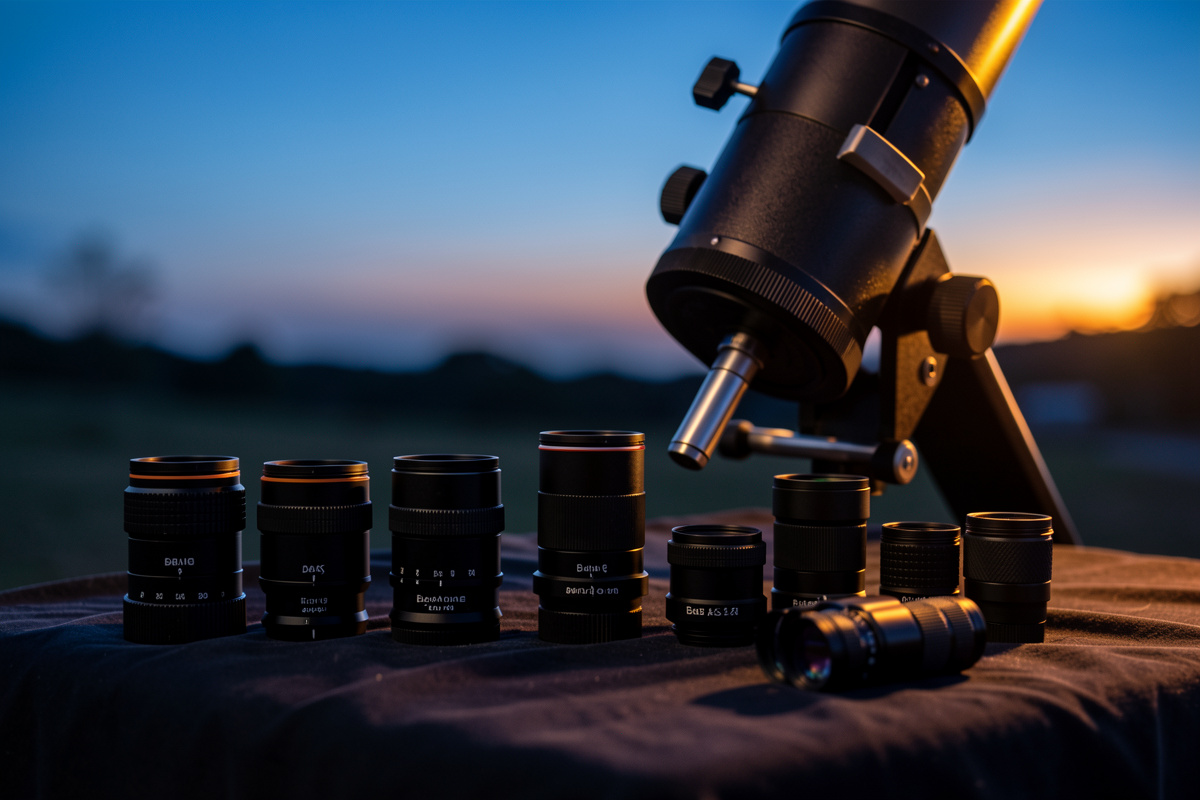

The eyepiece is half your telescope. The number every buyer fixates on is aperture, but the piece of glass you drop into the focuser decides the magnification, the field of view, and whether the night is comfortable or a squint-fest. A good 25mm eyepiece in a modest scope beats a bad 6mm in an expensive one, every time.
I have owned the lot — a 12-inch Dobsonian light bucket, a 100mm ED apo, an 8-inch SCT, and a 127mm Maksutov — and run the same eyepieces across all four from a suburban Bortle 5 backyard in Sweden and a darker Nordic site I drive to. This guide is the conversation I have when someone asks what to buy after the scope: how focal length, exit pupil, true field, and eye relief actually behave at the focuser, not on a spec sheet.
Why the eyepiece is half the optical system
Your telescope gathers and focuses light; the eyepiece magnifies that focused image and delivers it to your eye. Swap the eyepiece and you change everything the telescope shows without touching the scope itself. The objective sets the ceiling on detail and brightness, but the eyepiece decides how much of that ceiling you actually reach on any given target.
This is where most new buyers under-spend. They put a four-figure budget into aperture and then look through the two plastic-barrel Plossls that came in the box. I keep my original kit Plossls precisely so I can show people the difference: the same globular cluster through a 25mm kit piece and through a premium wide-field is not a subtle upgrade, it is a different object. The cheap glass throws away edge sharpness, contrast, and field, and it makes the scope look worse than it is. Half your optical performance lives in the eyepiece, so plan the budget that way.
The one equation that runs everything
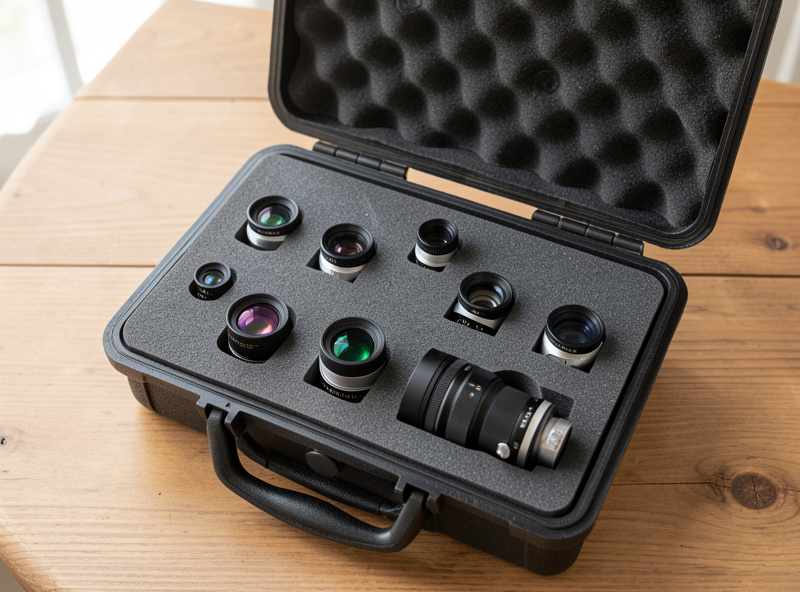
Magnification equals your telescope’s focal length divided by the eyepiece’s focal length. A 1500mm scope with a 30mm eyepiece gives 50x; the same scope with a 10mm gives 150x. That single relationship is the whole game, and once it is in your head you stop buying eyepieces by guesswork and start buying them by the view you want.
The number printed on the eyepiece — 32mm, 17mm, 10mm, 5mm — is its focal length in millimetres. Longer focal length means lower magnification and a wider, brighter view; shorter means higher magnification and a narrow, dimmer one. Exit pupil, the diameter of the light cone leaving the eyepiece, is the eyepiece focal length divided by the focal ratio, and it tells you how bright the image will look to your dark-adapted eye. I walk through the full math, the practical magnification limits, and how to pick focal lengths for your scope in the eyepiece focal length and magnification guide — it is the first thing to read if the numbers feel abstract.
How many eyepieces you actually need
Three, chosen well, cover almost everything. A low-power wide-field for finding targets and framing large deep-sky objects, a medium-power workhorse for the bulk of galaxies and clusters, and a high-power eyepiece for planets, the Moon, and double stars. Everything else is refinement. Buyers chasing a seven-piece set before they have logged twenty nights are optimizing the wrong thing.
The trap is buying eyepieces in even focal-length steps that look tidy on paper but cluster around magnifications you rarely use. I would rather own three excellent focal lengths spaced to give roughly 50x, 100x, and 200x in my scope than seven mediocre ones. If you are starting from the box kit, the upgrade order is low-power first (the view you spend most time at), then high-power, then the gap in the middle. I lay out specific curated bundles, the genuinely useful sets, and where a boxed kit makes sense versus buying piecemeal in the best eyepiece sets for 2026 roundup, and I cover the individual standout pieces in the best telescope eyepieces list.
Wide-field versus planetary: two different jobs
A wide-field eyepiece and a planetary eyepiece are built for opposite tasks, and trying to make one do both is how people end up disappointed. Wide-fields run long focal lengths and big apparent fields — 68 to 100 degrees — to sweep the Milky Way, frame the Pleiades, or hold a whole open cluster in one view at low power. Planetary eyepieces run short focal lengths for high magnification, and they prize on-axis sharpness and contrast over field width because a planet sits dead centre and small.
From my dark site, the wide-field is the eyepiece I reach for first — sweeping Cygnus at 50x with a 5mm exit pupil is the view that hooks people on the hobby. Back home under light pollution, the planetary eyepiece earns its keep on the Moon and Jupiter, where aperture and seeing matter more than darkness. The two are not interchangeable, and the budget split between them depends on what you observe and where. I break down the design differences, the eye-relief and field trade-offs, and how to choose between them in the wide-field versus planetary eyepiece comparison.
Barlows and Powermates: doubling your kit
A Barlow lens multiplies the magnification of any eyepiece it is paired with, usually by 2x, effectively turning a three-eyepiece kit into six focal lengths. A good 2x Barlow ahead of a 20mm eyepiece behaves like a 10mm, but keeps the longer eyepiece’s comfortable eye relief — which is exactly why I use one rather than buying ultra-short focal lengths that put my eyelash on the glass.
The catch is that a cheap Barlow throws away everything you saved. A poor element adds chromatic aberration, softens the image, and stacks tolerances with the eyepiece behind it, so the high-power view ends up worse than a single decent short eyepiece would have been. A Powermate is a more sophisticated, telecentric version that holds the exit pupil position steady and plays better with a long eyepiece train, which matters for imaging. I cover when a Barlow is the smart buy, what magnification factors are worth owning, and the quality floor to stay above in the Barlow lens guide, with specific picks in the best Barlow lenses roundup.
AFOV and eye relief: the comfort factors that get ignored
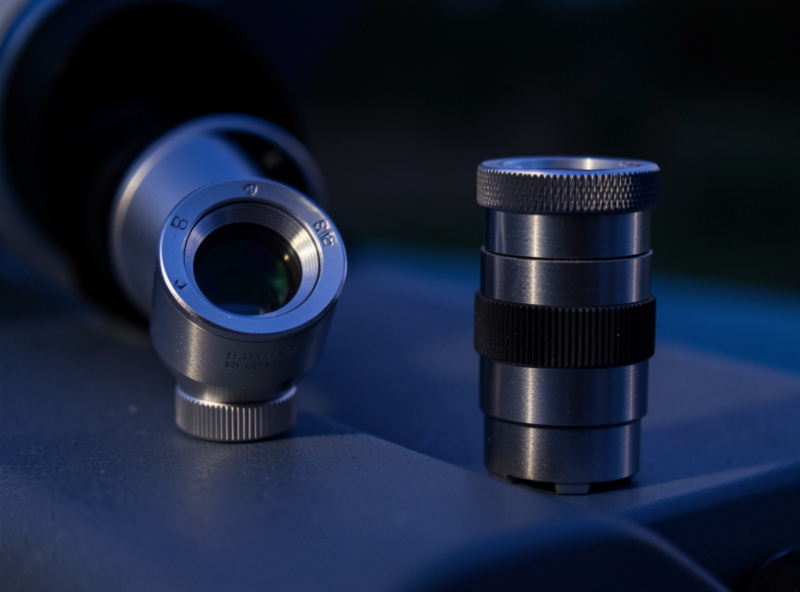
Apparent field of view (AFOV) is how wide the circle of sky looks when you put your eye to the eyepiece, measured in degrees. A 52-degree Plossl shows you a porthole; an 82-degree wide-field shows you a window you can lean into. True field — the actual patch of real sky you see — is the AFOV divided by the magnification, and it is what decides whether a target fits in the view.
Eye relief is the distance your eye sits from the eyepiece while still seeing the whole field, and it is the spec that quietly ruins short focal lengths. Many cheap 6mm eyepieces have 5 to 7mm of eye relief, which means pressing your eyeball against the glass and is unusable if you wear glasses. This is the single most common reason a new observer hates their high-power view and blames the scope. From my logs, comfortable eye relief is worth more than another five degrees of field, especially in a Nordic winter when you are observing in gloves and the eyepiece is at minus fifteen. I explain how to read both specs and what numbers actually work at the eyepiece in the AFOV and eye relief guide.
Matching eyepieces to your scope’s focal ratio
The same eyepiece behaves differently in a fast f/4.9 Dobsonian than in a slow f/12 Maksutov, and that is why owning four designs has been the most useful thing for understanding eyepieces. Fast scopes — low focal ratios — are demanding: they bend light at steep angles and brutally expose a cheap eyepiece’s edge aberrations and field curvature, so my fast Dob and apo want well-corrected wide-fields to look good across the field. Slow scopes are forgiving: my f/12 Mak and f/10 SCT make even modest eyepieces look sharp edge to edge because the light cone is gentle.
Exit pupil ties it together. A 30mm eyepiece gives a 6.1mm exit pupil in my f/4.9 Dob — bright and luxurious — but only a 2.5mm exit pupil in the f/12 Mak, a noticeably dimmer, higher-power view from the identical glass. So a long focal length that is a perfect low-power finder in the Dob is a medium-power eyepiece in the Mak. The practical lesson: buy eyepieces for the scope’s focal ratio, not in the abstract. Fast scopes reward spending on corrected wide-fields; slow scopes let you save money at low power and put it into the high-power end. The table below shows how focal length plays out in my 12-inch f/4.9 Dob.
| Eyepiece focal length | Magnification (1500mm scope) | Exit pupil (f/4.9) | What I use it for |
|---|---|---|---|
| 30mm | 50x | 6.1mm | Milky Way sweeping, large nebulae, framing big clusters |
| 17mm | 88x | 3.5mm | Galaxies, globular clusters, the all-night workhorse |
| 10mm | 150x | 2.0mm | Planetary nebulae, smaller galaxies, lunar detail |
| 7mm | 214x | 1.4mm | Planets, double stars, high-contrast lunar work |
| 5mm | 300x | 1.0mm | Planets on the rare night of excellent seeing |
Useful magnification has a ceiling set by aperture and a floor set by your eye. The rough upper limit is about 50x per inch of aperture — around 600x for the 12-inch on paper — but seeing, the steadiness of the atmosphere, almost always caps real planetary views at 200x to 300x from my latitude, where planets ride low. At the bottom, an exit pupil much above 7mm wastes light your iris cannot accept. Anyone buying for planets specifically should read how magnification interacts with seeing in the best magnification for planets guide before chasing the shortest eyepiece on the shelf.
Filters belong in the eyepiece conversation
Filters thread into the bottom of the eyepiece barrel and are part of the visual accessory kit, not a separate hobby. A narrowband UHC or OIII filter blocks the wavelengths that streetlights and skyglow pour out while passing the light emission nebulae actually emit, which can pull the Veil Nebula out of a Bortle 5 sky that shows nothing without it. A neutral-density Moon filter knocks down the glare of a gibbous Moon so the view stops dazzling your dark adaptation.
What filters cannot do is add detail a small aperture never collected, and no filter helps galaxies, which glow across the whole spectrum. The big exception, and a safety line I will not blur, is the Sun: solar observing requires a full-aperture white-light filter over the front of the scope, never an eyepiece “sun” filter, which can crack from concentrated heat and blind you. I cover visual filter selection by sky and target in the eyepiece filters for visual astronomy guide, the planetary-contrast filters in eyepiece filters for planets, the broader telescope filter types and usage reference, and solar safety in the white-light solar filter guide.
The real-friend test: my core kit and what I would tell you to buy
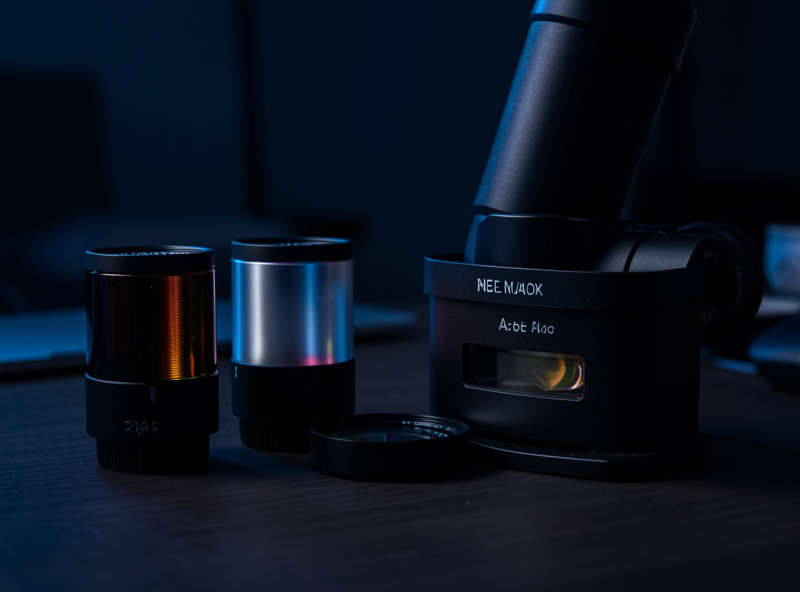
If a friend handed me their budget for eyepieces, I would not point at a flashy seven-piece case. I would buy three focal lengths that hit roughly 50x, 100x, and 200x in their scope, in the best glass the budget allows, plus one good 2x Barlow and a UHC filter. That is the kit that gets used. The premium wide-fields I reach for on showpiece nights are a luxury I added after years, not a starting point, and I am honest about that with anyone new.
For a fast Dob or apo, prioritize a well-corrected wide-field at the low-power end, because that is the view you live in and the one a cheap eyepiece ruins fastest. For a slow Mak or SCT, you can save at low power and spend the difference on a sharp short eyepiece for planets. A quality zoom eyepiece is the underrated one-purchase answer for someone who hates swapping glass with cold fingers — it is the eyepiece I hand to visitors. If you want to shop the pieces yourself, an eyepiece set, a good 2x Barlow, a zoom eyepiece, and a UHC nebula filter are the four searches I would run.
As an Amazon Associate I earn from qualifying purchases.
The same setup-and-tweak discipline that I bring to my hydroponics and 3D-printing benches shows up here: the temptation is always to optimize the one glamorous number — aperture, focal length, AFOV — while the rest of the system holds you back. A coherent eyepiece kit, matched to your scope and your sky, is what turns a good telescope into the view you actually remember.
Barrel size, parfocal kits, and the small stuff that matters
Eyepieces come in two barrel sizes: 1.25-inch, which fits every focuser, and 2-inch, which only the larger focusers accept. The 2-inch barrel exists for one reason — long focal-length, wide-field eyepieces need the extra glass to show their full field. My 30mm-and-up wide-fields are 2-inch; everything from the medium workhorse down is 1.25-inch. If your scope only has a 1.25-inch focuser, the widest true field you can ever reach is capped by that barrel, which is worth knowing before you buy a low-power eyepiece that will be stopped down.
A parfocal kit is one where the eyepieces all reach focus at nearly the same point, so swapping from 17mm to 10mm needs only a tiny focuser nudge instead of a full refocus. It sounds trivial until you are doing it in gloves at minus fifteen with the target drifting through the field. Matched sets from one product line are usually close to parfocal; mixing brands rarely is. The same goes for filters — thread a UHC into the bottom of one eyepiece and you will want it parfocal with the others so you are not refocusing every swap. These are the unglamorous details that separate a kit that gets used from one that lives in the case, and they matter more in cold-climate observing than any spec sheet admits.
Frequently Asked Questions
How many eyepieces do I really need to start?
Three is enough for almost everything: a low-power wide-field for finding and framing, a medium-power workhorse for galaxies and clusters, and a high-power eyepiece for planets and the Moon. Add a 2x Barlow before buying a fourth, since it doubles your effective focal lengths.
What does the millimetre number on an eyepiece mean?
It is the eyepiece focal length. Magnification equals your telescope focal length divided by it: a 1500mm scope with a 10mm eyepiece gives 150x. Larger numbers mean lower magnification and a wider, brighter view; smaller numbers mean higher magnification and a dimmer, narrower one.
Is a more expensive eyepiece actually worth it?
In a fast scope, yes. Low focal-ratio scopes expose a cheap eyepiece’s edge blur and field curvature, so a corrected wide-field is a real upgrade. In a slow f/10 or f/12 scope the difference is smaller, and a mid-range eyepiece already looks sharp across the field.
Why is my high-power eyepiece so uncomfortable to look through?
Short focal-length eyepieces often have only 5 to 7mm of eye relief, forcing your eye against the glass. Choose eyepiece designs with 15mm or more of eye relief, or use a Barlow with a longer eyepiece to reach high power while keeping a comfortable eye position.
Will a filter make faint galaxies brighter?
No. UHC and OIII filters help emission nebulae by blocking light pollution wavelengths, but galaxies glow across the whole spectrum, so a filter only dims them. Galaxies need aperture and a dark sky, not a filter.
Can I use the same eyepieces on different telescopes?
Yes, as long as the barrel size matches, usually 1.25-inch. The eyepiece gives different magnification and exit pupil in each scope because those depend on the telescope focal length and focal ratio, so the same 20mm behaves differently in a fast Dob than in a slow Maksutov.
