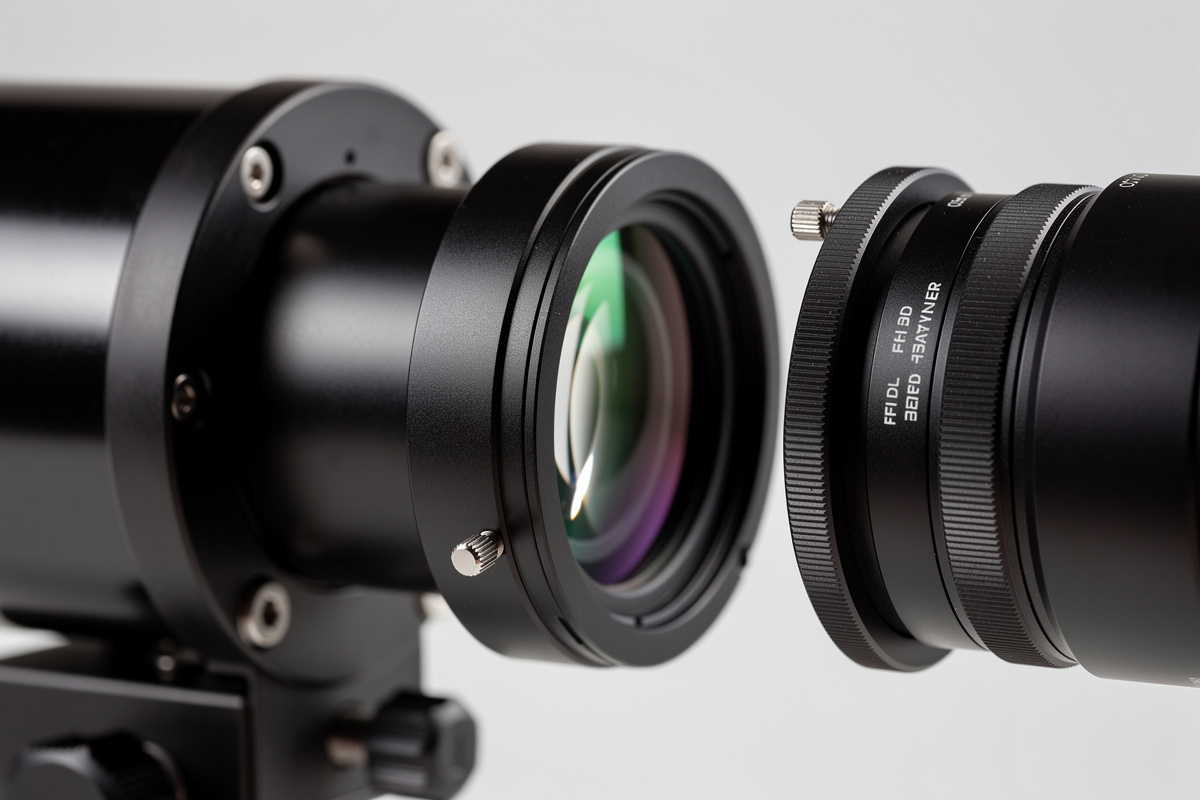

A field flattener corrects the curved focal plane that every refractor produces, turning elongated edge stars into round pinpoint stars across the entire sensor. A coma corrector fixes the comet-shaped star aberration that fast Newtonian reflectors produce at the field edges. Both accessories cost $100-300 and are essential for any refractor or Newtonian used for astrophotography with sensors larger than micro four-thirds.
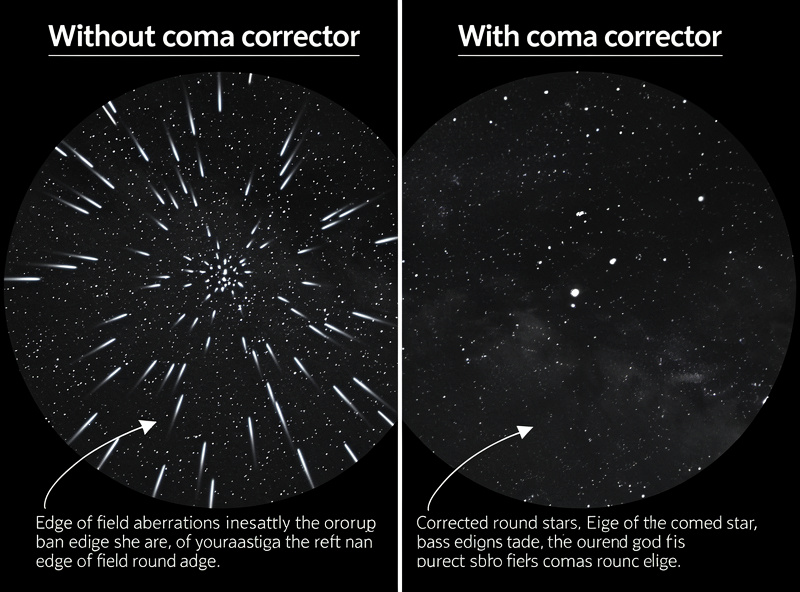
Without a field flattener or coma corrector, the center of your image shows sharp round stars while the corners show progressively elongated, distorted stars. This distortion comes from the telescope’s optical design, not from tracking errors or poor focus. No amount of processing can fix it — only the correct optical accessory placed in the light path between the telescope and camera produces round stars from edge to edge. The companion astrophotography equipment hub covers the broader chain context.
Field Flatteners for Refractors
Every refractor produces field curvature — a curved focal plane where the center focus point sits at a different distance than the edge focus point. On a flat sensor, this means either the center or the edges are in focus, but not both simultaneously. A field flattener is a lens element (usually one or two pieces of glass) placed between the telescope’s focuser and the camera that reshapes the curved focal plane into a flat one matching the sensor.
How Field Flatteners Work
The flattener adds a small amount of opposite curvature that cancels the refractor’s native field curvature. The result is a flat focal plane where stars are sharp from center to corner on a flat sensor. Flatteners also typically reduce the telescope’s focal length slightly — a 0.8x reducer-flattener on a 480mm f/6 refractor produces 384mm at f/4.8, increasing the field of view and reducing exposure time.
Field flatteners are matched to specific telescope designs and focal lengths. A flattener designed for a 600mm f/6 triplet will not work correctly on a 480mm f/5 doublet because the field curvature characteristics differ. Always buy the flattener recommended by the telescope manufacturer or one specifically designed for your telescope’s focal length and optical design. Baader publishes a complete MPCC Mark III specification sheet with back-focus, field correction, and compatibility details that is worth reading even when comparing refractor flatteners — the math is identical.
Reducer-Flatteners vs Plain Flatteners
A plain flattener maintains the telescope’s native focal length while correcting field curvature. A reducer-flattener does both — flattens the field and reduces focal length by 0.63x to 0.8x. Reducer-flatteners are more popular because they increase the field of view (framing larger nebulae), reduce exposure time (faster focal ratio), and are more forgiving of mount tracking errors (shorter focal length).
A 0.8x reducer-flattener on a 480mm f/6 refractor produces 384mm at f/4.8. This is the most popular combination for wide-field deep sky astrophotography because 384mm frames large emission nebulae like the North America Nebula and the Lagoon Nebula beautifully, and f/4.8 gathers enough light for 3-5 minute sub-exposures. The best telescopes for astrophotography spoke lists which scopes ship with matched flatteners and which require a third-party purchase.
Coma Correctors for Newtonians
Fast Newtonian reflectors (f/4 to f/5) produce coma — an aberration where stars at the field edges appear as small comets or seagulls rather than round points. Coma is inherent to parabolic mirrors and worsens with faster focal ratios. A coma corrector is a lens assembly placed in the focuser that corrects this aberration, producing round stars across the field.
Popular Coma Correctors
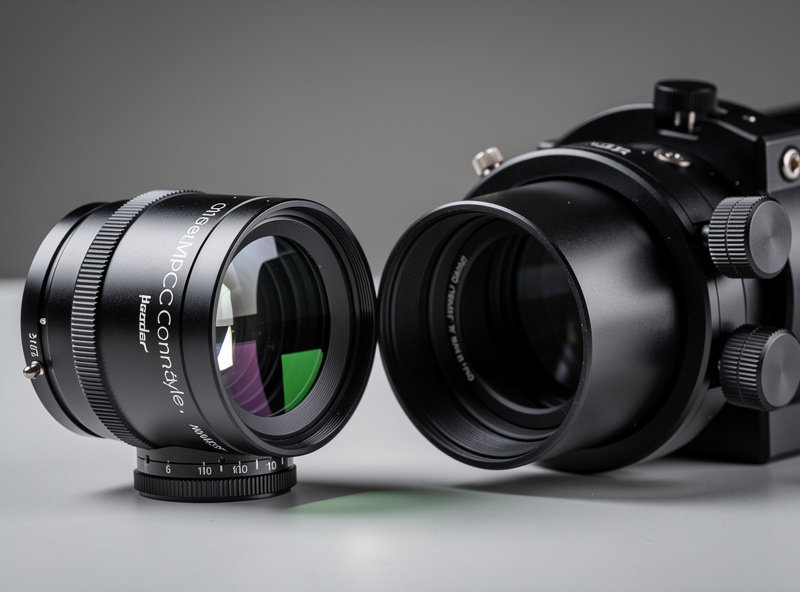
The Baader MPCC Mark III ($200) and the Sky-Watcher f/4 Aplanatic Coma Corrector ($150-200) are the most popular coma correctors for 6-8 inch f/4 Newtonians. Both correct coma across APS-C sensors. The TeleVue Paracorr Type 2 ($300) corrects across full-frame sensors and is considered the gold standard but costs more.
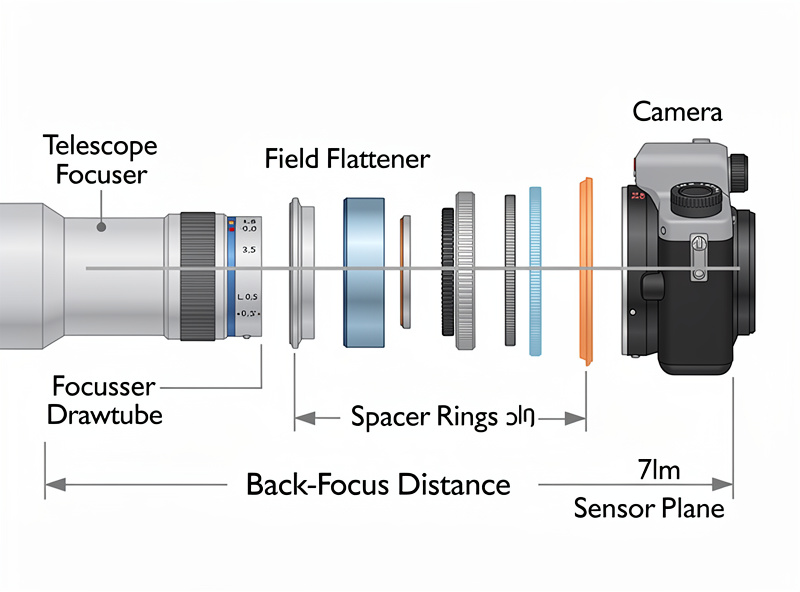
Coma correctors add 10-15mm of back-focus distance, which must be accounted for when calculating the total optical path length from the corrector to the camera sensor. If the back-focus distance exceeds the telescope’s focuser travel, the system cannot reach focus. This is the most common problem with Newtonian astrophotography — always verify back-focus compatibility before purchasing a coma corrector.
Back-Focus Distance: The Critical Measurement
Back-focus distance is the distance from the last optical element (field flattener, coma corrector, or reducer) to the camera sensor. Most accessories specify 55mm of back-focus, which is the standard distance from a T-thread to a camera sensor. The camera sensor sits at a fixed distance inside the camera body, and the remaining distance must be made up with extension tubes, spacers, or an adjustable adapter.
Measuring back-focus requires knowing three distances: the accessory’s required back-focus (55mm for most flatteners), the camera’s flange-to-sensor distance (17.5mm for Canon EF, 18mm for Nikon F, 12.5mm for M42 thread), and the adapter/spacer length. The formula is: spacer length = required back-focus minus camera flange distance. For a 55mm back-focus flattener with a Canon EF camera (17.5mm): spacer = 55 – 17.5 = 37.5mm of spacer between the flattener and camera.
Matching Accessories to Your Setup
| Telescope Type | Accessory Needed | Typical Cost | Sensor Coverage |
|---|---|---|---|
| ED Doublet Refractor | Field flattener or 0.8x reducer | $100-250 | Up to APS-C |
| Triplet APO Refractor | Matched flattener or reducer | $150-350 | Up to full frame |
| Quadruplet Astrograph | Built-in (none needed) | $0 | Full frame |
| f/4 Newtonian | Coma corrector | $150-300 | Up to APS-C or full frame |
| f/5 Newtonian | Coma corrector (optional) | $150-300 | Up to APS-C |
| SCT at f/10 | 0.63x focal reducer | $100-200 | Up to APS-C |
Installation and Adjustment Tips
Install the field flattener or coma corrector in the focuser’s draw tube, then attach the camera with the correct spacer stack to achieve the specified back-focus distance. Tighten all set screws firmly but do not overtighten — the glass elements can crack under excessive pressure. Rotate the flattener to find the orientation that produces the most symmetric star shapes in all four corners. Some flatteners have orientation marks that should face a specific direction.
After installation, refocus using a Bahtinov mask. The flattener changes the focal plane position slightly, so focus achieved without the flattener installed will not be correct with it installed. Check all four corners of the field in test exposures — if one corner is worse than the others, the flattener may need slight rotation or the back-focus distance may be slightly off. Adjust in 1-2mm increments until all corners match. The autoguiding setup guide covers what to check first when stars appear elongated — guiding errors look similar to back-focus errors at first glance, but they have different fixes.
Common Mistakes I Made on Back-Focus
The first mistake was the canonical Newtonian astrophoto failure: I bought a Sky-Watcher f/4 Aplanatic Coma Corrector for my 6-inch f/4 Newt without doing the back-focus math. The corrector specified 55mm; my Canon T7i with a T-ring contributed 17.5mm + 11mm = 28.5mm; my filter drawer added 21mm; and somehow nothing was reaching focus. After two evenings of confused troubleshooting I sat down with a measuring tape and realized I had stacked 27.5mm of extension on a system that needed 26.5mm — and that 1mm error was enough to put the sensor outside the corrector’s working range entirely. Once I removed a 5mm spacer the stars became sharp across the corners. Back-focus is geometry; the math has to be exact.
The second mistake was buying a reducer rated for f/6 and using it on an f/5 doublet I “borrowed” from a friend. The reducer over-reduced the focal length, the corners showed star elongation in the opposite direction (now pulled inward), and the field-flattening correction was wrong because the optical design did not match. I learned that flatteners and reducers are designed for specific focal lengths within a tight tolerance — borrowing one across telescopes does not work.
The third mistake was rotating the flattener once it was installed. Some flatteners (like several Sky-Watcher reducers) have an orientation mark that should face a specific direction; rotating them by 90 degrees re-introduces field curvature on a different axis. I spent a session diagnosing what looked like differential flexure before realizing the flattener arrow had ended up pointing the wrong way after I had loosened it to clean dust. Lesson: photograph your accessory orientations before disassembly.
What I Would Do Tonight
If you bought a flattener or coma corrector and your first imaging session shows ugly corner stars, here is the diagnostic routine. First, check back-focus math: write down each spacer in the optical chain in millimeters, sum them, compare to the manufacturer’s specification. If the math is wrong by even 0.5mm, fix it before anything else. Second, check rotation: rotate the flattener 90 degrees and shoot a test frame; if corner shape changes, your initial rotation was wrong. Third, take a 30-second test exposure of a bright star field with high contrast (the Pleiades works well) and inspect the four corners at 100% zoom. If three corners are good but one is bad, the back-focus is right but the flattener is tilted slightly — usually a tube adapter that did not seat fully. Fix one variable at a time. Within 30 minutes you will know whether the corner problem is back-focus, rotation, tilt, or guiding — and three of those four have a $0 fix.
Frequently Asked Questions
Do I need a field flattener for astrophotography?
Yes, if you use a refractor with a sensor larger than micro four-thirds. Every refractor produces field curvature that elongates stars at the edges. A field flattener (100-300 dollars) corrects this and is the single most important accessory after the camera itself. Some quadruplet refractors include a built-in flattener.
What is the difference between a field flattener and a coma corrector?
A field flattener corrects the curved focal plane produced by refractors. A coma corrector fixes the comet-shaped star aberration produced by fast Newtonian reflectors. They solve different problems caused by different telescope designs. A refractor needs a flattener; a Newtonian needs a coma corrector.
Can you use a field flattener from a different brand?
Usually not. Field flatteners are designed for specific focal lengths and optical designs. A flattener made for a 600mm f/6 triplet will not correct the field curvature of a 480mm f/5 doublet. Always buy the flattener matched to your specific telescope model or one explicitly rated for your focal length.
What is back-focus distance?
Back-focus distance is the space between the last optical element (flattener, corrector, or reducer) and the camera sensor. Most accessories require 55mm. The camera flange-to-sensor distance plus extension tubes must equal exactly 55mm for the flattener to work correctly.
Does a reducer-flattener reduce image quality?
No, a quality reducer-flattener maintains or improves image quality while increasing the field of view and reducing exposure time. Cheap reducers may introduce chromatic aberration or vignetting, but name-brand reducers from TeleVue, Baader, or matched manufacturer reducers produce excellent results.
How do I know if I need a coma corrector?
If you use a Newtonian reflector at f/5 or faster for astrophotography with a sensor larger than micro four-thirds, you need a coma corrector. Look at your test exposures — if stars at the field edges are comet-shaped rather than round, coma is the cause. A coma corrector (150-300 dollars) fixes it completely.
Related Articles
Astrophotography Equipment Guide — the complete imaging chain.
Best Telescopes for Astrophotography — telescope types and designs.
Astrophotography Cameras — choosing the right camera for your scope.
Star Tracker Mount Guide — entry-level tracking platforms.
Autoguiding Setup Guide — PHD2 calibration and tuning.
