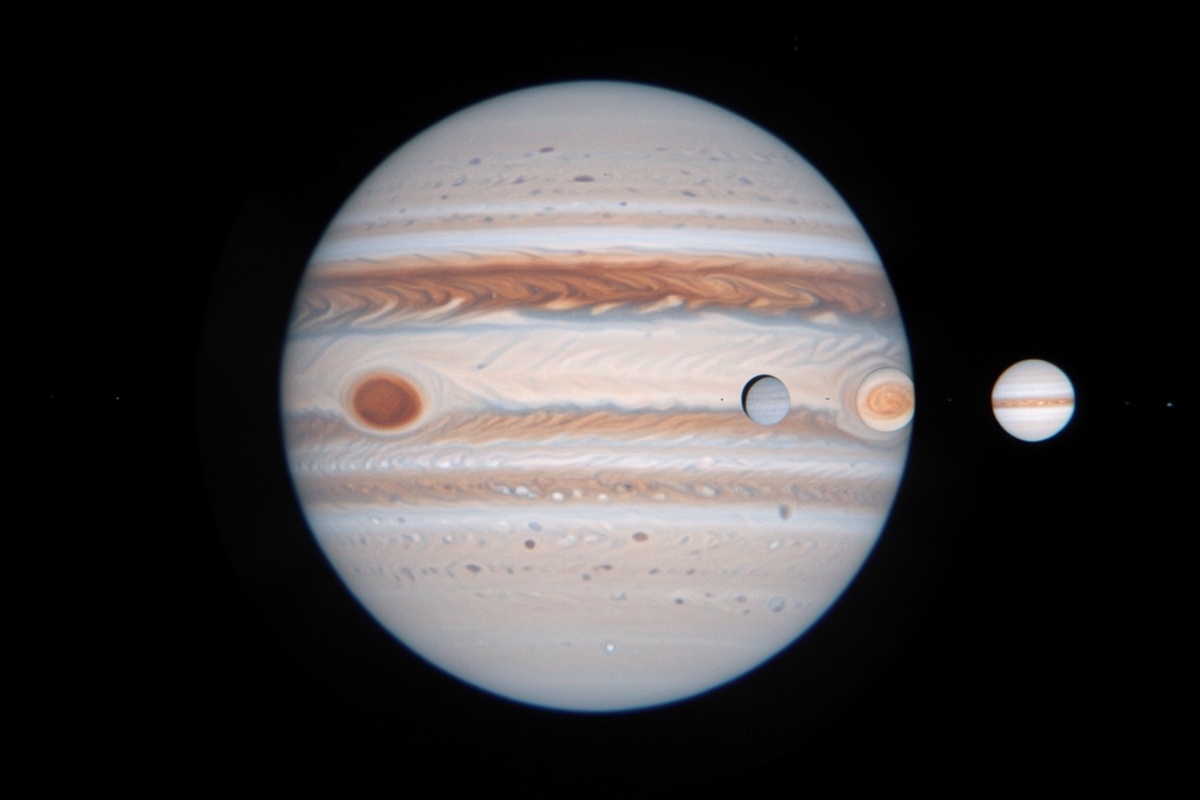

Jupiter is the planet I send every new observer to first, because it’s the one that pays off fastest. Even a modest scope shows you a flattened, banded disc with four pinprick moons strung out beside it, and unlike Mars or Saturn it gives you something new every single night — the moons shuffle, the Great Red Spot rotates in and out of view, and the cloud belts shift their detail as the seeing comes and goes. But “point and look” is not the same as “observe,” and the difference between a beginner’s frustrating glance and a satisfying session at the eyepiece is almost entirely technique. This guide is the actual routine I run on Jupiter from my Swedish backyard, step by step.
If you want the catalogue of what each feature is — the named belts, the moon order, the structure of the Great Red Spot — I cover that in the Jupiter through a telescope feature tour. This piece is about how: how to set up, what power to use, how to coax detail out of a small, shimmering disc. For the wider context of how Jupiter fits among the planets and which scope suits planetary work, start from the planetary observing guide that anchors this cluster.
Before you even uncap the scope
Most disappointing Jupiter sessions are lost before the observer reaches the eyepiece. Two things decide whether tonight will be sharp or soft, and neither is your telescope.
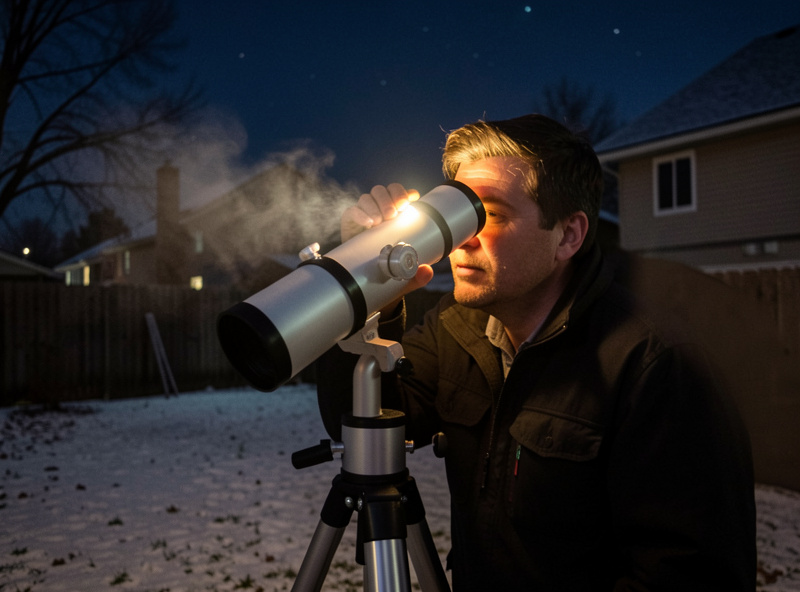
The first is thermal acclimation. A telescope warmer than the night air sheds heat through its tube, and those rising currents smear fine planetary detail into mush. Put your scope outside thirty to sixty minutes before you observe — longer for a big closed-tube SCT or Maksutov. From a cold Nordic backyard I’ve learned to set the scope out, go back in for a coffee, and only then start observing. The difference in Jupiter’s belt detail between a warm scope and a cooled one is not subtle.
The second is altitude and seeing. Jupiter shows its best when it rides high in the sky, because low to the horizon you’re looking through a thick, turbulent slab of air. From a high northern latitude this matters even more — there are nights when Jupiter simply never climbs high enough to settle down, and no amount of aperture fixes a boiling atmosphere. Pick the nights when the planet is well placed and the air feels still (stars near it twinkling gently rather than dancing), and you’ll do better with a small scope than you would with a giant on a turbulent night.
Finding Jupiter and getting it centred
Jupiter is one of the easiest objects in the sky to find — it’s the brilliant “star” that doesn’t twinkle, usually outshining everything around it. Start with your lowest-power eyepiece to get a wide field, drop the planet in, then centre it carefully. If your mount tracks, engage it now; if it doesn’t, get comfortable nudging the scope, because at high power Jupiter drifts out of the field in well under a minute. This is exactly why I tell beginners the mount matters as much as the optics for planets — fighting a shaky, drifting view ruins the patience that planetary detail demands.
Once Jupiter is centred, resist the urge to crank the power immediately. Spend a couple of minutes just looking at the low-power view. Let your eye relax and adapt. The two main equatorial belts will start to separate from the brighter zones, and the moons will resolve as crisp points rather than a smear. Only then start stepping up.
Choosing your magnification on the night
Here’s the single biggest technique lesson: the right magnification on Jupiter is whatever the seeing allows tonight, not the highest number you own. Step the power up one eyepiece at a time. The instant the image stops getting sharper and just gets bigger and dimmer, you’ve passed the seeing ceiling — drop back to the last crisp step and stay there.
On a good night from a steady sky I’ll happily run Jupiter at 150x to 200x; on a turbulent one I’m pegged at 100x and the planet looks better for it. A quality medium-short eyepiece in the 6mm–9mm range is your workhorse here, and rather than buying a drawer of short eyepieces I lean on a good Barlow to double my usable focal lengths from the glass I already own. A solid 2x Barlow lens turns a comfortable 12mm and 18mm into an effective 6mm and 9mm without sacrificing eye relief — the way I prefer to reach high power on planets. For the broader reasoning on building a planetary eyepiece kit, the main planetary guide lays out the priorities.
Disclosure: some links above are affiliate links. As an Amazon Associate I earn from qualifying purchases, at no extra cost to you. I only recommend gear I’d put on my own mount.
Reading the belts and zones
The first thing everyone sees is the pair of dark equatorial belts — the North and South Equatorial Belts — flanking the bright Equatorial Zone. That’s the easy view. The reward of patient observing is everything between those gross features: the subtle barges and ovals riding in the belts, the festoons (dark blue-grey streamers) trailing off the edge of a belt into the zone, and on a steady night the fainter temperate belts further toward the poles.
This detail does not arrive all at once. The atmosphere comes and goes in waves, and the finest structure appears in brief windows of calm that might last only a second or two. The trick is to stay at the eyepiece — keep looking, let your eye learn the planet, and pounce on those moments of steady air when the belts suddenly snap into focus and the festoons appear. Glance for ten seconds and you’ll see a bland disc; observe for ten minutes and Jupiter unfolds.
Catching the Great Red Spot
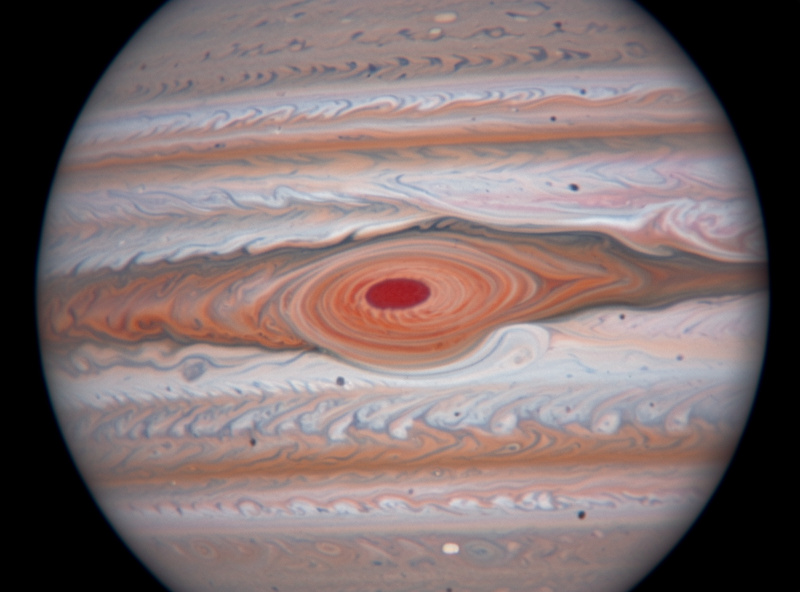
The Great Red Spot is on the far side of the planet for roughly half of every rotation, so timing matters. Jupiter spins fast — under ten hours — which means the Spot’s visibility shifts noticeably across a single evening, and across nights it transits at a different time each session. The practical approach: use a planetarium app or an observing almanac to find the Spot’s transit time (when it crosses Jupiter’s central meridian), and plan your session for the hour or two on either side. When it’s well placed, look for a pale oval indenting the southern edge of the South Equatorial Belt — it’s often more salmon than red, and a light blue filter can help lift it from the surrounding cloud.
The Galilean moons — the part beginners underrate
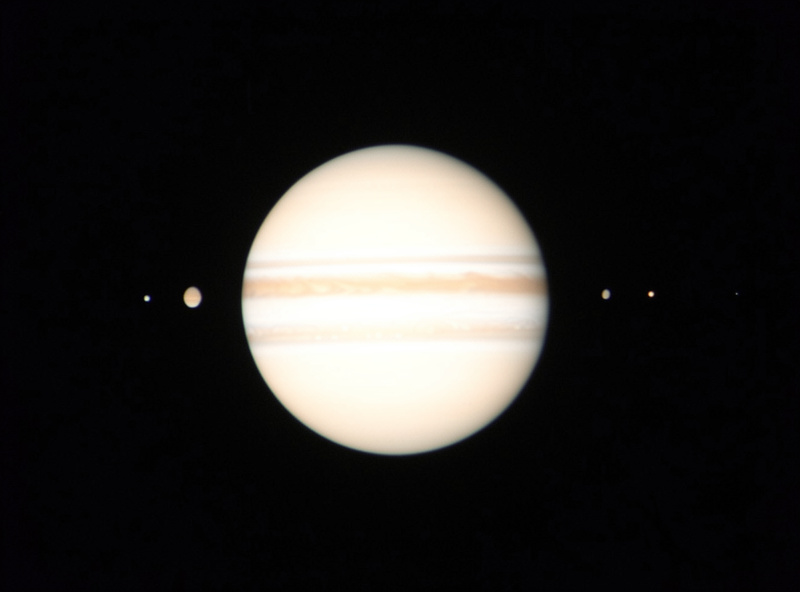
The four bright moons — Io, Europa, Ganymede, and Callisto — are visible in anything from binoculars upward, and they’re far more rewarding than newcomers expect. Their arrangement changes night to night and even hour to hour, and the real magic is in the events: a moon’s tiny black shadow tracking across the cloud tops (a shadow transit), a moon slipping behind the planet (an occultation) or into Jupiter’s shadow (an eclipse), or a moon sitting right against the limb. Catching a crisp round shadow crawling across Jupiter’s disc is one of the genuine thrills of small-scope observing, and it takes only a modest aperture and a steady moment. Almanac apps list these events; plan a session around one and you’ll be hooked.
Filters and the small refinements
You don’t need filters to enjoy Jupiter, but a couple help. A light blue filter (Wratten 80A) gently boosts the contrast of the belts and can make the Great Red Spot easier to pick out. A neutral-density Moon filter knocks back glare on a bright night if you find the planet dazzling. Keep it light — filters refine an already-good view; they don’t rescue a warm scope or a turbulent sky. And resist the temptation to keep a filter screwed in permanently; flip it in and out so you can judge whether it’s genuinely helping tonight.
Putting it together: a Jupiter session
My routine, distilled: set the scope out to cool while Jupiter is still climbing; find it at low power and centre it; spend two minutes letting my eye adapt; step the magnification up to the seeing limit and back off one notch; then settle in for fifteen or twenty minutes, watching for the moments of steady air when the festoons and the Spot bloom into view. Check the almanac beforehand so I know whether the Red Spot or a shadow transit is on offer. That’s it — no exotic gear, just patience and the discipline to observe rather than glance. Do that, and Jupiter will reward you more than any other planet in the sky.
What magnification is best for observing Jupiter?
Use whatever your seeing allows, not the maximum your scope can reach. On a steady night 150x–200x shows excellent belt detail; on a turbulent night you may be limited to 100x. Step up one eyepiece at a time and back off the moment the image stops getting sharper and only gets bigger and dimmer.
Can I see the Great Red Spot on any night?
No. The Spot is on the far side of Jupiter for about half of every roughly ten-hour rotation, so it’s only visible during certain windows. Check a planetarium app or observing almanac for its transit time and plan your session for an hour or two on either side of it.
Why does Jupiter look blurry through my telescope?
The two usual culprits are a telescope that hasn’t cooled to the night air (rising heat currents smear the image) and poor atmospheric seeing, especially when Jupiter is low to the horizon. Let the scope acclimate for 30–60 minutes and observe when the planet rides high and the air is steady.
How many of Jupiter’s moons can I see?
The four large Galilean moons — Io, Europa, Ganymede, and Callisto — are visible in binoculars and any telescope, though their arrangement changes nightly and occasionally one or more hides behind or in front of the planet. The many smaller moons are far too faint for amateur visual observing.
Do I need a filter to observe Jupiter?
Not at all, but a light blue filter (Wratten 80A) can lift the contrast of the cloud belts and the Great Red Spot, and a neutral-density Moon filter tames glare on a bright night. Filters are a refinement on an already-good, cooled view — they won’t fix a warm scope or a turbulent sky.
