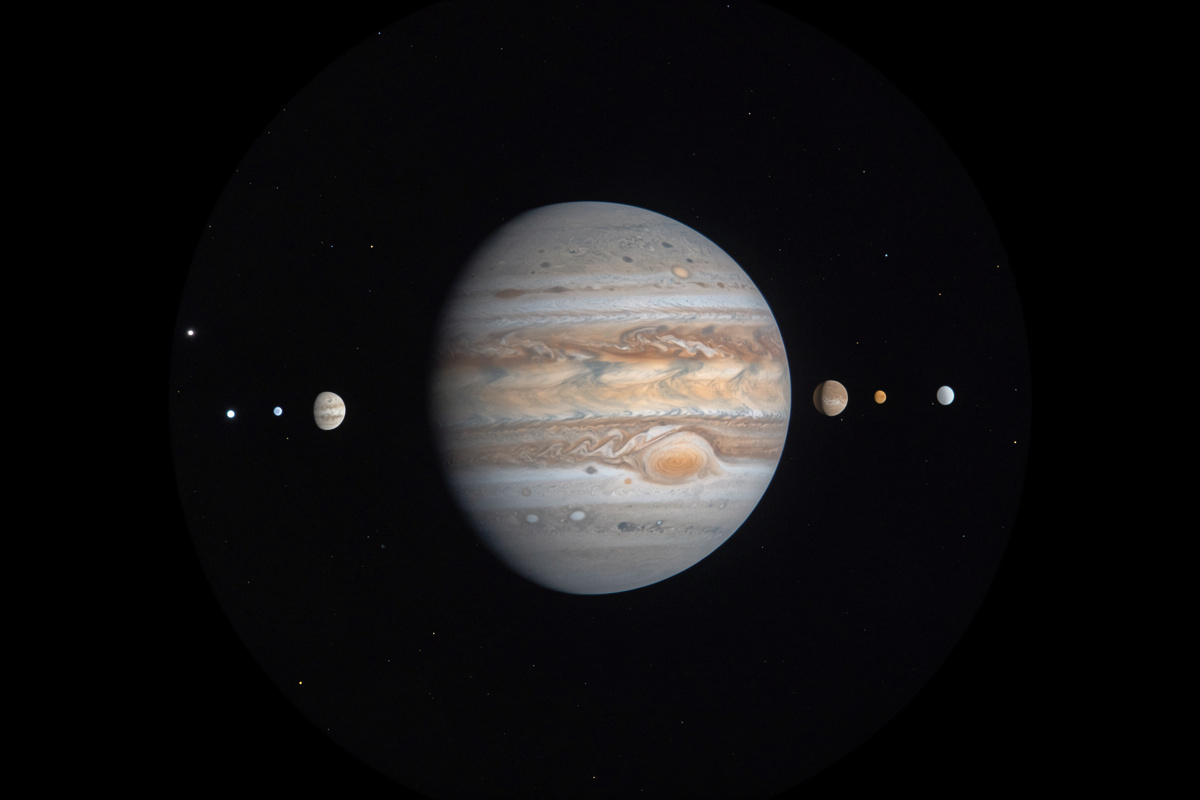

Jupiter through a telescope reveals two dark equatorial belts, up to four Galilean moons, and occasionally the Great Red Spot — all in a 60 mm refractor at 40x. The planet’s disc spans 31-50 arcseconds depending on its distance from Earth (4.2 to 6.2 AU), making it the largest planetary disc visible in amateur telescopes.
Jupiter is the planet that pays you back for every minute you spend at the eyepiece. Unlike Mars, it does not require a favorable opposition; unlike Saturn, it does not depend on ring tilt; unlike the Moon, the show changes within a single hour as the planet rotates. My 8-inch SCT pulls fresh detail off Jupiter on essentially every clear night, and I time at least one extended session per week during the apparition. This guide is the eyepiece-side workflow I run for Jupiter; the broader cluster planetary observation guide covers the other four bright planets.
What to Expect in Your Telescope
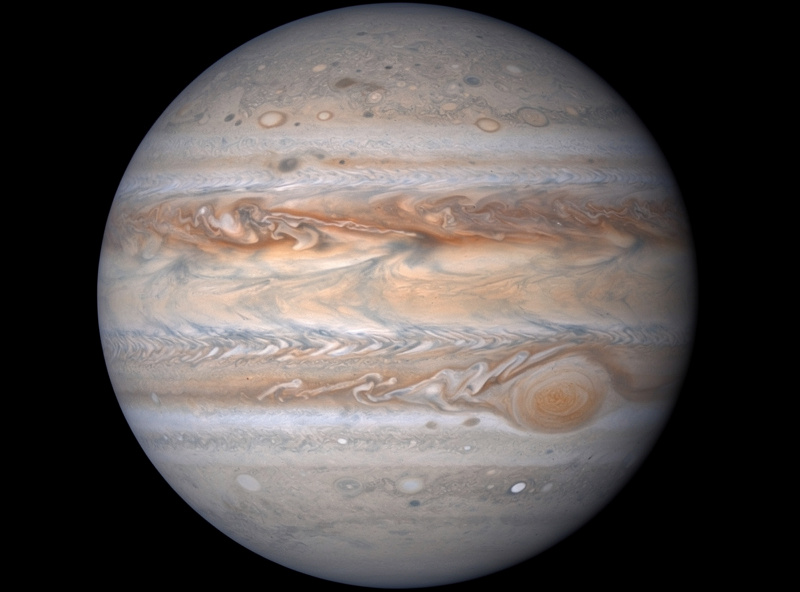
Even a modest instrument delivers a rewarding Jupiter view. At 40x in a 70 mm refractor, the disc is a small bright oval with two conspicuous dark bands flanking a bright equatorial zone. These are the North Equatorial Belt (NEB) and South Equatorial Belt (SEB). The four Galilean moons — Io, Europa, Ganymede, and Callisto — appear as star-like points lined up near the planet.
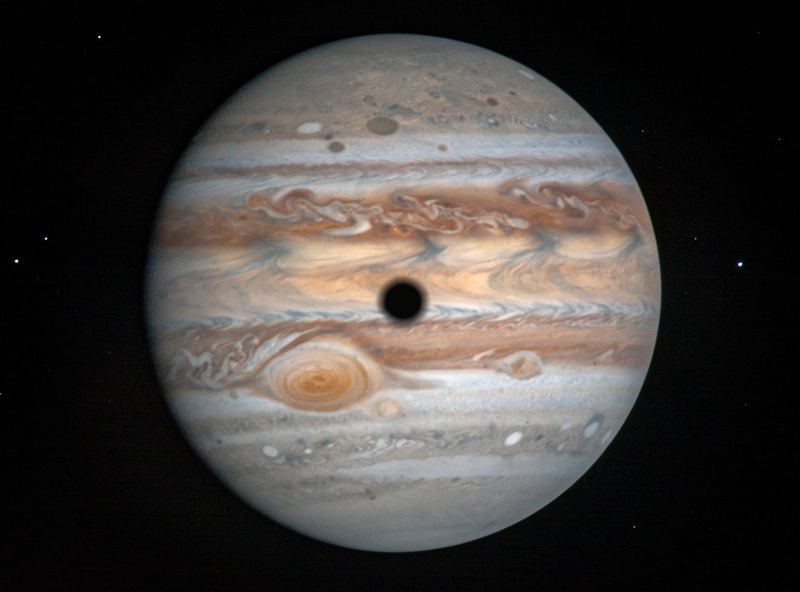
Push to 120x in a 4-inch scope and additional belts emerge: the North and South Temperate Belts (NTB, STB), fainter and narrower. The equatorial zone shows subtle banding and shading. The Great Red Spot (GRS), when on the visible hemisphere, appears as a salmon-pink oval indentation in the South Equatorial Belt. Jupiter rotates in 9 hours 55 minutes, so any feature is visible for roughly 2 hours before rotating off the disc.
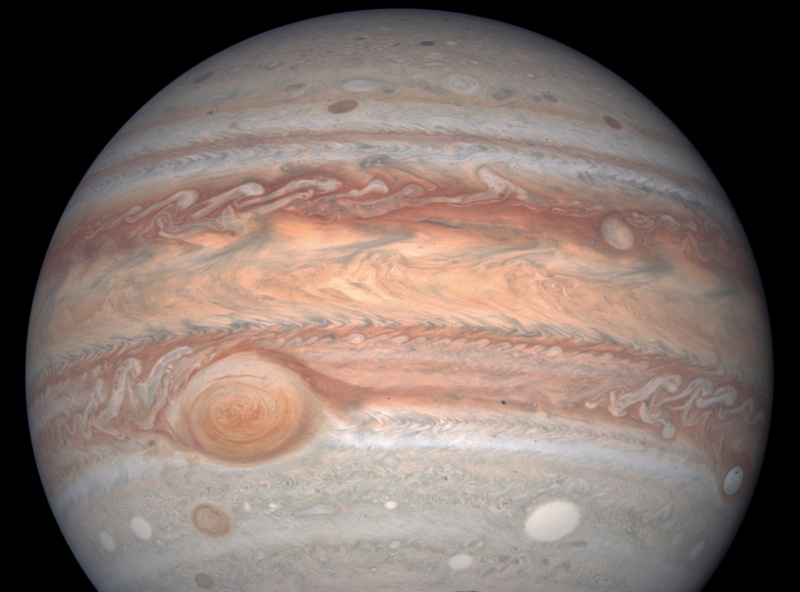
An 8-inch telescope at 200x transforms Jupiter. The NEB shows internal structure — festoons, white ovals, dark barges. The GRS reveals its full extent (currently about 1.3 Earth diameters, down from 3 Earth diameters in the 1800s). Shadow transits of the Galilean moons become dramatic events: a black dot crossing the bright disc at roughly 1 arcsecond per minute. The first time I caught a double shadow transit (Io and Europa simultaneously) was on November 12, 2024 — I had not planned for it, the prediction popped up in Stellarium two hours before, and I spent the entire event swapping between an 8 mm and 5 mm Astro-Tech Paradigm while my hands shook from the cold. Plan-around-Stellarium events are now half the reason I check the program every morning.
The Galilean Moons
Io, Europa, Ganymede, and Callisto have been observed since Galileo’s 1610 discovery. Their positions change nightly as they orbit Jupiter with periods of 1.77, 3.55, 7.15, and 16.69 days respectively. Any planetarium software predicts their configuration for any date.
Io (magnitude 5.0, diameter 3,643 km) is the innermost and brightest. It transits Jupiter’s disc most frequently. During transit, Io itself is hard to see against the bright disc, but its shadow — a crisp black dot — is unmistakable.
Europa (magnitude 5.3, diameter 3,122 km) is slightly smaller than Earth’s Moon. At opposition, it sits as close as 2 arcminutes from Jupiter. Europa frequently undergoes eclipses in Jupiter’s shadow — one moment visible, the next gone.
Ganymede (magnitude 4.6, diameter 5,268 km) is the largest moon in the solar system — larger than Mercury. Its size means it sometimes shows a tiny disc in 10-inch+ telescopes rather than appearing as a point source.
Callisto (magnitude 5.6, diameter 4,821 km) orbits furthest out and never transits or occults Jupiter from our perspective (its orbital inclination prevents this). It sometimes passes nearly a full Jovian diameter from the planet.
The Great Red Spot
The GRS is an anticyclonic storm roughly 16,000 km long as of 2026 — down from approximately 40,000 km in the late 1800s. It sits in Jupiter’s southern hemisphere at roughly 23° south latitude and has persisted for at least 350 years. The storm’s rotational period is roughly 6 Earth days, with wind speeds exceeding 430 km/h at its periphery.
The spot’s color varies from pale salmon to brick red over years-long cycles. Since 2014, the GRS has been intensifying in color, appearing distinctly reddish in 8-inch+ telescopes. The cause of color changes is debated — proposed mechanisms include UV photolysis of ammonia and acetylene producing red phosphorus compounds, or upwelling of sulfur-rich material from deeper atmospheric layers.
Observing the GRS requires knowing when it faces Earth. Jupiter’s rotation period is 9 hours 55 minutes, so the GRS comes into view roughly every 10 hours. Apps like “Gas Giants” or the BAA’s Jupiter tools calculate transit times. The GRS is on the disc for about 2-3 hours centered on its transit time. Planets at opposition covers the year-by-year Jupiter opposition schedule that brackets the apparition.
Transits, Occultations, and Eclipses
The Galilean moons produce three types of events visible in amateur telescopes:
Transits: A moon crosses Jupiter’s disc. Io takes about 3.5 hours to transit, Europa 5.5 hours, Ganymede 8.5 hours, and Callisto (rarely) 14 hours. During transit, the moon itself is often difficult to see against the bright disc, but its shadow — a crisp black dot — is always visible.
Shadow transits: The moon’s shadow crosses Jupiter. These are the most dramatic events — a sharp black circle crossing the planet. Shadow transits last as long as the corresponding moon transit but begin and end roughly 30-60 minutes before/after the moon’s transit.
Occultations: Jupiter passes in front of a moon (or vice versa from our perspective). The moon disappears behind Jupiter’s limb over 2-3 minutes. Telescopes with 6-inch+ aperture occasionally show the moon dimming and reddening before disappearing — atmospheric refraction at Jupiter’s limb.
Eclipses: A moon enters Jupiter’s shadow. Io and Europa eclipse every orbit. Ganymede eclipses near opposition. Callisto rarely eclipses. Watching Io vanish in 2-3 seconds while Callisto remains visible half a diameter away illustrates the geometry of the Jovian system.
Telescope Requirements for Jupiter
Jupiter is bright (magnitude -2.9 at opposition) and large — it is forgiving of small aperture. A 60 mm refractor shows belts and all four Galilean moons. However, aperture determines what additional detail you detect:
60-80 mm: Two main belts, GRS as a faint notch if timing is right, all four moons. Limited to 120-150x before image dims.
100-150 mm (4-6 inch): 4-6 belts, GRS color detectable, festoons occasionally, shadow transits clearly visible. Optimal magnification: 150-250x.
200 mm (8 inch): Full belt structure, GRS internal detail, white ovals, barges, festoons regularly seen. Optimal magnification: 200-350x. This is the practical “sweet spot” for Jupiter observation.
250+ mm (10 inch+): Fine atmospheric detail, GRS hollow structure, individual cloud features within belts. Limited primarily by seeing, not aperture. On sub-arcsecond nights, 400x+ reveals detail approaching spacecraft imagery in resolution. The eyepiece guide compares short focal lengths in the planetary range, and color filters earn their slot for belt-contrast work.
Imaging Jupiter
Jupiter is the easiest planet to image well because of its brightness and size. The standard technique is lucky imaging: capture thousands of video frames, select the sharpest 5-10%, and stack them. Atmospheric seeing randomly delivers moments of sharpness that single frames miss.
Camera: A ZWO ASI224MC or ASI462MC (color) at prime focus on an 8-inch f/10 SCT shoots 150-200 fps. For advanced work, a monochrome ASI290MM with RGB filters captures full-color data with higher resolution per channel.
Settings: Exposure 15-30 ms, gain adjusted so histogram fills 60-80%. Shoot 60-90 second videos (9,000-18,000 frames). Stack best 10% in AutoStakkert. Sharpen with Registax wavelets — Jupiter tolerates more sharpening than Saturn because of higher surface brightness.
Derotation: Jupiter rotates fast — 1° per 4 minutes. If you shoot RGB with a monochrome camera over 10+ minutes, the red and blue channels will be misaligned due to rotation. Use WinJUPOS to derotate frames before stacking. For single-camera color imaging, keep total acquisition under 3 minutes to minimize rotation blur. The astrophotography guide covers the camera-to-laptop pipeline if you are starting from zero.
Jupiter’s Atmospheric Phenomena
Jupiter’s visible cloud tops sit at the 0.5-1 bar pressure level, roughly 50 km above the water cloud deck. The belts are regions of downwelling (sinking) air that reveals darker material from below. Zones are upwelling regions that form bright ammonia ice clouds.
White ovals are anticyclones similar to the GRS but smaller — typically 2,000-5,000 km across. The “String of Pearls” white oval chain in the South Temperate Belt has been observed since the 1930s. These ovals are visible in 6-inch+ telescopes as bright spots within the STB.
Barges are dark cyclonic features in the NEB, typically 2,000-7,000 km across. They persist for years to decades. In 8-inch+ telescopes, they appear as dark rectangular markings embedded within the NEB — distinct from the surrounding belt structure.
Festoons are dark cloud features extending from the NEB into the equatorial zone. They appear as hooked or teardrop-shaped intrusions. Festoons are transient — they can form and dissipate within weeks. Observing festoons over multiple nights reveals Jupiter’s rapid atmospheric dynamics.
| Feature | Location | Size | Min Aperture | Persistence |
|---|---|---|---|---|
| NEB (North Equatorial Belt) | 7-12° N | Full circumference | 60 mm | Permanent |
| SEB (South Equatorial Belt) | 7-12° S | Full circumference | 60 mm | Permanent (fades occasionally) |
| Great Red Spot | 23° S | 16,000 km long | 100 mm | 350+ years |
| White ovals | STB (30-40° S) | 2,000-5,000 km | 150 mm | Years to decades |
| Barges | NEB (7-12° N) | 2,000-7,000 km | 200 mm | Years to decades |
| Festoons | NEB → equatorial zone | 1,000-5,000 km | 150 mm | Weeks to months |
| Galilean moons | Orbital plane | 3,122-5,268 km | Any | Permanent |
Common Mistakes I Made on Jupiter Nights
The first three Jupiter sessions I ran with the 8-inch SCT, I sat down at the eyepiece within 5 minutes of bringing the scope outside. The image was a boiling mess and I assumed Jupiter just looked like that. The mirror needed 25-30 minutes to reach ambient temperature; once I started waiting, the planet looked like a different object. I now set the scope outside while I make coffee, every time.
The second mistake was pushing 350x on Jupiter every clear night because “it is bright enough.” Bright enough is not the constraint — the atmosphere is. On a 4-arcsecond seeing night, 350x just magnifies the boil. I now read the seeing scale at 100x for a full minute before deciding the night’s magnification ceiling. Most nights I land at 180-220x and stay there.
The third mistake: ignoring rotation. The first time I shot RGB sequence imaging across 12 minutes I came back to a Jupiter with red and blue channels offset by half a belt-width. WinJUPOS derotation was the fix, but I should have known to keep the acquisition window short before the first attempt. Now any single-camera Jupiter video stays under 3 minutes total.
What I Would Do Tonight
If Jupiter is up tonight and you have a 4 to 8-inch scope, here is the session I would build. Set the scope outside 30 minutes before you start. Insert a 12-15 mm eyepiece (150-200x in most scopes) and find Jupiter; spend 5 minutes just watching the disc rotate — features will visibly drift over that window. Note the four Galilean moon positions on a sketch pad. Check Stellarium for any GRS transit, shadow transit, or moon occultation in the next 2 hours; if there is one, plan around it. Push to your highest steady magnification (probably 200-250x) and look for festoons hanging off the NEB and any white ovals in the STB. End the session by sketching the moon positions one more time so you can compare against tomorrow’s. The moon positional change between consecutive nights is the same observation Galileo made in 1610, and it never stops feeling personal. When you are ready to structure a complete Jupiter session — timing GRS transits, working the belts systematically, and sketching moon positions — my how to observe Jupiter with a telescope guide walks through the full workflow step by step.
Frequently Asked Questions
What telescope do I need to see Jupiter moons?
Any telescope with 25x magnification or higher shows all four Galilean moons as star-like points near Jupiter. Even 10×50 binoculars detect them under steady conditions. A 60 mm refractor at 40x is the standard starting point — the moons are unmistakable.
Can I see the Great Red Spot with a small telescope?
Yes, with a 4-inch telescope at 120x or higher, the GRS appears as a faint oval indentation in the South Equatorial Belt when it faces Earth. An 8-inch telescope at 200x shows it as a distinct reddish oval. You need to time your observation for when the GRS is on Jupiter visible hemisphere — it rotates across the disc every 10 hours.
How often does Jupiter Great Red Spot face Earth?
Jupiter rotates every 9 hours 55 minutes, so the GRS comes into view roughly every 9 hours 55 minutes — about 2.5 times per Earth day. The exact transit time shifts by about 4 minutes per rotation. Planetarium apps or the BAA Jupiter Section tools calculate exact transit times for your location and date.
Why do Jupiter bands look different each time I observe?
Jupiter atmosphere is dynamic — belts and zones change color, width, and structure over weeks to years. The SEB famously disappears entirely every 3-15 years before reappearing. The NTB undergoes periodic outbursts that briefly brighten the entire hemisphere. What you see depends on when you look.
How can I tell Jupiter moons apart?
Io is innermost and brightest (magnitude 5.0), always closest to Jupiter. Europa is the second brightest inner moon. Ganymede is the brightest overall (magnitude 4.6) but orbits further out. Callisto is the faintest (5.6) and orbits furthest away. Use Stellarium or a phone app to predict exact positions for any date.
What is the best magnification for observing Jupiter?
150-250x is the practical optimum for most nights. Below 100x, the disc is too small for belt detail. Above 300x, atmospheric seeing typically blurs the image unless conditions are exceptional. On nights of sub-arcsecond seeing, 300-400x in an 8-inch scope reveals the finest details.
Related Articles
- Planetary Observation Guide — The Cluster 6 hub covering all five bright planets.
- Saturn Rings Through a Telescope — Ring structure, moons, and imaging.
- Moon Observation Guide with Telescope — Craters, maria, and libration.
- Planets at Opposition: Best Viewing Times — When planets are closest and brightest.
- Meteor Showers: When and How to Watch — Annual shower calendar and technique.
- Comet Watching Guide for Amateur Astronomers — Finding and tracking comets.
