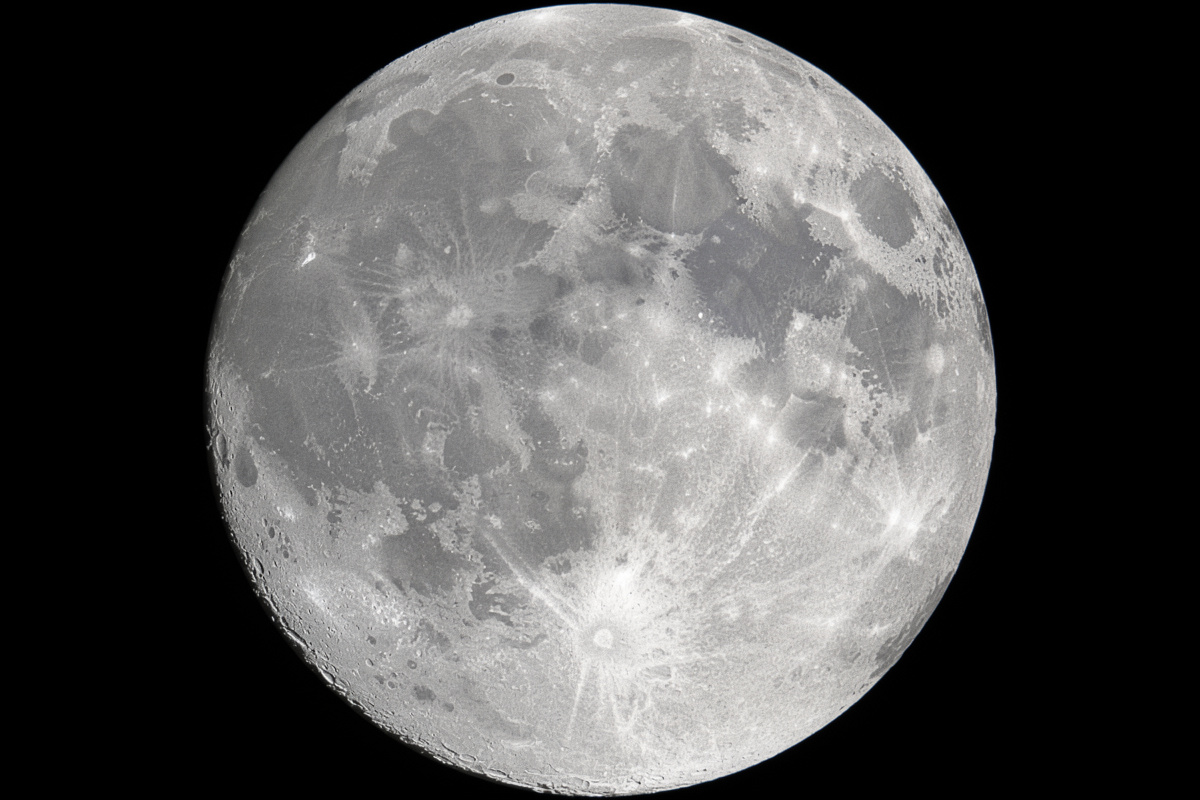

The Moon is the most rewarding telescope target for beginners, revealing craters as small as 1.5 km across through a 4-inch aperture at 100x magnification. Its surface brightness of roughly -12.7 apparent magnitude means even modest equipment delivers jaw-dropping detail on any clear night.
The Moon is also the target I keep coming back to after every fancy gear purchase, because it pays off attention faster than anything else in the sky. My 8-inch SCT can pull craterlet detail out of Plato’s floor in 20 minutes, but a $40 60 mm achromat I borrowed from a friend last spring still showed Tycho’s ray system across half the disc — the Moon makes any telescope look good. This guide is the field workflow I run for the eyepiece-side experience; the broader cluster planetary observation guide covers Mars, Jupiter, Saturn, and the rest of the planetary calendar.
Best Telescopes for Lunar Observation
You do not need an observatory-class instrument to enjoy the Moon. A 70 mm refractor resolves craterlets within Plato, ray systems around Tycho, and the rugged walls of Copernicus at magnifications between 50x and 150x. Refractors excel here because they produce high-contrast images with no central obstruction — every photon hits the eyepiece directly.
Reflector owners fare equally well. A 6-inch f/8 Newtonian resolves the Hadley Rille (Rima Hadley), the winding channel astronauts walked beside during Apollo 15. Dobsonian mounts keep costs low; a 10-inch Dob under steady seeing can push past 300x on the Moon and reveal rilles, domes, and shadow-casting peaks invisible in smaller instruments.
Catadioptric designs — 5-inch and 8-inch Schmidt-Cassegrains — combine portability with long focal lengths. An 8-inch SCT at f/10 delivers a 2,000 mm focal length in a tube under 45 cm long. That focal length makes framing individual craters straightforward without swapping to ultra-short eyepieces. My own 8-inch SCT lives a 30-second carry from the back door, which is why it gets used 5x more nights per year than the 12-inch Dob in the garage. Aperture matters less than the scope you actually set up.
Lunar Phases and What They Reveal
Full Moon is actually the worst phase for surface detail. With the Sun directly overhead from the Moon’s perspective, shadows vanish and terrain flattens into a bright, featureless disc. The terminator — the boundary between light and dark — is where the action is.
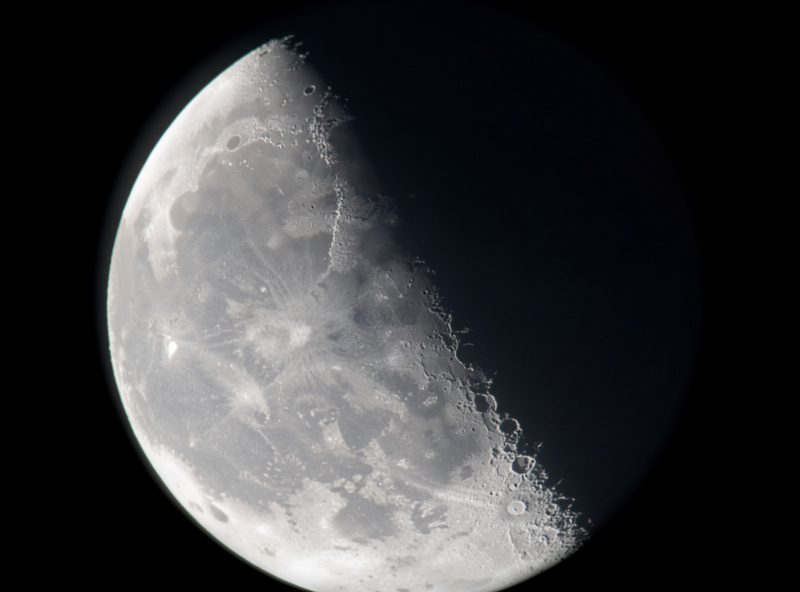
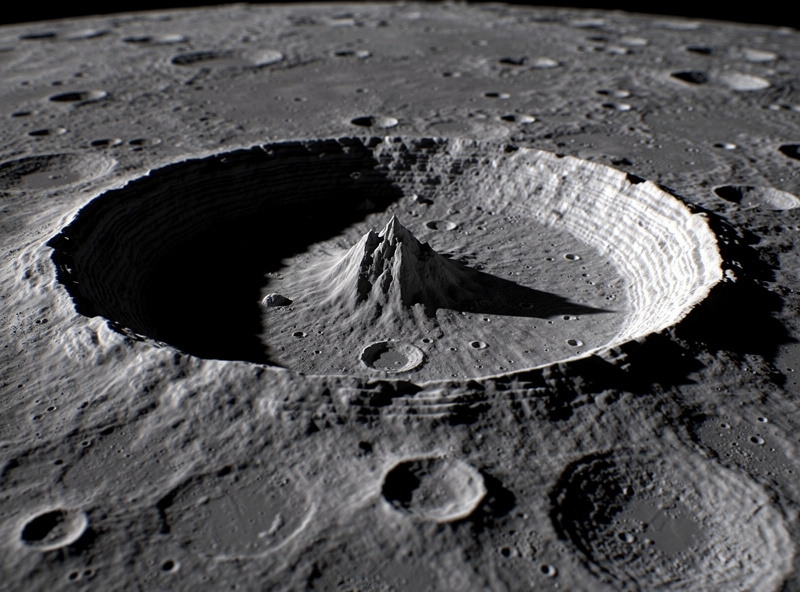
At 5 days past new, the terminator crosses the Mare Crisium basin. Shadows stretch dozens of kilometers across crater floors, revealing depth through chiaroscuro. By day 8, the terminator illuminates the Alpine Valley (Vallis Alpes), a 166 km rift cutting through the Montes Alpes. At day 10, Copernicus enters sunlight, its 93 km-wide bowl casting a dramatic wedge of shadow across a central peak complex that rises 1.2 km above the crater floor.
The last quarter phase (day 22) offers the best views of the Sinus Iridum region — the “Bay of Rainbows.” This 241 km crater sits half-submerged in Mare Imbrium. When the terminator slides across it, sunlight catches the curved western rim, creating the “Jeweled Handle” effect that draws observers worldwide to their telescopes. The first time I caught the Jeweled Handle I had been ignoring last-quarter mornings for two years; once I set an alarm for 4 AM during a favorable libration, I stopped skipping that half of the lunar month.
Top 20 Lunar Features for Telescope Observers
Certain features rank as perennial targets because they respond to a wide range of apertures. Here are the ones every lunar observer should log:
Craters: Plato (101 km, dark floor, craterlets on floor require 8-inch+), Copernicus (93 km, terraced walls, central peaks), Tycho (85 km, spectacular ray system extending 1,500+ km), Aristarchus (40 km, brightest spot on the nearside, albedo 0.18), and Eudoxus (67 km, sharp walls in steady seeing). Plato is a particular favorite — its dark lava floor hosts 10+ small craterlets ranging from 0.5 to 2 km in diameter. Under excellent seeing with a 10-inch scope, dedicated observers have logged 15 or more craterlets in a single session. My personal best on Plato is 7 craterlets through the 8-inch at 254x — and I had to stare at the dark floor for 25 unbroken minutes before the smaller ones popped in. Lunar craterlet hunting is the most patience-rewarding observing I do.
Maria: Mare Tranquillitatis (Apollo 11 landing site), Mare Imbrium (largest visible basin at 1,123 km diameter), Mare Serenitatis (partially flooded Serenitatis basin). The borders between maria and highlands show where ancient lava flows stopped — these boundaries are visible as irregular bright margins that trace the original topography of pre-existing craters and ridges partially submerged by basalt.
Rilles: Rima Hadley (Apollo 15 site, needs 8-inch+), Schröter’s Valley (largest sinuous rille on the Moon, 168 km long, visible in 4-inch scopes). Rilles are collapsed lava tubes or graben structures created by crustal stress. Observing them teaches you to read the Moon’s geological history — each rille tells a story of volcanic activity 3-4 billion years ago.
Other: Vallis Alpes (166 km valley), the Straight Wall (Rupes Recta, 110 km scarp, 240 m high — visible in 3-inch+ at appropriate illumination). The Straight Wall is one of the Moon’s most iconic features: a bright line when the Sun illuminates it from the west, a dark line when lit from the east. Its appearance reverses completely between waxing and waning phases.
Magnification and Eyepiece Strategy
The Moon tolerates high magnification better than any other target because of its brightness. The theoretical maximum useful magnification is 50x per inch of aperture, but atmospheric seeing usually caps you at 200-300x regardless of telescope size. On nights of excellent seeing (sub-1-arcsecond), you can push to 400x in a 10-inch scope and resolve features under 1 km.
A practical eyepiece kit for the Moon includes three focal lengths: a low-power widefield (25-32 mm) for framing entire maria and crater fields, a medium-power (12-15 mm) for isolating individual craters, and a high-power (5-7 mm) for rilles and craterlets. A 2x Barlow lens doubles your options to six effective magnifications. The eyepiece guide compares specific options at each focal length, and the planetary observing technique guide walks through how to step through magnifications without overshooting the seeing.
Lunar filters — typically neutral density or polarizing filters that thread into the eyepiece barrel — reduce glare at high magnification. A polarizing filter is more versatile because it allows stepless brightness adjustment. On nights of good seeing, reducing brightness by 50-70% reveals subtle albedo differences invisible at full brightness. I run a Baader Neutral Density 0.9 filter on my 8mm Astro-Tech Paradigm during gibbous and full phases — without it, 30 minutes at the eyepiece leaves my dark-adapted eye useless for everything else for the rest of the night.
Imaging the Moon Through a Telescope
Smartphone adapters costing under $30 let you hold a phone camera to the eyepiece and capture surprisingly detailed images. For serious work, a dedicated planetary camera — the ZWO ASI224MC or ASI462MC, for example — shoots video at 150+ frames per second. Software like AutoStakkert! stacks the sharpest frames, producing images that rival Hubble in resolution of lunar features.
For mosaic work — capturing the entire disc — shoot overlapping panels and stitch in Microsoft ICE or Autostakkert’s built-in mosaicker. A single panel through an 8-inch SCT at prime focus covers roughly a quarter of the disc. Four panels stitched together produce a 40+ megapixel full-disc image showing every crater from 5 km upward.
Timing matters. Shoot within 2 hours of the terminator crossing your target feature. The changing illumination angle means a mosaic shot over 3 hours will show inconsistent shadows across panels. Plan your sequence before you go outside.
Lunar Libration and Hidden Features
Because the Moon’s orbit is elliptical and tilted 5.1° to the ecliptic, it librates — wobbles — revealing about 59% of its total surface over time. East-west libration reaches ±7.9°, and north-south libration reaches ±6.7°. This means features near the limb occasionally swing into view that are normally hidden.
Mare Orientale, the multi-ring impact basin on the western limb, is the most famous libration target. Normally invisible, favorable libration reveals its dark lava-filled center and concentric ring mountains spanning 930 km. The crater Grimaldi (222 km) and Heaviside on the southeastern limb are also libration-dependent targets worth logging. I have one Mare Orientale observation in my log book in five years of trying — a 4 AM session in February 2024 with the limb tilted exactly the right way. It was worth the alarm.
Track libration using software like Stellarium or the Virtual Moon Atlas. On nights when libration favors a limb region, prioritize targets there — you may not get another clear view for months.
| Feature | Type | Size | Min Aperture | Best Phase | Difficulty |
|---|---|---|---|---|---|
| Copernicus | Crater | 93 km | 60 mm | Day 8-10 | Easy |
| Tycho | Crater | 85 km | 60 mm | Day 13-15 | Easy |
| Plato craterlets | Craterlets | 0.5-2 km | 200 mm | Day 5-8 | Hard |
| Rima Hadley | Rille | 120 km | 200 mm | Day 7-9 | Moderate |
| Rupes Recta | Scarp | 110 km | 75 mm | Day 7-8 / Day 20-21 | Easy |
| Jeweled Handle | Rim effect | 241 km basin | 50 mm | Day 20-22 | Easy |
| Mare Orientale | Basin | 930 km | 100 mm | Libration dependent | Moderate |
| Schröter’s Valley | Rille | 168 km | 100 mm | Day 5-8 | Moderate |
Common Mistakes I Made Starting Out
I burned my first six lunar sessions on full Moons because that was when the Moon was “biggest and brightest.” I came home each time wondering why my photos looked like a painted ping-pong ball — no shadows, no relief, no sense of depth. The terminator is everything. Now I check the lunar phase before I check the weather, and I skip nights within 3 days of full unless I am chasing a libration target.
The second mistake was observing the Moon without a filter at high magnification on a gibbous night, then trying to switch to Jupiter immediately afterward. My dark-adapted eye took 25 minutes to come back, and Jupiter’s belts looked smeared the entire time. Lunar glare burns out your night vision faster than you would expect — a polarizing or neutral density filter pays for itself the first time you swing from the Moon to a deep-sky target.
The third mistake: skipping last-quarter mornings. The waning Moon is the same Moon, viewed from the opposite light angle, with shadows reversed and a completely different feature set in relief. Sinus Iridum’s Jeweled Handle, the Straight Wall reversed in tone, and the eastern limb’s libration windows are all morning-only views. If you only observe the waxing Moon, you are seeing half the Moon.
What I Would Do Tonight
If you have a 4 to 8-inch scope and the Moon is between days 6 and 10 tonight, here is the session I would build. Set the scope outside 30 minutes before the Moon clears your eastern roofline. Insert your 25 mm widefield first, find the terminator, and just slide along it for 5 minutes — let the brain register the scale. Switch to a 10-12 mm eyepiece and park on Copernicus. Watch the central peaks throw their shadow across the floor; the shadow length will visibly shrink over an hour as the Sun rises higher over the crater. Push to 200x on a polarizing or ND filter and look for craterlets on Plato’s floor. End the session on Tycho if it is in shadow — its ray system at half-light is one of the most surprising views in amateur astronomy. Tomorrow night, do the same crater list and notice how the shadows have moved.
Frequently Asked Questions
What telescope magnification do I need to see craters on the Moon?
At 50x magnification, craters 15-20 km across are clearly visible. At 100x, you resolve features down to 5-8 km, including the central peaks of Copernicus. At 200x with a 6-inch or larger telescope, craterlets as small as 1.5 km become detectable under steady atmospheric seeing.
Is a full Moon good for telescope observation?
No. Full Moon eliminates shadows, which are essential for perceiving depth and terrain. The terminator — the day-night boundary — produces shadows that reveal crater walls, mountain peaks, and rilles. Observe within 5 days of first quarter or last quarter for the best surface detail.
Can I observe the Moon with a 70 mm telescope?
Yes. A 70 mm refractor at 100x shows major craters like Copernicus and Tycho, maria boundaries, and mountain ranges. You will not see fine rilles or craterlets on Plato floor, but the overall view is still impressive and suitable for beginners.
Do I need a filter to look at the Moon?
A neutral density or polarizing filter reduces glare at magnifications above 100x, making the view more comfortable and revealing subtle brightness variations. It is not required — the Moon will not damage your eyes through a telescope — but it improves contrast noticeably.
When is the best time to observe the Moon?
During the first and last quarter phases (roughly 7 days after and before new Moon). The terminator crosses heavily cratered terrain at these times, producing dramatic shadows. Avoid full Moon for surface detail. The Moon is above the horizon roughly 12 hours per day, shifting later by about 50 minutes daily.
How many craters can I see on the Moon through a telescope?
Through a 6-inch telescope at 150x, you can identify several hundred named craters and thousands of smaller unnamed ones. The Moon has roughly 9,000 craters catalogued with diameters over 20 km. Under excellent seeing with a 12-inch scope, the count climbs well into the tens of thousands including sub-kilometer features.
Related Articles
- Planetary Observation Guide — The Cluster 6 hub covering all five bright planets.
- Saturn Rings Through a Telescope — What to expect at the eyepiece.
- Jupiter Through a Telescope Guide — Bands, moons, and the Great Red Spot.
- Planets at Opposition: Best Viewing Times — When planets are closest and brightest.
- Comet Watching Guide for Amateur Astronomers — Finding and tracking comets.
