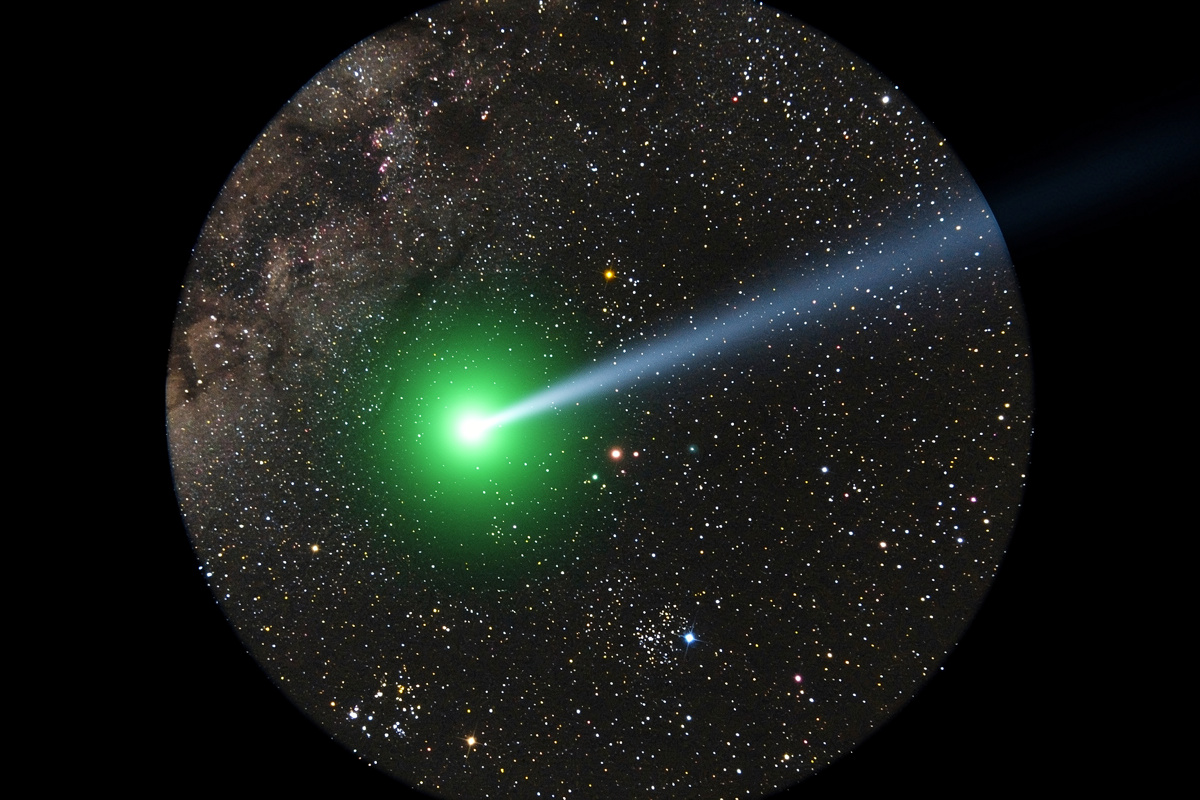

Amateur astronomers can observe comets in any telescope with a 60 mm aperture or larger — the key is knowing when and where to look. Bright comets like C/2020 F3 (NEOWISE) reach magnitude 0.5 and are visible to the naked eye, while typical yearly comets require binoculars (magnitude 6-9) and a dark sky at least 40 km from city lights.
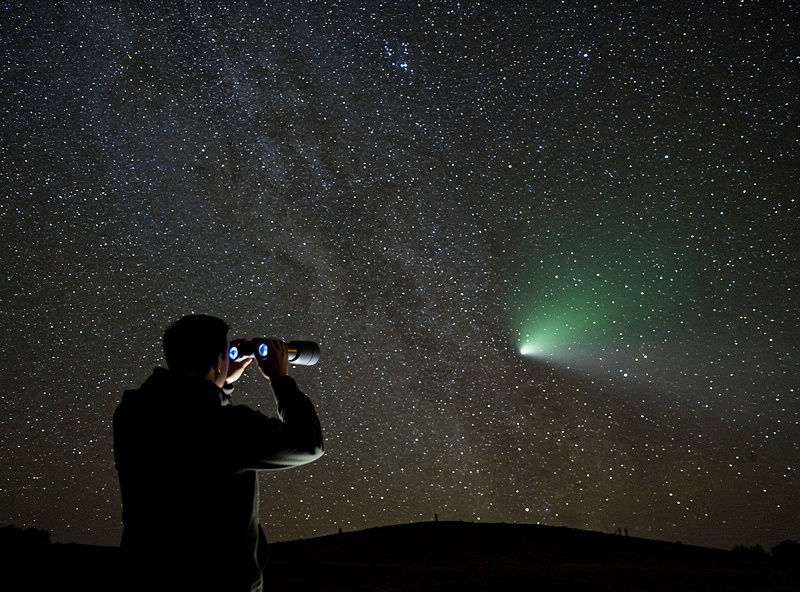
I caught Comet NEOWISE in July 2020 first through 10×50 binoculars from a Bortle 5 driveway, then through my 8-inch SCT a week later. The binocular view was the one I remember — a fuzzy magnitude-1 head with a 5° tail running up out of the eyepiece field, naked-eye easy from a darker site 40 km west of the city. The telescope view through the SCT actually showed less of the tail (too narrow a field) but resolved a sharper inner coma. The lesson stuck: comets are wide-field objects first, telescope objects second. This guide is the workflow I use across binoculars, finder scopes, and the main scope; the broader cluster planets at opposition guide covers the planetary side of the events calendar.
What Is a Comet?
A comet is a small solar system body composed of ice, dust, and rocky material — often described as a “dirty snowball.” Nuclei range from 500 meters to 50 km in diameter. The nucleus of 1P/Halley is 15 × 8 × 8 km and has a mass of roughly 2.2 × 10^14 kg. When a comet approaches the Sun within 3-4 AU, solar heating sublimates surface ices, releasing gas and dust that form the coma (a thin atmosphere up to 100,000 km across) and tail (extending millions of kilometers).
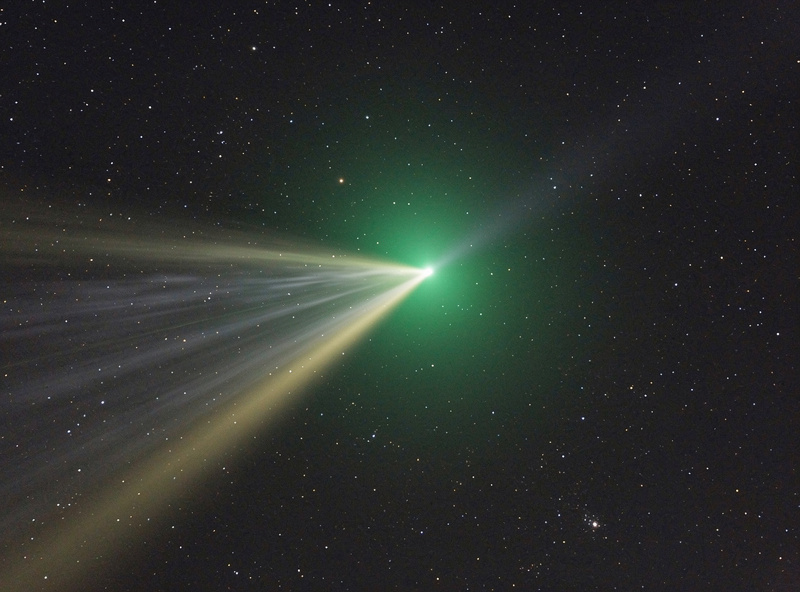
Comets display two types of tails. The ion (gas) tail points directly away from the Sun, fluorescing blue in sunlight due to CO+ emission. The dust tail curves slightly because larger dust particles are pushed by radiation pressure less efficiently — it often appears yellowish-white due to reflected sunlight. A third, extremely faint structure — the anti-tail — is an optical effect caused by Earth passing through the plane of the comet’s orbit.
Comets are classified by orbital period. Short-period comets (period under 200 years) originate from the Kuiper Belt beyond Neptune. Long-period comets (period over 200 years, up to millions of years) come from the Oort Cloud, a spherical shell of icy bodies at 2,000-100,000 AU from the Sun. Cometary debris is also responsible for most annual meteor showers — the meteor showers guide walks through which comets feed which showers.
Bright Comets and How to Find Them
Truly spectacular comets — those reaching magnitude 0 or brighter — appear roughly once per decade. Recent examples include C/2020 F3 (NEOWISE) in July 2020 (magnitude 0.5, tail 20°+ long), C/2006 P1 (McNaught) in January 2007 (magnitude -5.5, brightest comet in 40 years), and 153P/Ikeya-Zhang in 2002 (magnitude 3.5, 3° tail).
Finding bright comets requires knowing their current position. The best resources are:
Sky & Telescope’s comet page (skyandtelescope.org): Updated weekly with finder charts showing comet positions relative to stars. Magnitude predictions, tail length estimates, and best viewing times for each hemisphere.
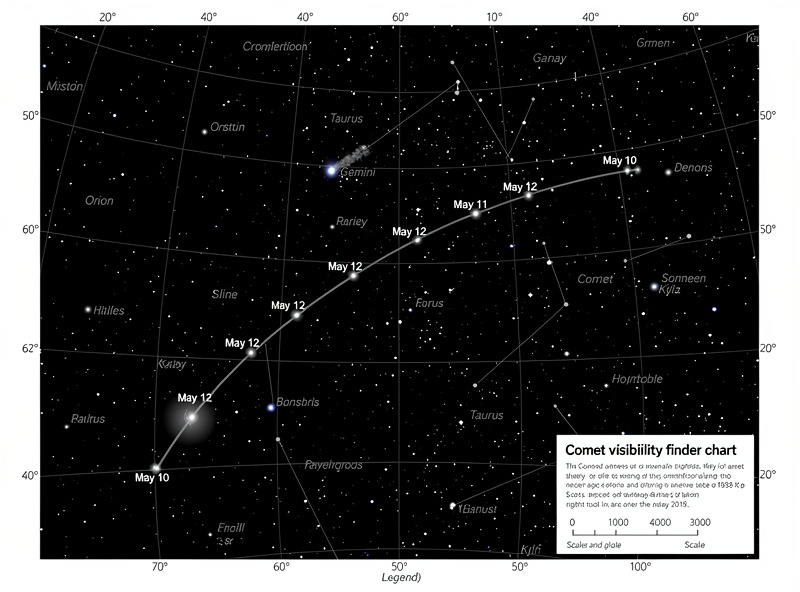
Heavens-Above (heavens-above.com): Calculates comet positions for your exact location. Generates printable finder charts showing the comet’s track across the sky over multiple nights.
ALPO Comet Section (alpo-astronomy.org/comet): The Association of Lunar and Planetary Observers maintains visual magnitude estimates from amateur observers worldwide. Updated frequently — these are real observed magnitudes, not predictions.
Seiichi Yoshida’s Weekly Information (aerith.net/comet): The most comprehensive accessible comet database. Lists all currently visible comets with magnitude, position, ephemeris, and finder charts.
Telescope Requirements for Comet Observing
Comets are extended, low-surface-brightness objects. This makes them fundamentally different from planets or double stars — you need a wide field of view and large light grasp, not high magnification.
Aperture: Larger is always better for comets because coma brightness decreases rapidly with distance from the nucleus. A 6-inch reflector shows comets 2 magnitudes fainter than 7×50 binoculars. An 8-10 inch Dobsonian is the practical sweet spot — affordable, portable, and powerful enough to hunt comets down to magnitude 12-13.
Focal ratio: Fast focal ratios (f/4-f/6) give wider fields of view, making it easier to frame the entire coma and tail. A 10-inch f/4.7 Dob provides a 4-degree true field with a 32 mm Plössl — wide enough for most comet tails. Slow f/10 SCTs have narrow fields unless paired with a focal reducer; my own 8-inch SCT uses a 0.63x reducer specifically for comet nights, which gives roughly a 1.5° field that is wide enough for the inner coma plus a few degrees of tail.
Eyepieces: Low magnification (25-50x) for initial location and framing. Medium magnification (80-120x) for nucleus and inner coma detail. A wide-angle eyepiece (68-82° apparent field) makes scanning easier. Do not use high magnification — comets are too diffuse for 200x+ to add value.
Filters: A Swan band filter (also called a comet filter) passes the CO+ and C2 molecular emission bands while blocking light pollution wavelengths. It improves contrast on faint comets by 0.5-1 magnitude. Cost: $50-100. A UHC or O-III filter does NOT work well on comets — comets emit primarily in molecular bands, not the narrow lines that those filters pass.
Comet Hunting: How to Discover a New Comet
Discovering a comet remains one of the few areas where amateur astronomers regularly beat professionals. Many comets are still found by dedicated visual and CCD amateur observers systematically sweeping the sky.
Visual sweeping: The traditional method. Use a wide-field telescope (4-16 inch, f/4-f/5) at 30-50x magnification. Sweep the sky along the ecliptic in systematic strips, checking each field for fuzzy objects that are not stars or known deep-sky objects. Expect to log 200-500 hours per discovery. David Levy discovered 22 comets this way over decades of systematic sweeping.
CCD survey: Modern comet discovery is dominated by CCD-equipped telescopes. A 4-8 inch f/4 reflector with a cooled CCD camera (ZWO ASI2600MM, QHY268M) and automated survey software can systematically image fields and subtract known objects. The Catalina Sky Survey and Pan-STARRS discover most comets today, but amateurs still contribute discoveries from their blind spots (northern sky, near the Moon, etc.).
Online survey data: Amateur astronomers mine existing survey data (Pan-STARRS, ATLAS, ZTF) for comet candidates that the automated pipelines missed. This requires image processing skill but no telescope — just a computer and internet access. Several recent comet discoveries originated from amateurs processing public survey images.
Any suspected comet discovery must be reported to the Central Bureau for Astronomical Telegrams (CBAT) at the Minor Planet Center. Provide at least three positions over at least 2 hours. The CBAT issues a designation if confirmed — your name goes on the comet permanently.
Famous Periodic Comets and When to See Them
Periodic comets return at predictable intervals. Here are the ones accessible to amateur telescopes:
1P/Halley: Period 75.3 years. Last perihelion: February 9, 1986. Next perihelion: July 28, 2061. At the 1986 return, Halley reached magnitude 2.1 with a 10° tail visible to the naked eye. The 2061 return is predicted to be more favorable (closer approach to Earth). Current magnitude: ~25 (invisible to amateurs).
2P/Encke: Period 3.3 years — the shortest of any known comet. Perihelion: 0.34 AU (inside Mercury’s orbit). Returns frequently but is faint (magnitude 6-8) because it is small (4.8 km nucleus) and loses mass rapidly. Next favorable return: 2027.
9P/Tempel 1: Period 5.5 years. Target of NASA’s Deep Impact mission (2005) and Stardust-NEXT (2011). Faint (magnitude 9-11) — requires an 8-inch+ telescope.
19P/Borrelly: Period 6.8 years. Target of Deep Space 1 flyby (2001). Reaches magnitude 7-9 at favorable returns — visible in 4-inch+ telescopes.
67P/Churyumov-Gerasimenko: Period 6.4 years. Target of ESA’s Rosetta mission (2014-2016). Reaches magnitude 8-10 at perihelion — binoculars or small telescopes from dark sites.
103P/Hartley: Period 6.5 years. Target of EPOXI flyby (2010). Reaches magnitude 5-6 at favorable returns — visible in binoculars. Small nucleus (1.6 km) but active.
Photographing Comets
Comet photography is challenging because comets move against the background stars during long exposures. The nucleus moves at its own rate while the tail remains oriented away from the Sun — both shift in the camera frame during exposure.
Wide-field (trailing exposure): A camera on a fixed tripod with a 24-50 mm f/2.8 lens. Expose 10-30 seconds at ISO 1600-6400. Stars trail slightly; the comet appears as a fuzzy streak with a tail. Good for bright comets (magnitude 3+) and capturing the comet in landscape context. No tracking required.
Telescope tracking the stars: A camera on a tracking mount with a 200-500 mm lens or telescope. Expose 30-120 seconds. Stars are pinpoints; the comet drifts and appears blurred. Stack and register on stars — the comet becomes a fuzzy streak. Good for capturing star field context around the comet.
Telescope tracking the comet: The best technique for detail. Use guiding software (PHD2) with a guide camera, manually center the comet nucleus, and guide on it. Expose 60-300 seconds. Stars trail slightly; the comet is sharp. Stack registered on the comet. This reveals coma structure, jets, and tail detail invisible in single frames. The astrophotography guide covers PHD2 and stacking workflow if you are starting from zero.
Image processing: Stack in DeepSkyStacker or PixInsight. For comet-tracking images, use the comet stacking mode that aligns on the comet nucleus. Apply gradient removal (comets near the horizon suffer from heavy atmospheric gradients). Stretch carefully — over-stretching reveals noise that looks like faint tail structure.
Comet Observing Log: What to Record
Serious comet observers maintain detailed logs that contribute to scientific monitoring. Record these elements for every observation:
Date and time (UT): Essential for magnitude estimates and position confirmation.
Position: RA/Dec or star-hop path from a bright reference star. Use a planetarium program to identify the field.
Total magnitude: Estimate by defocusing the comet until it matches nearby stars of known magnitude. The AAVSO (aavso.org) provides comparison star charts for comets.
Coma diameter: Estimate in arcminutes by comparing to the field of view. A 20 mm eyepiece at 100x in a 6-inch scope gives a roughly 30-arcminute field.
Coma condensation (DC): Rated 0-9, where 0 is diffuse with no central concentration and 9 is stellar (like a planet). Most comets are DC 3-6.
Tail length and position angle: Estimate length in degrees and direction (position angle relative to north). A 10-inch scope at 50x may show tails to 0.5-2° for moderately bright comets.
2026 and 2027 Comet Visibility Forecast
Comet predictions are inherently uncertain — outbursts can brighten a comet by 2-5 magnitudes overnight, and disruptions can make a predicted bright comet vanish. Always check current reports before planning an observation session.
C/2025 K1 (ATLAS): Predicted to reach magnitude 7-8 in late 2026. Perihelion: 1.2 AU in October 2026. Best viewing: September-November 2026 in the evening sky. Binocular target from dark sites.
29P/Schwassmann-Wachmann 1: Period 14.7 years. Known for frequent outbursts (5-10 per year) where it brightens from magnitude 16 to 10-12 in days. Always near 6 AU from the Sun (between Jupiter and Saturn). Interesting for monitoring outbursts — an 8-inch+ telescope target.
C/2023 A3 (Tsuchinshan-ATLAS): Passed perihelion in 2024. Now fading and receding. No longer a practical amateur target in 2026.
Check aerith.net/comet/weekly.html monthly for updated predictions and finder charts. Comet predictions more than 6 months out have significant uncertainty — brightness can deviate by 2-4 magnitudes from predicted values.
| Comet | Type | Period (years) | Next Perihelion | Expected Mag | Min Scope |
|---|---|---|---|---|---|
| 1P/Halley | Long-period | 75.3 | July 2061 | 2-4 | Naked eye |
| 2P/Encke | Short-period | 3.3 | 2027 | 6-8 | Binoculars / 60 mm |
| 19P/Borrelly | Short-period | 6.8 | 2028 | 7-9 | 100 mm |
| 67P/Churyumov-G. | Short-period | 6.4 | 2028 | 8-10 | Binoculars / 80 mm |
| 103P/Hartley | Short-period | 6.5 | 2028 | 5-6 | Binoculars |
| C/2025 K1 (ATLAS) | Long-period | ~10,000+ | Oct 2026 | 7-8 | Binoculars / 60 mm |
Common Mistakes I Made on Comet Nights
The first comet I tried to chase was Comet PanSTARRS in 2013. I read about it in a magazine, drove to a dark site, set up the 8-inch SCT, and proceeded to fail to see it for 90 minutes. The problem was that I had a finder chart for two weeks earlier and never updated it. Comets move 0.5-2° per day against the background stars; a chart older than 4-5 days is useless for any comet near perihelion. Now I print the chart the morning of the session, never the week before.
The second mistake was using my high-power planetary eyepieces on a magnitude 8 comet. At 200x in the 8-inch SCT, the coma was a vague gray patch and I lost the comet against the sky background twice trying to refocus. Comets are wide-field, low-power objects; my 32 mm Plössl at 63x with a 0.63x reducer gives me the field and the surface brightness I need. High magnification makes faint comets disappear.
The third mistake was trying to photograph Comet NEOWISE with my 8-inch SCT in July 2020. The comet was bright enough that I could have shot it on a phone with night mode, but I insisted on prime focus through the SCT. The narrow field cropped the tail to about 0.3°, and the bright sky background washed out the dust streamer. The 24 mm wide-angle shot from a tripod, no tracking required, ended up being the keeper image. Match the optics to the comet, not the comet to the optics you happen to own.
What I Would Do for the Next Bright Comet
If a magnitude 4 or brighter comet is announced and visible from your latitude, here is the kit and routine I would build. Pull 10×50 binoculars, a fully charged camera with a 24-50 mm fast lens, and a basic tripod first — these alone will give you the wide-field view that most defines bright comets. Pull the telescope second, with the lowest-power eyepiece in your collection plus a focal reducer if your scope is f/8 or slower. Print a fresh finder chart from aerith.net or Sky & Telescope on the morning of the session and make sure the moon phase is below first or last quarter for darkest skies. Drive to your darkest accessible site at least 30 minutes before the comet rises or transits. Use binoculars first for the visual experience, camera second for documentation, telescope last for tail and coma detail. The whole point of comets is the wide-field grandeur — do not let the largest scope in your closet narrow that down.
Frequently Asked Questions
What telescope do I need to see a comet?
For bright comets (magnitude 5+), 7×50 or 10×50 binoculars show a fuzzy coma and short tail from dark skies. For typical comets (magnitude 7-10), a 4-6 inch telescope at 30-80x is sufficient. For faint comets (magnitude 10-13), an 8-10 inch telescope and dark skies are needed. High magnification is not helpful — comets are diffuse objects best viewed at low to medium power.
How do I find comets in the night sky?
Use planetarium software (Stellarium, Cartes du Ciel) to plot the comet current RA/Dec for your location. Print or save a finder chart showing the comet path relative to nearby stars. Star-hop from a bright naked-eye star to the comet position. Most comets move 0.5-2 degrees per day against the background stars — recognizable motion over 2-3 nights confirms you have found the comet.
Can I see a comet without a telescope?
Yes, during great comets that reach magnitude 3 or brighter. C/2020 F3 (NEOWISE) was easily visible to the naked eye in July 2020 with a 20 degree tail. However, naked-eye comets appear roughly once per decade. Binoculars (7×50 or 10×50) show 2-3 times more comets than the naked eye — at least several per year from dark sites.
What is the best time of night to observe comets?
Depends on the comet position. Comets near the ecliptic are best observed when they are highest in the sky (transit time). Many bright comets appear in the evening twilight or pre-dawn — these require careful timing because the sky must be dark enough but the comet must still be above the horizon. Check ephemerides for exact rise/set times and transit elevation.
How bright does a comet need to be to see it?
Under a dark sky (Bortle 4 or better): magnitude 6 is visible in binoculars, magnitude 4 is naked-eye visible. Under suburban skies (Bortle 7): magnitude 4-5 is visible in binoculars, magnitude 2 for naked eye. Under city skies (Bortle 9): only comets brighter than magnitude 1-2 are visible at all. Dark sky location is the single most important factor for comet observing.
Do comets pose a danger of hitting Earth?
Short-period comets have well-known orbits — none currently pose a threat. Long-period comets can appear with little warning, but Earth cross-section is extremely small relative to the solar system volume. No known comet is on a collision course with Earth. Comet C/1996 B2 (Hyakutake) passed 0.10 AU from Earth in 1996 — the closest comet approach in 200 years — with no impact risk.
Related Articles
- Planets at Opposition: Best Viewing Times — When planets are closest and brightest.
- Meteor Showers Guide — Cometary debris produces annual meteor showers.
- Solar Eclipse Guide: How to Observe Safely — Safe solar viewing techniques.
- Moon Observation Guide with Telescope — The easiest telescope target.
- Dark Sky Locations — Where to find Bortle 4 or darker skies.
