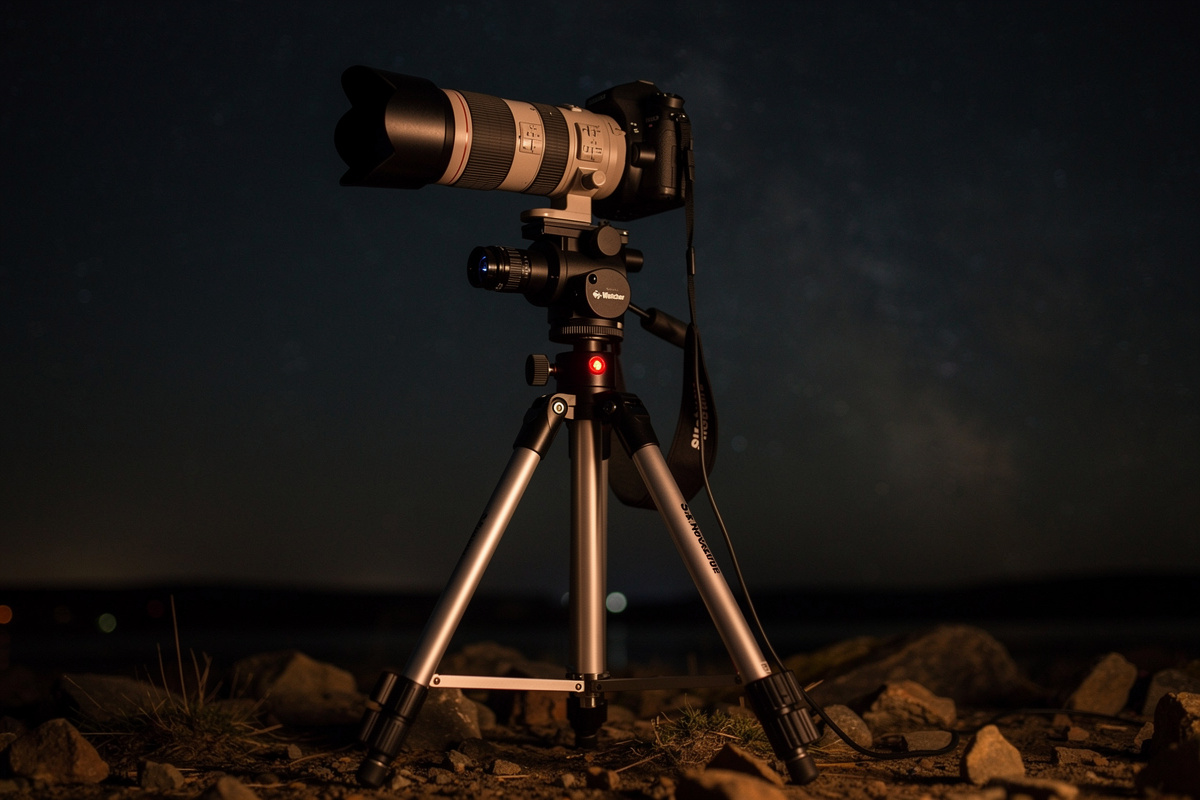

A star tracker moves your camera at the same rate the Earth rotates — 15 degrees per hour at the celestial equator — turning a 20-second Milky Way exposure into a 4-minute pin-point exposure at base ISO. A star tracker costs $300-500 for a quality portable unit and adds roughly 2 kilograms to your kit, but it is the single piece of equipment that separates entry-level astro-landscape images from the sharp, noise-free Milky Way photos that get printed large. A tracking mount does not replace your camera lens or your composition skills — it replaces ISO 6400 noise with ISO 400 clarity, and that tradeoff is visible in every pixel of the final image.
Star Trackers vs Equatorial Mounts: Different Tools for Different Jobs
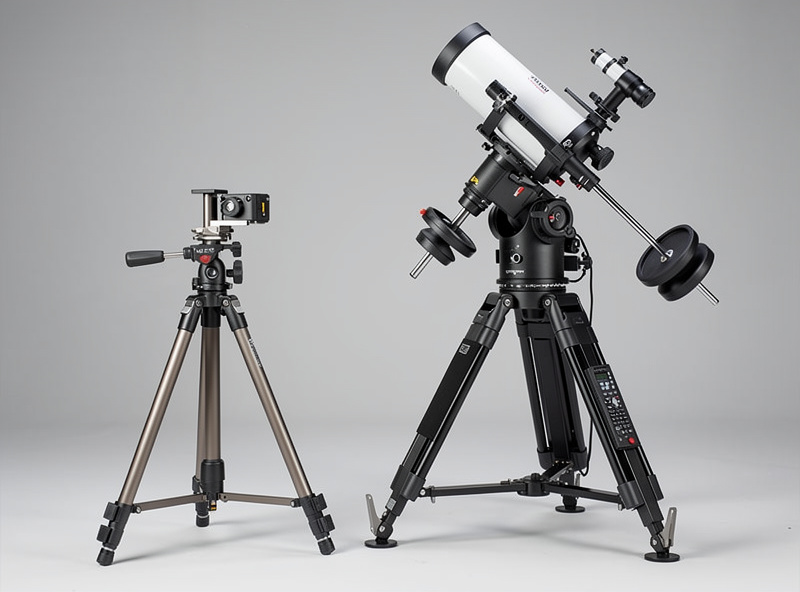
A star tracker like the Sky-Watcher Star Adventurer 2i or iOptron SkyGuider Pro is a single-axis motorized mount designed for camera-and-lens payloads up to 5 kilograms. It aligns with the north celestial pole via a built-in polar scope, runs on 4 AA batteries for roughly 72 hours of tracking, and fits in a camera bag alongside a body and two lenses. An equatorial mount like the Sky-Watcher HEQ5 or Celestron AVX is a two-axis motorized mount designed for telescope payloads up to 13 kilograms, requires a separate 12V power supply or large battery, weighs 10-15 kilograms, and needs a dedicated tripod or pier. If you are shooting with camera lenses under 300mm focal length, buy a star tracker — an equatorial mount is overkill for payload, weight, and setup time, and you will leave it at home while the compact tracker comes on every trip.
| Mount Type | Payload Capacity | Weight (mount only) | Setup Time | Best For | Price Range |
|---|---|---|---|---|---|
| Star Tracker (Star Adventurer 2i) | 5 kg | 1.1 kg | 5-10 min | 14-300mm camera lenses | $350-450 |
| Star Tracker (SkyGuider Pro) | 5 kg | 1.3 kg | 5-10 min | 14-200mm camera lenses | $400-500 |
| Star Tracker (Move Shoot Move) | 3 kg | 0.5 kg | 3-5 min | 14-100mm ultralight travel | $200-300 |
| Equatorial Mount (HEQ5) | 13 kg | 10 kg | 15-30 min | 200-1000mm telescope | $1,200-1,500 |
| Equatorial Mount (AVX) | 14 kg | 8 kg | 15-30 min | 200-1000mm telescope | $1,000-1,200 |
Polar Alignment: The 5-Minute Skill That Makes or Breaks Every Tracked Exposure
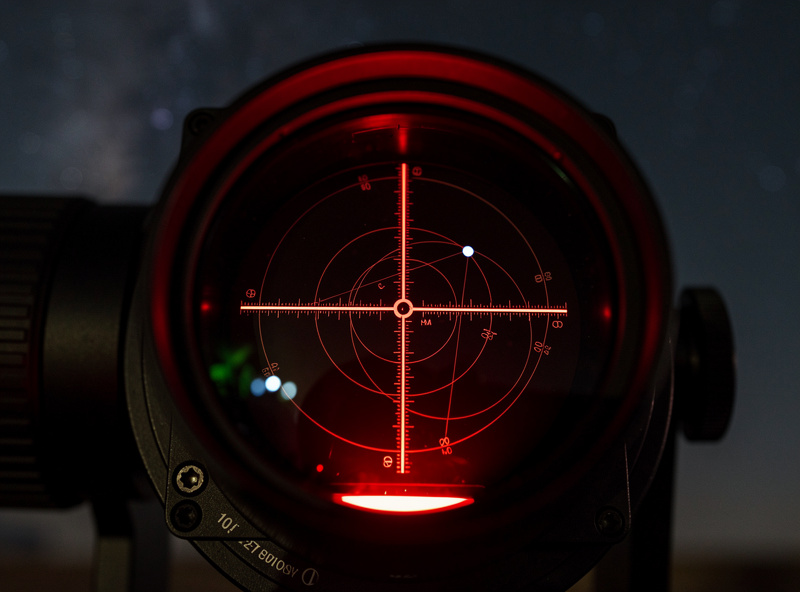
Polar alignment is the process of pointing the tracker’s rotation axis directly at the north celestial pole (Polaris in the Northern Hemisphere). An alignment error of 0.5 degrees produces visible star trailing at 4-minute exposures with a 50mm lens — you can see it at pixel level as elongated stars in the corners of the frame while the center is sharp. The Star Adventurer 2i’s polar scope includes a reticle with Polaris at a specific offset position that changes with date and time — the Polar Scope Align app on your phone tells you exactly where in the reticle circle Polaris should appear for your location and time. The alignment takes 2-3 minutes once you have done it three times and understand the mechanical movements of the mount’s altitude and azimuth adjustment knobs. Do not skip polar alignment because it is “close enough” — at 200mm, “close enough” limits you to 30-second exposures before trailing, and the whole point of the tracker is to shoot minutes, not seconds.
For the camera gear side of astrophotography — including the lens selection, sensor comparisons, and RAW processing workflow that pairs with whichever mount you choose — the camera buying guide on LensLabHQ covers the imaging hardware that sits on top of the tracker.
Autoguiding: When a Star Tracker Is Not Enough
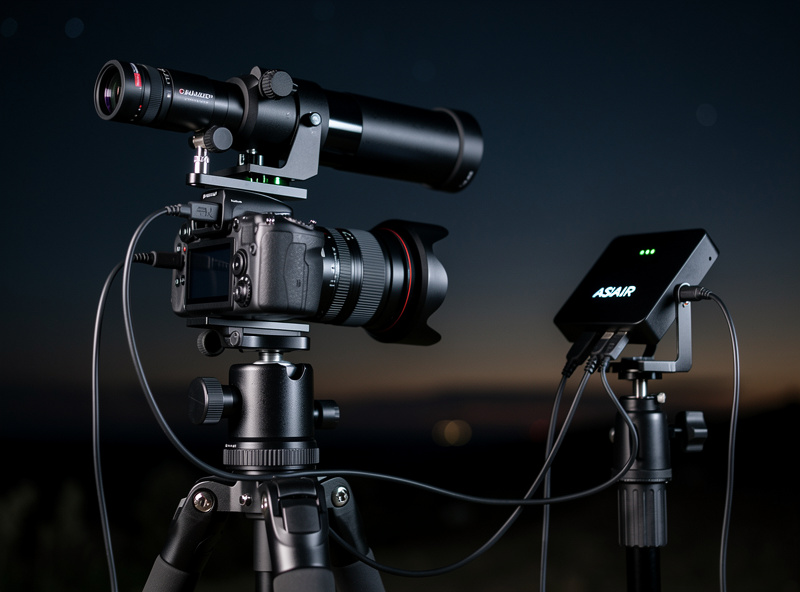
A star tracker’s single-axis motor has periodic error — small mechanical imperfections in the gears that cause the tracking rate to vary by roughly +/- 5-10 arcseconds over a worm-gear cycle of 8-10 minutes. At focal lengths below 100mm, this periodic error is invisible. At 200-300mm on a high-resolution sensor, it produces elongated stars in roughly 20-30% of your 60-second exposures. The solution is autoguiding: a small secondary camera (a ZWO ASI120MM Mini at 50) mounted on a 30mm guide scope or an off-axis guider, connected to a laptop or ASIAIR running PHD2 software, which monitors a guide star and sends micro-corrections to the tracker’s guide port. Autoguiding reduces periodic error from 5-10 arcseconds to roughly 0.5-1 arcsecond, making consistent 3-5 minute exposures possible even at 300mm. The Star Adventurer 2i and SkyGuider Pro both have ST-4 guide ports that accept autoguider corrections — the hardware is ready; you only need the guide camera and software to enable it.
Frequently Asked Questions
What is a star tracker for camera lenses?
A star tracker is a single-axis motorized mount that rotates your camera at the same rate as the Earth to eliminate star trailing in long exposures. It aligns with the north celestial pole, runs on batteries for 72+ hours, and handles camera-lens payloads up to 5 kg for exposures of 2-4 minutes at any focal length.
Do I need a star tracker for Milky Way photography?
No for wide-field single exposures under 30 seconds at 14-24mm. A tracker lets you expose for 2-4 minutes at ISO 400 instead of 15 seconds at ISO 6400, dramatically reducing noise. If you want to print large or shoot at focal lengths above 35mm, a tracker changes what is photographically possible.
What is the difference between a star tracker and equatorial mount?
Star trackers are single-axis, weigh 0.5-1.3 kg, handle 3-5 kg payloads, and cost $200-500. Equatorial mounts are two-axis, weigh 8-15 kg, handle 13-14 kg payloads, and cost $1,000-1,500. For camera lenses under 300mm, buy a star tracker — equatorial mounts are overkill in weight and setup time.
How accurate does polar alignment need to be for a star tracker?
An alignment error of 0.5 degrees produces visible trailing at 4-minute exposures with a 50mm lens. At 200mm, the same error limits you to 30 seconds. Use a polar scope app to place Polaris at the correct offset position. After three practice alignments, you will achieve sub-0.25-degree accuracy in under 3 minutes.
Can I use a star tracker for deep-sky objects?
Yes at focal lengths up to 300mm with a star tracker rated for 5 kg. At 300mm, a tracking accuracy of roughly 5 arcseconds per minute is achievable, which supports 60-90 second exposures on targets like the Orion Nebula or Andromeda Galaxy. For focal lengths above 300mm, an equatorial mount with autoguiding is required.
What is the best star tracker for travel astrophotography?
The Move Shoot Move Rotator at 0.5 kg is the lightest tracker available and handles payloads up to 3 kg — enough for a mirrorless body with a 14-85mm lens. The Sky-Watcher Star Adventurer 2i at 1.1 kg adds a polar scope for more precise alignment and handles 5 kg payloads for heavier zoom lenses.
