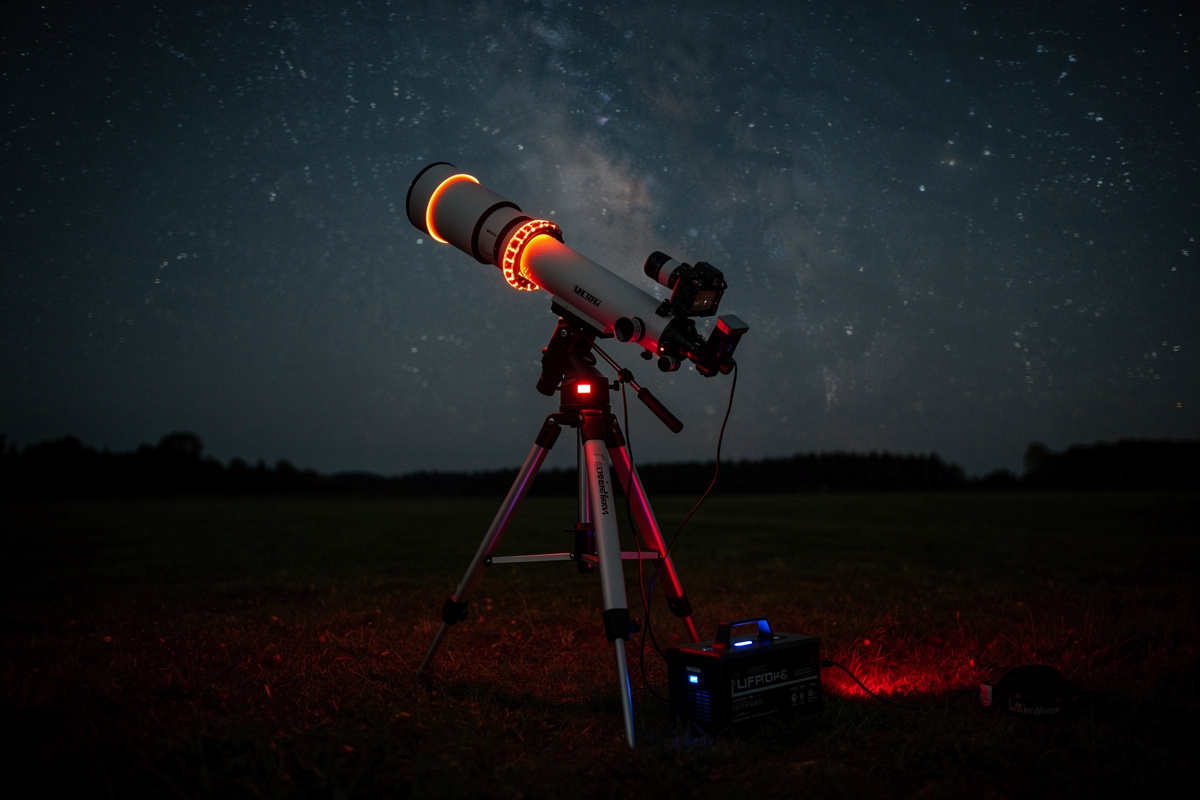

An all-night astrophotography session draws roughly 200 watt-hours from a 12-volt battery — 25 watts for a dew-heater strip running 8 hours to keep the corrector plate clear, 5 watts for an autoguider camera, 3 watts for the mount tracking motors, and 12 watts for a cooled camera TEC cycling on and off through the night. A 12V 20Ah LiFePO4 battery delivers 240 watt-hours total and roughly 200 watt-hours usable at 85 percent depth of discharge — exactly enough for an 8-hour summer session and exactly nothing left for the drive home. In winter at minus 10 degrees, that same battery delivers 140 to 160 watt-hours, and the telescope that ran all night in July dies at 4 a.m. in January with 2 hours of dead tracking time and a camera sensor frosting over in the dark.
The gap between summer battery runtime and winter battery failure is cold-weather capacity derating — a 20 to 30 percent loss that catches every astrophotographer on the first clear winter night. The dew heater also draws more power in winter because the dew point is lower and the heater runs at a higher duty cycle. Lower battery capacity meets higher load, and the session ends before dawn. The fix is not a bigger battery by default — it is understanding the actual hourly draw of the rig, derating the battery capacity for the ambient temperature, and sizing the battery to the session’s total watt-hours with cold-weather margin.
Load Calculation: What Your Rig Actually Draws Per Hour
the scope I run lives in an unheated shed, and the imaging community has settled on LiFePO4 as the reliable field option for all-night sessions. An astrophotography rig breaks into constant loads (tracking motors at 3 to 5 watts, autoguider at 2 to 3 watts, ASIAIR control computer at 5 to 8 watts) and intermittent loads (dew heater at 10 to 30 watts depending on strip length and duty cycle, cooled camera TEC at 10 to 20 watts cycling roughly 50 percent of the time). The surge load — the mount slewing at startup — draws 15 to 30 watts for 30 seconds and is negligible for capacity planning.
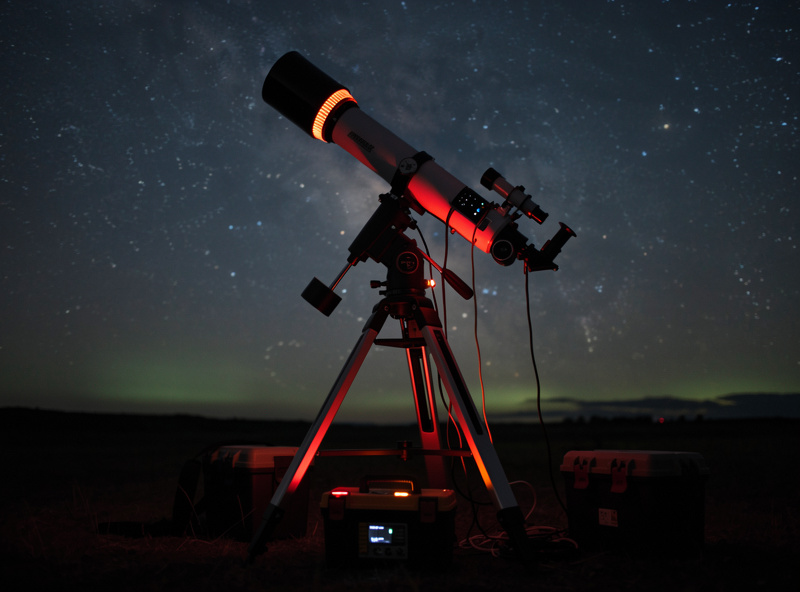
Total hourly draw: 4 watts (mount) + 3 watts (guider) + 6 watts (control computer) + 15 watts (dew heater at 50 percent duty) + 10 watts (camera TEC at 50 percent) = 38 watts, rounded to 40 watts for margin. An 8-hour session at 40 watts consumes 320 watt-hours. At 20 degrees Celsius, a 12V 30Ah LiFePO4 battery provides roughly 306 watt-hours usable at 85 percent DoD — tight but adequate. At minus 10 degrees, the same battery derates to roughly 220 watt-hours — 100 watt-hours short, and the dew heater shuts off at 5 a.m. For the full load- calculation and capacity-planning method that powers the rig through the full session, the battery sizing guide applies the same Wh-to-Ah math to any DC load — the battery does not know whether it is powering a telescope or a home circuit.
Battery Chemistry: Why LiFePO4 Wins Field Astronomy
LiFePO4 delivers flat voltage across 90 percent of its discharge curve — 12.8 volts nominal, staying above 12 volts until roughly 95 percent of capacity is used. A lead-acid battery sags below 11.5 volts at 50 percent state of charge, and most astrophotography mounts trip their low-voltage cutoff at 11.5 to 12 volts — the mount shuts down when the lead-acid battery still has half its capacity remaining. LiFePO4 extracts nearly the full rated watt-hours before the mount sees a voltage sag. It also weighs roughly half as much as the equivalent lead-acid, and weight matters when you are carrying a battery, a mount, a scope, and a camera case from the car to a field a hundred meters from the parking lot.
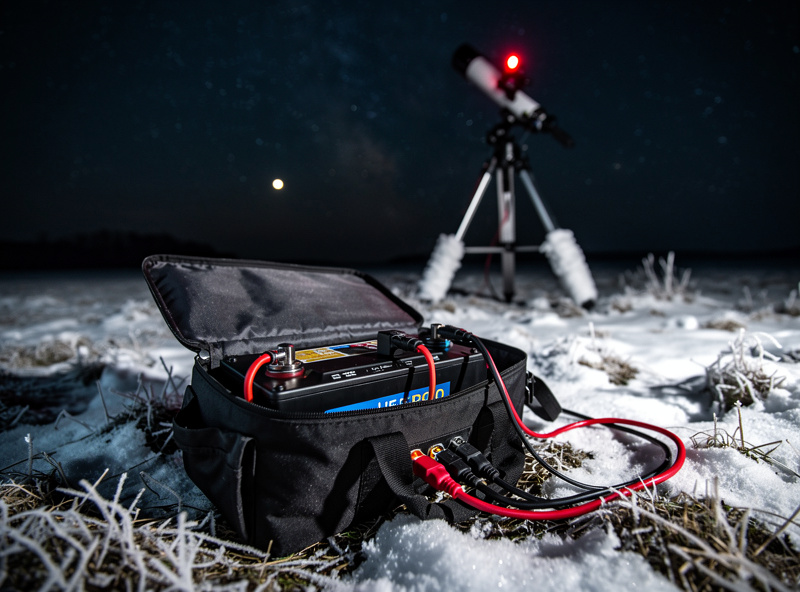
Cold-weather capacity loss is the LiFePO4 tradeoff. At minus 10 degrees, capacity drops by 20 to 30 percent. An insulated bag — a $10 lunch cooler — wrapped around the battery and placed at the mount base retains roughly 15 percent more capacity than a battery exposed to ambient air because the discharge current self-heats the cells slightly. The battery that lost 100 watt-hours to cold loses only 50 watt-hours inside the bag, and those 50 watt-hours are the difference between the dew heater running until dawn and the corrector plate fogging at 5 a.m. An insulated bag is the cheapest capacity upgrade in field astronomy and the one most astrophotographers skip because the battery spec sheet does not mention it.
Single Battery vs Separate Batteries for Mount and Dew Heater
Running the mount and the dew heater from the same battery simplifies setup, but the dew heater is a resistive load that pulls a pulsing current as the controller cycles the heating element on and off. The pulse can introduce voltage ripple on the 12-volt line that the mount’s electronics read as a voltage sag and trip the low-voltage cutoff. Separating the dew heater onto its own battery isolates the mount from the ripple and eliminates the most common cause of mid-session mount shutdowns — not a dead battery, but a noisy one.
A 12V 7Ah LiFePO4 battery dedicated to the dew heater — roughly 70 watt-hours usable — runs a 15-watt heater strip at 50 percent duty cycle for 9 hours, covering the full session with margin. The mount and camera run from a 12V 20Ah or 30Ah battery sized to the session’s non-heater load. Two small batteries cost roughly the same as one large battery, and the noise-isolation benefit is free. The only penalty is carrying two batteries instead of one, and the penalty of a dead mount at 4 a.m. is a full night of subframes lost — heavier bag, better session.
Field Charging: Solar for Multi-Night Star Parties
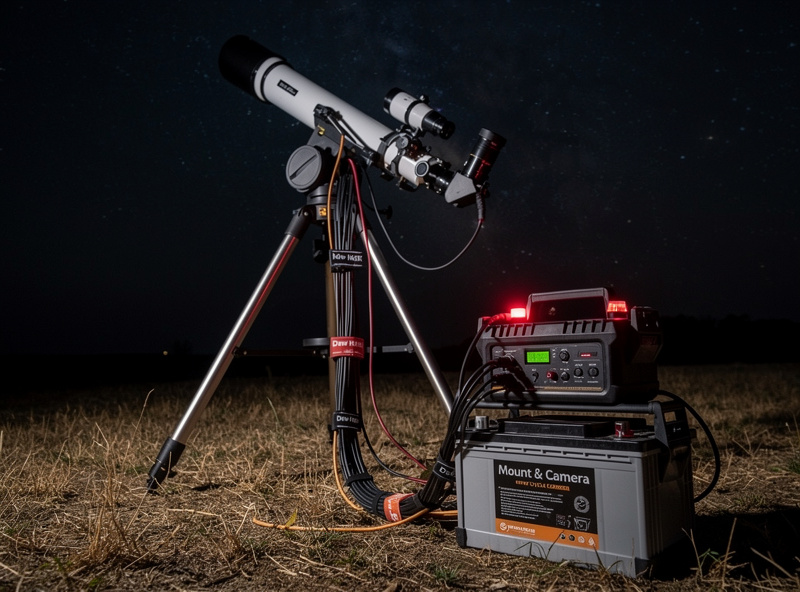
A 50-watt folding solar panel set up at the observing site during the day recharges a 30Ah LiFePO4 battery from 20 percent to full in roughly 6 hours of direct sun — enough to run the rig again that night. The panel produces roughly 3.5 amps at 12 volts under full sun, and the battery accepts roughly 30 amp-hours of charge from empty. The solar panel adds 4 kilograms to the gear load and costs $80 to $120, and for a multi-night star party where grid power is not available, it eliminates the need to bring three pre-charged batteries and swap them mid-session. One battery and one panel, recharged during the day, powers the rig every night indefinitely as long as the weather cooperates with solar production. The same panel that recharges a telescope battery also recharges the camera batteries, the laptop, and the phone — one panel, one charge controller, and the whole observing camp runs off-grid for a week.
Frequently Asked Questions
How big a battery do I need for all-night astrophotography?
A 12V 30Ah LiFePO4 battery providing roughly 306 watt-hours at 20 degrees Celsius covers an 8-hour session drawing 40 watts average. In winter at minus 10 degrees, derate by 30 percent to roughly 214 watt-hours, and either use an insulated battery bag or size up to 12V 40Ah for cold-weather margin.
Why does my mount shut down when the battery still shows 50 percent charge?
Lead-acid batteries sag below 11.5 volts at 50 percent state of charge, and most mounts trip their low-voltage cutoff at 11.5 to 12 volts. The battery has capacity remaining but the voltage is too low for the mount to accept. Switch to LiFePO4, which maintains above 12 volts until roughly 95 percent of capacity is used.
Should I power the dew heater from the same battery as the mount?
Separate the dew heater onto its own battery. The heater controller’s pulse-width modulation introduces voltage ripple on the 12V line that can trigger the mount’s low-voltage cutoff even when the battery is charged. A dedicated 12V 7Ah LiFePO4 runs a 15W heater strip for 9 hours at 50 percent duty cycle.
How do I keep my battery warm enough during winter sessions?
Place the battery in an insulated bag — a lunch cooler works — at the mount base. The battery’s self-heating from discharge current warms the cells inside the bag, recovering roughly 15 percent of cold-weather capacity loss. Keep the battery inside your jacket or the car until setup to start the session with warm cells.
Can I charge my astrophotography battery from my car during a session?
Yes, but do not run the car engine all night. A deep-cycle auxiliary battery charged from the car’s alternator during a 20-minute engine run every 3 to 4 hours tops off the telescope battery without idling the engine continuously. Use a DC-to-DC charger between the car battery and the telescope battery to limit charge current and prevent overloading the alternator.
How many watt-hours does a dew heater actually use per night?
A single dew-heater strip rated at 15 watts running at 50 percent duty cycle for 8 hours uses 60 watt-hours. Two strips — one for the objective, one for the eyepiece or guide scope — use 120 watt-hours. The dew heater is typically the largest single load in a field astrophotography setup, not the camera or the mount.
