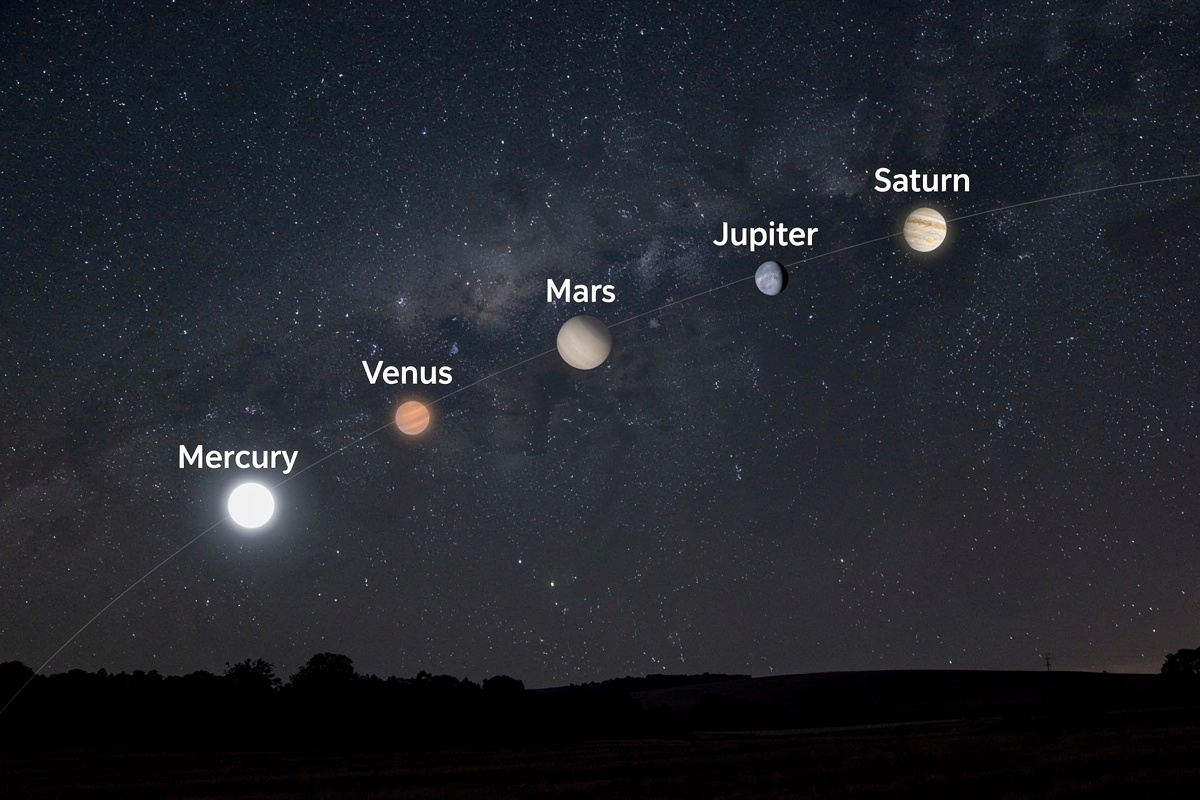

At opposition, an outer planet rises as the Sun sets, transits at midnight, and reaches its closest, brightest, biggest view of the year — the single best window the calendar gives an amateur. Mars at favorable opposition reaches magnitude -2.9 and 25 arcseconds; at aphelion opposition it dims to magnitude -1.2 and 3.5 arcseconds at conjunction. The opposition cycle is the spine of every planetary observing plan.
I plan my year around two opposition windows: a late-summer Saturn night and the autumn Jupiter run. The 2026 calendar is a generous one — Jupiter on October 11 hitting 49.6 arcseconds in Taurus near the Pleiades, Saturn on September 21 with rings tilted 3-4° in Pisces, and Uranus on November 13 at magnitude 5.6 in Aries. This guide is the planning document I actually use through my own 8-inch SCT, with the dates, geometry, and equipment notes I have learned to check before a session. The companion planetary observation guide covers the night-of technique once opposition arrives.
What Is Planetary Opposition?
Opposition is a geometric event: the Sun, Earth, and an outer planet align with Earth in the middle. The planet rises at sunset, transits at midnight, and sets at sunrise — it is visible all night long. At opposition, the planet is at its closest approach to Earth for that orbital cycle, making it appear largest and brightest through a telescope.
Only superior planets — those orbiting beyond Earth’s path — experience opposition: Mars, Jupiter, Saturn, Uranus, and Neptune. Mercury and Venus, orbiting inside Earth’s path, never reach opposition; they display phases like the Moon instead. Inferior conjunction (Venus between Earth and Sun) is the closest analog for inner planets.
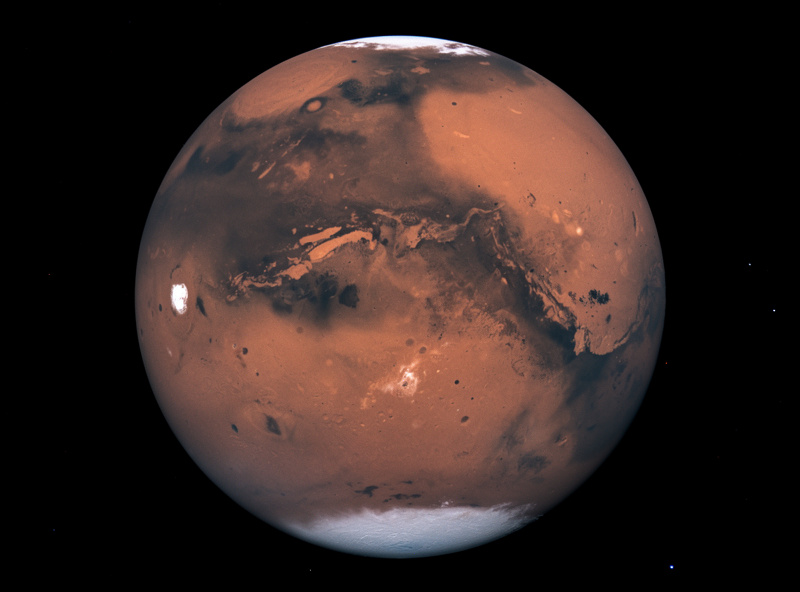
At opposition, the planet’s apparent size is maximized because the Earth-planet distance is minimized. For Mars, this difference is dramatic: its disc is 6-7x larger at favorable opposition than at conjunction. For Jupiter and Saturn, the difference is modest (15-20% variation) because their orbits are larger and eccentricities are lower. For everything specific to Mars — aperture minimums for surface features, the red and blue filters worth using, and how to plan around the 26-month opposition cycle — the observing Mars at opposition guide covers the detail.
Opposition Cycles of the Major Planets
Each planet’s opposition interval equals its synodic period — the time it takes to return to the same position relative to the Sun as seen from Earth.
Mars: 780 days (2 years, 50 days). Mars has the most variable opposition geometry because its orbital eccentricity (0.093) is the highest of the major planets. Oppositions near perihelion bring Mars within 55-57 million km (apparent diameter 25+ arcseconds). Oppositions near aphelion leave it at 95-100 million km (14-15 arcseconds). The perihelion opposition cycle repeats every 15-17 years.
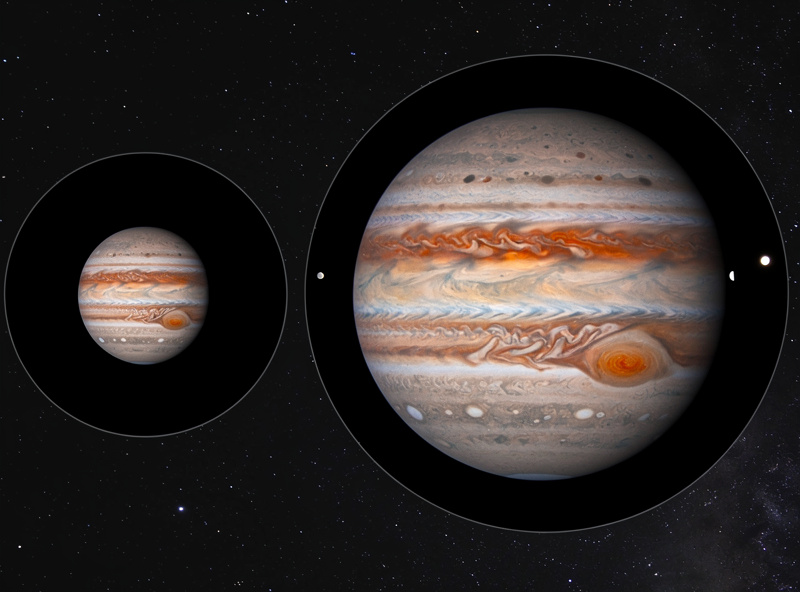
Jupiter: 399 days (1 year, 34 days). Jupiter’s oppositions are nearly annual with modest size variation (31-50 arcseconds) due to its distance and low eccentricity (0.049). Every opposition is excellent for observation.
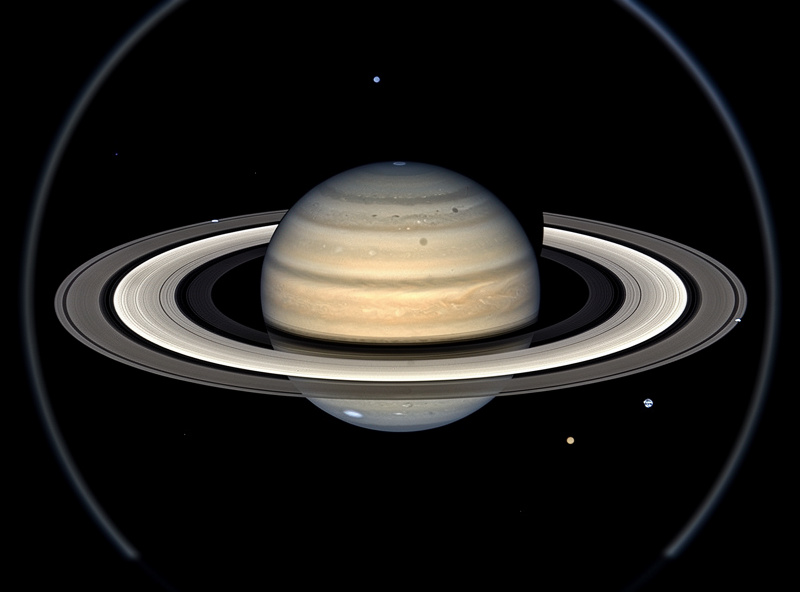
Saturn: 378 days (1 year, 13 days). Saturn’s oppositions are also nearly annual. The main variable is ring tilt, which cycles over 29.5 years — not the opposition interval. Saturn’s apparent size varies only between 16 and 21 arcseconds.
Uranus: 370 days. Opposition magnitude: 5.6-5.9. Visible in binoculars as a faint star; shows a tiny 3.4-4.1 arcsecond disc in telescopes.
Neptune: 367 days. Opposition magnitude: 7.8. Telescopes only — appears as a 2.2-2.4 arcsecond pale blue dot.
Opposition Dates for 2026 and 2027
Planning ahead is essential for the best opposition views. Here are confirmed and predicted opposition dates:
2026 Oppositions:
Jupiter: October 11, 2026. Magnitude -2.9, disc diameter 49.6 arcseconds. Excellent opposition — Jupiter is relatively close at 3.95 AU. Visible in Taurus, near the Pleiades. The full Jupiter observing guide covers what to chase at this size.
Saturn: September 21, 2026. Magnitude +0.4, disc diameter 19.2 arcseconds. Rings at roughly 3-4° tilt (narrow but visible). Located in Pisces. The Saturn rings guide walks through what a low-tilt opposition looks like at the eyepiece.
Uranus: November 13, 2026. Magnitude 5.6, disc 3.7 arcseconds. In Aries.
Neptune: September 17, 2026. Magnitude 7.8, disc 2.4 arcseconds. In Pisces.
2027 Oppositions:
Mars: February 19, 2027. Magnitude -1.2, disc 13.8 arcseconds. This is a distant, unfavorable aphelion-era opposition. Mars will be small — better to wait for the 2033 favorable opposition for serious surface work.
Jupiter: November 1, 2027. Magnitude -2.9, disc 49.3 arcseconds.
Saturn: October 5, 2027. Magnitude +0.4, disc 18.8 arcseconds. Rings tilting open toward 10-12°.
Mars Opposition: Why Some Are Better Than Others
Mars is the planet most affected by opposition geometry. Its orbital eccentricity means the distance between Earth and Mars at opposition ranges from 54.6 million km (2003 approach, closest in 60,000 years) to 101 million km (the 2027 opposition). A closer opposition means a larger disc, longer observation window, and more surface detail visible.
Favorable oppositions (disc 20+ arcseconds) occur when Mars is near perihelion at opposition. The cycle repeats every 15-17 years. Recent favorable oppositions: 2003 (25.1″), 2018 (24.3″), and the next is 2033 (24.2″). 2035 is even better at 24.6″. These are the oppositions worth planning telescope time around.
Unfavorable oppositions (disc 14-16 arcseconds) occur near aphelion. The 2025 and 2027 oppositions are unfavorable — I worked the January 2025 opposition for nine consecutive nights through my 8-inch SCT and Mars topped out at 14.6 arcseconds. The polar caps were visible at 200x but the dark albedo features were a struggle. The lesson stuck: Mars at 14 arcseconds is fundamentally a different target than Mars at 24 arcseconds, and books written about the latter mislead you about the former.
At a favorable opposition, a 6-inch telescope at 200x shows dark surface features (Syrtis Major, Mare Erythraeum, Sinus Meridiani), bright features (Hellas basin, Tharsis volcanoes), and the shrinking south polar cap (if southern hemisphere is tilted toward Earth). At unfavorable oppositions, even an 8-inch struggles to show the same detail. How to observe planets covers the seeing and magnification routine that gets the most out of either.
Jupiter and Saturn: The Reliable Targets
Jupiter and Saturn offer excellent views at every opposition because their distance variation is small. Jupiter’s disc ranges from 31 arcseconds (at distant opposition) to 50 arcseconds (at close opposition). Saturn’s ranges from 16 to 21 arcseconds. Both are big enough at any opposition to show major features in moderate telescopes.
Jupiter at opposition: Always shows belts, GRS (with correct timing), and Galilean moons. At closer oppositions, festoons and white ovals become easier. The 2026 opposition at 49.6 arcseconds is near the maximum — an excellent year for Jupiter, and the closest it has been since 2022. I caught my first double shadow transit (Io and Europa simultaneously) on November 12, 2024 with no advance planning — the prediction popped up in Stellarium two hours before, and I spent the entire event swapping between an 8 mm and 5 mm Astro-Tech Paradigm.
Saturn at opposition: The view depends more on ring tilt than distance. Saturn near maximum ring tilt (25-27°) shows the rings in their full glory regardless of distance. Saturn near edge-on (0-5°) shows thin rings even at closest approach. The 2026 opposition has narrow rings (3-4° tilt) — still visible but not as dramatic as wide-open rings. The most recent ring-plane crossing was March 23, 2025, so 2026 starts the slow 13-year tilt back toward the 2032-33 maximum.
Uranus and Neptune at opposition: These ice giants are always faint telescopic targets. Uranus at magnitude 5.6 is visible in 10×50 binoculars as a “star” — a telescope resolves its 3.7 arcsecond disc into a tiny pale-green dot. Neptune (7.8, 2.4 arcseconds) requires a telescope and looks like a faint blue-grey star. Neither planet shows surface detail in amateur equipment.
Planning Your Opposition Observation Session
Opposition is the best night, but the planet is excellent for 2-4 weeks on either side. The size and brightness change by less than 5% over this window. Do not wait for the exact opposition date — start observing 2 weeks before and continue 2 weeks after.
Timing: At opposition, the planet is highest at local midnight. For Mars or Jupiter, this means the best seeing (most stable atmosphere) occurs from 11 PM to 2 AM when the planet has been above the horizon for hours and atmospheric turbulence has settled. For planets at lower elevation, mid-evening or pre-dawn may offer better seeing depending on local conditions.
Atmospheric dispersion: When planets are low on the horizon (below 30° elevation), atmospheric dispersion splits their light into a vertical spectrum — you see a rainbow fringe. An atmospheric dispersion corrector (ADC) — essentially a pair of counter-rotating prisms — eliminates this effect and is essential for low-elevation planetary observation. Cost: $150-250.
Equipment preparation: Collimate your telescope before the session — the collimation guide covers the 5-minute version I run before every planetary night. Allow 30 minutes for thermal equilibration; an 8-inch mirror takes 25-30 minutes to match ambient temperature. Use a dew shield or heated dew strap. Set up eyepieces in order of increasing magnification and start low. Point the scope at the Moon first (if visible) to confirm focus and alignment before swinging to the planet — the Moon observation guide has terminator targets that double as great seeing tests. A well-prepared setup makes the difference between a frustrating session and a memorable one.
Opposition and Retrograde Motion
At opposition, outer planets exhibit retrograde motion — they appear to move westward against the background stars. This is an optical illusion caused by Earth overtaking the slower outer planet in its orbit. Mars shows the most dramatic retrograde loop because it is closest to Earth.
Retrograde motion begins 2-4 weeks before opposition and ends 2-4 weeks after, lasting 6-12 weeks total depending on the planet. Jupiter’s retrograde lasts about 4 months; Saturn’s about 4.5 months. During retrograde, the planet’s position changes slowly, making it easy to find over multiple nights.
The retrograde loop itself varies in shape. Mars traces an S-curve, a loop, or a double loop depending on the opposition geometry. The 2003 opposition produced a tight S-curve. The 2018 opposition produced an elongated loop. This is purely geometric — the planet does not actually reverse direction — but it creates interesting star-hopping opportunities as the planet drifts through different star fields.
Telescope Recommendations by Planet at Opposition
Different planets demand different equipment strategies. Matching your telescope to the target maximizes what you see at opposition. If you are still narrowing down a first scope, the beginner telescope guide covers the budget tiers that actually deliver opposition detail.
Mars: A 6-inch f/8 Dobsonian or 5-inch apochromatic refractor is the practical minimum for surface feature detection at favorable oppositions. Push to 200-300x for Syrtis Major and polar cap detail. A green (#58) filter enhances dark surface features against the orange-ochre background. Mars is small even at opposition — aperture and steady seeing matter more than field of view. An 8-inch SCT at f/10 with a quality 5 mm eyepiece (400x) is a serious Mars instrument. The full eyepiece guide compares short focal lengths in the planetary range.
Jupiter: Any 4-inch telescope at 120-200x shows belts and the Great Red Spot. An 8-inch at 250x resolves festoons, white ovals, and barges. Jupiter is forgiving of moderate seeing because its brightness makes any atmospheric detail detectable. A light blue (#80A) filter increases belt contrast — the filters guide covers when each Wratten number earns its place. Fast focal ratios work fine — Jupiter is bright enough that light collection is not a concern.
Saturn: A 6-inch telescope resolves the Cassini Division at 200x. Saturn’s lower surface brightness benefits from larger aperture — an 8-inch shows more ring and belt detail than a 6-inch at the same magnification. Ring tilt is the primary variable: a low-tilt Saturn is less impressive regardless of telescope size. A yellow (#12) filter brightens the rings relative to the disc.
Uranus: Binoculars confirm its position. A 4-inch telescope at 100x resolves its 3.7 arcsecond disc. No amateur telescope shows surface features. Uranus’s value at opposition is positional — it is easy to locate when bright and can be used as a reference point for finding nearby faint objects.
Neptune: A 6-inch telescope at 150x shows a 2.4 arcsecond pale blue dot. Neptune is always a “star or disc” test — if you can see a small disc rather than a point, you have confirmed it. Triton (magnitude 13.5) is visible in 12-inch+ telescopes as a faint companion.
Imaging Planets at Opposition
Opposition is the best time to image planets because they are largest and highest in the sky. The dominant technique is planetary lucky imaging — shooting thousands of video frames and stacking the sharpest. The astrophotography guide covers the camera-to-laptop pipeline if you are starting from zero.
Mars: At favorable opposition, a ZWO ASI462MC camera on an 8-inch SCT captures surface features at 150 fps. Shoot 90-second videos (13,500 frames). Stack the best 10% in AutoStakkert. Apply moderate wavelet sharpening in Registax. Mars’s rotation (24.6 hour period) means you can shoot 3-4 minutes before derotation is needed. Process in WinJUPOS if shooting RGB with filters over 10+ minutes.
Jupiter: The easiest planet to image. Even a 5-inch SCT with a $200 camera produces recognizable belt detail. Jupiter’s brightness (magnitude -2.9) means short exposures (15-20 ms) freeze seeing. Shoot 60-90 seconds at 150+ fps. Jupiter’s fast rotation (9h 55m) means derotation is essential for any multi-filter sequence over 5 minutes.
Saturn: Dimmer than Jupiter, requiring higher gain or longer exposures (30-50 ms). Saturn’s 29.5-year orbital period means its image scale changes slowly — your imaging setup from one opposition to the next produces comparable results. Focus on ring detail: the Cassini Division, Encke Gap (10-inch+), and ring shadow on the disc are the primary targets.
Deep-sky at opposition: Opposition is also when outer planets pass near deep-sky objects. Saturn near M75, Jupiter near the Pleiades — wide-field shots capturing the planet among stars create unique images. Use a camera lens (50-135 mm) on a tracking mount, expose 30-60 seconds at ISO 800-1600, and capture the scene.
Historical Observations of Planetary Oppositions
Opposition observations have driven major astronomical discoveries. Understanding this history adds depth to your own observing sessions.
Tycho Brahe (1546-1601) compiled the most accurate pre-telescopic planetary observations. His Mars data — precise positions at opposition and throughout the synodic period — enabled Kepler to derive the three laws of planetary motion. Without Tycho’s opposition measurements, the elliptical nature of planetary orbits might have remained hidden for decades longer.
Giovanni Cassini (1625-1712) used opposition observations of Mars to estimate the Mars-Sun distance via parallax. By comparing Mars’s position against background stars from Paris and French Guiana simultaneously, Cassini calculated the AU (astronomical unit) with 7% accuracy — a remarkable achievement for the 17th century.
The 1877 Mars opposition brought Mars within 56.1 million km. Asaph Hall discovered Phobos and Deimos — Mars’s two tiny moons — using the 26-inch refractor at the US Naval Observatory. Giovanni Schiaparelli mapped the “canali” (channels, mistranslated as “canals”) that sparked decades of speculation about Martian life. These discoveries required the close approach geometry that favorable opposition provides.
The 2003 Mars opposition brought Mars within 55.76 million km — the closest approach in nearly 60,000 years. Mars reached magnitude -2.9 and 25.1 arcseconds. Millions of people viewed Mars through telescopes at public star parties. The Mars Exploration Rovers Spirit and Opportunity were launched during the preceding months, taking advantage of the close approach for shorter travel times.
Opposition Mythology and Cultural Significance
Opposition has been observed and interpreted across cultures for millennia. Babylonian astronomers recorded Mars opposition dates on cuneiform tablets as early as the 7th century BCE, recognizing the 780-day synodic period and building predictive models. These clay tablets, now held in the British Museum, show opposition dates calculated to within 1-2 days — astonishing accuracy for 2,700 years ago.
The Greeks called Mars “Pyroeis” (the fiery one) and associated opposition periods with war and upheaval — Mars at opposition was a blood-red disc dominating the midnight sky. Medieval European astrologers considered Mars oppositions omens of plague and conflict. The 1516 Mars opposition coincided with an outbreak of sweating sickness in England, reinforcing the astrological link in the public mind. While the association is purely superstition, it kept opposition observations culturally significant for centuries.
In modern amateur astronomy, opposition represents the practical peak of the observing season. It is when the planet is most accessible — visible all night, high in the sky, and at maximum apparent size. The concept of “opposition season” drives telescope sales, star party scheduling, and astrophotography competitions. Planning an opposition session weeks in advance, checking forecasts, and preparing equipment is a ritual that connects amateur astronomers to 3,000 years of observational tradition.
Combining Opposition Observing with Other Targets
Opposition planets do not exist in isolation — they sit among stars, nebulae, and star clusters that become easy targets during your session. Combining planetary observation with deep-sky work maximizes your telescope time.
Jupiter at opposition in Taurus passes near the Pleiades (M45) and Hyades star clusters. A pair of binoculars shows Jupiter flanked by the Pleiades’ blue-white stars — one of the most beautiful wide-field sights in the night sky. Photographing this conjunction with a 50 mm lens captures a scene reminiscent of ancient astronomical illustrations. The star clusters guide covers other open clusters worth swinging to between planetary glances.
Saturn at opposition in Pisces sits near the Pisces-constellation boundary with no major deep-sky objects nearby, but the Milky Way passes overhead during Saturn’s opposition months. After observing Saturn at the eyepiece, swing the telescope to the Sagittarius Star Cloud (M24), the Lagoon Nebula (M8), or the Trifid Nebula (M20) — all high overhead during Saturn opposition season and at their best when the sky is darkest. The nebulae guide sequences these summer targets by visibility window.
Mars at opposition occasionally passes near bright star clusters or globular clusters. The 2018 opposition placed Mars near M22, a magnitude 5.1 globular cluster in Sagittarius. Observing the planet and the cluster in the same eyepiece session highlights the difference between a planetary disc and a stellar collection — Mars at 24 arcseconds is resolvable while M22’s 32 arcminute extent fills the entire field of view. The Messier guide ranks the catalog by visual impact for evenings like this.
Opposition season also overlaps with comet apparitions and meteor activity. Planning a single late-September night around Saturn opposition, the August Perseid tail, and a passing comet is the kind of combined session that justifies the gear. The comet watching guide and meteor showers guide cover the timing windows and equipment choices for both. The solar eclipse guide rounds out the events calendar for the year.
Uranus and Neptune at opposition are useful finder references for fainter objects. Uranus in Aries passes near several 8th-10th magnitude galaxies that are challenging targets on their own. Using Uranus as a starting point for star-hopping to these galaxies makes them far easier to locate.
Common Mistakes I Made at Opposition
Even after a decade of opposition seasons, I still catch myself repeating the same handful of errors. These are the four that have cost me the most observing time.
Observing only on the exact opposition date. The first Mars opposition I tracked, I cleared my calendar for one specific Tuesday in October and the sky was solid overcast. I treated the entire opposition as a write-off. The size and brightness change by less than 5% over a 4-week window centered on opposition — I now plan a 6-week corridor and stop checking the exact date.
Pushing magnification past what the air supports. The first time I ran 350x on Jupiter the disc boiled like a frying pan. I burned 90 minutes assuming the scope was the problem — fresh collimation, fresh diagonal, swapping eyepieces — when the real cause was a 22-degree temperature gradient over the city. Backing down to 180x produced a sharp, steady Jupiter immediately. When the planet refuses to look right, try less magnification before you try more.
Skipping thermal equilibration to “save time.” A telescope mirror or lens brought outside from a warm house creates thermal currents inside the tube that destroy image quality. An 8-inch mirror needs 25-30 minutes to cool to ambient temperature. The first 20 minutes of any session I rush is the 20 minutes I get the worst views. I now set the scope outside while I make coffee.
Forgetting atmospheric dispersion correction. At elevations below 30°, atmospheric dispersion smears the planet’s image into a vertical spectrum — the top of the disc appears blue-shifted and the bottom red-shifted. I observed two full Saturn oppositions before I bought a $180 ZWO ADC, and the difference at 25° altitude was the difference between “interesting” and “actually sharp.” For low-elevation planetary observation it is the single most impactful accessory you can add.
Magnitude and Size Comparison Table
| Planet | Opposition Magnitude | Opposition Disc Size | Conjunction Magnitude | Conjunction Disc Size | Synodic Period |
|---|---|---|---|---|---|
| Mars | -2.9 (favorable) to -1.2 (unfavorable) | 14-25 arcsec | +1.8 | 3.5 arcsec | 780 days |
| Jupiter | -2.9 to -2.5 | 31-50 arcsec | -1.7 | 30-32 arcsec | 399 days |
| Saturn | +0.4 to -0.5 | 16-21 arcsec | +1.0 | 15-16 arcsec | 378 days |
| Uranus | +5.6 to +5.9 | 3.4-4.1 arcsec | +5.9 | 3.4 arcsec | 370 days |
| Neptune | +7.8 | 2.2-2.4 arcsec | +8.0 | 2.2 arcsec | 367 days |
What I Would Do This Opposition Season
If I could only run three sessions across the 2026-2027 opposition window, here is the order I would build them in. First, Saturn around September 21, 2026 — narrow rings yes, but the entire 13-year tilt arc is now opening, and a low-tilt Saturn is the only Saturn first-time observers will see for the next 18 months without checking dates. Second, Jupiter around October 11, 2026 with the Pleiades 5° away — set up at moonrise, work the GRS at 250x, swing 1° west to the Pleiades wide-field, repeat for an hour. Third, hold a clear night in November 2026 for Uranus opposition — a binocular hop, a telescope confirm, and you have observed all five superior planets in a six-week stretch. The 2027 Mars opposition is small enough to skip without guilt; save the storage drive space for 2033.
Frequently Asked Questions
What does opposition mean for a planet?
Opposition means the planet is directly opposite the Sun from Earth perspective. The Sun, Earth, and planet form a straight line with Earth in the middle. At opposition, the planet is closest to Earth for that orbit, rises at sunset, is visible all night, and appears at maximum brightness and apparent size in a telescope.
How often does Mars reach opposition?
Mars reaches opposition every 780 days (approximately 2 years and 50 days). However, not all Mars oppositions are equal — favorable oppositions where Mars is close to perihelion occur every 15-17 years and bring Mars within 55-60 million km. Unfavorable oppositions near aphelion leave Mars at 95-100 million km, making it appear significantly smaller.
Is opposition the best time to observe a planet?
Yes. At opposition, a planet is closest to Earth (maximum apparent size), at its brightest, highest in the sky at midnight, and visible all night. The viewing window extends 2-4 weeks on either side with minimal change in quality. Start observing 2 weeks before opposition and continue 2 weeks after.
When is Jupiter next opposition?
Jupiter next opposition is October 11, 2026, with a disc diameter of 49.6 arcseconds — near the maximum possible. Jupiter will be in Taurus near the Pleiades, reaching magnitude -2.9. After that, the following opposition is November 1, 2027.
Why is Mars sometimes very bright and sometimes dim at opposition?
Mars has the most eccentric orbit of the major planets. At perihelic oppositions (every 15-17 years), Mars is 55-60 million km away and appears 20-25 arcseconds across at magnitude -2.6 to -2.9. At aphelic oppositions, it is 95-100 million km away, appearing only 14-16 arcseconds at magnitude -1.2 to -1.4. The difference in brightness is roughly 10x.
What is retrograde motion at opposition?
At opposition, outer planets appear to move backward (westward) against background stars for several weeks. This is an optical effect — Earth, orbiting faster, overtakes the slower outer planet, making it seem to reverse direction. Mars shows the most dramatic retrograde loops. Retrograde begins before opposition and ends after, lasting 6-12 weeks.
Do Mercury and Venus have oppositions?
No. Mercury and Venus orbit inside Earth path, so they can never be opposite the Sun as seen from Earth. Their closest approach is inferior conjunction (between Earth and Sun). Venus reaches maximum apparent size (about 66 arcseconds) at inferior conjunction, but it shows a thin crescent phase — only about 1 percent illuminated.
Related Articles
- Meteor Showers: When and How to Watch — Annual shower calendar and observing technique.
- Solar Eclipse Guide — Safe solar viewing techniques and gear.
- Comet Watching Guide — Finding and tracking comet apparitions.
- Planetary Observation Guide — The companion hub on the eyepiece-side technique.
- Jupiter Through a Telescope — Detailed observing guide for the king of planets.
