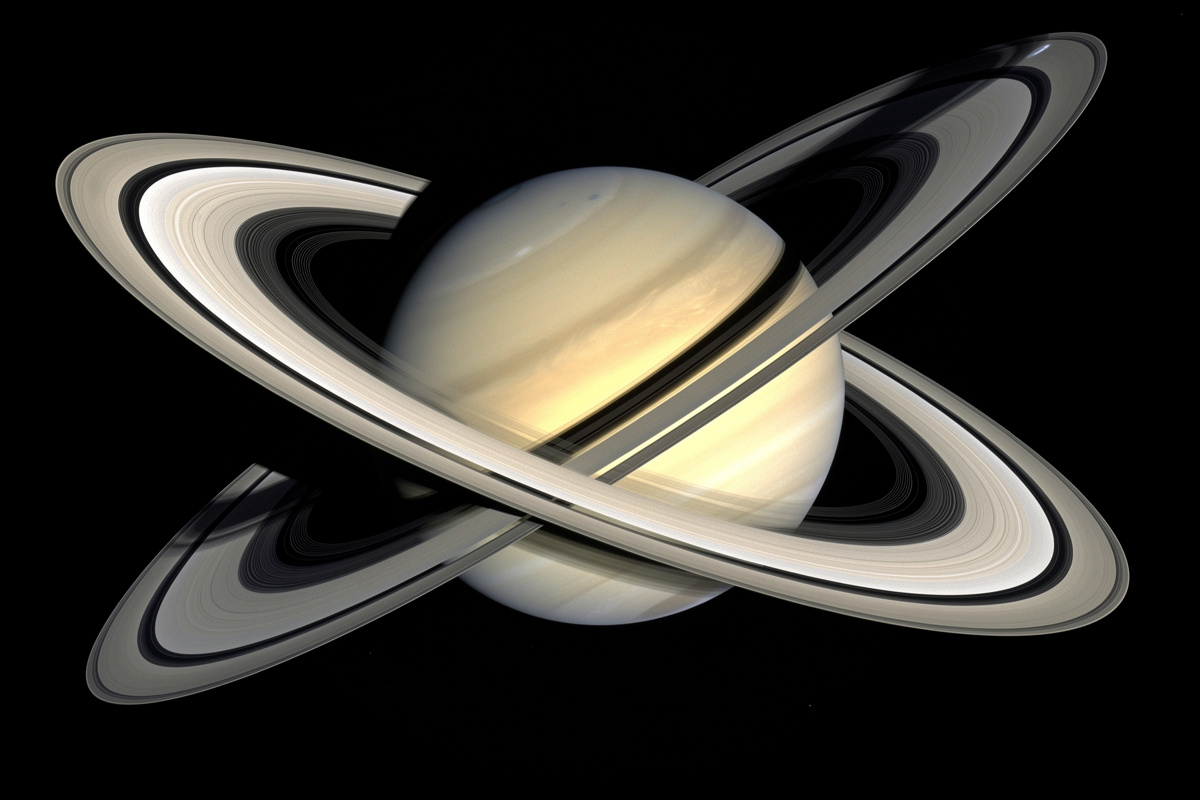

Saturn’s rings become visible in any telescope with 25x magnification or higher, but resolving the Cassini Division — the 4,595 km gap between the A and B rings — requires at least a 4-inch aperture at 150x under steady seeing. Saturn reaches opposition roughly once every 378 days, and ring tilt varies from 0° to 27° over a 15-year cycle.
Saturn is the planet that hooked me on telescope astronomy, and it is the planet I always end an observing session on. The first time I saw the rings clearly separated from the disc through a borrowed 4-inch refractor at 100x, I sat at the eyepiece for 40 minutes without moving — there is genuinely nothing else in the sky that looks like Saturn. This guide is the eyepiece-side workflow I run on Saturn nights through my own 8-inch SCT; the broader cluster planetary observation guide covers the other four bright planets in the same cluster.
What You See at the Eyepiece
Through a small refractor at 50x, Saturn appears as a pale golden disc with a thin ring extending on either side. The planet itself spans roughly 16-20 arcseconds at opposition depending on its distance from Earth (which varies between 8.89 and 10.09 AU). At 50x, the disc is small but the ring system is unmistakable — no other object in the solar system looks like it.
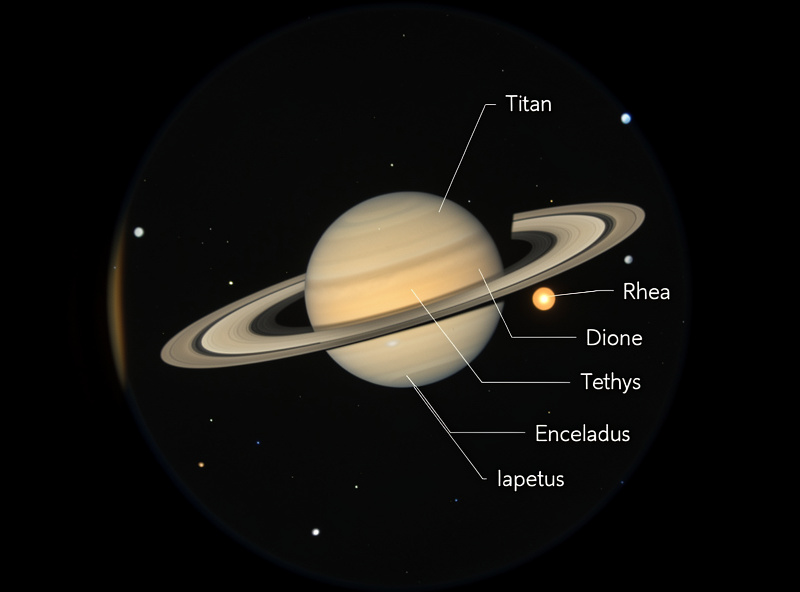
Push to 150x in a 4-inch scope and the ring structure opens up. The B ring appears bright and dense, separated from the darker, more transparent A ring by the Cassini Division. The C ring (Crepe Ring), interior to the B ring, is faintly visible as a thin translucent band hugging the planet. The planet’s disc shows subtle banding — at least two or three equatorial belts are detectable in steady air.
With an 8-inch telescope at 250x and good seeing, the Encke Gap (325 km wide) in the A ring becomes possible — this is a stern test of both aperture and atmospheric stability. Shadow bands from ring particles on the planet’s disc become visible. The north-south asymmetry of the ring shadow tells you the tilt angle intuitively. I have only nailed the Encke Gap clearly twice in five years of observing Saturn — both times on freezing-still January nights with the planet near the meridian. Aperture alone does not get you there; the atmosphere has to cooperate.
Ring Tilt Cycle and Why It Matters
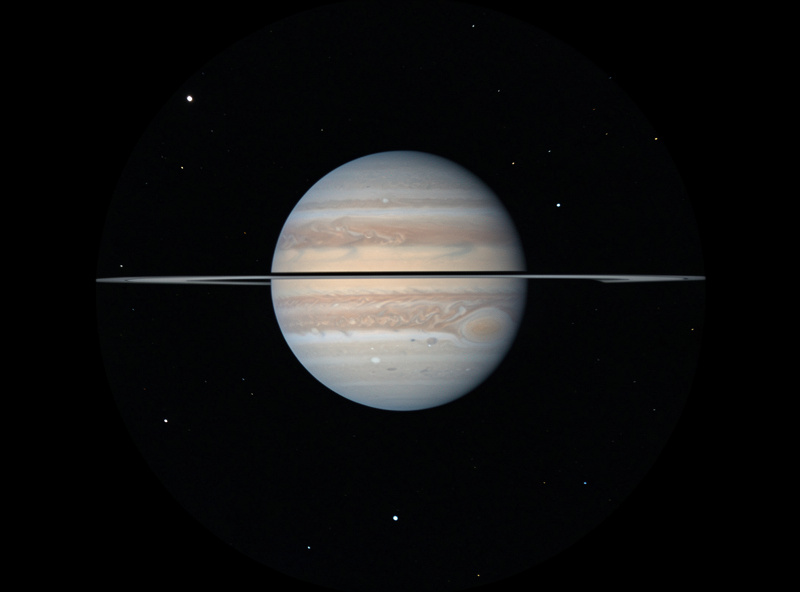
Saturn’s rings are tilted 26.7° relative to its orbital plane, but Earth’s viewing angle changes as Saturn orbits the Sun. Every 13-15 years, the rings present edge-on to Earth. At edge-on (0° tilt), the rings vanish entirely in amateur telescopes — Saturn appears as a plain disc with no rings visible.
The most recent ring-plane crossing was March 23, 2025. Through 2026 the rings are tilted 3-4° on the southern side and increasing slowly. The view will improve steadily through 2027-2032 as tilt climbs back toward maximum, with the next maximum tilt around 2032-2033. The previous maximum tilt of 27° was 2017, and the previous edge-on was 2009. I drove an hour to a clearer eastern horizon in March 2025 to catch the rings as a single hairline through 200x — that was the last edge-on crossing many of us will see, and the next is not until 2038-2039.
Low tilt means the rings appear as a razor-thin line. This is still worth observing — it tests your optics and seeing conditions. But moderate to high tilt (15°+) is when the ring system really opens up and shows its full three-dimensional depth through shadow and perspective. Planets at opposition covers the year-by-year opposition schedule that pairs with the tilt cycle.
Saturn’s Moons Through the Telescope
Saturn has 146 known moons, but only six are routinely visible in amateur telescopes. Titan (magnitude 8.3, diameter 5,150 km) is the easiest — it is brighter than many asteroids and visible in any telescope that shows the rings. At opposition, Titan sits roughly 3 arcminutes from Saturn’s disc.
Rhea (magnitude 9.7), Dione (magnitude 10.4), Tethys (magnitude 10.2), and Iapetus (magnitude 10.2 at western elongation, 11.9 at eastern) are visible in 6-inch telescopes. Enceladus (magnitude 11.7) needs an 8-inch or larger scope and excellent conditions. Hyperion (magnitude 14.2) requires a 12-inch telescope and careful star-hopping.
Iapetus is the most interesting moon to track. Its leading hemisphere is dark (albedo 0.05) while its trailing hemisphere is bright (albedo 0.5). Over its 79-day orbit, Iapetus varies by 1.7 magnitudes — sometimes it is an easy binocular object, sometimes it pushes the limits of moderate telescopes.
Saturn’s Atmospheric Features
Saturn’s atmosphere is less dramatic than Jupiter’s, but dedicated observers detect significant detail. The planet’s equatorial zone is the brightest region, bounded by the North and South Equatorial Belts (NEB and SEB). These belts are usually pale tan but occasionally darken. The North and South Temperate Belts sit poleward and are thinner and fainter.
Great White Spots (GWS) erupt roughly every 29-30 years — one Saturn year. The most recent was in 2010-2011, visible in 8-inch telescopes as a bright spot spanning 5,000+ km. The next GWS is expected around 2039-2040.
The hexagonal storm at Saturn’s north pole, first imaged by Voyager in 1981 and re-imaged by Cassini, is not visible in amateur telescopes — it requires imaging with infrared filters. However, observers with 10-inch+ scopes and CMOS cameras occasionally detect subtle polar darkening through blue or IR-cut filters. Jupiter through a telescope covers the more dramatic atmospheric show on the next planet inward.
Best Telescope and Eyepiece Setup for Saturn
Aperture is king for Saturn. The planet’s low surface brightness means larger mirrors gather more light, producing a brighter image that supports higher magnification. A 6-inch telescope is the practical minimum for resolving ring structure and detecting belt detail. An 8-inch is the sweet spot for serious planetary observers.
Refractors offer slightly higher contrast on planetary detail than reflectors of equal aperture, but the difference narrows above 6 inches. Apochromatic refractors in the 5-6 inch range are premium Saturn instruments — their contrast and freedom from chromatic aberration reveal subtle ring and atmospheric features.
Eyepiece selection: use 180-250x as your standard Saturn magnification. Going higher rarely helps because seeing typically limits resolution to 1-2 arcseconds. A good quality 5-6 mm eyepiece in an f/10 SCT gives you 330-400x — reserve this for nights of exceptional seeing. A 12-15 mm eyepiece with a 2x Barlow is a practical combination. My own go-to Saturn pair is an 8mm Astro-Tech Paradigm (254x in the 8-inch SCT) for the standard view, with a 5mm only on freeze-clear winter nights. The full eyepiece guide compares the lineup at each focal length.
Imaging Saturn: From Smartphones to Dedicated Cameras
Lucky imaging is the dominant technique. A ZWO ASI224MC or ASI462MC camera at prime focus on an 8-inch SCT shoots thousands of frames at 150-200 fps. Software (AutoStakkert, Registax) selects the sharpest 5-10% and stacks them. The result, processed with wavelet sharpening in Registax, reveals ring divisions, belt detail, and shadow bands invisible in a single frame.
Exposure: keep exposures under 50 ms to freeze atmospheric turbulence. Gain: push gain high enough to capture 50-80 frames per second minimum. Saturn’s disc brightness is roughly magnitude 0.5 at opposition — much dimmer than Jupiter — so longer exposures or higher gain are needed compared to Jupiter imaging.
For a single “money shot” session, shoot 3-5 minutes of video (18,000-60,000 frames) in good seeing. Stack the best 2,000-5,000 frames. Apply moderate wavelet sharpening — oversharpening creates ringing artifacts that look like false ring divisions. Process in WinJUPOS for derotation if you shoot over 10 minutes. The astrophotography guide covers the camera-to-laptop pipeline if you are starting from zero.
Historical Observations of Saturn’s Rings
Galileo first observed Saturn in 1610 through a 20x telescope but could not resolve the rings — he saw what he described as “ears” or companions on either side of the planet. Christiaan Huygens identified the ring structure in 1655 using a superior 50x instrument. Giovanni Cassini discovered the Cassini Division in 1675.
The rings’ composition remained unknown until James Clerk Maxwell proved in 1859 that they could not be solid or liquid — they must be composed of independently orbiting particles. Spectroscopic confirmation came in 1895 when Keeler measured a Doppler shift across the rings consistent with orbital motion.
The Cassini spacecraft (1997-2017) revealed the ring system in unprecedented detail: thousands of individual ringlets, braided rings in the F ring, propeller-shaped gaps carved by moonlets, and the total ring mass — roughly 40% of Mimas. The rings are now known to be young, perhaps only 100 million years old, and actively losing material to Saturn’s atmosphere at 10,000 kg per second.
| Ring | Distance from Saturn center | Width | Visibility in Amateur Scope |
|---|---|---|---|
| D Ring | 66,900 – 74,510 km | 7,500 km | Rarely visible; needs 14-inch+ and exceptional seeing |
| C Ring (Crepe) | 74,658 – 92,000 km | 17,500 km | Faintly visible in 6-inch+ at 200x |
| B Ring | 92,000 – 117,580 km | 25,500 km | Brightest ring; visible in any telescope |
| Cassini Division | 117,580 – 122,170 km | 4,595 km | Resolved in 4-inch+ at 150x |
| A Ring | 122,170 – 136,775 km | 14,600 km | Visible in any telescope; Encke Gap needs 10-inch+ |
| Roche Division | 136,775 – 139,380 km | 2,600 km | Difficult; 8-inch+ in steady seeing |
| F Ring | 140,180 km (center) | 30-500 km | 14-inch+ with imaging; extremely faint |
Common Mistakes I Made on Saturn Nights
The first three Saturn sessions I ran, I observed when the planet was 22° above the horizon in haze. The rings looked smeared into a yellow ribbon and I assumed my optics were the problem. The next session I observed Saturn near the meridian at 55° altitude — same scope, same eyepiece, same seeing forecast — and the Cassini Division was a clean black hairline. Altitude matters more than aperture on planetary work. Atmospheric path length doubles between 30° and 15° altitude, and the ring structure is the first thing the atmosphere washes out. The seeing Saturn’s rings guide goes deeper on exactly what each aperture class resolves and how seeing interacts with ring tilt angle.
The second mistake: trying to image Saturn the same way I image Jupiter. I used 20 ms exposures and the same gain settings, and Saturn came out underexposed and noisy. Saturn is roughly 10x dimmer than Jupiter at opposition. I now run 35-40 ms on Saturn through my ZWO ASI462MC and accept slightly more motion blur in exchange for usable signal-to-noise.
The third mistake: chasing the Encke Gap on every clear night. The Encke Gap is a sub-2-arcsecond test that needs sub-1-arcsecond seeing and an aperture that is honestly comfortable with 300x. I burned dozens of sessions pushing for it through average seeing in my 8-inch and seeing it twice. Now I list the Encke Gap as a “bonus if seeing cooperates” target and focus the session on belt detail, ring shadow, and moon hunting instead.
What I Would Do Tonight
If Saturn is up tonight and you have a 4 to 8-inch scope, here is the session I would build. Start at 100x with a 12-15 mm eyepiece — center Saturn, find Titan to the east or west, and just look at the whole system for 5 minutes. Switch to 200x and trace the Cassini Division around the entire ring. If the seeing is steady, push to 250-300x and look for belt detail on the disc and shadow on the rings where they cross in front. End the session by hopping back to 100x for a wide field that includes Titan and Rhea — that is the Saturn portrait first-time observers always remember. Tomorrow night, repeat and notice that Titan has moved a few arcminutes; tracking moon motion across consecutive sessions is the cheapest, most rewarding observing project on Saturn.
Frequently Asked Questions
What magnification do I need to see Saturn rings?
25x is enough to see that Saturn is not round — the rings are obvious. At 50x, the ring structure is clearly separated from the planet. To resolve the Cassini Division (the gap between the A and B rings), use at least 150x with a 4-inch or larger telescope under steady atmospheric seeing.
Why can I not see Saturn rings?
If Saturn appears as a plain disc without rings, the rings are likely near edge-on. Saturn rings cycle between maximum tilt of 27 degrees and edge-on (0 degrees) every 13-15 years. At edge-on, the rings become a razor-thin line invisible in small telescopes. Check current ring tilt on Stellarium or a planetarium app.
Can I see the Cassini Division in a 4-inch telescope?
Yes, under good seeing conditions (sub-2-arcsecond) at 150-200x magnification. A 4-inch apochromatic refractor at f/10 is ideal for this. Reflector owners with a 4-inch may need slightly higher magnification (200x) because diffraction from the central obstruction slightly reduces contrast on fine detail.
How many of Saturn moons can I see?
With a 6-inch telescope, you can see 4-5 moons: Titan (magnitude 8.3, easy in any scope), Rhea (9.7), Dione (10.4), Tethys (10.2), and Iapetus (10.2-11.9 depending on orbital position). An 8-inch adds Enceladus (11.7) on the best nights. The remaining moons are magnitude 13+ and require 12-inch+ telescopes.
What is the best time of year to observe Saturn?
At opposition (when Saturn is opposite the Sun in the sky), typically occurring in August-September in recent years. Saturn is then visible all night, highest around midnight, and at its brightest (roughly magnitude 0.4 to 0.9 depending on ring tilt). Opposition date shifts roughly 2 weeks later each year because Saturn orbital period is 29.46 years.
Do I need special filters to see Saturn cloud bands?
Not required, but a light blue (#80A) filter enhances belt contrast, and a yellow (#12) filter brightens the rings relative to the disc. A polarizing filter reduces glare on overexposed ring regions. For imaging, IR-pass filters reveal polar hexagonal structure but require a monochrome camera.
Related Articles
- Planetary Observation Guide — The Cluster 6 hub covering all five bright planets.
- Jupiter Through a Telescope Guide — Bands, moons, and the Great Red Spot.
- Moon Observation Guide with Telescope — The best beginner target in the night sky.
- Planets at Opposition: Best Viewing Times — When planets are closest to Earth.
- Meteor Showers: When and How to Watch — Annual meteor shower calendar and technique.
- Comet Watching Guide for Amateur Astronomers — Finding and tracking faint comets.
