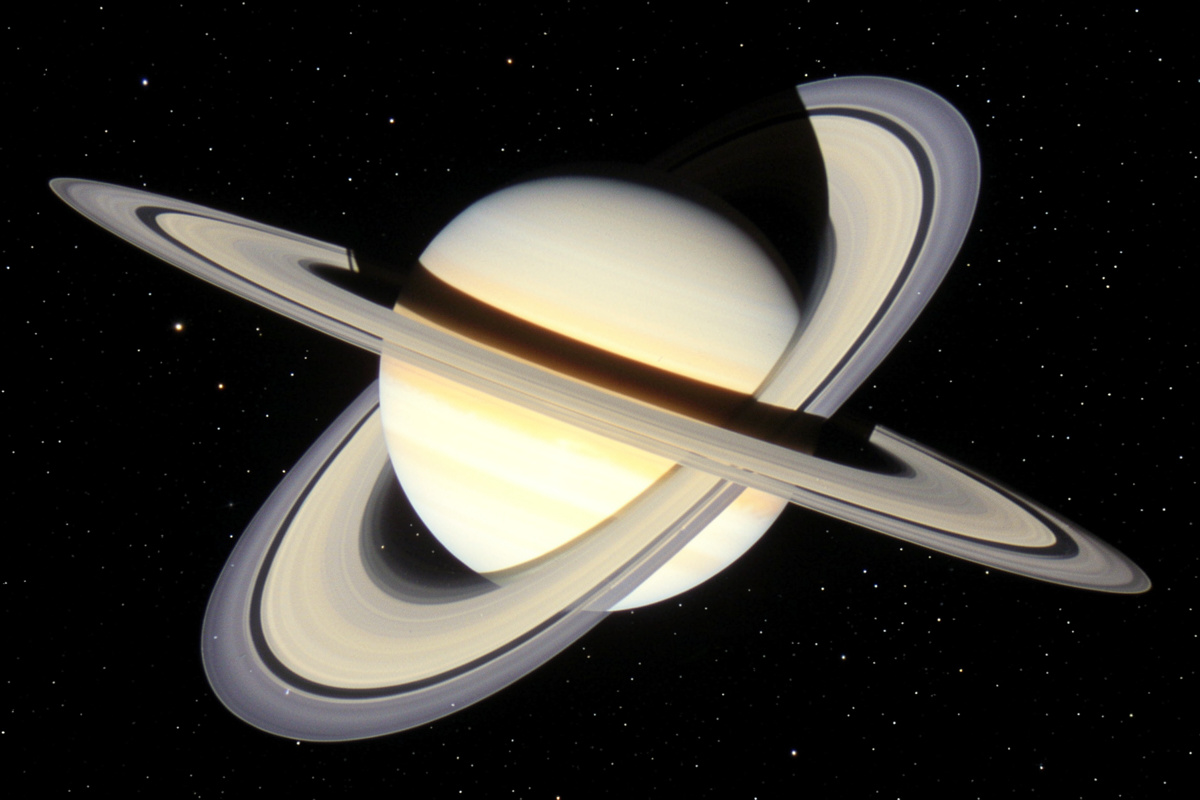

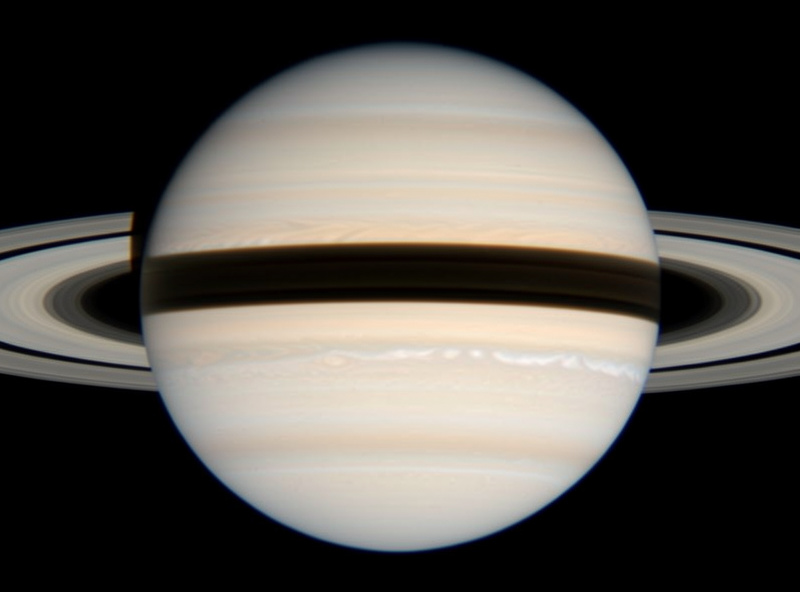
There is a moment, the first time someone sees Saturn through a telescope, when they pull back from the eyepiece and laugh — because it looks exactly like the pictures, hanging there in three dimensions, rings and all, and somehow that’s more astonishing than any photograph. I’ve handed that moment to dozens of first-time observers, and it never gets old. But there’s a wide gulf between glimpsing the rings as a featureless loop and actually resolving them — splitting the dark Cassini Division, reading the shading on the globe, catching the way the rings cast a shadow on the planet. That gulf is governed by two things: your aperture and the seeing. This guide is about getting the most ring detail your equipment and your sky can give.
For the catalogue of what Saturn’s features are and how the planet looks overall, my Saturn’s rings through a telescope tour covers the tour-guide version. Here I’m going deeper on the conditions — how aperture, atmospheric seeing, and ring tilt decide what you’ll actually pull out at the eyepiece. It’s the natural companion to the planetary observing guide that anchors this cluster, and the same patience that pays off on Jupiter pays off double on Saturn.
What aperture buys you on Saturn
Saturn rewards aperture, but not the way deep-sky objects do. The planet is bright; you’re not gathering faint light, you’re trying to resolve fine structure. Here’s roughly what each step up the aperture ladder gives you on a steady night:
- A small scope (60–80mm): the rings are unmistakable as a separate loop around the globe — the gasp-inducing first view. You’ll see the planet is not round but ringed, and that alone is worth the price of admission.
- A 4–5 inch scope: the Cassini Division starts to show on a good night, especially when the rings are well tilted, and the globe shows a hint of banding. Titan, Saturn’s big moon, is an easy point of light off to the side.
- A 6–8 inch scope: the Cassini Division is clear when the air steadies, the shadow of the rings on the globe (and the globe on the rings) becomes obvious, and you’ll catch the dusky polar region and a couple more moons.
- A 10–12 inch scope: on a genuinely steady night, the subtle shading within the rings, the Crepe (C) ring as a faint inner veil, and several moons. My 12-inch Dob on a rare calm Nordic night shows Saturn in a way that still stops me.
But every one of those descriptions carries the caveat “on a steady night,” because aperture you can’t use is aperture wasted — which brings us to seeing.
Seeing is the real gatekeeper
The atmosphere decides how much of your aperture you actually get to use. On a turbulent night even a big scope shows a soft, trembling Saturn with the Cassini Division coming and going; on a steady night a modest scope shows it rock-solid. The fine ring structure that distinguishes a great Saturn session from a mediocre one lives right at the edge of what the seeing allows, so picking your nights matters more than upgrading your scope.
From a high northern latitude this is a particular challenge: Saturn often rides low across the southern sky, and low means thick, turbulent air. The nights to chase are the ones when the planet climbs as high as it gets and the stars near it twinkle gently rather than dance. Counterintuitively, the crystal-clear nights right behind a cold front are often the worst for planetary seeing because the same moving air that scrubbed the haze is churning — while a hazy, still night can deliver gorgeous, steady ring detail. Learning that inversion is one of the biggest jumps a planetary observer makes.
Ring tilt: the multi-year factor you can’t control
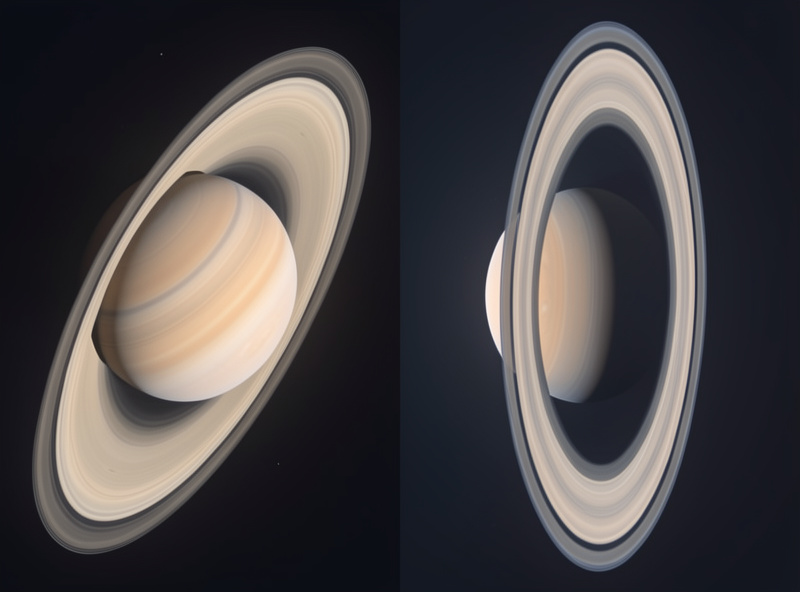
Saturn’s rings are tilted relative to its orbit, so over the course of its long journey around the Sun our view of them slowly opens and closes — from wide open, when the rings dominate the view and the Cassini Division is easy, to nearly edge-on, when they thin to a line and can briefly all but vanish. This isn’t something you observe in one night; it’s a slow change you notice across years of observing the same planet. When the rings are well opened, Saturn is at its showpiece best and the Division is far easier to catch; when they’re closing toward edge-on, the ring system is a striking thin blade and the globe takes centre stage. Neither is “better” — they’re different gifts, and observing Saturn across this cycle is one of the long-term pleasures of the hobby.
The technique: getting the rings to snap into focus
The mechanics are the same discipline that works on every planet, applied with Saturn’s particular reward in mind:
- Cool the scope. Thirty to sixty minutes outside (longer for a big closed tube). A warm scope smears the Cassini Division into invisibility.
- Find it and centre it at low power. Saturn is a steady, slightly yellow “star” — bright but not as brilliant as Jupiter or Venus.
- Let your eye adapt for a minute or two at low power before pushing the magnification.
- Step the power up one eyepiece at a time. Saturn takes magnification well — 150x to 250x on a good night — but back off the instant the image softens rather than sharpens.
- Wait for the steady moments. The Cassini Division and the ring shadow appear in the brief windows when the air stills. Stay at the eyepiece; don’t glance and move on.
To reach the high powers Saturn rewards without buying a stack of short eyepieces, I lean on a good Barlow. Pairing a comfortable mid-focal-length eyepiece with a quality 2x Barlow lens gives me the 200x-plus that snaps the Division into view on a steady night, while keeping the eye relief comfortable for the long, patient looks Saturn demands. The Barlow lens guide covers how to choose one that won’t degrade the image. A neutral-density Moon filter can also help on a bright night by taking the edge off the glare and letting subtle ring shading show.
Disclosure: some links above are affiliate links. As an Amazon Associate I earn from qualifying purchases, at no extra cost to you. I only recommend gear I’d use on my own scopes.
Don’t forget the moons
Titan is bright enough to spot in almost any scope as a star-like point off to one side, and it shifts position from night to night as it orbits. A 6-inch or larger scope on a dark, steady night will add a few fainter moons — Rhea, Tethys, Dione — strung around the planet. They’re a quiet bonus that most beginners overlook entirely, fixated on the rings.
The honest expectations talk
Saturn is small. Even at 200x it’s a modest object, and the first-timer who expects a poster-sized view is briefly let down before the three-dimensional reality of it sinks in and wins them over. The detail — the Cassini Division, the shadows, the banding — is subtle and emerges only to the patient, dark-adapted eye in moments of steady air. Manage that expectation, cool your scope, pick a good night, and Saturn will deliver the single most reliable “wow” in all of amateur astronomy. When you turn the scope to Venus, the experience is completely different — phases instead of surface detail — and my Venus phases through a telescope guide walks through what to look for and when.
What size telescope do I need to see Saturn’s rings?
Even a small 60–80mm telescope shows the rings clearly as a separate loop around the planet. To resolve the dark Cassini Division within the rings you generally want a 4-inch or larger scope on a steady night, and a 6–8 inch scope makes it routine when the seeing cooperates.
Why can’t I see the Cassini Division in my telescope?
Usually it’s seeing or a warm scope rather than aperture. The Division is a fine detail that only shows when the atmosphere steadies and the optics have cooled to ambient temperature. It’s also far easier when the rings are well tilted toward us than when they’re nearly edge-on.
Why do the rings sometimes look thin or almost gone?
Our view of Saturn’s tilted rings slowly opens and closes over its long orbit. When the rings are near edge-on they thin to a bright line and can nearly disappear; when they’re wide open they dominate the view. This is a years-long cycle, not a nightly change.
What magnification is best for Saturn?
Saturn takes magnification well — 150x to 250x on a steady night reveals the rings, Cassini Division, and ring shadow nicely. As always, step up gradually and back off the instant the image softens instead of sharpening; the seeing, not the scope, sets the ceiling on any given night.
