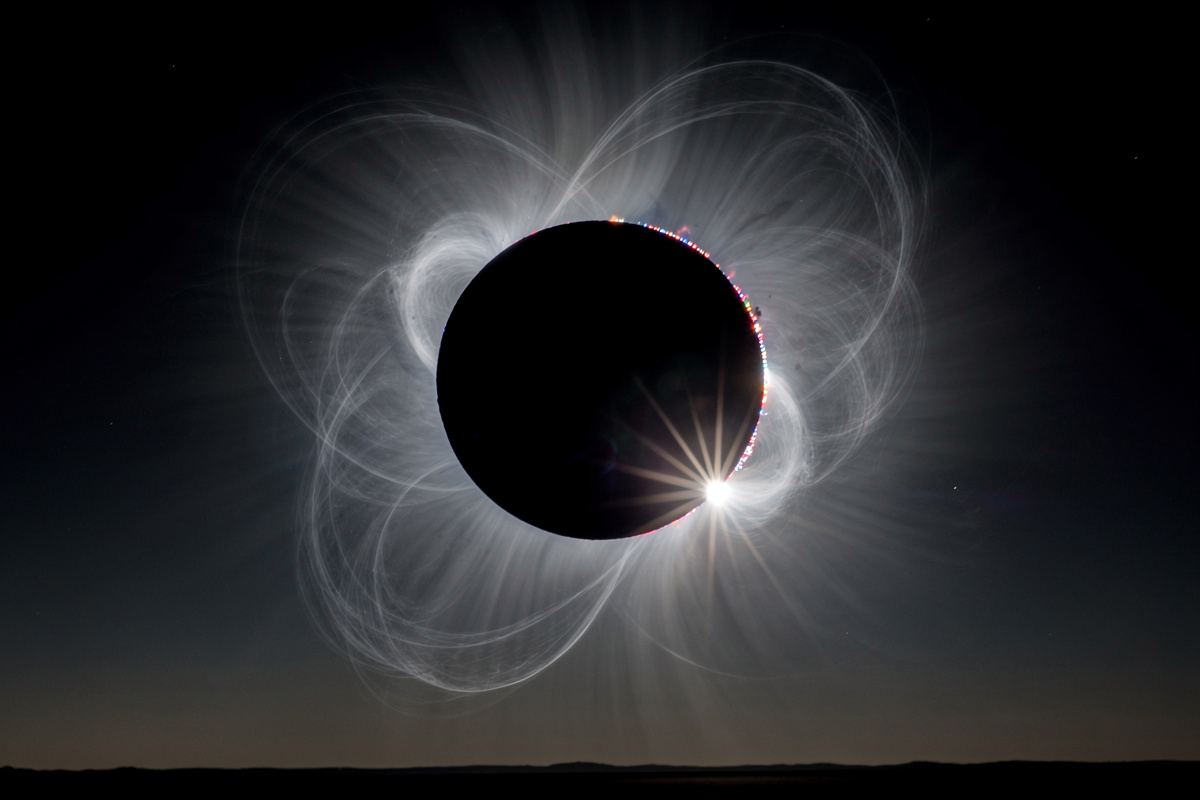

The Moon’s shadow sweeps across Earth’s surface at up to 5,400 km/h, and for a path roughly 270 km wide and a window of up to 7 minutes 32 seconds, the Sun’s corona — its 1-3 million degree Celsius outer atmosphere — is visible to the naked eye. That is a total solar eclipse, and it is the single most spectacular event in amateur astronomy. Direct solar viewing without proper filtration causes permanent retinal damage within seconds, so eclipse work is also the most safety-critical observing you will ever do.
I drove from northern Sweden to a friend’s place in Texas for the April 8, 2024 total eclipse — 4 minutes 28 seconds of totality from a clearing outside Kerrville. I had read about totality in books for fifteen years; nothing in print prepares you for the moment the Diamond Ring cuts off and the corona unfolds. This guide is the planning document I built before that trip and the one I will use again for the August 12, 2026 path through Iceland and Spain. The cluster planets at opposition guide covers the rest of the events calendar.
Types of Solar Eclipses
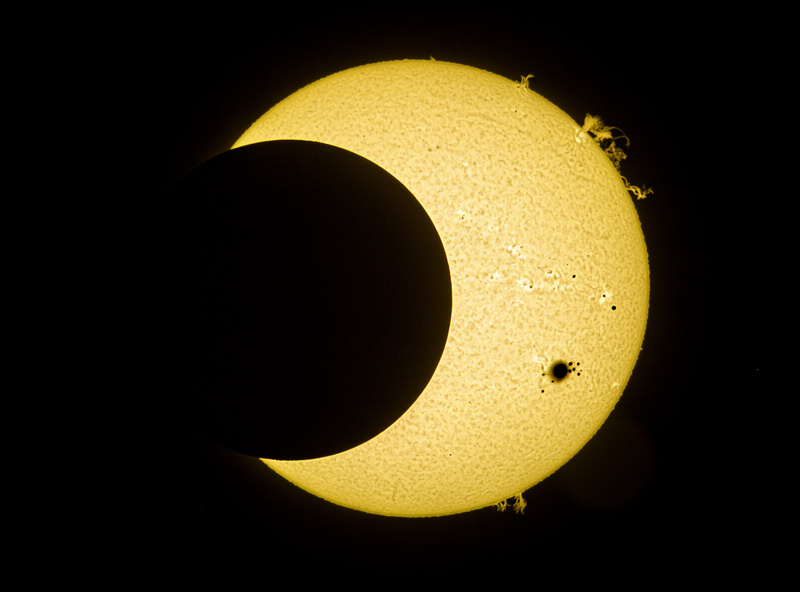
Solar eclipses come in four types, determined by the Moon’s distance from Earth and the precise alignment geometry.
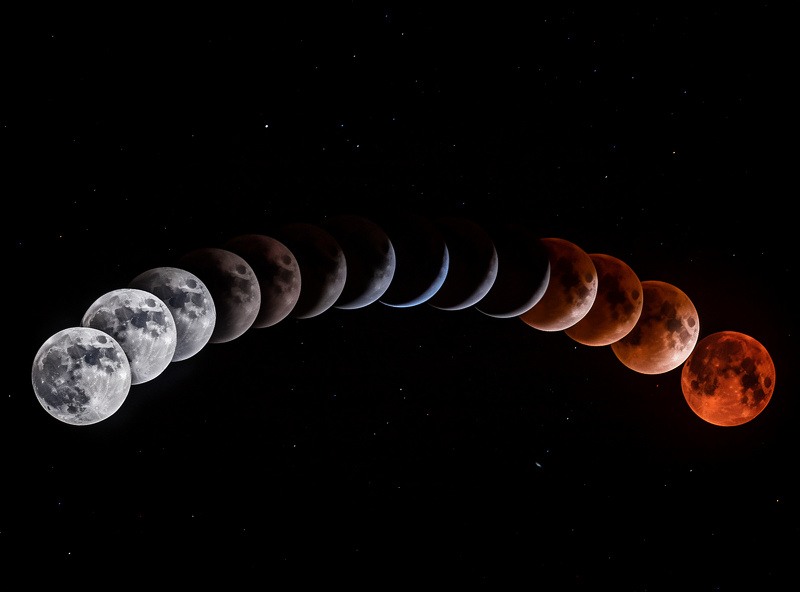
Total solar eclipse: The Moon completely covers the Sun’s photosphere. The sky darkens to twilight levels, stars and planets appear, the corona becomes visible, and the temperature can drop 5-10°C in minutes. Totality lasts 1-7.5 minutes depending on the geometry. The path of totality on Earth’s surface is a narrow corridor typically 100-270 km wide and 10,000-14,000 km long.
Partial solar eclipse: The Moon covers only part of the Sun. The Sun appears as a crescent. No corona is visible. Outside the path of totality, observers see a partial eclipse — even 99% coverage is NOT safe to view without protection because the remaining 1% of the photosphere is still blindingly bright.
Annular solar eclipse: The Moon is near apogee (farthest from Earth), so its apparent diameter is smaller than the Sun’s. A ring (“annulus”) of sunlight remains visible around the Moon. The sky does not darken significantly. Annular eclipses require eye protection throughout — never look at an annular eclipse without solar filters.
Hybrid solar eclipse: The Moon’s apparent size is nearly equal to the Sun’s. Along different parts of the eclipse path, the eclipse transitions between total and annular. Hybrid eclipses are rare — only about 5% of all solar eclipses are hybrid.
Upcoming Solar Eclipses Visible from North America
Solar eclipses follow the Saros cycle — a period of 18 years, 11 days, 8 hours after which nearly identical eclipses recur. Each Saros series produces 69-75 eclipses over 1,200-1,500 years.
August 12, 2026 — Total solar eclipse: Path of totality crosses the Arctic, Iceland, and northern Spain. Partial phases visible across Europe, northern Africa, and the Middle East. Maximum totality: 2 minutes 18 seconds. This is the next major total eclipse and the one I am traveling for.
February 17, 2026 — Annular solar eclipse: Path of annularity crosses Antarctica. Partial phases visible from southern South America, southern Africa, and parts of Antarctica.
August 2, 2027 — Total solar eclipse: Path of totality crosses North Africa, Spain (totality in Seville and Málaga), and the Middle East. Maximum totality: 6 minutes 23 seconds — one of the longest total eclipses of the 21st century.
January 26, 2028 — Annular solar eclipse: Path of annularity crosses the Pacific Ocean, including parts of Australia (Sydney sees annularity).
July 22, 2028 — Total solar eclipse: Path crosses Australia (Sydney sees totality) and New Zealand. Maximum totality: 5 minutes 10 seconds.
November 25, 2030 — Total solar eclipse: Path crosses southern Africa, the Indian Ocean, and Australia. Maximum totality: 3 minutes 44 seconds.
Safe Solar Viewing Methods
The Sun’s surface brightness is 1.6 million times brighter than the full Moon. Looking at the Sun through ANY optical device — telescope, binoculars, camera viewfinder — without a proper solar filter destroys the instrument’s eyepiece and your eye simultaneously. This is not a precaution — it is physics.
Eclipse glasses / solar viewers: Must meet the ISO 12312-2 international safety standard. These block 99.999% of visible light and 100% of UV and IR radiation. Test them before use: you should see NOTHING except the Sun or extremely bright artificial lights through them. Scratched, wrinkled, or older than 3 years — replace them. Cost: $2-5 per pair. I bring twice as many pairs as people in my group, every time, because someone always drops or sits on one.
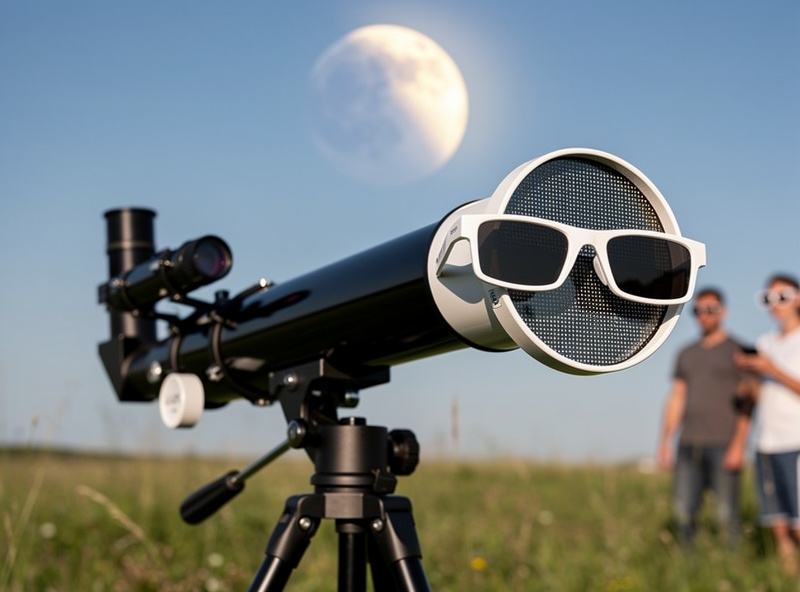
Telescope solar filters: Front-mounted full-aperture filters that fit over the objective lens or mirror cell. These are either glass (Baader AstroSolar, Thousand Oaks Type 2+) or polymer film (Thousand Oaks Type 2). They MUST be securely mounted — a gust of wind that dislodges a solar filter while you are looking through the eyepiece causes instant eye damage. NEVER use eyepiece-mounted solar filters — concentrated solar heat can crack them. My own eclipse-day rig is a Sky-Watcher 80ED refractor with a Baader AstroSolar Visual Density 5 film filter clamped at the objective with a friction ring and three layers of gaffer tape; I trust the tape more than I trust the friction ring.
Welder’s glass: Shade 14 (not lower) is safe for direct solar viewing. Shade 13 or below is NOT sufficient. Welder’s glass provides a green-tinted view. It is suitable for naked-eye viewing during totality approaches but not ideal for telescopic work.
Pinhole projection: Poke a 1-2 mm hole in a card. Hold it so sunlight passes through onto a flat white surface 30-50 cm behind. A sharp circular image of the Sun appears — during partial eclipse, it shows the crescent shape. This method works well for groups and does not require looking at the Sun directly. A telescope or binocular can also project a larger, brighter image onto white card — but NEVER look through the eyepiece when the instrument is pointed at the Sun.
Viewing a Total Solar Eclipse: Second-by-Second Timeline
Totality is the only safe moment to look at the Sun without filters. Understanding the timeline ensures you do not miss it — or damage your eyes by removing filters too early.
C1 — First contact (partial eclipse begins): The Moon’s limb first touches the Sun’s limb. The eclipse has started. Keep solar filters on. Nothing is visually obvious yet.
C1 to C2 — Partial phases: Over 60-90 minutes, the Moon progressively covers the Sun. The light changes subtly — shadows sharpen, crescent-shaped projections appear under trees. At 80% coverage, the light takes on a strange quality that photographers describe as “flat.” Keep filters on.
At 95%+ coverage: The sky is noticeably darker. Temperature drops. Baily’s Beads appear — bright points of sunlight shining through lunar valleys along the Moon’s limb. These last 10-15 seconds. Filter still required — do NOT remove yet.
Diamond Ring effect: One final bright bead of sunlight creates a “diamond ring” appearance. This is the last moment before totality. Filter STILL required — the photosphere is still visible.
C2 — Second contact (totality begins): The last bead vanishes. The photosphere is completely covered. REMOVE FILTERS NOW. The corona blazes into view — a pearly white halo extending 2-5 solar diameters. Prominences (pink loops of hydrogen plasma) may be visible at the limb. The chromosphere (thin pink ring) appears briefly.
Totality: Lasts 1-7.5 minutes. Look at the corona — its shape varies with the solar cycle. Near solar maximum, the corona is roughly symmetric. Near solar minimum, it has long equatorial streamers and short polar brushes. Look for coronal streamers extending 5+ solar diameters. Look for stars and planets — Venus and Jupiter are often visible. During the April 2024 totality at Kerrville the corona showed two long streamers extending almost 5 solar radii to the east-southeast — solar maximum was 8 months out and the structure was complex enough that nobody around me spoke for the first minute.
C3 — Third contact (totality ends): The photosphere reappears on the opposite limb as a brilliant point — the Diamond Ring returns. REPLACE FILTERS IMMEDIATELY. Even a 1-second unfiltered glimpse of the returning photosphere causes eye damage.
C3 to C4 — Partial phases (exit): Mirror image of the entry partial phases. Keep filters on until the eclipse ends.
Telescope Setup for Eclipse Photography
Eclipse photography requires planning months in advance. Practice your setup at home at least twice before eclipse day.
Equipment: A telescope with a front-mounted solar filter, a camera body (DSLR or mirrorless) connected via T-ring and prime focus adapter, and a sturdy equatorial or alt-azimuth tracking mount. A 60-80 mm refractor at f/6-f/8 (360-640 mm focal length) frames the Sun comfortably with margin for the corona.
Partial phase settings: ISO 100, 1/1000-1/2000s at f/8 with solar filter. Bracket heavily — the changing illumination during partial phases affects exposure. Focus on sunspots (if any) using live view at 10x zoom. Refocus every 15-20 minutes as temperature changes shift focus.
Totality settings (filter REMOVED): The corona spans roughly 14 magnitudes of brightness across its extent. Use bracketed exposures: 1/1000s for inner corona, 1/250s for mid-corona, 1/60s and 1/15s for outer corona. ISO 400-800. Shoot continuously during totality — you cannot re-do it. A motorized tracking mount keeps the Sun centered during totality.
Wide-field shots: A 24-70 mm lens captures the corona with landscape context. This produces the most visually stunning images. Mount on a separate tripod. Settings: f/5.6, 1-2 seconds, ISO 400. The 360° sunset effect during totality creates an orange horizon in all directions — include it in your composition.
Solar Eclipse Frequency and Geography
There are between 2 and 5 solar eclipses per year globally, but total eclipses at any specific location are rare. The path of totality covers only 0.5% of Earth’s surface during a single eclipse. On average, a given location experiences a total solar eclipse once every 375 years.
Eclipses cluster in “eclipse seasons” — 34-38 day periods when the Sun is near the lunar nodes (where the Moon’s orbit crosses the ecliptic). Eclipse seasons occur every 173 days (roughly every 6 months) and shift earlier by about 19 days each year due to the regression of the lunar nodes.
The frequency of total eclipses exceeds what most people expect: roughly once every 18 months somewhere on Earth. But the paths are narrow and often cross remote ocean or polar regions. Accessible total eclipses — crossing major population centers — occur perhaps once per decade for a given continent.
Solar Filter Comparison
| Filter Type | ISO 12312-2 | Viewing Method | Image Color | Cost | Notes |
|---|---|---|---|---|---|
| Eclipse glasses (polymer) | Yes (if certified) | Naked eye only | Orange/yellow | $2-5 | Disposable; check certification |
| Baader AstroSolar film | Yes | Telescope front filter | White/blue-white | $30-80 | High resolution; needs cell |
| Thousand Oaks glass | Yes | Telescope front filter | Orange | $60-150 | Durable; heavier than film |
| Welder’s glass #14 | No (but safe) | Naked eye only | Green | $5-15 | Shade 14 only; not for telescopes |
| H-alpha telescope | N/A (dedicated scope) | Telescope eyepiece | Red (H-alpha) | $600-5,000 | Shows prominences, filaments at any time |
Common Mistakes I Made on Eclipse Day
The first mistake was on April 8, 2024 — I spent the entire 90-minute partial phase fussing with the camera focus and shooting bracketed sunspot images. When C2 hit, I dropped the cable release, looked up, and realized I had not actually looked at the Sun with my own eyes for the previous hour. I had reduced the most spectacular event in amateur astronomy to a checklist. Now I plan partials around 50% camera time, 50% just standing there with eclipse glasses on watching the light change.
The second mistake was a near-miss with the filter at C3. With about 8 seconds left in totality, I almost — almost — left the camera bracket open while I lifted my eyepiece-end solar filter back into position. The phone alarm I had set for “C3 minus 30 seconds” saved me. I now set two phone alarms — one at C3 minus 60 seconds and one at C3 minus 30 — and I refuse to be near the eyepiece without the filter back in hand for the final minute. The retina does not give second chances.
The third mistake was bringing only one pair of eclipse glasses. My friend’s son sat on them 20 minutes before C1 and the lens cracked. I had to drive 25 minutes to a hardware store with viewers in stock for the partial phase. I now travel with five pairs minimum, regardless of group size, and keep them in their cardstock sleeves until eclipse day.
What I Would Do for the Next Total Eclipse
If you are planning for the August 12, 2026 totality across Iceland or northern Spain — or any future total eclipse — here is the prep list I now use. Book accommodation 18 months out; the path-of-totality villages fill earlier than you expect. Arrive 48 hours before eclipse day to scout the site and watch the local weather pattern; clouds at totality erase the entire trip. Practice your camera setup at home with a solar filter on a sunny afternoon at least twice — the partial-phase routine is muscle memory you do not want to be developing on the day. Pack two filter sets, two eclipse glasses per person, two phone alarms with the C2 and C3 times in local time, and two backup batteries for everything that needs power. On the day, arrive at the site 3 hours before C1, eat lunch early, and from C2 onward put the camera on autofocus, push the shutter every 15 seconds with an intervalometer, and just look. The corona is the only thing the camera will not do justice to.
Frequently Asked Questions
Can I look at a solar eclipse with regular sunglasses?
No. Regular sunglasses block only 10-25 percent of visible light — nowhere near the 99.999 percent required for safe solar viewing. ISO 12312-2 certified eclipse glasses are the minimum requirement. Looking at the Sun through regular sunglasses causes the same retinal damage as unfiltered viewing; the pupil may dilate further because the sunglasses reduce brightness, worsening the injury.
When can I remove my eclipse glasses during a total eclipse?
Remove filters ONLY after the Diamond Ring effect disappears completely and totality begins (C2). Replace them the instant the Diamond Ring reappears at the end of totality (C3). During a 3-minute totality, you have roughly 170 seconds of safe unfiltered viewing. Set a phone timer for 30 seconds before estimated C3 to alert you.
How long does a total solar eclipse last?
Totality duration depends on geometry: the longest possible is 7 minutes 32 seconds (theoretical maximum). Practical maximum in the 21st century is 6 minutes 23 seconds (July 22, 2028, and August 12, 2045). Most total eclipses deliver 2-4 minutes of totality. Partial phases before and after totality last 2-3 hours combined.
What is the difference between a total and annular eclipse?
In a total eclipse, the Moon fully covers the Sun because it is near perigee (closest to Earth), appearing large enough to block the photosphere. In an annular eclipse, the Moon is near apogee (farthest from Earth), appearing too small to fully cover the Sun — a ring of sunlight remains visible. Total eclipses allow safe unfiltered viewing during totality; annular eclipses require filters throughout.
Can I photograph a solar eclipse with my phone?
Yes, but with precautions. Use a certified solar filter over the phone camera lens during partial phases — the concentrated sunlight can damage the sensor. During totality, remove the filter and shoot normally — phone cameras lack the zoom for corona detail but capture the darkened sky and diamond ring well. A cheap phone solar filter costs under 10 dollars.
Where is the next total solar eclipse visible from?
The next total solar eclipse is August 12, 2026, visible from Iceland and northern Spain. The next one crossing North America is March 30, 2033 (Alaska only). The next crossing the contiguous US is August 23, 2044 (Montana, North Dakota). Planning travel to the path of totality is recommended — partial eclipses do not compare.
Related Articles
- Planets at Opposition: Best Viewing Times — When planets are closest and brightest.
- Meteor Showers Guide — Annual shower calendar and observing technique.
- Comet Watching Guide for Amateur Astronomers — Finding and tracking comets.
- Moon Observation Guide with Telescope — The Moon’s surface features and observation technique.
- Saturn Rings Through a Telescope — Ring structure and imaging.
