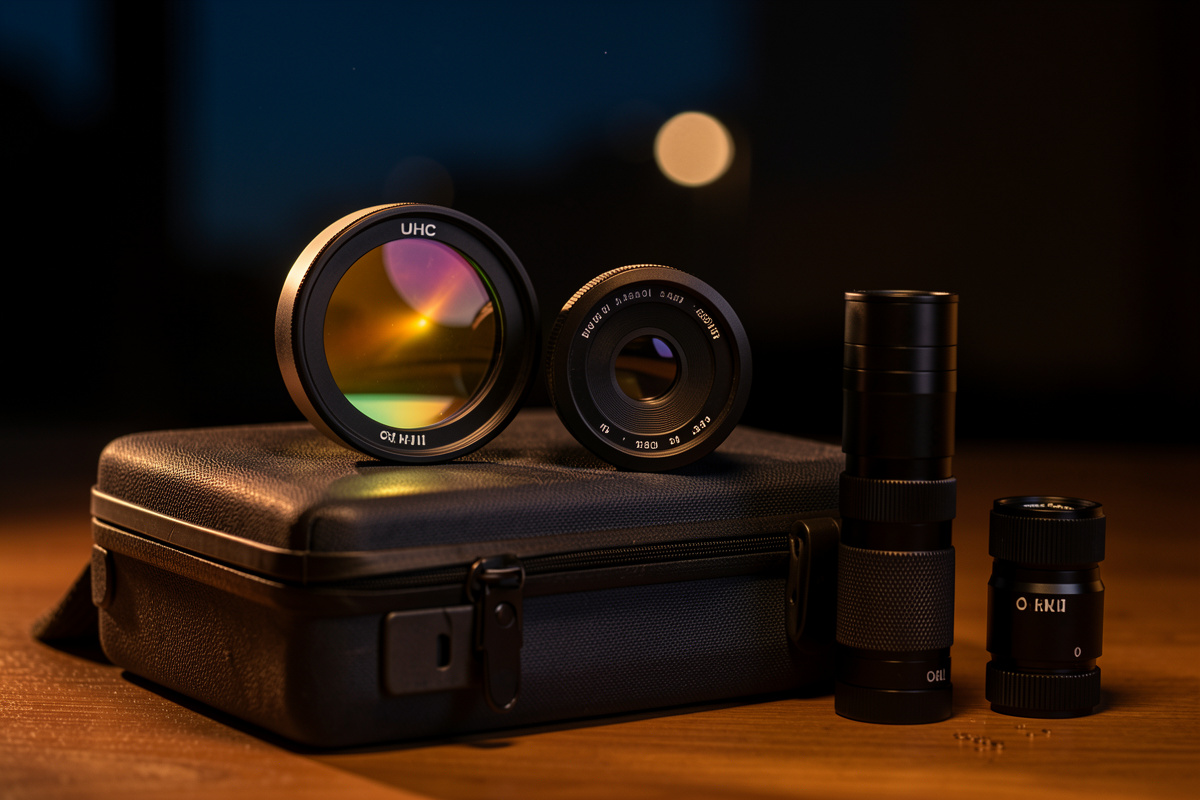

If you observe under light pollution and want the short answer, here it is: buy a quality UHC filter first. Its roughly 20-25nm passband isolates the key hydrogen and oxygen nebula lines while rejecting most skyglow, which makes it the single best contrast upgrade for backyard nebula observing, helps on the widest range of targets, and is the filter I’d hand almost any light-polluted observer. Everything else — OIII, dual-band imaging filters, Moon filters — is a refinement for a specific job. The one filter to avoid is the broadband “light pollution reduction” filter most beginners reach for, which barely works under modern LED street lighting.
But “best” depends entirely on what you observe and how, so this guide gives the best filter for each real-world scenario rather than one blanket pick. I run a UHC and OIII for visual work and a dual-band narrowband filter on my cooled camera, across scopes from a 127mm Maksutov to a 12-inch Dobsonian, from a Bortle 5 suburb to a Bortle 2 dark site. These are the picks I actually stand behind. For the reasoning behind the categories, see my narrowband vs broadband explainer and the full filter comparison.
The Best Filter for Each Situation
The right filter is decided by two questions: do you observe visually or image, and what targets do you chase. Here are my picks by scenario, with the honest reasoning for each. Notice that for several common situations the best “filter” is actually no filter at all — a darker sky.
| Your Situation | Best Choice | Why |
|---|---|---|
| Visual, suburban, first filter | UHC | Widest target range, biggest contrast gain |
| Visual, planetary nebulae & Veil | OIII | Stronger boost on oxygen-line targets |
| Visual, faint specific nebulae | H-beta | Only filter that shows the Horsehead backdrop |
| Imaging from the city | Dual-band (Ha/OIII) | Records emission nebulae despite skyglow |
| Bright Moon glare | Neutral-density Moon | Comfort on the Moon; not a contrast tool |
| Galaxies & star clusters | No filter — drive to dark sky | No filter helps broadband objects |
That last row is the one people resist, so it bears repeating: there is no “best filter” for galaxies or star clusters under light pollution, because they emit broadband light and any filter dims them. The best upgrade for those targets is a darker sky, not glass.
Best Overall: A Quality UHC Filter
For visual observing under any light-polluted sky, a UHC filter is the best all-round purchase. It passes a band covering both the key hydrogen and oxygen emission lines, so it improves the contrast on the broadest range of emission nebulae — the Orion Nebula’s wings, the Lagoon, the North America Nebula, the Dumbbell. From my Bortle 5 yard it’s the filter that makes backyard nebula observing genuinely worthwhile rather than frustrating. Buy a mid-range one from an established astronomy brand rather than the cheapest no-name, whose passband is usually too wide to reject much skyglow.
A solid 1.25-inch UHC filter fits standard eyepieces and is the size most observers need; choose a 2-inch UHC filter only if your eyepieces are 2-inch. As an Amazon Associate I earn from qualifying purchases. If you buy one filter for light-polluted visual astronomy, make it this. Used at low-to-medium power for a 3-5mm exit pupil and with a fully dark-adapted eye, it does more for backyard deep-sky observing than any other single accessory under a hundred euros.
Best for Planetary Nebulae: An OIII Filter
Once you’re chasing planetary nebulae and supernova remnants, an OIII filter is the upgrade. Its tighter passband around just the doubly-ionised oxygen lines gives a more aggressive contrast boost on the right targets — the Ring Nebula, the Dumbbell, and above all the Veil, which an OIII transforms from a faint suggestion into a structured ribbon of gas. The trade-off is that it dims stars more heavily and is less of an all-rounder than the UHC, which is why it’s the second filter to buy, not the first.
An OIII filter pairs naturally with a UHC to cover almost everything the visual nebula observer wants. Between the two, the UHC handles the broad diffuse nebulae and the OIII handles the oxygen-rich planetaries and remnants. I carry both to every dark-site session and reach for them constantly; from the suburb they still earn their place on the brighter targets.
Best for Imaging and Best Filters to Skip
If you image deep-sky from light pollution, the best filter is a dual-band (or tri-band) narrowband filter that isolates the hydrogen-alpha and oxygen lines for your camera. These very tight passbands reject almost all skyglow while passing the nebula’s own light, which is the one genuine way to capture colourful emission nebulae from a bright backyard. They’re too dark to use by eye — they’re a camera tool — but for the city-bound astrophotographer they’re the key to the whole game. My guide to electronically assisted astronomy in light pollution covers how these change what’s possible.
The filters to skip: the broadband “light pollution reduction” or “CLS” filter for visual use under modern LED lighting, which has almost nothing left to block; and any ultra-cheap no-name nebula filter, whose loose passband delivers a feeble boost that convinces beginners filters don’t work. A neutral-density Moon filter is worth a few euros for comfort on the bright Moon, but understand it’s a glare-reducer, not a contrast tool — it does nothing for faint objects. For how all of these fit your kit, see my telescope filters guide.
Building a Filter Kit Over Time
You don’t need to buy everything at once, and you shouldn’t. The sensible order for a visual observer is a UHC first, lived with for a season so you learn what it does on real targets, then an OIII once planetary nebulae and the Veil are pulling at you, and only much later an H-beta if a specific faint target like the Horsehead becomes an obsession. Most observers are happy stopping at UHC plus OIII, which together cover the overwhelming majority of emission targets. Spreading the purchases also spreads the cost and lets each filter teach you something before the next arrives.
Apply the real-friend test I use for every astronomy purchase: would I actually tell a friend to spend this money, or would I tell them to put it toward something with more impact? For a beginner under light pollution, a single good UHC plus a tank of fuel for a dark-sky trip beats a drawer full of filters every time. Filters are a genuine, high-value upgrade for emission nebulae — but they sit inside a system that includes your eyepieces, your dark adaptation, and above all your sky. Buy the UHC, learn to use it, drive to darker skies when you can, and add the OIII when your targets demand it. That’s the honest path, not a shopping spree.
How to Get the Most From Whatever Filter You Buy
The best filter underperforms if you use it wrong. Match it to a low-to-medium power eyepiece for a 3-5mm exit pupil, give your eyes a full 20-30 minutes to dark-adapt with red light only, and use averted vision on faint targets. Use the “blink” test — slide the filter in and out of the light path — to confirm it’s actually helping on this object rather than just dimming it. And remember the cardinal rule one last time: lift the filter for emission nebulae, leave it in the case for galaxies, clusters, and reflection nebulae. The technique is covered in detail in my nebula filters for visual observing guide. Get those habits right and a mid-range UHC will outperform a premium filter used carelessly by a half-adapted eye at the wrong magnification — the filter is only ever half of the result, and the observer behind it is the other half.
Frequently Asked Questions
What is the best filter for light pollution?
For visual observing, a quality UHC filter is the best all-round choice. It boosts contrast on the widest range of emission nebulae and works even from suburban skies. Avoid broadband light pollution reduction filters, which barely help under modern white-LED street lighting.
Is a UHC or OIII filter better for light pollution?
Buy a UHC first as the versatile all-rounder for most emission nebulae. Add an OIII second for planetary nebulae and supernova remnants like the Veil, where its tighter oxygen-line passband gives a stronger contrast boost. Together they cover almost all visual nebula targets.
Do light pollution filters help with galaxies?
No. Galaxies emit broadband light across all wavelengths, so any filter that blocks skyglow also blocks the galaxy equally. No filter improves galaxies, star clusters, or reflection nebulae. The only real upgrade for those targets is observing from a darker sky.
What is the best light pollution filter for astrophotography?
A dual-band or tri-band narrowband filter that isolates the hydrogen-alpha and oxygen emission lines for your camera. Its tight passbands reject almost all skyglow, letting you image colourful emission nebulae even from a city backyard. These are camera filters, too dark for visual use.
Are cheap nebula filters worth buying?
Usually not. Very cheap no-name filters often have wide, imprecise passbands and low transmission, so the contrast gain is weak and unconvincing. A mid-range filter from an established astronomy brand is the value sweet spot and delivers the dramatic effect filters are known for.
