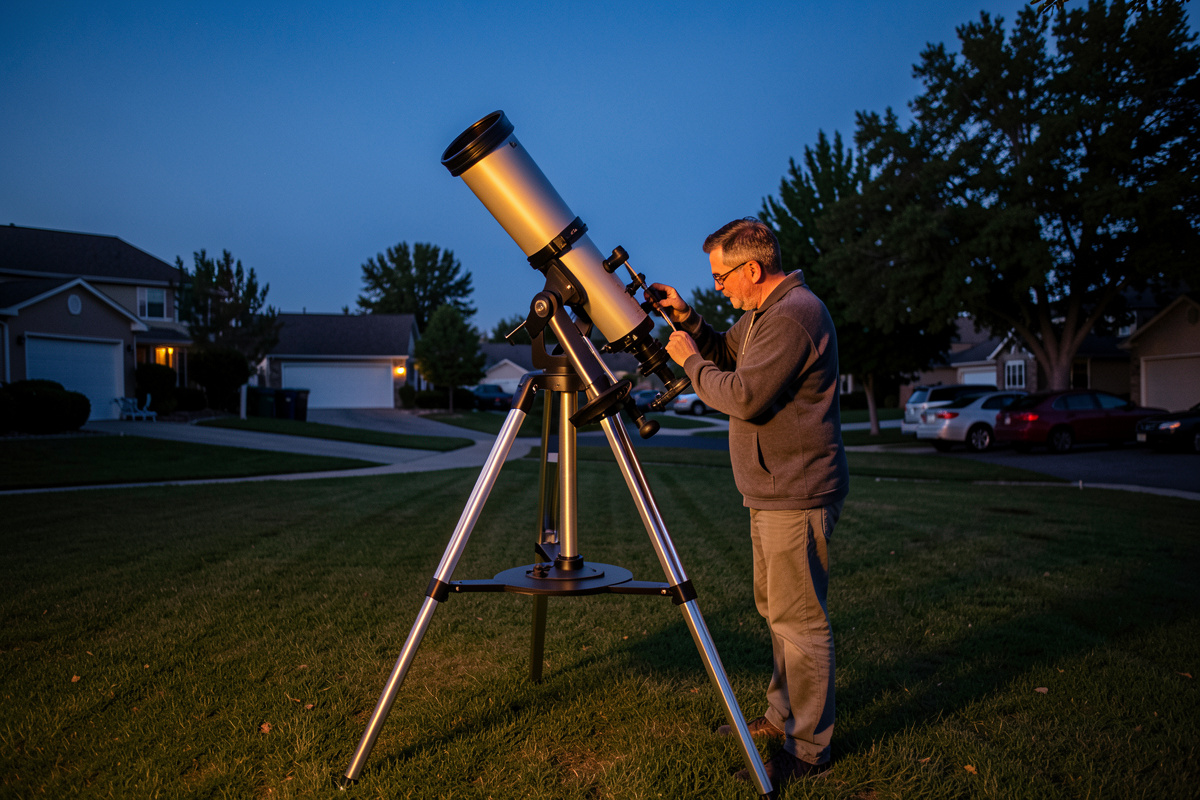

Here is the part nobody tells you before you spend an hour cursing at a new scope: the overwhelming majority of “my telescope is broken” nights are not optics at all. In my observing logs, when I sort the complaints I have personally chased down, the order is almost always the same — you are not at focus, the scope has not cooled, the seeing is mush, the collimation has drifted, dew is creeping in, or the mount is shaking the image to pieces. Actual defective glass is rare. This guide is the order I work through those, the triage spine I run every single time, with a handoff to the deep fix for each one.
I have owned the common scope designs side by side for years — a 12-inch Dobsonian light bucket, a 127mm Maksutov that lives in the car, a 100mm ED triplet I use as my reference for what a star is supposed to look like, an 8-inch SCT on a GoTo mount — and I made every one of these mistakes before I learned to diagnose instead of panic. So nothing below is theory. It is the checklist I actually run under a cold Swedish sky when the view looks wrong.
The blunt version: what is usually actually wrong
Before any decision tree, set your expectations honestly. If I had to put rough numbers on the “broken scope” reports I have triaged, the lion’s share land in six buckets: focus, thermal cool-down, atmospheric seeing, collimation, dew, and the mount. In that rough order. Genuine optical faults — a pinched mirror, a decentered lens, a scratched coating that actually matters — are the rare exception, not the rule.
That ordering matters because it tells you where to spend the first sixty seconds. Beginners tend to assume the worst (the expensive thing — the optics) and ignore the cheap, fixable things first. Reverse that instinct. The cheapest, most common culprits sit at the top of the list, and almost all of them cost nothing to fix beyond patience and a screwdriver. When you internalise that the scope is probably fine, you stop tearing it down and start working the problem in the right order.
The other thing to accept up front: a lot of what looks like a malfunction is just physics and your sky. A planet looking small, a galaxy looking like a faint smudge, a blue-white star refusing to show colour — those are correct behaviours, not faults. I will get to those near the end, because half the “fixes” people want are really expectation resets.
How I triage, in order, every time
My whole system is a decision path I run top to bottom, and I do not skip steps. The genius of doing it in a fixed order is that you stop guessing: each check either clears that cause or finds your problem, and you never waste a tweak on the wrong thing. Here is the spine, exactly as I run it at the eyepiece.
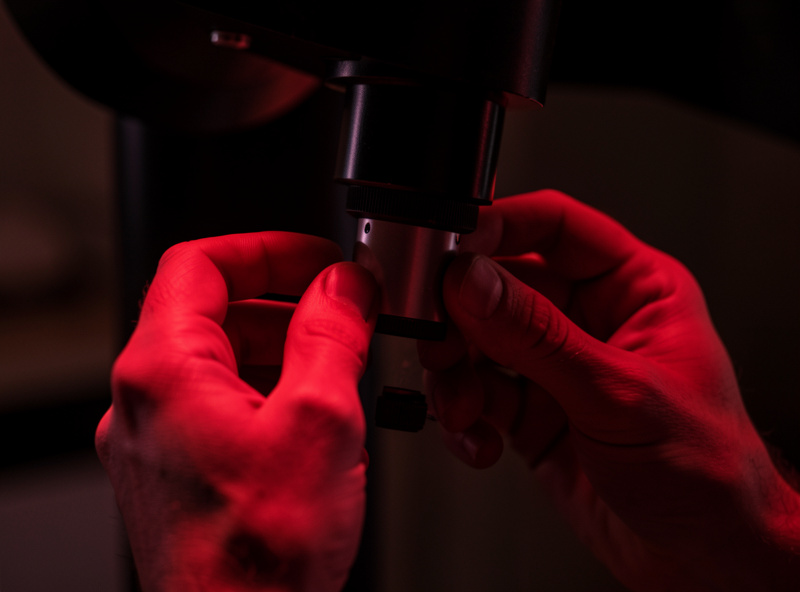
1. Am I actually at focus? This sounds insultingly basic, but it is the single most common cause I find, and not just in beginners. A bright star should snap down to a tight point. If the best you can get is a soft blob, rack the focuser all the way through focus slowly in both directions and watch the star expand symmetrically on either side. If it never reaches a tight point at all — if the focuser runs out of travel before the star collapses — that is a different, specific problem and I send people straight to the full walkthrough that lives in my guide on why a telescope won’t reach focus. If it does reach a point but the surrounding view is still soft, keep going down the list.
2. Has the scope cooled to the air? Thermal acclimation is the quietest killer of sharp views. A warm tube full of warm air sets up currents inside the optical path that smear every high-power image into shimmer. My 12-inch Dob needs the better part of an hour to settle on a cold winter night; the little Maksutov, with its sealed tube and thick corrector, can need longer than its aperture suggests. If you carried the scope from a heated house straight onto a freezing lawn and went to 200x in five minutes, the optics are not the problem — the temperature gradient is. Set it outside early, let it sit, and re-check.
3. What is the seeing and transparency doing tonight? These are two different things and people conflate them constantly. Seeing is atmospheric steadiness — how much the air is boiling. Transparency is how clear and dark the sky is. A night can be crystal transparent and have terrible seeing (stars twinkling hard, planets a wobbling mess at high power), or hazy-soft transparency with rock-steady seeing. Look at a bright star: if it is twinkling violently, your seeing is poor and no amount of collimation or focus will give you a crisp planet tonight. That is the sky, not the scope. Drop the magnification and observe what the night will actually give you.
4. Is it collimated? If focus, cool-down, and seeing all check out and the view is still soft or asymmetric, suspect alignment of the optics. Reflectors — Dobs and Newtonians especially — drift out of collimation just from being moved, and a miscollimated scope can never deliver a clean star. A quick star test at high power tells you: an in-focus star should show a clean disc with concentric rings, not a comet-like flare to one side. If it is lopsided, you collimate. I keep a full process in my collimation guide for aligning mirrors, and it is a discipline, not a one-time event — I check mine at the start of most sessions.
5. Is there dew? On a still, humid, radiatively-cooling night, the corrector plate or objective lens fogs over and your bright image just quietly fades to milk. People blame the optics or the sky when the front element has dewed up. A quick look at the front of the scope with a red light usually settles it — full walkthrough below and in the dedicated eyepiece and optics fogging fix.
6. Is the mount shaking? Last on the path because it is the easiest to see: touch the focuser and watch the image dance for two seconds before it settles. If it does, your usable magnification is being stolen by vibration, and the optics never get a chance. A wobbly mount is a fixable problem, and I treat it separately in the shaky mount fix.
Run those six in order and you will diagnose the large majority of bad nights without ever doubting your glass. Now the symptom-by-symptom detail, because each of these deserves more than a line.
Blurry, soft views that won’t sharpen
A blurry view that refuses to come good is almost never a bad mirror. In my experience it is the stack of the first three triage steps — focus, cool-down, seeing — usually two of them at once. Work them in that order before you so much as touch a collimation screw.
The classic trap is too much magnification for the night. New observers grab the shortest eyepiece or stack a Barlow because more power feels like more capability. But every scope and every sky has a ceiling, and past it you are just magnifying mush. Exit pupil is the honest way to think about it: very high powers shrink the exit pupil so small that floaters in your own eye and the air’s turbulence dominate. If the planet looks better when you back off to a longer eyepiece, the scope is telling you the truth about tonight. I get into the magnification-and-eyepiece logic in the eyepiece focal length and magnification guide, and the full diagnostic path is in the dedicated fix for blurry telescope views.
One more soft-view culprit worth naming: dirty or dewed optics, and cheap eyepieces. Half the optical system is the eyepiece. I keep the original Plossls from the box around purely to remind myself what “what you get in the box” looks like next to a good wide-field — the difference at the edge of the field is not subtle. If your views are soft only at the edges but tack-sharp in the centre, that is the eyepiece and the scope’s field curvature, not a fault.
It won’t reach focus at all
This is a different animal from “soft focus.” Here the star never collapses to a point because the focuser physically runs out of travel before reaching the focal plane. The most common cause by a mile is a configuration problem, not a broken scope: a Barlow or diagonal in or out of the train when it shouldn’t be, a camera that needs more back-focus than a visual setup, or a binoviewer that demands extra optical path.
On reflectors, a focuser that won’t reach focus visually can mean the primary mirror has crept down its tube or the focuser was shimmed wrong from the factory. On compound scopes the moving-mirror focus has a huge range, so “won’t focus” there is usually a diagonal or adapter issue. The full decision tree — visual versus imaging, which scope type, what to add or remove from the train — lives in my walkthrough for a telescope that won’t focus. If you just swapped to a camera and lost focus, that is almost always back-focus, and it is solvable with the right spacer.
The GoTo points at nothing
When a GoTo mount slews confidently to a target and the eyepiece shows empty sky, the mount is not broken — your alignment or your setup data is wrong. GoTo is only ever as good as the star alignment and the location, date, and time you fed it. A wrong time zone, a stale date, a swapped longitude, or sloppy centering on the alignment stars and the whole sky is off by degrees.
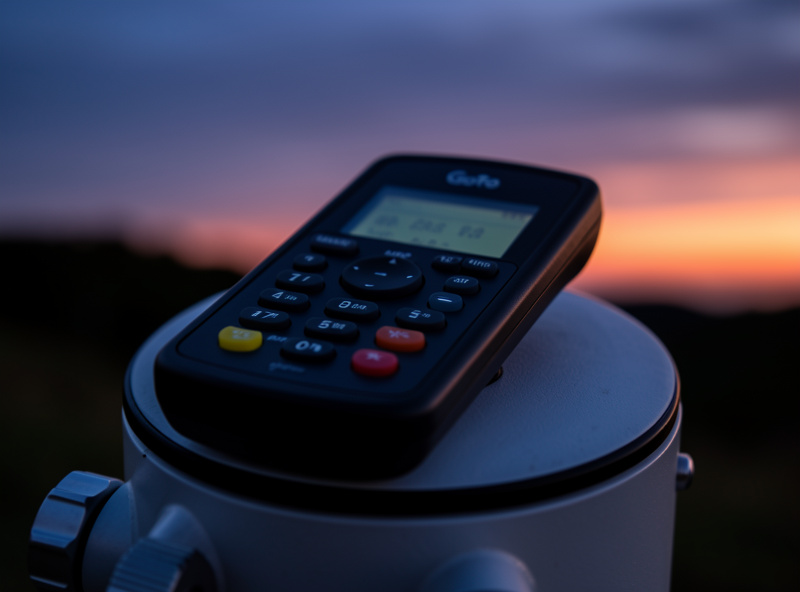
My checklist when GoTo misses: confirm the controller has the right date, time (and time zone — get this wrong and you can be off by an hour of sky), and an accurate site location. Then redo the alignment, centering each alignment star carefully at high power, not just “close enough” in the finder. On an equatorial GoTo, a rough polar alignment compounds every miss, so I treat that as a prerequisite — my polar alignment guide covers getting that close enough for visual use. For the alignment routine itself I lean on the GoTo mount alignment guide, and the full symptom-by-symptom rescue is in why a GoTo telescope isn’t finding objects. Nine times out of ten it is data entry or a lazy alignment, not hardware.
One Nordic-latitude wrinkle worth flagging: in high summer up here there is no real astronomical darkness, so the alignment stars you need may simply not be visible against a bright twilight sky. That is not a fault either — it is the latitude, and it is why I do most of my serious GoTo work in the long dark winter.
Everything shakes — the mount, not the scope
If the image quivers every time you nudge the focuser and takes a couple of seconds to settle, the mount or tripod is undersized or set up loose, and it is robbing you at exactly the high powers where you most need stillness. This has nothing to do with optical quality.
The quick wins, in order: spread the tripod legs fully and plant them firm, retract the legs to their shortest usable height (long extended legs are springs), tighten every clamp and bolt, and get the load off a flimsy accessory tray if the design hangs weight there. Hang a modest counterweight from the centre to damp vibration. If you are at the eyepiece on a tall tripod in wind, even your own body is part of the system. Mount choice underpins all of this — an undersized head will never be steady under a heavy tube — and I work through matching mount to scope in the telescope mount guide. The hands-on damping fixes are in the shaky mount fix. The same setup-and-tweak discipline I bring to a 3D-printer bench applies here: a steady base first, then worry about the fine stuff.
The image is upside-down or mirror-flipped
This is the one “problem” that is not a problem at all, and I want to disarm the panic early: an astronomical telescope is supposed to give an inverted or mirror-reversed image. A Newtonian shows the field rotated; a refractor or compound scope with a star diagonal shows it correct-side-up but flipped left-to-right. Nothing is broken. The extra erecting optics that make a terrestrial spotting scope read “right” actually cost a little light and sharpness, so astronomy scopes leave them out.
Where it genuinely matters is star-hopping and matching a chart to the eyepiece. The trick is to learn how your particular scope orients the sky and to flip your charts or atlas to match, rather than fighting the optics. It also explains the disorienting moment when you nudge the scope and the field drifts the “wrong” way. The full explanation, with how to orient each scope type and how to mentally flip a chart, is in the guide on why your telescope image is upside down or backwards.
Optics fogging over — dew, the silent fade
On a still, damp, clear night the front of your scope radiates heat to the sky, drops below the dew point, and the corrector plate, objective, or eyepiece fogs. The image does not blur dramatically — it quietly dims and goes flat, and people blame haze or tired optics. Compound scopes with an exposed corrector plate (my SCT, the Maksutov) are the worst offenders; open-tube Newtonians fare a little better but the eyepiece and finder still dew.
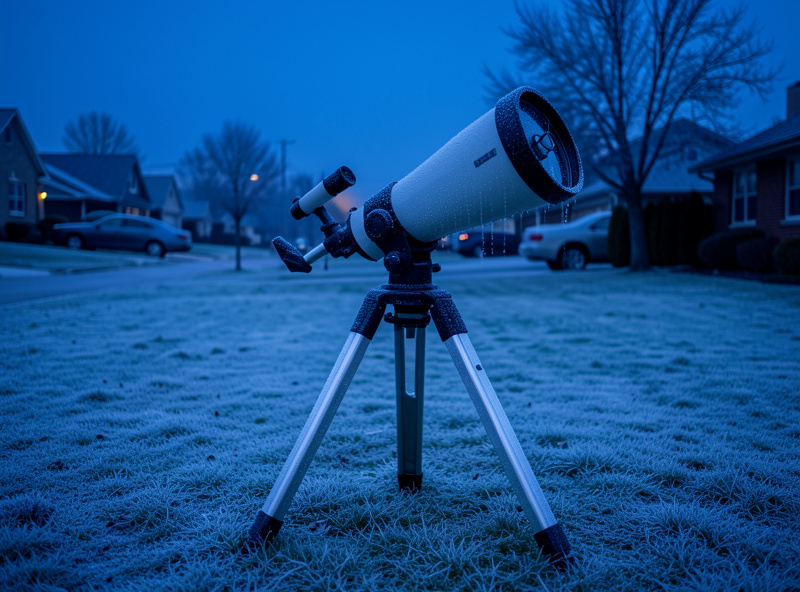
The defence is to keep the optics a touch above ambient so they never reach the dew point: a dew shield extends the tube and slows radiative cooling, and a low-power dew heater strip wrapped near the front element keeps it just warm enough. The mistake is reacting after fogging — once dewed, gently warming it clear with a hairdryer on low or a 12V heater is a recovery, not a fix, and it will recur within minutes without prevention. Never wipe a wet optic. The full prevention-and-recovery routine is in the eyepiece and optics fogging fix, and dew management is also a standing item in my telescope maintenance guide.
If you only buy one thing after reading this, a dew heater strip is the most night-saving cheap accessory I own. A basic dew heater strip and controller sits on the front of every scope I take out on a damp night. As an Amazon Associate I earn from qualifying purchases.
The finder won’t stay aligned
A finder that pointed true last session and is off tonight is almost always a mechanical looseness, not a defect: the bracket screws or the finder shoe have worked loose, or the finder was knocked in transport. A red-dot finder that won’t hold can also be a tired battery making the dot drift in apparent brightness rather than the alignment actually moving.
My routine is to align the finder on a distant fixed object in daylight or on a bright star, then snug — not crank — the adjustment screws so they hold without flexing the bracket, and re-check after the first slew. If it drifts every session, the shoe or bracket is loose at the tube, and that is where I look. For a red-dot specifically there are setup quirks worth knowing, which I cover in the red-dot finder guide; the full troubleshooting path, including magnified finders and right-angle versus straight-through, is in the finder scope alignment troubleshooting guide. A finder you cannot trust makes every other problem on this page harder to diagnose, so I fix it early.
Washed-out, low-contrast views
When deep-sky objects look grey and faint and planets look pale, the usual cause is not your scope — it is light pollution, dew, or a moonlit sky robbing contrast. A galaxy that is a bright spiral in a magazine is, from a Bortle 5 backyard, a faint smudge that only averted vision pulls out. That is the sky, working exactly as it should at that brightness.
The diagnostics: check for dew first (it flattens contrast before it fully fogs), check whether the Moon is up, and check your own dark adaptation — twenty minutes away from white light makes a real difference and people undercut themselves with a phone screen. For nebulae, a UHC or OIII filter cuts the artificial skyglow and lifts contrast dramatically from a suburban site; I would not observe emission nebulae from home without one. Light pollution is the biggest lever of all, and I lay out the whole picture in the light pollution astronomy guide. The symptom-specific walkthrough lives in the fix for low-contrast, washed-out views. The honest answer, though, is often that driving to a darker site does more than any filter — the difference between my Bortle 5 backyard and a Bortle 2 dark site is night and day, literally.
Things beginners blame that almost never are it
A big chunk of “broken scope” reports are expectation problems, and naming them saves people from chasing fixes that do not exist. None of the following is a fault.
“Saturn is tiny.” It is. Even in a good scope at sensible magnification, Saturn is a small, sharp jewel, not a full-field poster. The rings are obvious, Cassini’s division shows on a steady night, and that is a fantastic view — but it is small, and that is correct.
“M31 is just a smudge.” From a Bortle 5 backyard, the Andromeda Galaxy is a bright core fading into a soft glow, and most of its enormous disc is lost to skyglow. It is not your optics; it is the sky. From my dark site the same scope shows dust lanes. Aperture and dark sky, not a better-coated mirror, are what change that.
“More magnification must be better.” The most expensive habit on this list. Past a scope’s and the night’s ceiling, extra power gives you a bigger, dimmer, blurrier image — never more detail. The useful magnification is set by aperture, the eyepiece, the seeing, and your exit pupil, not by the number on the eyepiece barrel.
“My scope must be faulty.” Usually the last thing wrong, after focus, cool-down, seeing, collimation, dew, and the mount. If a star tests clean — a tight point at focus, symmetric rings just inside and outside — the optics are fine. If you genuinely suspect a defect, the star test is your evidence; until it fails, work the rest of the list.
If you are still early in this hobby and want the ground floor under all of this, my telescope buying guide explains what realistic performance looks like for a given aperture and budget, which heads off a lot of these expectation gaps before they start.
The fundamentals that prevent most of this
Most of the problems above are downstream of a handful of habits. Build these in and the bad nights mostly stop happening.
Cool the scope. Set it outside well before you want to observe — an hour for a large reflector on a cold night is not excessive. A scope that has reached air temperature is the single biggest sharpness upgrade you can make for free.
Collimate as a discipline. For reflectors, check collimation at the start of a session, not once a year. It drifts with handling. A quick star test takes a minute and a collimation cap costs almost nothing.
Learn seeing versus transparency. Decide what kind of night it is before you pick a target. Steady-but-hazy is a planetary night at high power; transparent-but-turbulent is a wide-field deep-sky night at low power. Fighting the sky for the wrong target is the most common self-inflicted bad session.
Respect exit pupil. Match magnification to the scope and the night. When in doubt, less power and a sharper, brighter image beats more power and mush, every time.
Account for the latitude. Up here the planets ride low through the murk near the horizon, where seeing is worst, and summer offers no real darkness. None of that is a scope fault — it is the sky we have, and planning around it (winter for planets and faint DSOs, accepting low altitudes) saves a lot of frustration.
The triage table — symptom to first move
This is the cheat sheet I wish I had taped to the tripod when I started. Read it as “if you see this, check this first.” It maps every symptom above to its most likely cause and the very first thing I do at the eyepiece.
| Symptom | Most likely cause | First thing I check or fix |
|---|---|---|
| Soft, blurry view that won’t sharpen | Not at focus, scope not cooled, or poor seeing | Rack through focus slowly; confirm the scope has cooled to air; drop magnification |
| Star never collapses to a point | Focuser out of travel; wrong train (diagonal, Barlow, back-focus) | Remove or add diagonal/Barlow; check back-focus if a camera is attached |
| GoTo slews to empty sky | Bad date/time/location or sloppy star alignment | Fix time zone and location, then redo alignment centering stars at high power |
| Image jumps and won’t settle | Undersized or loose mount and tripod | Plant and shorten the legs, tighten every clamp, add a counterweight |
| View is upside-down or mirror-flipped | Normal astronomical optics — not a fault | Learn the scope’s orientation and flip your chart to match |
| Image quietly dims and goes flat | Dew on the corrector, objective, or eyepiece | Check the front element with a red light; fit a dew shield and heater strip |
| Finder won’t hold alignment | Loose bracket/shoe or a dying red-dot battery | Snug the bracket screws; replace the red-dot battery; re-align and re-check |
| Deep-sky looks grey and washed out | Light pollution, Moon, or poor dark adaptation | Add a UHC/OIII filter, kill white light for 20 minutes, or drive to darker sky |
| Planet looks tiny or featureless | Correct behaviour or too much magnification | Back off the power; reset expectations — a small sharp planet is the win |
Work that table top to bottom and you will resolve the large majority of “broken telescope” nights without ever opening the tube. If you want the broader habits that keep all of this from recurring, the standing routines are in my telescope maintenance guide, and if you are still choosing gear, the buying guide will keep you from inheriting these problems in the first place.
Frequently asked questions
Is my telescope broken or is something else wrong?
Almost certainly something else. In my experience the large majority of bad nights are focus, the scope not being cooled to air, poor seeing, collimation drift, dew, or a shaky mount — not faulty optics. Star-test before you ever suspect the glass.
Why is my telescope image blurry no matter what I do?
Usually too much magnification for the night, a scope that has not cooled, or poor atmospheric seeing — often two at once. Rack carefully through focus, let the scope reach air temperature, and back the power off before blaming the optics.
Why does my GoTo mount point at empty sky?
The mount is only as accurate as its setup. Check the date, time, time zone, and site location, then redo the star alignment and center each alignment star carefully at high power. Bad data or a lazy alignment causes the misses, not hardware.
Why is my telescope image upside down or backwards?
That is normal. Astronomical telescopes give an inverted or mirror-reversed image because the erecting optics that flip it correct cost light and sharpness. Nothing is broken — just learn your scope’s orientation and flip your star charts to match.
How do I stop my telescope optics from fogging up with dew?
Keep the front element a touch above the dew point. A dew shield slows radiative cooling and a low-power dew heater strip near the objective or corrector prevents fogging. Never wipe a wet optic; prevention beats trying to clear dew after it forms.
Why do galaxies and nebulae look so faint and washed out?
Light pollution, moonlight, dew, or poor dark adaptation. From a suburban Bortle 5 sky most deep-sky objects are faint by nature. A UHC or OIII filter helps on nebulae, but a darker site does far more than any filter.
Related guides
Each symptom above has its own deep walkthrough. Start with the one that matches your night:
