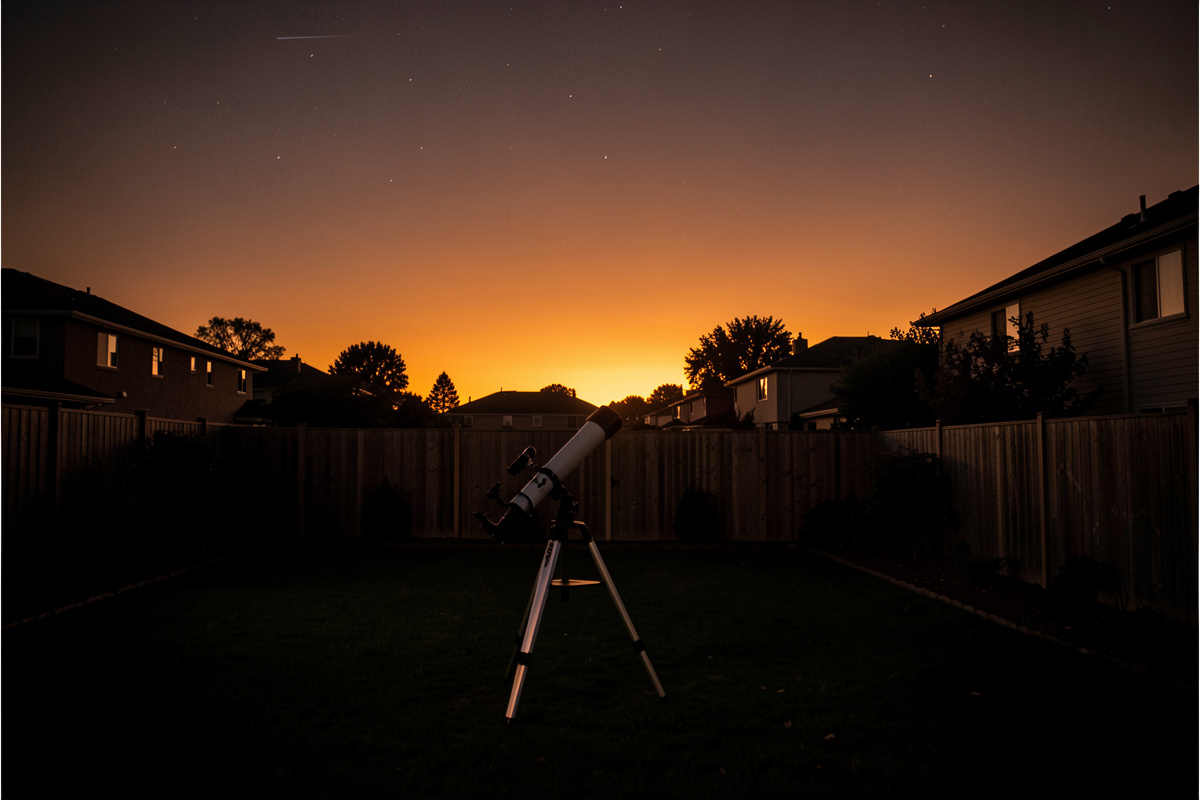

Light pollution is the single biggest reason new telescope owners give up. Skyglow doesn’t just dim the sky — it erases the faint, low-contrast detail that makes deep-sky objects worth chasing. From my suburban Bortle 5 backyard the naked-eye limit sits near magnitude 4.5; from my Nordic dark site it drops past magnitude 6.5, and that two-magnitude gain is the difference between a smudge and a galaxy with structure.
This is the guide I wish someone had handed me before I bought my first scope on a streetlit lawn. I observe from both ends of the scale — a light-washed suburb most nights and a genuinely dark Bortle 2-3 site I drive to when the forecast lines up — so I can tell you exactly what light pollution steals, what filters and maps can claw back, and what only a tank of fuel and a dark horizon will fix. No brochure copy, no “city skies are fine actually.” Just what works at the eyepiece.
What Light Pollution Actually Does to the View
Light pollution raises the brightness of the sky background, and contrast — not aperture — is what lets you see faint deep-sky objects. A galaxy that is intrinsically faint can only be seen if it is brighter than the sky behind it. Flood the sky with sodium and LED glow and you compress that contrast until the object vanishes into the grey, even though the photons are still arriving at your eye.
The practical consequence: planets and the Moon barely care about light pollution — they are blindingly bright point-or-disk sources, so I happily observe Jupiter and Saturn from my driveway. Extended faint objects — nebulae, galaxies, the outer reaches of star clusters — are murdered by it. From Bortle 5 I can still pick out the brighter Messier objects with effort; the Andromeda Galaxy shows as its bright core only, not the sprawling disk that fills the eyepiece from my dark site. Light pollution doesn’t make objects smaller. It makes them disappear from the outside in.
The other thing it costs you is dark adaptation. Your eyes take 20-30 minutes to reach full sensitivity, and a single glance at a phone screen or a neighbour’s security light resets it. In a bright suburb your eyes never fully adapt because the sky itself is the offending light source. That is why two observers with identical scopes can have completely different nights — one is using a dark-adapted eye against a dark sky, the other is squinting through perpetual twilight.
The Bortle Scale, Read by Someone Who Observes at Both Ends
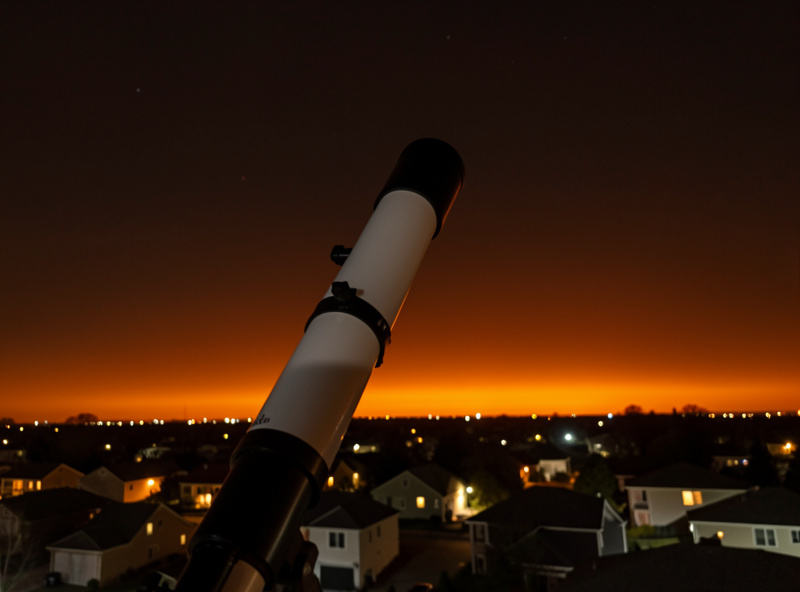
The Bortle scale runs from Class 1 (a pristine, almost frightening dark sky) to Class 9 (an inner-city sky where you see the Moon, a few planets, and little else). It is the single most useful number in this hobby because it tells you, before you set up, roughly what is even possible tonight. Most readers live somewhere in Bortle 5-8 and dream about Bortle 1-3.
Here is the honest version of what each band delivers through a telescope, from someone who logs nights across the range. The jump from Bortle 5 to Bortle 3 is far more dramatic than the modest aperture upgrade most beginners obsess over.
| Bortle Class | Typical Location | Naked-Eye Limit | What You Realistically See |
|---|---|---|---|
| 1-2 | Remote dark site | 7.0-7.5 | Zodiacal light, Milky Way casts shadows, galaxies show spiral structure |
| 3 | Rural | 6.5-7.0 | Milky Way detailed; most Messier and many NGC objects show structure |
| 4 | Rural/suburban transition | 6.0-6.5 | Milky Way visible but washed near horizon; brighter galaxies as oval glows |
| 5 | Suburban | 5.5-6.0 | Milky Way faint overhead only; Messier objects need effort and averted vision |
| 6-7 | Bright suburban/urban edge | 4.5-5.5 | No Milky Way; only the brightest DSOs; nebula filters earn their keep |
| 8-9 | Inner city | 3.0-4.5 | Moon, planets, double stars, brightest clusters; little else |
I keep a Sky Quality Meter reading in my logs alongside the Bortle estimate because the descriptive scale is coarse — a “Bortle 5” sky on a humid, hazy night behaves like Bortle 6.5. If you want to know precisely where you stand and how the scale maps to deep-sky targets, I walk through it in detail in my guide to dark sky sites and the Bortle scale.
Reading a Light Pollution Map Before You Spend a Krona
Before buying a scope, a filter, or a tank of fuel for a dark-sky run, open a light pollution map. The colour-coded maps built on satellite radiance data (the VIIRS dataset) tell you your home Bortle class and — more usefully — show you where the nearest genuinely dark sky is and how far you’d have to drive. This single step prevents the most common beginner mistake: buying a big light-bucket Dobsonian to fight a sky that no aperture can win.
The maps also kill a myth. Beginners assume driving “out of town” fixes everything. From my own runs, the radiance gradient is steep but not instant — I have to clear a surprising distance of suburban and small-town glow before the map turns from yellow-green to grey-blue, and the last push from Bortle 4 to Bortle 2 often means another 40 minutes past where I thought “dark” began. The map turns that guesswork into a route. I cover how to read the colours, the radiance scale, and how to scout a usable observing spot in my light pollution map guide for astronomers.
Filters: What They Can and Cannot Fix
Filters are the most over-sold and most misunderstood accessory in light-polluted astronomy. Here is the rule that saves people money: a filter can only improve contrast on objects that emit light in narrow, specific wavelengths — chiefly emission nebulae. It does nothing useful for galaxies, star clusters, or broadband starlight, because those emit across the whole spectrum and any filter that blocks skyglow also blocks the object.
There are two broad families. Broadband “light pollution reduction” (LPR) filters block the narrow emission lines of old sodium and mercury street lighting while passing most other light. They give a modest contrast bump on some objects but are increasingly useless against modern broad-spectrum white LED street lighting, which smears light across the whole visible band — there is no narrow line to block. Narrowband filters (UHC, OIII, H-beta) pass only the specific wavelengths that emission nebulae glow at and reject everything else, including most skyglow. On the right target — the Veil, the Orion Nebula, planetary nebulae — the effect from my Bortle 5 yard is genuinely transformative.
| Filter Type | Best For | Useless For | Verdict in Light Pollution |
|---|---|---|---|
| Broadband LPR | Old sodium-lit skies, imaging baseline | Galaxies, clusters, white-LED skies | Marginal today; skip for visual |
| UHC (narrowband) | Most emission nebulae, all-rounder | Galaxies, clusters, stars | The one filter to own first |
| OIII (line filter) | Planetary & supernova-remnant nebulae | Galaxies, reflection nebulae | Spectacular on the right target |
| H-beta (line filter) | A handful of faint nebulae (Horsehead) | Almost everything else | Specialist; buy last |
| Neutral density (Moon) | Cutting glare on the bright Moon | Faint objects of any kind | Comfort, not contrast |
The single biggest filter mistake I see is buying a broadband “light pollution” filter, pointing it at the Andromeda Galaxy, and being baffled that nothing changed. Nothing changed because galaxies emit broadband light — no filter helps. If you only read one section here before buying, read my narrowband vs broadband filters explained, and if you observe visually rather than image, my nebula filters for visual observing covers exactly which filter to lift to your eye on which object.
For a side-by-side of the actual products — which UHC and OIII filters punch above their price, and where the expensive glass earns it — see my light pollution filter comparison. And if you just want the short answer for a specific sky, I name the picks in best filters for light polluted skies. A solid starting point most observers reach for is a quality UHC nebula filter. As an Amazon Associate I earn from qualifying purchases.
Aperture, Targets, and Realistic Expectations Under City Skies
The cruellest trick light pollution plays is convincing beginners that a bigger telescope is the cure. Aperture gathers more light from the object — but it gathers exactly as much extra light from the bright sky background. You make the target brighter and the sky brighter in equal measure, so contrast barely improves. A 12-inch Dobsonian under Bortle 7 does not show the faint nebulae that a 4-inch refractor shows under Bortle 3. I own both ends of that range, and the dark sky wins every time on faint extended objects.
Where aperture does help in light pollution: targets that survive skyglow. The Moon, planets, double stars, bright globular and open clusters, planetary nebulae (especially with an OIII filter). These are the smart city targets. From my suburban yard I aim my 8-inch SCT and 127 Maksutov at the Moon, Jupiter, Saturn, the brighter globulars like M13, and tight double stars — objects where more aperture genuinely buys more detail because they punch through the bright background. I save the galaxies and the faint nebulae for the dark site.
If you are choosing a scope specifically because you’re stuck under bright skies, match the instrument to the targets that survive — that decision is part of the broader aperture versus portability tradeoff, and it usually argues for a portable scope you’ll actually carry to a dark site over a giant one you’ll fight your home sky with. My guide to electronically assisted astronomy in light pollution covers the one genuine exception — a camera and live stacking can pull deep-sky detail from a city sky that the eye simply cannot.
Escaping to Dark Skies vs Fighting From Home
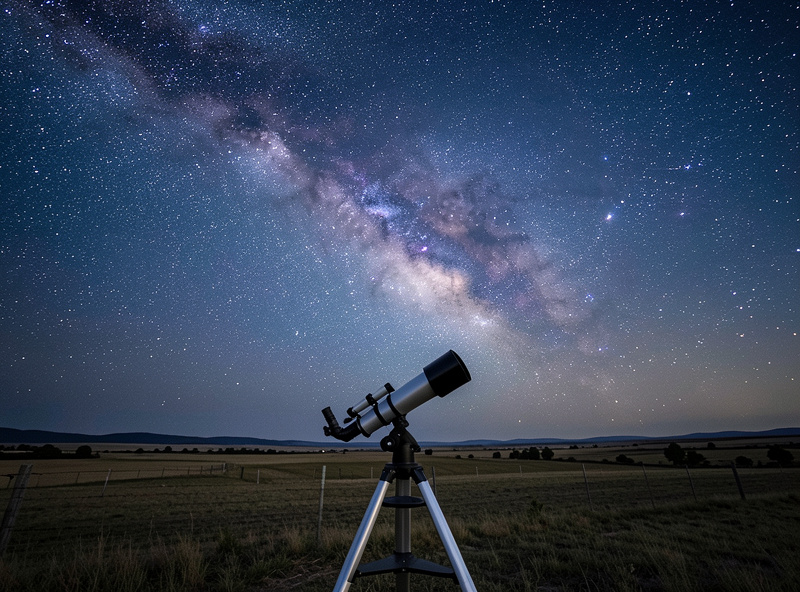
There comes a point in every deep-sky observer’s life where they stop fighting their home sky and start driving. It is the highest-value upgrade in the hobby — more impactful than any scope, eyepiece, or filter. A modest 6-inch scope under Bortle 2 outperforms a monster under Bortle 7 for everything except the planets. The economics are simple: a tank of fuel buys you a sky upgrade that no amount of glass can replicate at home.
That said, you observe most nights from where you live, so do both. Build a “city target list” of objects that survive light pollution and keep the scope ready for the clear weeknight. Then plan deliberate dark-sky runs around the new-Moon window — the Moon is itself a powerful source of natural light pollution, so I time faint deep-sky sessions for the moonless nights and use the bright-Moon weeks for lunar and planetary work. I plan those sessions with the same care I describe in my deep-sky observation session planning guide, and I check transparency and seeing first with the tools in best weather apps for astronomy.
The Nordic latitude where I observe adds a twist most US and UK guides skip: for several weeks around midsummer there is no astronomical darkness at all this far north — the sky never gets properly black — while winter delivers brutally cold but gloriously long, dark nights. Light pollution planning here is as much about season as it is about location. The same patience that the rest of my hobbies demand applies to the sky: you observe when the sky cooperates, not when you want to.
Where the Glow Comes From — and Why LED Made It Worse
Skyglow is light that should have hit the ground but instead escaped upward, scattered off air molecules and aerosols, and came back down as a uniform grey wash. The worst offenders are unshielded fixtures that throw light sideways and up: old “cobra head” street lights, floodlit car parks, sports fields, and the security light on the side of every other house. None of it helps anyone see better on the ground — it is wasted light, and it lands in your eyepiece.
The shift from sodium to LED street lighting over the last decade changed the problem in two ways that matter to observers. First, modern white LEDs emit a broad, continuous spectrum, so the old broadband “light pollution reduction” filters that worked by blocking sodium’s narrow yellow line have far less to grab. Second, cheap LEDs are often blue-rich (high colour temperature, 4000K and up), and blue light scatters more strongly in the atmosphere — so the same lumens produce more skyglow. The promised efficiency gains were frequently spent on simply installing brighter lights, leaving the night sky worse, not better. This is the real-world reason narrowband filters have quietly become the only filters worth owning for light-polluted visual work.
Understanding the source also explains why position matters so much. Light pollution is strongly directional near its sources — the glow domes over a town are far brighter low on the horizon in that direction. From my suburban yard the worst quarter of the sky points at the town centre, and I plan targets toward the darker quarters. A simple choice of which way to face can buy you the equivalent of a half-class improvement on the Bortle scale.
Fixing the Light You Actually Control
You cannot rewire your town, but you can fix your own observing site, and it makes a real difference at the eyepiece. The single highest-value change is killing every white light within your own property line during a session. A neighbour’s motion-sensor security light triggering halfway through observing M13 will undo half an hour of dark adaptation in a second, so I site the scope where local lights are blocked by the house, a fence, or a hedge — a “light shadow” matters as much as a clear horizon.
For your own fixtures, the fixes are cheap and well established: shield outdoor lights so they point down, not sideways or up; switch to warm, low colour-temperature bulbs (under 3000K) on the lowest practical wattage; and put them on motion sensors and timers so they are not burning all night. At the eyepiece, use only dim red light — a red headlamp or a red-filtered torch — because red light preserves the dark adaptation that white light destroys. None of this is exotic; it is the same shielded, downward, warm-and-dim philosophy that the dark-sky community has spent decades promoting, and it happens to also reduce wasted energy. The point that connects all of it: most of the light fighting your telescope is simply badly aimed, and a surprising amount of it is yours.
My Light-Pollution Workflow, Start to Finish
Here is how I actually decide what to do on any given clear night, distilled from years of logs. First, I check the Moon phase and the forecast for transparency. A clear but moonlit or hazy night goes to planets, the Moon, and double stars from the backyard — no point chasing faint fuzzies. Second, on a dark-of-the-Moon transparent night, I decide between home and the dark site based on how faint my target list is. Galaxies and faint nebulae mean I’m driving.
Third, at the eyepiece, I let my eyes dark-adapt fully — 30 minutes, red light only, no phone — and I use averted vision on faint targets, because the most sensitive part of your retina is off-centre. Fourth, for emission nebulae I bring the UHC and OIII filters; for galaxies and clusters I leave the filters in the case because they only dim the view. Fifth, I dress for the cold. The single most common reason a Nordic session ends early isn’t the sky — it’s frozen hands, and a cold, miserable observer stops looking carefully.
Sixth, I track the sky itself over time. I note a rough Sky Quality Meter reading and the transparency in every log entry, because light pollution is not static — it varies with humidity, snow cover (fresh snow reflects town light straight back up and noticeably brightens a suburban sky), and the slow creep of new development. Knowing my own site’s typical numbers across the seasons tells me instantly whether a disappointing view is the sky’s fault or mine. It is the same record-keeping discipline I apply on every bench: measure first, then judge. If you observe seriously, start an observing log early — it turns vague impressions into data you can act on.
The Nordic seasonal reality deserves repeating because it reframes the whole question for high-latitude readers. There is no escaping light pollution in June here regardless of how far you drive, because there is no astronomical darkness at all — the deep-sky season effectively closes for the brightest weeks of summer. The flip side is a long, generous winter window of genuinely dark hours, the same brutal cold and short days that make my hydroponics and indoor projects busy. I plan the year around it: galaxies and faint nebulae from autumn through spring at the dark site, planets and the Moon year-round from the yard, and the summer weeks spent on noctilucent clouds, the bright planets, and maintenance rather than fighting a sky that will not cooperate.
The unifying lesson, and the one that connects astronomy to every other hands-on hobby I run, is that beginners optimise the wrong variable. They chase aperture when the answer is darkness, buy a broadband filter when they need narrowband, and blame the scope when the real problem is a streetlight and an un-adapted eye. Fix the sky first — with a map, a drive, and the right filter — and even a modest scope will show you things you didn’t believe were up there. For the gear side of that decision, my telescope filters guide and telescope accessories guide round out the kit, and beginners brand-new to all of this should start with astronomy for beginners.
Frequently Asked Questions
Do light pollution filters actually work for visual astronomy?
Narrowband filters (UHC, OIII) genuinely work on emission nebulae by passing only the wavelengths the nebula glows at while rejecting skyglow. Broadband LPR filters help little, especially against modern white-LED street lighting. No filter improves galaxies or star clusters.
What is the best Bortle class for seeing galaxies?
Bortle 3 or darker is where galaxies start showing structure rather than just a faint core. From Bortle 5 suburban skies you see only the brightest galaxy cores; the difference between Bortle 5 and Bortle 3 is more dramatic than any telescope upgrade.
Will a bigger telescope beat light pollution?
No. More aperture brightens the target and the bright sky background equally, so contrast barely improves on faint objects. A small scope under a dark sky outperforms a large scope under a bright one for nebulae and galaxies. Darkness beats aperture.
Can I do any worthwhile astronomy from a city?
Yes, on targets that survive skyglow: the Moon, planets, double stars, bright globular clusters, and planetary nebulae with an OIII filter. Faint galaxies and large nebulae need a dark site or a camera with live stacking (electronically assisted astronomy).
How far do I need to drive to escape light pollution?
It varies by region, but the radiance gradient is steeper than most expect. Reaching genuinely dark Bortle 2-3 skies often means driving well past the first stretch of darkness. A light pollution map turns that guesswork into a measurable route before you leave.
Does the Moon count as light pollution?
Effectively yes. A bright Moon floods the sky and washes out faint deep-sky objects just as artificial light does. Experienced observers plan faint nebula and galaxy sessions around the new-Moon window and reserve the bright-Moon weeks for lunar and planetary observing.
