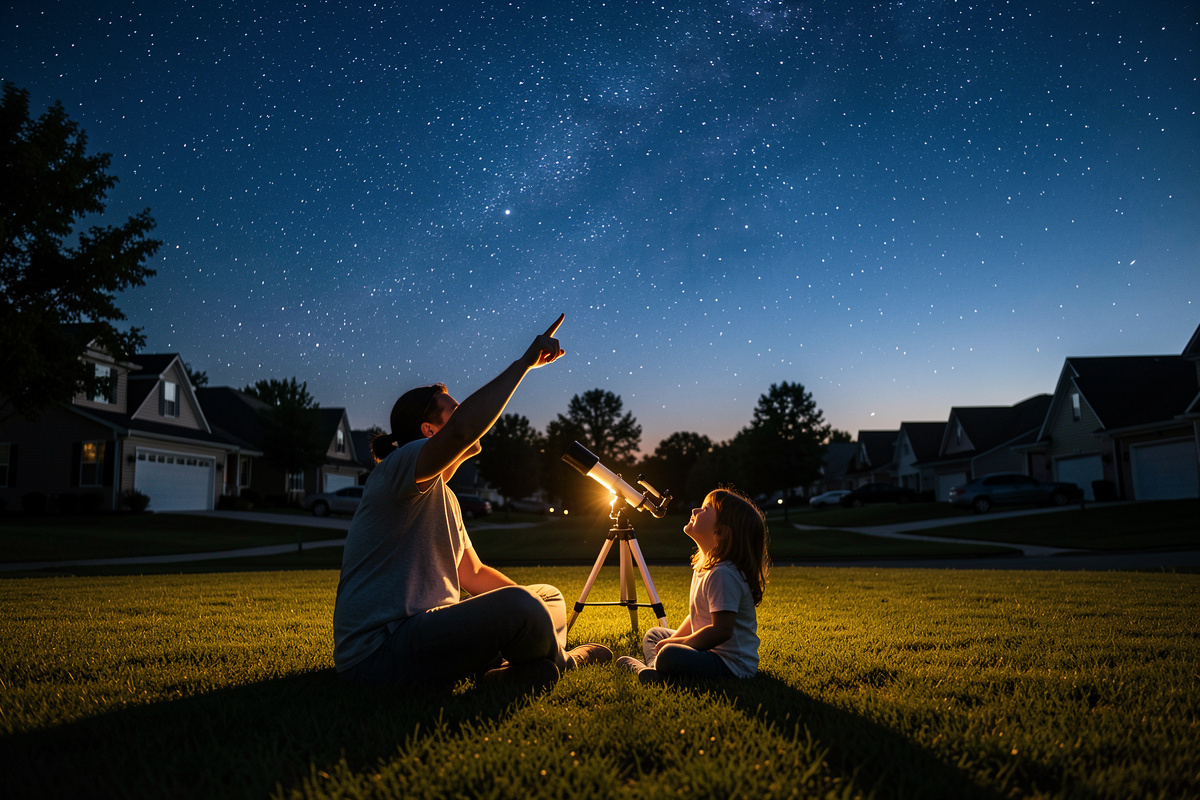

If you want to get a child into astronomy, the honest answer is that the telescope comes third, not first. The order that actually works is eyes, then binoculars, then a small scope on a mount the kid can aim alone. Skip the steps and roughly half of new family setups end up in a closet by spring.
I came to this hobby the same way most parents do — a small scope on a suburban lawn, a freezing eyepiece, and a kid who lost interest the moment Saturn looked like a tiny white dot instead of the poster. Years later I run a stable of scopes across every common design and observe from a dark Nordic site as well as my own light-polluted backyard, and the single biggest thing I’ve learned about getting kids into the sky is that the gear matters far less than the habit. This guide is the whole map: how to manage expectations, what to actually buy and when, how to fight the light pollution that quietly kills the hobby, and how a backyard interest grows into projects, club nights, and family star parties.
Why the Telescope Comes Third
The most common parental mistake is buying a department-store telescope as step one. A child’s astronomy journey works far better in three stages: naked-eye sky-learning, then binoculars, then a beginner telescope. Each stage builds the patience and sky-knowledge the next one needs, and each is cheaper than the last failure.
Here is the trap. A 60mm refractor on a wobbly photo tripod — the classic “400x!” box-store scope — shakes so badly that a child can’t hold a planet in view, and the supplied eyepieces are nearly unusable. The kid concludes that astronomy is frustrating, and they’re not wrong. Start instead with the naked eye: learn the Moon’s phases, find the brightest planets, trace a couple of constellations. This costs nothing and teaches the one skill every later stage depends on — knowing where things are and how the sky turns. The same setup-and-tweak discipline I bring to my other benches applies here: optimize the foundation before you optimize the optics. A child who can already find the Moon, Jupiter, and the Pleiades will get ten times more out of their first scope than one who’s never looked up. I cover the full beginner ramp in my complete guide to stargazing for beginners, and the deeper logic of the three-stage path is the backbone of my guide to starting stargazing with kids.
What Kids Actually Want to See — and What They’ll Get
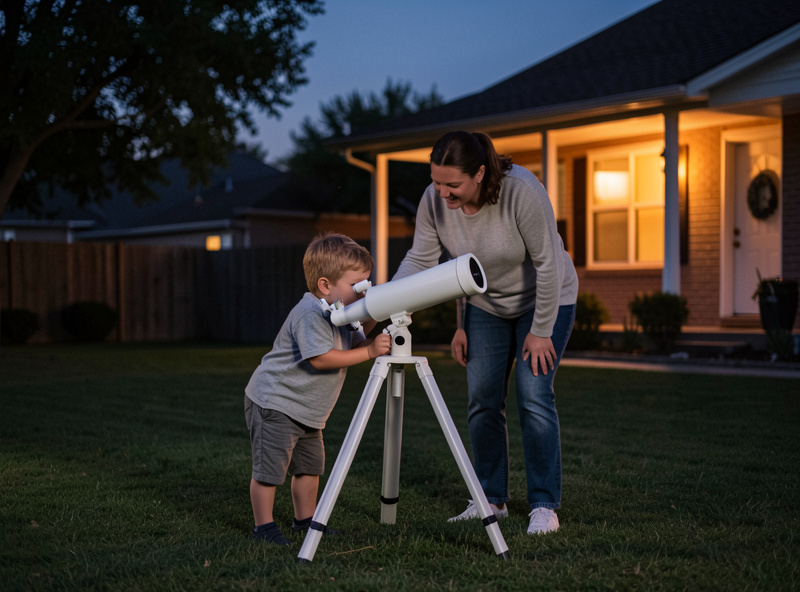
Manage expectations before the first session or you’ll lose the child in five minutes. Through a small telescope the Moon is spectacular, Saturn shows its rings as a tiny but unmistakable shape, Jupiter shows two cloud bands and four moons, and most deep-sky objects look like faint grey smudges. Knowing this in advance turns disappointment into discovery.
The Moon is the gateway drug, and it always wins. Even a modest scope shows craters, mountain ranges, and the razor line of the terminator where shadows are longest. Aim there first, every time, and let the child find a crater they like. After the Moon, the bright planets are the next reliable hit — Saturn’s rings genuinely make kids gasp once you’ve warned them it’ll be small, and Jupiter’s four Galilean moons visibly shift position from night to night, which is a fantastic hook because the child can predict and confirm a change. I walk through exactly what those views look like in my Moon observation guide and my guide to Jupiter through a telescope. What you steer them away from at first are faint galaxies and nebulae; those are a smudge in a suburban sky and a smudge is a hard sell to an eight-year-old. Build up to them once the child has fallen for the bright stuff.
Binoculars First, Telescope Second: Choosing Family Gear
For most families the best first instrument is not a telescope at all — it’s a pair of 10×50 binoculars. They’re cheap, indestructible compared to a scope, show a wide swath of sky that’s easy for a child to aim, and reveal craters on the Moon, Jupiter’s moons, star clusters, and the Milky Way. A decent pair costs a fraction of a usable telescope.
Binoculars solve the two problems that kill kids’ interest with a first scope: aiming and shake. A telescope shows a tiny patch of sky upside-down or mirror-reversed, and getting a planet into that patch is genuinely hard for a beginner. Binoculars show a wide, right-way-up view that a child can point like they’d point their eyes. The trade-off is magnification — you won’t split Saturn’s rings with handheld binoculars — but for learning the sky they’re unbeatable, and they stay useful forever even after you buy a scope. I lay out the whole case in binoculars vs telescope for beginners, recommend specific pairs by budget in best binoculars for astronomy, and cover the wider family options in my astronomy binoculars guide. When you are ready for a scope, the right one for a child is almost never the one with the biggest magnification number on the box. The full reasoning, with specific picks, lives in my best telescope for kids guide for 2026 — and it leans heavily on my general best beginner telescopes picks and the first-telescope buying guide.
| Instrument | Rough Cost | Best Age | What It Shows | Why It Suits Kids |
|---|---|---|---|---|
| Naked eye + star map app | Free | Any age | Constellations, planets, bright satellites, the Moon’s phases | No gear to break; builds the sky-knowledge everything else needs |
| 10×50 binoculars | Low | 6 and up | Moon craters, Jupiter’s moons, star clusters, Milky Way star fields | Wide view is easy to aim; right-way-up; nearly indestructible |
| Tabletop Dobsonian (76-130mm) | Low to medium | 7 and up | Lunar detail, Saturn’s rings, Jupiter’s bands, brighter clusters | Simple push-to aiming a child can do alone; stable on a table |
| Full-size Dobsonian (150-200mm) | Medium | 9 and up with help | Everything above plus galaxies and nebulae from a dark site | Most aperture per dollar; rugged; grows with the child for years |
| Department-store 60mm “400x” refractor | Low | Avoid | Wobble, frustration, a tiny shaking blur | It doesn’t — this is the scope that ends the hobby |
As an Amazon Associate I earn from qualifying purchases. If you want to browse current options, a search for tabletop Dobsonian telescopes for kids is a far safer starting point than the colourful “400x” boxes near the checkout.
The Light Pollution Reality No Box Mentions
Light pollution is the silent killer of family astronomy. From a bright suburban sky (Bortle 6-7) a child will see the Moon and bright planets fine, but the galaxies and nebulae they saw in books are simply invisible, no matter how big the telescope. Understanding your sky before you buy prevents the most expensive disappointment in the hobby.
The Bortle scale runs from 1 (a truly dark wilderness sky) to 9 (inner city). Most families live somewhere around Bortle 5-7, and that’s fine for the Moon, planets, double stars, and the brighter star clusters — the targets kids respond to anyway. What it isn’t good for is faint deep-sky, so don’t promise the Andromeda Galaxy looking like the photo, because from the backyard it’s a faint oval at best. The fix isn’t a bigger scope; it’s a darker sky. An occasional drive to a darker site does more for the view than any aperture upgrade, which is exactly why I keep a dark-site routine alongside my backyard setup. My dark-sky locations guide helps you find one, and if your own yard is the problem, my piece on killing light pollution from coop and security lights covers the small fixes that genuinely help. Filters get oversold to beginners — they help on specific nebulae from specific skies but won’t rescue a bright backyard, and I keep that honest in the telescope filters guide.
Building Observing Habits That Stick
The session structure matters more than the equipment. Keep early sessions short (20-30 minutes), warm, and ending on a high note while the child still wants more. A cold, hour-long session that drags into boredom teaches a child that astronomy is uncomfortable — the exact wrong lesson.
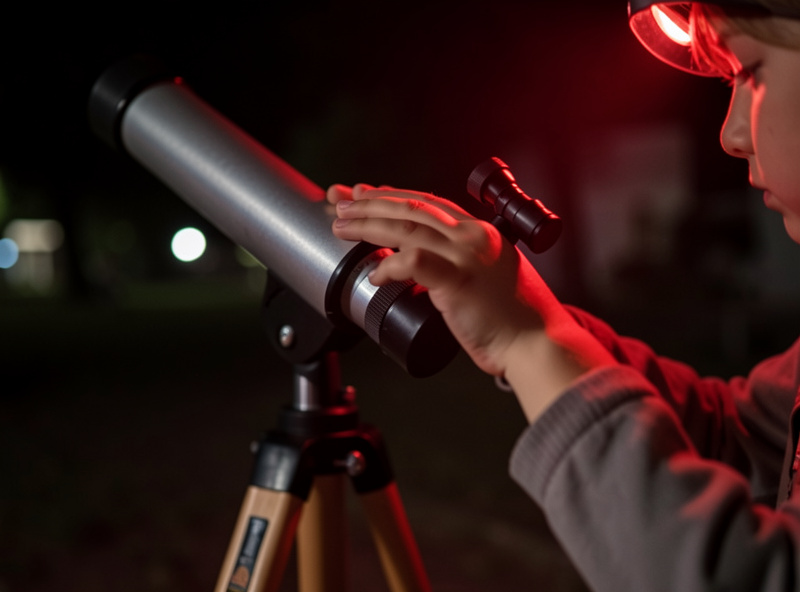
A few rules I’d give any parent. Dress the child warmer than you think they need; kids stand still at a scope and chill fast, and cold is the number-one reason a session ends in tears rather than wonder. Use a red flashlight, not a phone screen, to protect the dark-adapted eyes that take twenty minutes to build and two seconds of white light to wreck — a clipped-on red headlamp is a few dollars and changes the whole night. Let the child do the aiming once they’re able; ownership is what turns watching into doing. And keep a simple logbook — a cheap notebook where they sketch the Moon or note Jupiter’s moons — because the act of recording turns a passive look into an observation, and flipping back through past nights is its own reward. The astronomy apps I actually use at the eyepiece, including the red-screen night modes, are in my best stargazing apps guide. A search for a red astronomy flashlight is one of the cheapest upgrades that meaningfully improves a kid’s first nights.
Simple Projects That Turn Looking Into Understanding
Kids stay engaged longer when observing becomes doing. A handful of low-cost projects — a Moon-phase journal, a sundial, a pinhole solar projector, modelling the scale of the solar system across a backyard — convert passive watching into active science, and most need nothing you don’t already own.
The value of a project is that it gives a clear, finishable goal. Sketching the Moon over a month shows a child the phases as something they discovered rather than something they were told. A backyard solar-system walk — pacing out scaled distances between planets — lands the sheer emptiness of space in a way no diagram does. Building a simple sundial connects the sky’s motion to the time on the kitchen clock. None of this requires a telescope, which is the point: these projects keep the interest alive on cloudy nights and between the rare clear ones. I’ve collected the ones that work, with step-by-step instructions and the safety notes that matter, in my simple astronomy projects for kids guide. One hard safety line runs through all of them: never point any optical instrument at the Sun, and never use a screw-in “sun” eyepiece filter — solar viewing is only ever done with a proper full-aperture white-light filter or a dedicated solar scope, and with children that supervision is non-negotiable.
From Backyard to Community: Clubs, Outreach, and Star Parties
The fastest way to deepen a child’s interest is to put them next to other people’s telescopes. Local astronomy clubs, school outreach events, and family star parties let a child look through scopes worth thousands, meet people who love the sky, and see that this is a real community — not a solo hobby in a cold backyard.
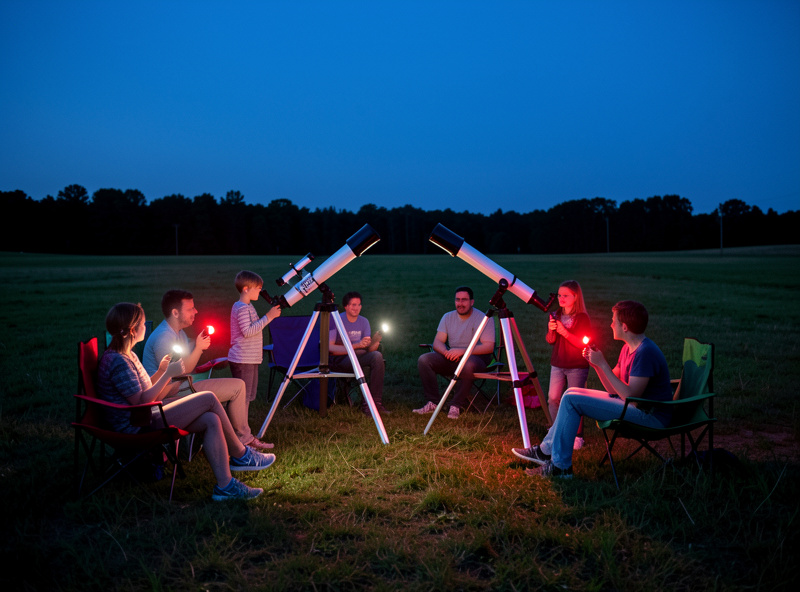
There’s a reason looking through someone else’s big Dobsonian can flip a casual kid into a committed one: a 12-inch scope from a dark site shows galaxies as actual structure rather than the smudge they get at home, and that contrast is electric. Most clubs run public observing nights and are genuinely welcoming to families — bring the kids, ask questions, and don’t worry about gear envy. If you’d rather organise your own, a family star party in the backyard or a local park is easier to pull off than people think, and it scales from three families to thirty. I cover how clubs work and how to run school or scout outreach in my astronomy club and outreach guide, and the practical logistics of hosting — site, timing, what to put in front of kids, how to handle the inevitable cloud — are all in my star party guide for families.
The Nordic-Latitude Angle Most Family Guides Miss
Where you live changes the whole calendar of family astronomy, and high-latitude families get a deal nobody warns them about. From a far-northern site like mine in Sweden, summer simply has no real darkness for weeks — the sky never gets fully dark — while winter delivers long, cold, gloriously dark nights perfect for kids who can stand the cold.
This flips the usual “summer is for stargazing” advice on its head. In the Nordic countries and the northern US and Canada, June and July are nearly useless for deep-sky observing because astronomical twilight never ends, but they’re wonderful for the Moon, the brighter planets, and — a bonus no mid-latitude family gets — the aurora. Winter is the real observing season up here: it’s dark by late afternoon, which means kids can observe before bedtime rather than long after it, a genuinely underrated advantage for families. The cold is the catch, so the warm-clothing rule becomes a hard rule, sessions stay short, and a thermos of cocoa does more for morale than any eyepiece. The brutal Swedish winter that’s miserable for so much else is, for an astronomy family, a gift — long, cold, and dark exactly when children are still awake. No reviewer writing from a mild mid-latitude backyard can hand you that calendar.
A Realistic First-Year Roadmap
If you want a plan rather than a pile of advice, here’s the arc that works. Spend the first month or two on naked-eye sky-learning and a star-map app — find the Moon, the bright planets, and a few constellations together. Add 10×50 binoculars next and spend real time on the Moon, Jupiter’s moons, and a star cluster or two. Only once the child can find things on their own does a telescope earn its place, and when it does, a tabletop or full-size Dobsonian beats a fiddly equatorial scope for a kid every time because aiming is intuitive. Mounts are where families quietly overspend or underspend; my telescope mount guide and the breakdown of alt-az, equatorial, and GoTo mount types explain why a simple Dobsonian rocker box is the right answer for most children.
Through the first year, weave in a couple of projects from the projects guide, take one trip to a darker sky, and get to at least one club night or family star party. By the end of a year a motivated child will know the sky, own a scope they can use alone, and have looked through something far bigger than they’ll ever have at home — which is exactly the foundation that keeps the hobby alive into the teenage years. The eyepiece is half the optical system, so when you do upgrade, a single better eyepiece often beats a whole new scope; the reasoning is in my telescope eyepiece guide and the best eyepieces for 2026.
Frequently Asked Questions
What age can a child start using a telescope?
Most children can use a simple tabletop Dobsonian by age seven or eight with light supervision, because the aiming is intuitive. Younger kids do better with binoculars or naked-eye sky-learning first, which builds the patience and sky-knowledge a telescope needs.
Should I buy binoculars or a telescope first for my child?
Binoculars first, for most families. A pair of 10×50 binoculars is cheaper, far easier for a child to aim, nearly indestructible, and shows the Moon, Jupiter’s moons, and star clusters. A telescope makes more sense once the child can already find things in the sky.
Why does my child get bored at the telescope so fast?
Usually three reasons: the views were oversold so reality disappoints, the child is cold and uncomfortable, or the session ran too long. Keep early sessions to 20-30 minutes, dress warmer than you think, start on the Moon, and stop while they still want more.
Can we see galaxies and nebulae from a normal backyard?
Rarely in any satisfying way. From a typical suburban Bortle 6-7 sky, galaxies and nebulae are faint grey smudges at best, no matter the telescope size. The Moon, planets, double stars, and bright clusters all show well; faint deep-sky needs a drive to a darker site.
Is it safe for kids to look at the Sun through a telescope?
Only with a proper full-aperture white-light solar filter or a dedicated solar telescope, and always with close adult supervision. Never use a screw-in eyepiece sun filter and never look at the Sun unfiltered — both can cause permanent eye damage in an instant.
How do I find an astronomy club or family star party near us?
Most regions have a local astronomy society that runs public observing nights welcoming to families. Search for your area plus astronomy club or star party, check science centres and planetariums, and look for outreach events tied to eclipses or meteor showers, which are the most family-friendly entry points.
Related Guides
- Best Telescope for Kids 2026 — what to actually buy, by age and budget
- How to Start Stargazing With Kids — the no-telescope first steps
- Simple Astronomy Projects for Kids — cloudy-night science you can do at home
- Astronomy Club and Outreach Guide — finding community and running events
- Star Party Guide for Families — hosting your own night under the stars
- Astronomy for Beginners — the full grown-up starter path
