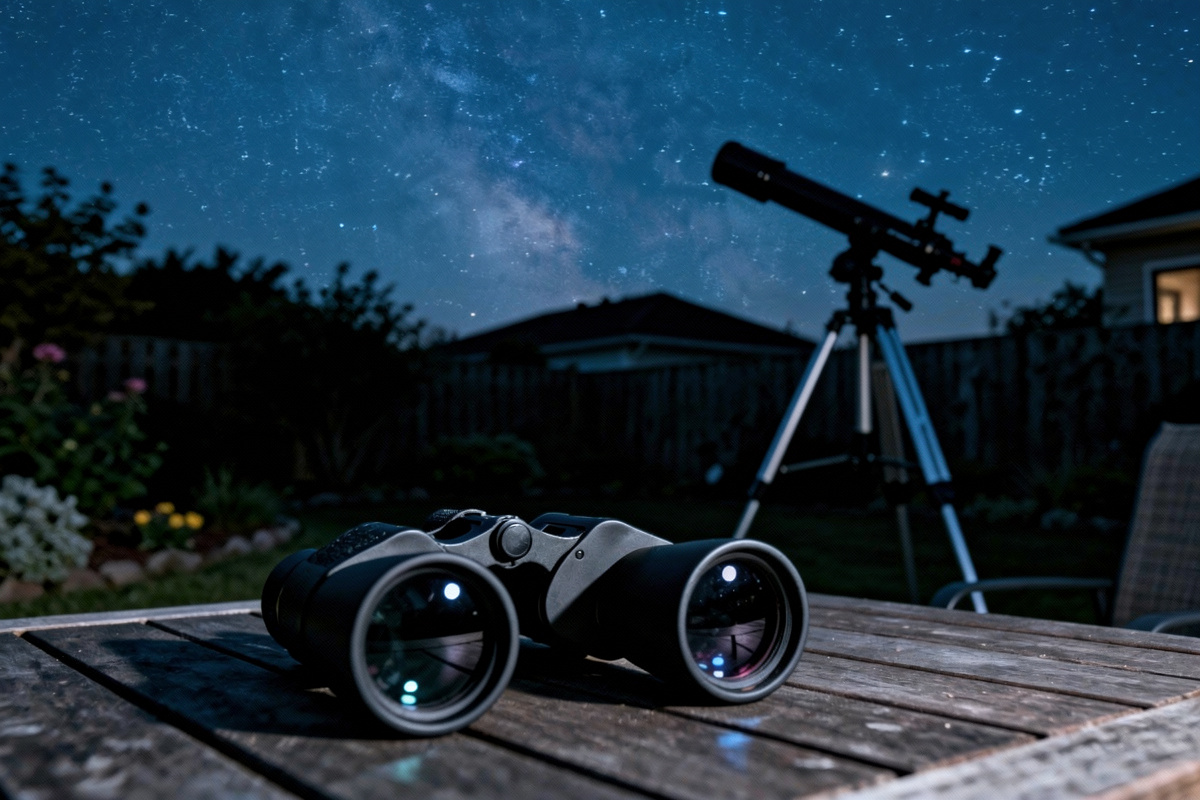

For most beginners, binoculars beat a telescope as a first instrument. A quality 10×50 costs less, needs zero setup, and shows large objects like the Pleiades and the Andromeda Galaxy better than most starter scopes — with none of the assembly, collimation, or wobbly-mount frustration that makes new telescope owners quit. A telescope wins later, once you crave planets, high-power Moon detail, and faint deep-sky structure. But the honest first-instrument answer, the one I give every friend who asks, is start with binoculars.
Disclosure: some links below are Amazon affiliate links. If you buy through them I may earn a small commission at no extra cost to you. I only recommend gear I would actually use.
This guide compares the two honestly, because the usual advice — “buy a telescope” — sends too many beginners straight to a frustrating, abandoned instrument. For the binocular side in depth, see my astronomy binoculars guide; for the scope side, the telescope buying guide.
The Case for Binoculars First
Binoculars remove every barrier that kills beginner enthusiasm. There is no assembly, no collimation, no cool-down wait, no finder to align, and no mount to fight — you walk outside and you are observing in ten seconds. That immediacy is the strongest predictor of whether someone sticks with the hobby, because the instrument that gets used is the one that is effortless to pick up. A telescope that takes fifteen minutes to set up gets used a tenth as often as a binocular by the door.
They are also forgiving and complete. A good 10×50 has no hidden costs — no eyepieces to buy, no mount to upgrade — so the modest price is close to the real price. And the two-eyed, wide-field view is genuinely better for a whole class of objects: big open clusters, the Milky Way, the larger galaxies and nebulae. Binoculars teach you the sky, which is the skill every telescope owner eventually needs anyway. Learn the constellations and star-hopping with binoculars and your future telescope becomes far easier to aim.
The Case for a Telescope
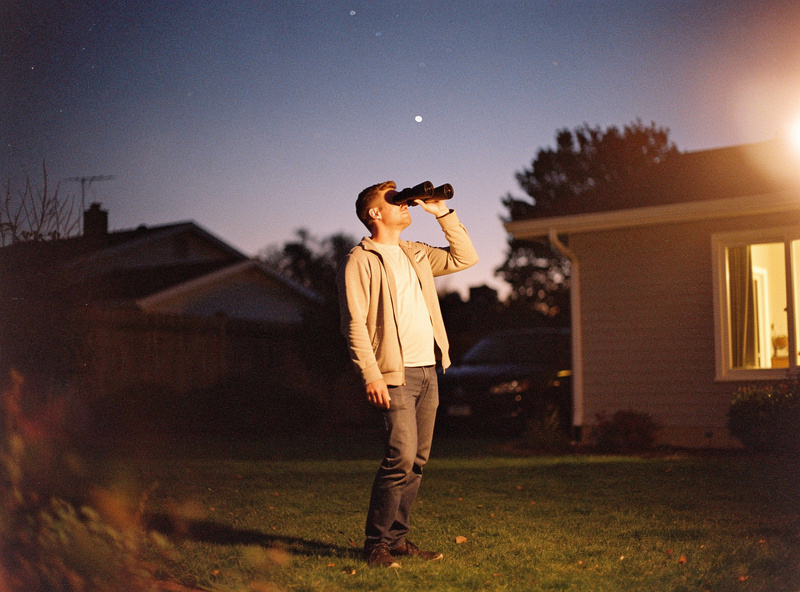
A telescope wins where binoculars hit their limits: magnification and aperture on a mount. If your dream is Saturn’s rings, Jupiter’s cloud belts, the phases of Venus, or the Cassini division, you need the higher power and steadiness only a scope provides — binoculars show Saturn as a tiny oval at best. A telescope also gathers more light from a fixed aperture and, crucially, can magnify enough to resolve a globular cluster into stars or show structure in a bright galaxy.
The trade is complexity and cost. A telescope that genuinely outperforms a 10×50 on deep-sky needs real aperture and a stable mount, and a cheap “department-store” scope on a wobbly tripod with plastic eyepieces will disappoint worse than any binocular. If you go the scope route, spend on aperture and the mount, not magnification claims — the reasoning is laid out in the telescope buying guide and the case for the best-value design in the Dobsonian guide.
Binoculars vs Telescope: Side by Side
The table below compares the two on the factors that actually decide a beginner’s experience. The pattern is clear: binoculars win on ease, cost, and wide-field objects; telescopes win on planets, high power, and faint detail. Neither is universally “better” — they suit different goals and different stages.
| Factor | Binoculars (10×50) | Beginner telescope |
|---|---|---|
| Setup time | Seconds | Several minutes |
| Cost for the quality | Low, complete | Higher, with hidden extras |
| Planets | Jupiter’s moons only | Rings, belts, detail |
| Large clusters and galaxies | Excellent, wide field | Often cropped |
| Faint deep-sky | Limited | Better with aperture |
| Portability | Grab-and-go | Bulkier |
| Learning the sky | Ideal | Harder without a finder |
Why the Answer Is Often Both
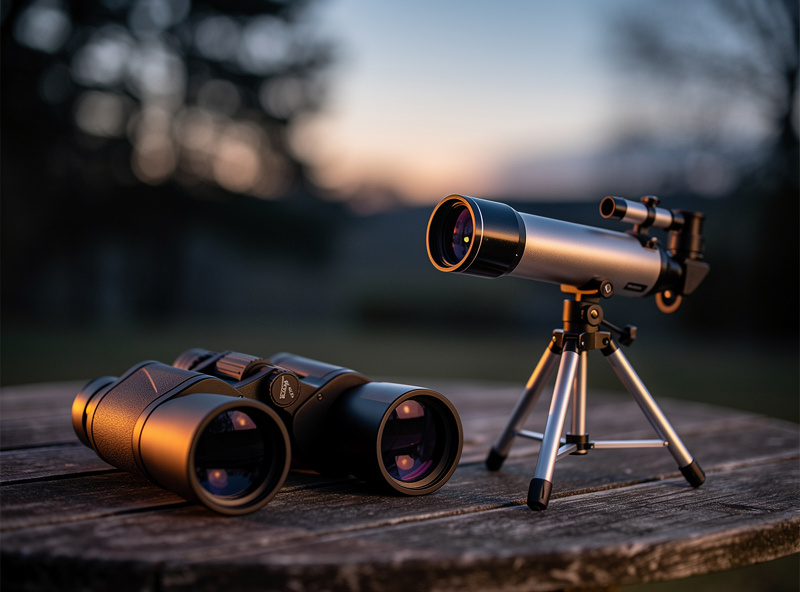
Here is the secret experienced observers know: binoculars and a telescope are complements, not rivals. The two instruments own different parts of the sky — binoculars handle the wide, bright, large-object end, and a telescope handles the high-power, small-object end. I own scopes of every design and still keep a 10×50 by the door, because for sweeping the Milky Way or framing the Pleiades, nothing beats it, and it is always ready when the scope is too much effort.
So the real question is not “binoculars or telescope forever,” it is “which one first.” Start with binoculars, learn the sky, see whether the hobby grabs you — and it will cost you little if it does not. When you find yourself wanting planets and faint detail, add a telescope, and you will choose it far more wisely for having learned the sky first. The two-instrument observer is the happy observer.
There is a workflow benefit too, not just a budget one. Many experienced observers use binoculars as a finder and survey tool even with a scope set up: sweep an area with the wide binocular field to locate a faint target or a comet, then swing the telescope to it for the close-up. The binocular’s job of teaching the sky never ends — it simply shifts from “first instrument” to “the one that points the way.” That is why the 10×50 stays by my door no matter how many scopes are in the shed.
The Beginner Mistakes Both Instruments Punish
Whichever you choose, the same handful of mistakes ruin the first experiences. The biggest is expecting Hubble-style colour and detail — visually, deep-sky objects are faint grey glows, not the saturated photographs you have seen, and that surprise drives more beginners away than any gear flaw. Set the expectation correctly and the real views, subtle and earned, become thrilling instead of disappointing. The Moon and Jupiter’s moons are the reliable early wins for exactly this reason.
The second mistake is ignoring light pollution. Both instruments are crippled by a bright sky, and a beginner who tries to see faint galaxies from a city centre concludes the gear is broken when the problem is the sky. Start with the Moon and bright clusters that punch through, and seek a darker site for the faint stuff. The third is chasing magnification — with binoculars that means buying a useless zoom or 30x pair, and with a telescope it means falling for “525x” box claims that deliver a dim blur. Aperture and steadiness win, not magnification numbers.
A Note on Kids and Gift Buyers
If you are buying for a child or as a gift, binoculars are almost always the right call. They are rugged, intuitive — point and look, no aiming a finder — and they double for daytime use on birds, wildlife, and sport, so they keep earning their place even on cloudy weeks. A child frustrated by a wobbly telescope they cannot aim loses interest fast; the same child with binoculars finds the Moon in seconds and stays curious.
A telescope can come later, once the interest is proven and the child is old enough to manage the setup. Many lifelong astronomers started exactly this way — a cheap pair of binoculars and a parent willing to stand in the cold pointing things out. The low cost and low frustration make binoculars the ideal on-ramp, and the daytime usefulness means the money is never wasted even if the stargazing does not stick.
My Recommendation
If you are buying your first instrument and unsure, buy the 10×50 binocular. It is the lowest-risk, highest-joy entry into astronomy, it teaches you the sky, and if you fall in love you will keep using it forever alongside whatever telescope you add later. You can browse 10×50 astronomy binoculars on Amazon to start, and see my best binoculars for astronomy picks for specifics.
Buy a telescope first only if you already know the sky, your heart is set on planets, and you are prepared to spend on real aperture and a stable mount rather than a cheap scope that will disappoint — in which case you can look at beginner Dobsonian telescopes on Amazon, the best-value design for the money. For everyone else — the curious beginner, the gift buyer, the parent with a stargazing kid — binoculars are the answer, and the one I have never regretted recommending.
Frequently Asked Questions
Are binoculars or a telescope better for beginners?
Binoculars are usually better first. A 10×50 costs less, needs no setup, and shows large objects like the Pleiades and Andromeda better than most starter scopes. A telescope wins later for planets, high-power Moon detail, and faint deep-sky structure.
Can you see planets with binoculars?
Only partially. Binoculars show Jupiter’s four bright Galilean moons as a line of dots, but Saturn looks like a tiny oval and the rings are not resolved. Seeing planetary detail like rings and cloud belts needs a telescope at around 30x or more.
Why do experts recommend binoculars before a telescope?
Because binoculars get used. With no setup, collimation, or mount to fight, they remove the friction that makes new telescope owners quit. They also teach the sky and star-hopping, the skill every telescope owner eventually needs to aim a scope.
Will a cheap telescope beat good binoculars?
Usually not. A cheap department-store telescope on a wobbly mount with plastic eyepieces disappoints worse than a quality 10×50. A telescope only clearly outperforms binoculars when it has real aperture and a stable mount, which costs more than a good binocular.
Should I buy both binoculars and a telescope?
Eventually, yes. They complement each other: binoculars own wide, bright, large objects and a telescope owns high-power, faint targets. Most experienced observers keep a 10×50 for grab-and-go sweeping even after buying a telescope. Start with binoculars first.
