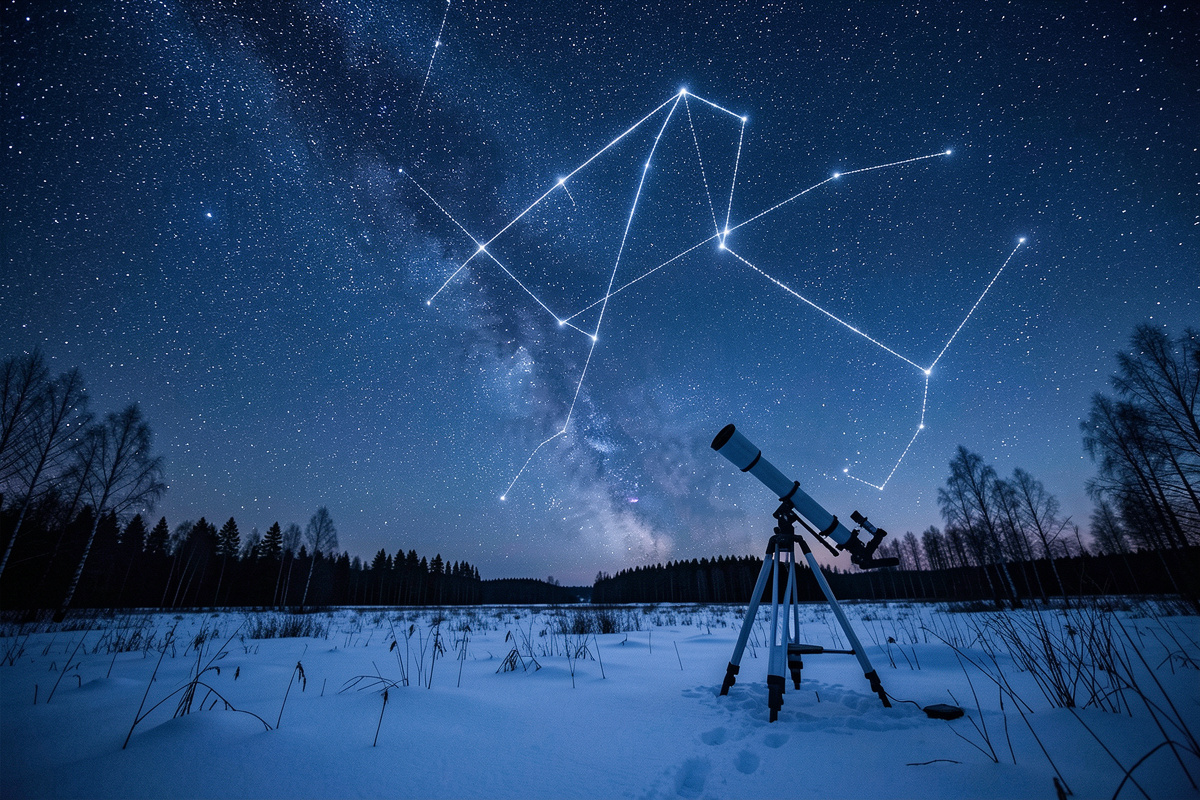

A winter night sky observing guide has one job: help you cash in on the best visual season of the year. Winter delivers the longest fully dark nights, the steadiest cold air for crisp star images, and the richest concentration of bright deep-sky showpieces — the Orion Nebula alone is worth the frozen fingers. The catch is the cold and the dew, both of which are beatable with a little discipline.
I do most of my best visual observing in winter, partly because of the targets and partly because of where I observe. From suburban Sweden the winter sky is genuinely dark by late afternoon, and that long darkness budget is something mid-latitude guides simply do not have. This guide covers what to point at, how to keep your optics and your hands working, and why winter rewards preparation more than any other season. It is the companion to my seasonal night sky guide.
Why Winter Is the Best Visual Season
Winter wins on three counts at once. First, the nights are long — at northern latitudes you get astronomical darkness for the better part of the evening and well into the small hours, so a single session can cover far more sky than a thin summer night. Second, the cold air behind a passing front is often exceptionally transparent, letting faint targets stand out against a darker background. Third, the winter sky is simply loaded: the Orion region and its surroundings hold more bright, satisfying objects per square degree than any other patch you will see all year.
The downside is steadiness. That same crisp, cold, post-front air is frequently turbulent high up, so seeing for planets can be poor even when transparency is superb. This is the classic winter trade-off, and the fix is simple: on transparent-but-turbulent nights, chase deep-sky targets and bright clusters rather than pushing high magnification on planets. Match the target to the conditions and a “bad” night becomes a good one.
The Winter Showpiece Targets
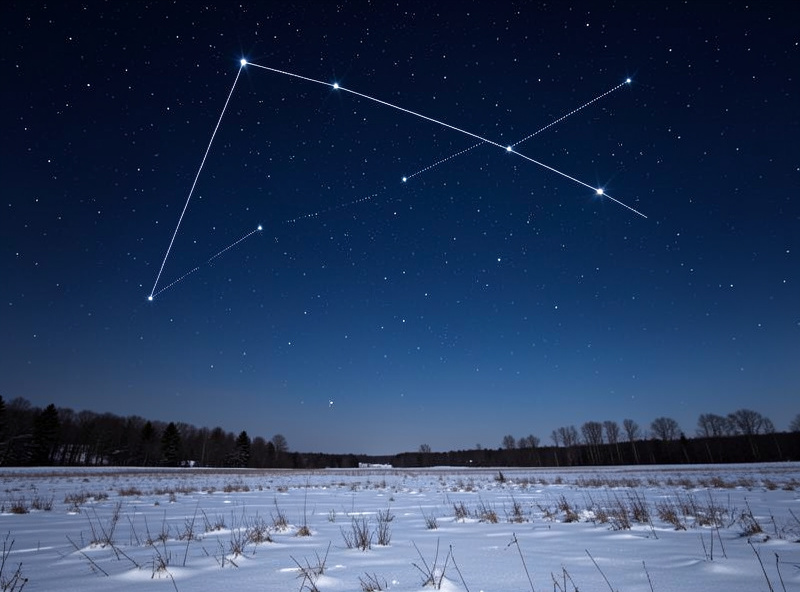
Start with the Orion Nebula (M42). It is the brightest emission nebula in the northern sky, visible to the naked eye as a fuzzy “star” in Orion’s sword, and it explodes into structure in anything from binoculars to a 12-inch Dob. The four stars of the Trapezium sit embedded in the glowing gas at its heart — a target that looks better with every increase in aperture. This is the object I show every newcomer first, because it never disappoints.
From there the winter sky opens up. The Pleiades (M45) are a glittering naked-eye open cluster that frame beautifully in a wide-field eyepiece or binoculars. The Double Cluster in Perseus is a pair of bright open clusters in the same low-power field, bridging autumn into winter. Auriga carries a string of open clusters (M36, M37, M38) that reward a slow sweep. Sirius, the brightest star in the night sky, blazes low in Canis Major, and the open cluster M41 sits just below it. For a galaxy challenge, Andromeda (M31) is still well placed in early winter evenings before it sinks west. A wide-field eyepiece earns its keep all winter — see my eyepiece guide for matching focal lengths to these large targets.
Fighting the Cold: Gear and Acclimation
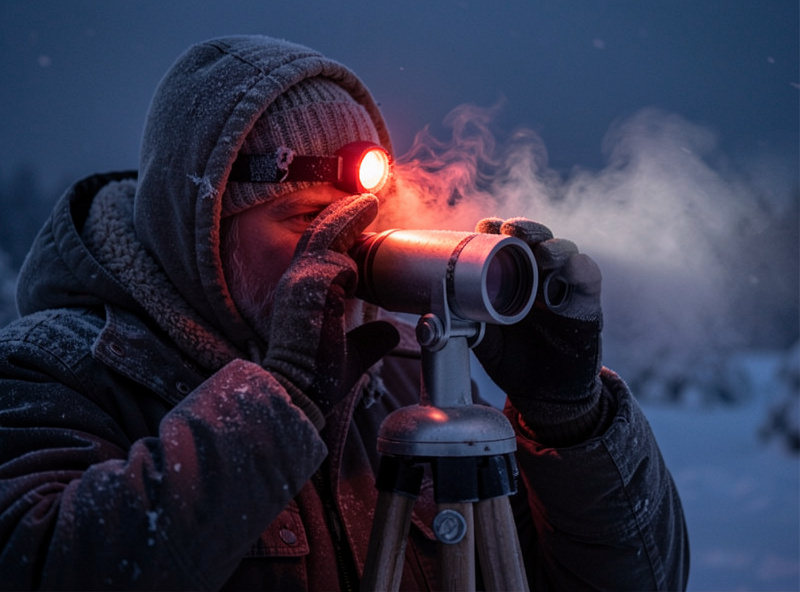
Cold is the real enemy of winter observing, and it attacks in two ways: your comfort and your optics. For yourself, dress as if for a stationary mountain hike, not a walk — you are standing still for hours. Layered insulation, genuinely warm boots a size up for thick socks, and serious gloves you can still focus in. Hand warmers in the gloves and boots are not a luxury at sub-zero temperatures; they are what lets you keep observing past the first half hour.
For the scope, thermal acclimation matters more in winter than at any other time of year. A telescope carried from a warm house into freezing air has warm optics and a warm tube, and the rising heat shimmer ruins the view until everything equalizes — often an hour or more for a large mirror. The grab-and-go answer is a smaller scope: my 127mm Maksutov cools far faster than the 12-inch Dob, so on a quick frosty night the Mak is the scope I reach for. If you want the big aperture, set it outside early and let it sit while you dress and set up. I learned that the hard way, dragging the 12-inch straight out of a warm hallway on my first cold clear night and watching Saturn boil for the entire first hour before the mirror finally caught up to the air.
Dew, Frost, and Thermal Management
Dew and frost form when an exposed surface drops below the dew point, and your optics — pointed at the cold sky — radiate heat and chill fastest of all. A refractor or Maksutov with an exposed front element is especially vulnerable; once frost forms on the corrector, the night is over until you can gently warm it clear. The fix is active dew control: a dew heater strip wrapped near the front of the tube, run off a field battery, keeps the optics a degree or two above dew point and stops frost before it starts.
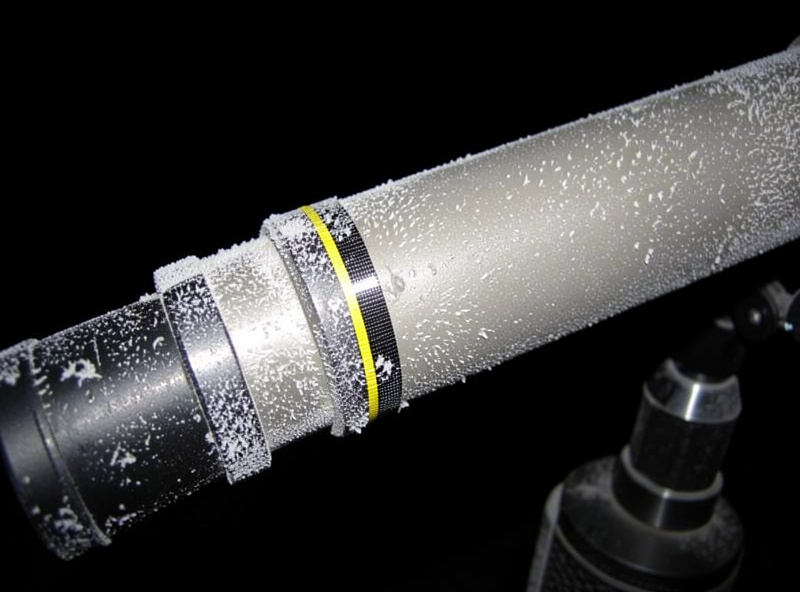
A dew shield helps too, extending the tube to slow radiative cooling, but in hard frost a passive shield alone is not enough. Never wipe a frosted lens or mirror — you will scratch coatings and smear the surface. Warm it gently with a heater or pack up. Keep your eyepieces in an inside pocket and swap them out so they are warm when they reach the focuser, or they will fog the instant your eye gets near them. Power for the heaters runs all night off a modest field battery; I cover sizing field power in the context of imaging in my note on all-night astrophotography power, and the same math applies to a visual dew-heater setup.
As an Amazon Associate I earn from qualifying purchases. A simple dew heater strip is the single best winter accessory once frost starts forming on your optics.
The Nordic Winter Advantage
If you observe from a high northern latitude, winter is your season in a way that southern observers never quite experience. The Sun sets early and stays far below the horizon, so darkness is generous and the observing window is enormous. The same brutal Swedish winter that makes daylight scarce is a genuine gift at the eyepiece — long, cold, and dark, with the bright winter constellations riding high.
The trade-off is weather: clear winter nights can be infrequent, so when one arrives you want to be ready to set up fast rather than spend the precious clear hours fumbling. That is the argument for a grab-and-go scope and a pre-packed kit. There is also the bonus that no mid-latitude observer can claim — aurora. On the right night the northern lights become part of the session, and a clear, dark, aurora-lit winter sky is one of the great rewards of observing this far north. Plan around the weather with a good astronomy weather app and pounce on the clear gaps.
Frequently Asked Questions
Is winter really the best season for stargazing?
For visual observers in the northern hemisphere, yes. Winter combines the longest fully dark nights, often excellent transparency behind cold fronts, and the richest field of bright deep-sky targets around Orion. The main trade-off is cold and frequently turbulent seeing for planets.
What is the best target to see in winter?
The Orion Nebula (M42) is the standout. It is visible to the naked eye in Orion’s sword and shows glowing nebulosity and the four Trapezium stars in any telescope, looking better with every increase in aperture from binoculars to a large Dobsonian.
How do I stop my telescope from frosting over in winter?
Use active dew control: a dew heater strip near the front of the tube keeps optics a degree or two above dew point and prevents frost. Add a dew shield to slow cooling. Never wipe a frosted lens or mirror, as it scratches coatings; warm it gently instead.
Why does my telescope view shimmer when I bring it outside in winter?
The optics and tube are still warm and rising heat causes the image to boil until they cool to the outside air. This thermal acclimation can take over an hour for a large mirror. Set the scope outside early, or use a faster-cooling small scope for grab-and-go.
Can I see planets well in winter?
Sometimes, but the crisp cold air that gives winter great transparency is often turbulent, hurting the steady seeing planets need for fine detail. On transparent but unsteady nights, switch to deep-sky targets and bright clusters rather than pushing high magnification on planets.
