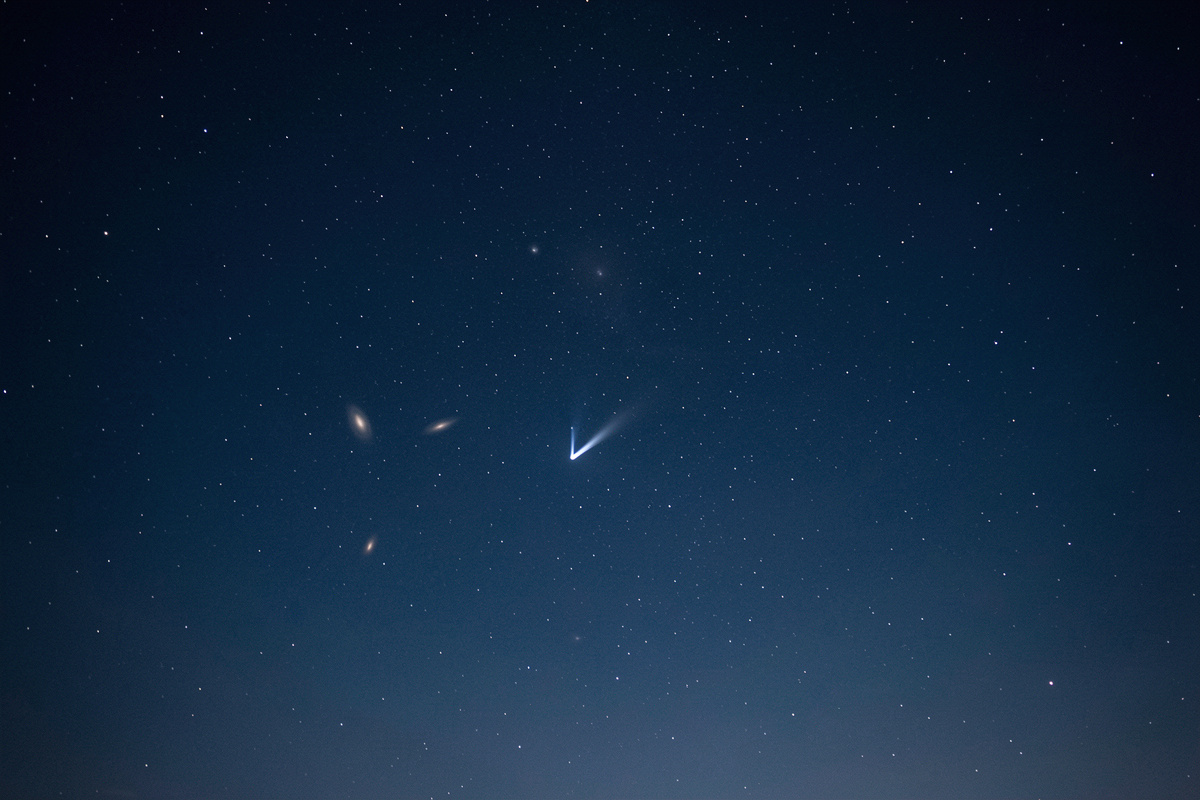

This spring night sky guide is built around one fact: as Orion sinks into the west, the sky swings to face out of our own galaxy, and spring becomes galaxy season. The trade-off is that galaxies are faint, diffuse, and unforgiving of light pollution — so spring rewards dark skies and aperture more than any other time of year. Get to a dark site and a modest scope shows island universes millions of light-years away.
Spring is the season that taught me the most about contrast and patience. The bright, easy targets of winter are gone, replaced by smudges that demand averted vision and a truly dark background. From my Nordic latitude the nights are still satisfyingly dark in early spring before the summer twilight creeps in, which makes spring a window I plan around carefully. This guide is part of my seasonal night sky guide, and it focuses on what spring does best.
Spring Is Galaxy Season
In spring the evening sky points away from the crowded plane of the Milky Way and out toward intergalactic space, so instead of nebulae and star clusters you get galaxies — hundreds of them within reach of amateur scopes. The constellations Leo, Virgo, Coma Berenices, and Ursa Major host the richest galaxy fields visible from the northern hemisphere. The Virgo Cluster alone packs a dozen-plus galaxies into a single binocular-sized region.
The character of the season is completely different from winter. Where winter throws bright, obvious objects at you, spring asks you to work: galaxies are low-surface-brightness targets, often appearing as faint oval glows that reveal structure only with aperture, dark skies, and a patient eye. That difficulty is exactly what makes a good spring galaxy so rewarding when it finally resolves.
The Best Spring Galaxies to Observe
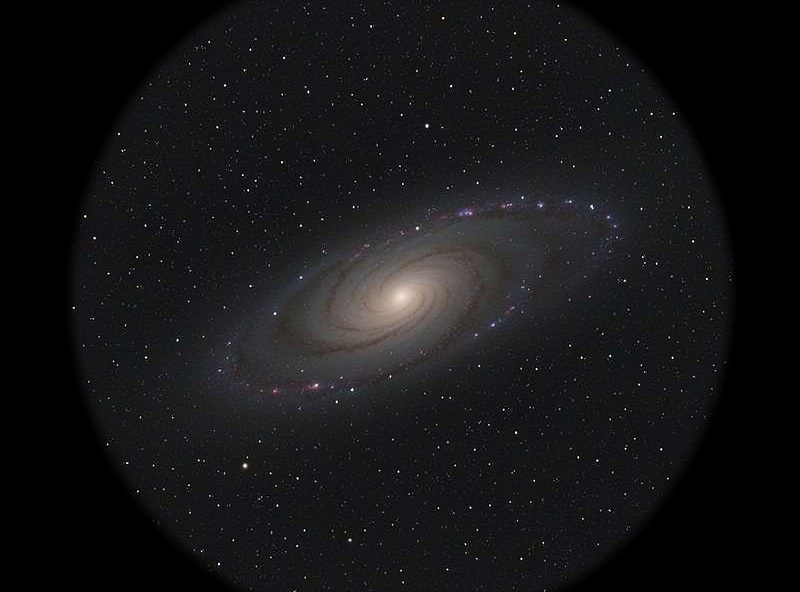
Start with the easy wins. The Leo Triplet (M65, M66, and NGC 3628) sits in the same low-power field and is a satisfying first galaxy group for a modest scope under a dark sky. Bode’s Galaxy (M81) and the Cigar Galaxy (M82) in Ursa Major are another bright pair in one field — M81 a smooth spiral glow, M82 a thin edge-on streak. Both show in a small scope and reward aperture with detail.
The Whirlpool (M51) in Canes Venatici is the prize: a face-on spiral with a companion, and in a 12-inch under a dark sky you can begin to trace the spiral arms directly — one of the few galaxies where that is visible visually. The Sombrero (M104) shows its dark dust lane in moderate aperture. For a step up in challenge, the Virgo Cluster and Markarian’s Chain let you hop from galaxy to galaxy across a single region, losing count of how many faint glows fill the field. Use a low-power, wide-field eyepiece to frame these — see my eyepiece guide — and lean on the broader galaxy observing guide for technique.
Why Galaxies Demand Dark Skies and Aperture
Galaxies are the season’s hardest targets because of surface brightness. A galaxy’s light is spread across a large area, so even a “bright” magnitude figure can hide a dim, diffuse object that washes out against any sky glow. This is why a galaxy that looks obvious from a Bortle 3 dark site can be completely invisible from a Bortle 7 backyard through the same scope. Light pollution does not just dim galaxies — it erases them.
Two things buy back the view: darkness and aperture. A dark sky lowers the background so faint glows stand out; aperture gathers more of the galaxy’s spread-out light. This is the season where the drive to a dark site stops being optional — my backyard at Bortle 4-6 is nearly useless for the faint spring stuff, so I plan the dark-site trips of the year around new Moons in spring. I wasted the better part of one early season trying to pull the Whirlpool’s spiral arms out of that backyard murk with the 12-inch Dob before I finally accepted the arms only ever show for me from the dark site. Nebula filters do not help here, because galaxies emit across the whole spectrum rather than at the narrow wavelengths a UHC or OIII filter passes. For galaxies, only real darkness works. The dark sky locations guide helps you find that darkness.
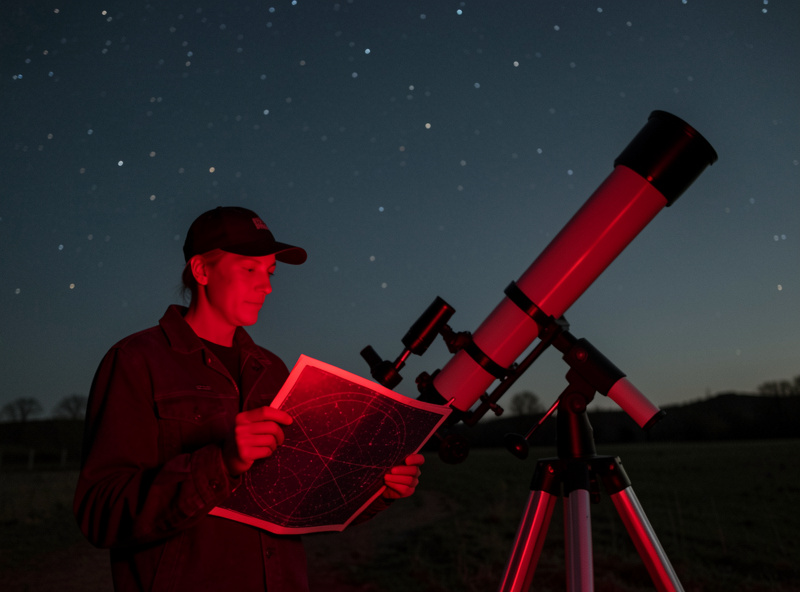
Technique matters as much as gear with faint galaxies. Give your eyes a full twenty to thirty minutes to dark-adapt and protect that adaptation with a dim red light only. Then use averted vision — looking slightly to the side of the target rather than straight at it — which puts the galaxy’s light onto the more sensitive part of your retina and often makes a glow snap into view that was invisible head-on. A gentle tap on the tube to introduce motion helps too; the eye detects a moving faint smudge more readily than a still one. These habits routinely add a magnitude of reach without spending a thing.
Star-Hopping the Blank Spring Sky
The spring sky has a navigation problem that winter does not: it is relatively empty of bright stars. Away from the Milky Way there are fewer bright signposts, so star-hopping to a faint galaxy can feel like sailing across open water with no landmarks. The handful of bright anchors — Arcturus in Boötes, Spica in Virgo, Regulus in Leo, and the Big Dipper overhead — become essential reference points.
This is where a good plan pays off. I sketch the hop from a bright anchor star through a chain of fainter stars to the target before I am at the eyepiece, using a detailed chart or a planetarium app. A GoTo mount obviously sidesteps the problem, but learning to star-hop the spring sky teaches you the constellations in a way GoTo never will. Either way, a quality finder and a low-power eyepiece for the initial search are non-negotiable. My notes on planetarium apps and printed star atlases cover the planning tools I actually use for this.
Beyond Galaxies: Spring’s Other Targets
Spring is not only galaxies. The Beehive Cluster (M44) in Cancer is a large, bright open cluster perfect for binoculars or a wide-field eyepiece, a holdover of cluster-rich observing into the galaxy season. The globular cluster M3 in Canes Venatici is one of the finest globulars in the northern sky, a tight ball of stars that resolves beautifully with aperture — an early hint of the globular season to come in summer.
Arcturus, the bright orange star that dominates spring evenings, is a useful naked-eye anchor and a lovely color contrast. And the planets wander on their own schedule, so depending on the year spring may serve up a well-placed Jupiter, Mars, or Saturn in the evening sky — check the monthly sky highlights for the current year, since planetary positions do not follow the fixed seasonal star map. For deeper target lists organized by when each object is up, the best deep-sky objects by season reference picks up where this guide leaves off.
Frequently Asked Questions
Why is spring called galaxy season?
In spring the evening sky faces away from the crowded Milky Way plane and out toward intergalactic space, so instead of nebulae and clusters the view fills with galaxies. Constellations like Leo, Virgo, and Ursa Major hold hundreds of galaxies within reach of amateur telescopes.
What are the best galaxies to see in spring?
The Leo Triplet, Bode’s and the Cigar Galaxy (M81 and M82), and the Whirlpool (M51) are top picks. The Virgo Cluster and Markarian’s Chain let you hop across many faint galaxies in one region. The Sombrero and Black Eye galaxies are rewarding moderate-aperture targets.
Can I see spring galaxies from a light-polluted backyard?
Usually not well. Galaxies have low surface brightness and wash out badly against any sky glow, so a galaxy obvious from a dark site can be invisible from a bright suburb. Spring is the season where a trip to a dark site matters most for faint deep-sky observing.
Do nebula filters help with galaxies?
No. UHC and OIII filters pass only the narrow wavelengths emitted by nebulae, while galaxies emit across the whole spectrum. A nebula filter dims a galaxy along with the background and provides no contrast gain. For galaxies, only genuine dark skies and aperture help.
Why is the spring sky harder to navigate?
Away from the Milky Way, spring has fewer bright stars to use as signposts, making star-hopping to faint galaxies harder. Use bright anchors like Arcturus, Spica, Regulus, and the Big Dipper, plan hops in advance with a chart, or use a GoTo mount.
